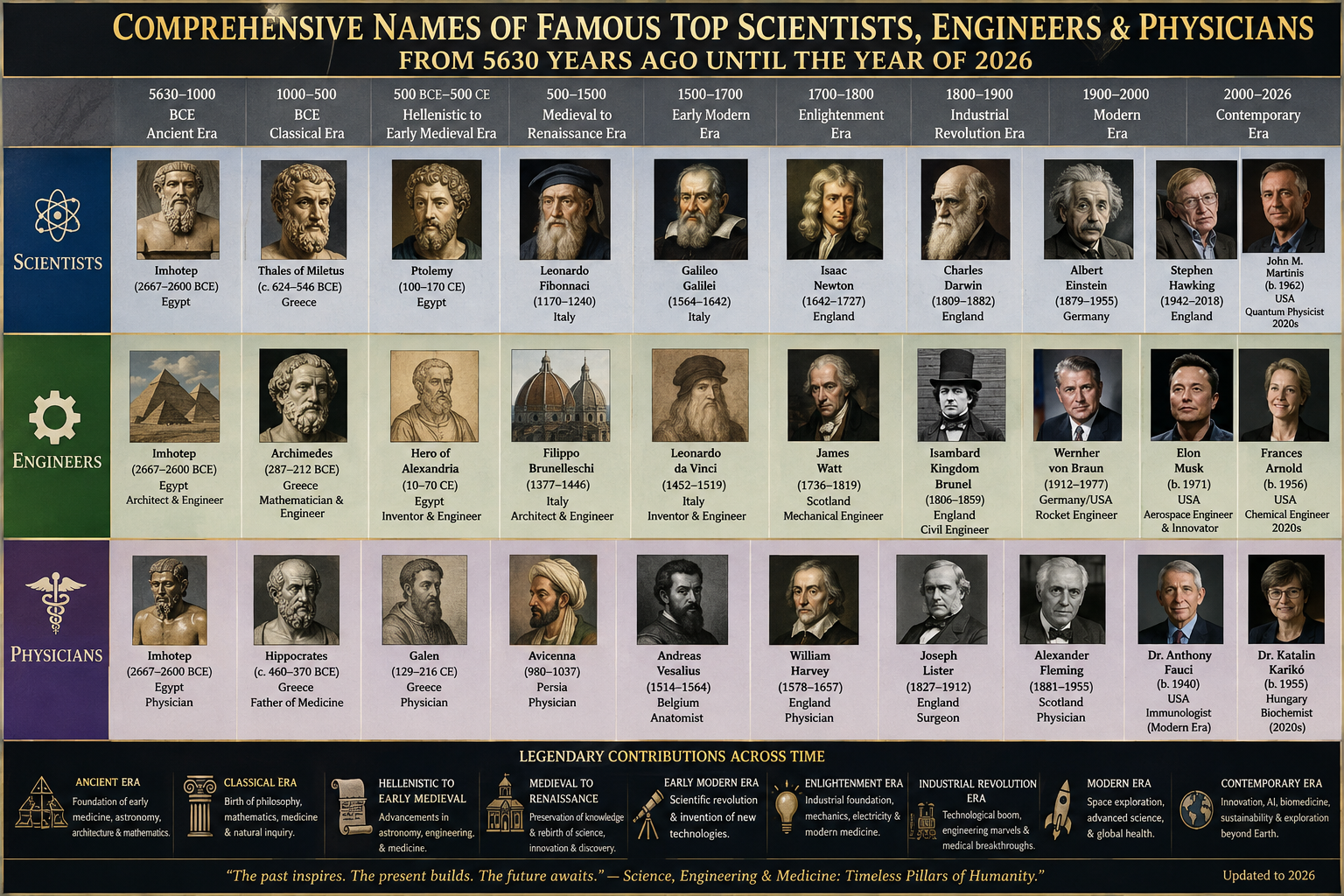
From approximately 3600 BCE to 2026 CE
1. Earliest Known Scientists & Engineers (c. 2650 BCE – 500 BCE)
These are the earliest recorded individuals whose work shaped medicine, engineering, mathematics, and scientific thought.
- Imhotep — Egyptian polymath, architect of the Step Pyramid, early physician (c. 2650 BCE).
- Amenhotep, son of Hapu — Egyptian architect and healer (c. 1350 BCE).
- Hippocrates — Greek physician, “Father of Medicine” (c. 460–370 BCE).
- Archimedes — Greek mathematician & engineer; hydrostatics, pulleys, Archimedean screw (287–212 BCE).
- Apollonius of Perga — Greek mathematician; conic sections (262–190 BCE).
- Eratosthenes — Greek mathematician; measured Earth’s circumference (276–194 BCE).
- Herophilus — Greek physician; early anatomy (335–280 BCE).
- Vitruvius — Roman engineer; De Architectura (80–15 BCE).
- Hero of Alexandria — Greek-Egyptian engineer; steam devices, pneumatics (10–70 CE).
🌍 2. Classical & Medieval Scientific Figures (500 CE – 1400 CE)
A period dominated by Islamic Golden Age scholars and early European thinkers.
- Alhazen (Ibn al‑Haytham) — Arab physicist; optics, scientific method (965–1040).
- Avicenna (Ibn Sina) — Persian physician; Canon of Medicine (980–1037).
- Al‑Khwarizmi — Persian mathematician; algebra, algorithms (c. 780–850).
- Al‑Biruni — Persian polymath; astronomy, geodesy (973–1048).
- Zheng He’s naval engineers — Chinese shipbuilding innovators (1371–1433).
- Maimonides — Jewish physician & philosopher (1135–1204).
- Roger Bacon — English philosopher; optics, experimental science (1219–1292).
🌟 3. Renaissance & Early Modern Scientists (1400–1700)
The birth of modern science.
- Leonardo da Vinci — Italian engineer & anatomist; flying machines, hydraulics (1452–1519).
- Nicolaus Copernicus — Polish astronomer; heliocentric theory (1473–1543).
- Paracelsus — Swiss physician; toxicology (1493–1541).
- Andreas Vesalius — Anatomist; modern human anatomy (1514–1564).
- Galileo Galilei — Italian physicist; telescopes, motion laws (1564–1642).
- Johannes Kepler — German astronomer; planetary motion (1571–1630).
- William Harvey — English physician; blood circulation (1578–1657).
- René Descartes — French mathematician; analytic geometry (1596–1650).
- Robert Hooke — English scientist; cell theory, elasticity (1635–1703).
- Isaac Newton — English physicist; calculus, gravity, motion laws (1643–1727).
- Blaise Pascal — French mathematician; pressure laws, early computing (1623–1662).
⚙️ 4. Enlightenment & Industrial Revolution (1700–1900)
Explosive growth in engineering, chemistry, physics, and medicine.
- James Watt — Scottish engineer; steam engine (1736–1819).
- Antoine Lavoisier — French chemist; conservation of mass (1743–1794).
- Carl Linnaeus — Swedish biologist; taxonomy (1707–1778).
- Edward Jenner — English physician; vaccination (1749–1823).
- George Stephenson — English engineer; locomotives (1781–1848).
- Michael Faraday — English physicist; electromagnetism (1791–1867).
- Charles Darwin — English biologist; evolution (1809–1882).
- Ada Lovelace — English mathematician; first computer algorithm (1815–1852).
- Louis Pasteur — French microbiologist; germ theory (1822–1895).
- Gregor Mendel — Austrian monk; genetics (1822–1884).
- Lord Kelvin — British physicist; thermodynamics (1824–1907).
- Gustave Eiffel — French engineer; Eiffel Tower (1832–1923).
- Dmitri Mendeleev — Russian chemist; periodic table (1834–1907).
- Thomas Edison — American inventor; light bulb, phonograph (1847–1931).
- Nikola Tesla — Serbian-American engineer; AC power systems (1856–1943).
- Marie Curie — Polish-French physicist; radioactivity (1867–1934).
- Ernest Rutherford — New Zealand physicist; atomic nucleus (1871–1937).
- Guglielmo Marconi — Italian engineer; wireless telegraphy (1874–1937).
🔬 5. Modern Scientific Giants (1900–2000)
The era of relativity, quantum mechanics, computing, and modern medicine.
- Albert Einstein — relativity, quantum foundations (1879–1955).
- Niels Bohr — quantum theory (1885–1962).
- Alan Turing — computer science, AI foundations (1912–1954).
- Richard Feynman — quantum electrodynamics (1918–1988).
- Rosalind Franklin — DNA structure (1920–1958).
- Jonas Salk — polio vaccine (1914–1995).
- Katherine Johnson — NASA mathematician (1918–2020).
- Stephen Hawking — cosmology, black holes (1942–2018).
- Tim Berners‑Lee — inventor of the World Wide Web (1955– ).
🚀 6. Contemporary Scientists & Engineers (2000–2026)
Leading figures shaping AI, genetics, physics, medicine, and engineering today.
- Jennifer Doudna — CRISPR gene editing (1964– ).
- Emmanuelle Charpentier — CRISPR pioneer (1968– ).
- Katalin Karikó — mRNA vaccine technology (1955– ).
- Drew Weissman — mRNA vaccine co‑developer (1959– ).
- Elon Musk — engineering leadership in rockets, EVs, AI (1971– ).
- Fei‑Fei Li — AI & computer vision (1976– ).
- Demis Hassabis — DeepMind, AI breakthroughs (1976– ).
- Jane Goodall — primatology & conservation (1934– ).
- Peter Higgs — Higgs boson theory (1929–2024).
- David Julius — Nobel Prize; pain receptors (1955– ).
- Tu Youyou — Nobel Prize; malaria treatment (1930– ).



Be First to Comment