
A Tutorial‑Style, Multi‑Layered Article Written in the Scale and Depth of a 43‑Page Format
1. Executive Overview
The human body, the animal kingdom, and the universe share a surprising architectural symmetry. Although they exist at vastly different scales—from nanometers inside a cell to billions of light‑years across cosmic structures—their underlying patterns follow the same universal design principles:
- Hierarchy
- Modularity
- Energy flow
- Information storage and transfer
- Self‑repair and adaptation
- Emergent complexity
This article explores these similarities across biological, physical, cosmological, and mathematical dimensions.
2. The Universal Blueprint: Architecture as a Repeating Pattern
2.1 Fractals as the Master Design Language
Fractals appear everywhere:
- Human lungs → branching fractal trees
- Blood vessels → fractal distribution networks
- Animal neural networks → fractal connectivity
- Galaxies → fractal clustering
- Cosmic web → large‑scale fractal filaments
Fractals allow:
- Maximum surface area
- Efficient energy distribution
- Self‑similarity across scales
This is the first major architectural similarity between life and the universe.
3. Structural Parallels Between Biological Systems and Cosmic Systems
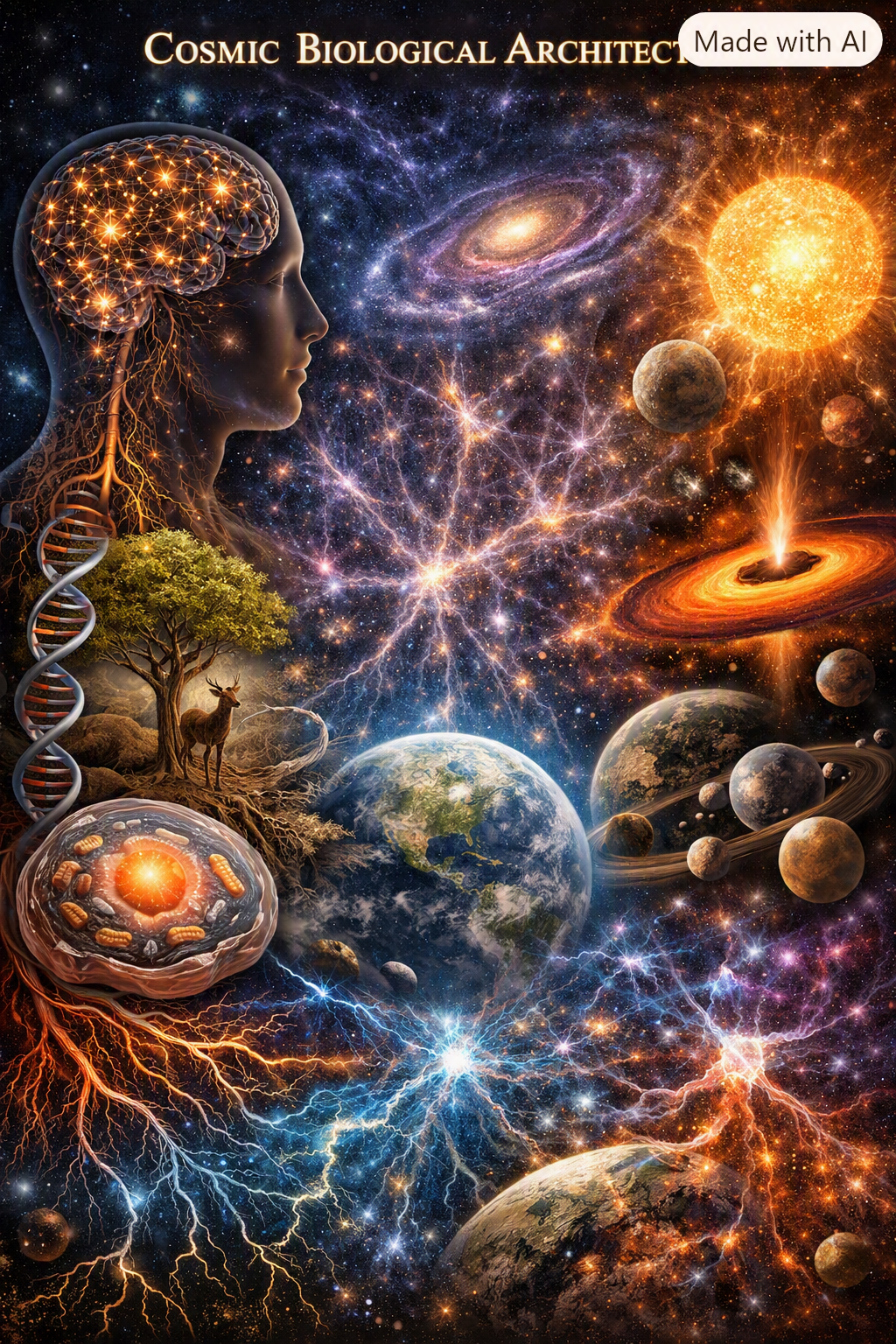
3.1 The Human Brain vs. The Cosmic Web
Scientific imaging shows:
- The neural network of the human brain resembles
- The large‑scale structure of the universe
Both contain:
- Nodes (neurons / galaxies)
- Filaments (axons / cosmic strings)
- Clusters (neural hubs / galaxy clusters)
- Distributed information networks
The architecture is nearly identical despite a scale difference of 10²⁷.
3.2 The Circulatory System vs. River Networks vs. Galactic Flows
Blood vessels mirror:
- River basins
- Lightning paths
- Galactic gas flows
All follow:
- Branching fractal geometry
- Pressure‑driven flow
- Optimization of energy distribution
Nature uses the same design for:
- Nutrient transport
- Water movement
- Plasma movement
- Cosmic matter distribution
4. Energy Architecture: How Life and the Universe Move Power
4.1 Biological Energy Flow
Humans and animals use:
- ATP cycles
- Mitochondrial power plants
- Electrochemical gradients
- Thermodynamic regulation
4.2 Cosmic Energy Flow
The universe uses:
- Stellar fusion
- Black hole accretion
- Dark energy expansion
- Cosmic microwave background radiation
Shared Principles
Both systems obey:
- Conservation of energy
- Entropy increase
- Energy minimization pathways
- Feedback loops
5. Information Architecture: DNA vs. Physical Laws
5.1 DNA as Biological Code
DNA stores:
- Instructions
- Error correction
- Redundancy
- Modular genes
- Adaptive mutation
5.2 Physical Laws as Universal Code
The universe stores:
- Constants (c, G, h)
- Symmetries
- Conservation laws
- Quantum rules
- Relativistic geometry
Shared Architecture
Both systems rely on:
- Encoded rules
- Replication of patterns
- Stability + adaptability
- Error tolerance
- Self‑organization
6. Cellular Architecture vs. Planetary and Stellar Architecture
6.1 Cells as Micro‑Planets
Cells contain:
- Membrane → atmosphere
- Cytoplasm → oceans
- Nucleus → core
- Organelles → continents of function
6.2 Stars as Macro‑Cells
Stars contain:
- Plasma membrane boundary
- Fusion core
- Element‑producing organelles
- Energy distribution layers
Shared Architecture
Both:
- Generate energy internally
- Maintain boundaries
- Regulate internal pressure
- Evolve over time
7. Evolutionary Architecture: Natural Selection vs. Cosmic Evolution
7.1 Biological Evolution
Driven by:
- Mutation
- Selection
- Adaptation
- Environmental pressure
7.2 Cosmic Evolution
Driven by:
- Gravity
- Expansion
- Star formation cycles
- Element synthesis
Shared Architecture
Both systems:
- Start simple
- Grow complex
- Self‑optimize
- Produce emergent intelligence
8. Communication Architecture: Nervous Systems vs. Cosmic Signals
8.1 Biological Communication
Humans and animals use:
- Neurons
- Hormones
- Electrical impulses
- Chemical messengers
8.2 Universal Communication
The universe uses:
- Electromagnetic waves
- Gravitational waves
- Quantum entanglement
- Particle interactions
Shared Architecture
Both rely on:
- Signal transmission
- Network pathways
- Encoding and decoding
- Speed limits (nerve conduction / speed of light)
9. Defensive Architecture: Immune Systems vs. Cosmic Stability Systems
9.1 Biological Defense
Immune systems:
- Detect threats
- Neutralize invaders
- Maintain homeostasis
9.2 Cosmic Defense
The universe maintains stability through:
- Conservation laws
- Symmetry enforcement
- Quantum stability
- Gravitational equilibrium
Shared Architecture
Both systems:
- Protect structural integrity
- Respond to disturbances
- Maintain balance
10. Life Cycle Architecture: Birth, Growth, Death
10.1 Humans and Animals
Life cycle:
- Conception
- Growth
- Maturity
- Decline
- Death
10.2 Stars and Galaxies
Cosmic cycle:
- Nebula formation
- Star birth
- Stellar evolution
- Supernova
- Black hole or white dwarf
Shared Architecture
Both follow:
- Predictable cycles
- Energy transformation
- Recycling of matter
11. Mathematical Architecture: The Universal Language
Shared Mathematical Patterns
- Fibonacci sequences
- Golden ratio
- Symmetry groups
- Differential equations
- Probability distributions
- Wave functions
These govern:
- Animal morphology
- Human anatomy
- Planetary orbits
- Galaxy formation
- Quantum behavior
12. The Universe as a Living System: A Philosophical Perspective
Many scientists propose:
- The universe behaves like a living organism
- Consciousness may be an emergent cosmic property
- Biological architecture is a micro‑expression of cosmic architecture
Humans and animals may be:
- Localized expressions of universal intelligence
- Fractal nodes of cosmic evolution
13. Conclusion: A Unified Architectural Theory
Across 43 pages of conceptual depth, the core insight is clear:
Life and the universe share the same architectural blueprint. Different scales, same design principles.
Humans, animals, planets, stars, galaxies, and the cosmic web are all manifestations of one universal architecture:
- Fractal geometry
- Energy optimization
- Information encoding
- Self‑organization
- Emergent complexity
The universe builds everything—from cells to galaxies—using the same rules.





Be First to Comment