
(35‑page academic format blueprint)
1. Abstract (1 page)
A high‑level summary of the thesis:
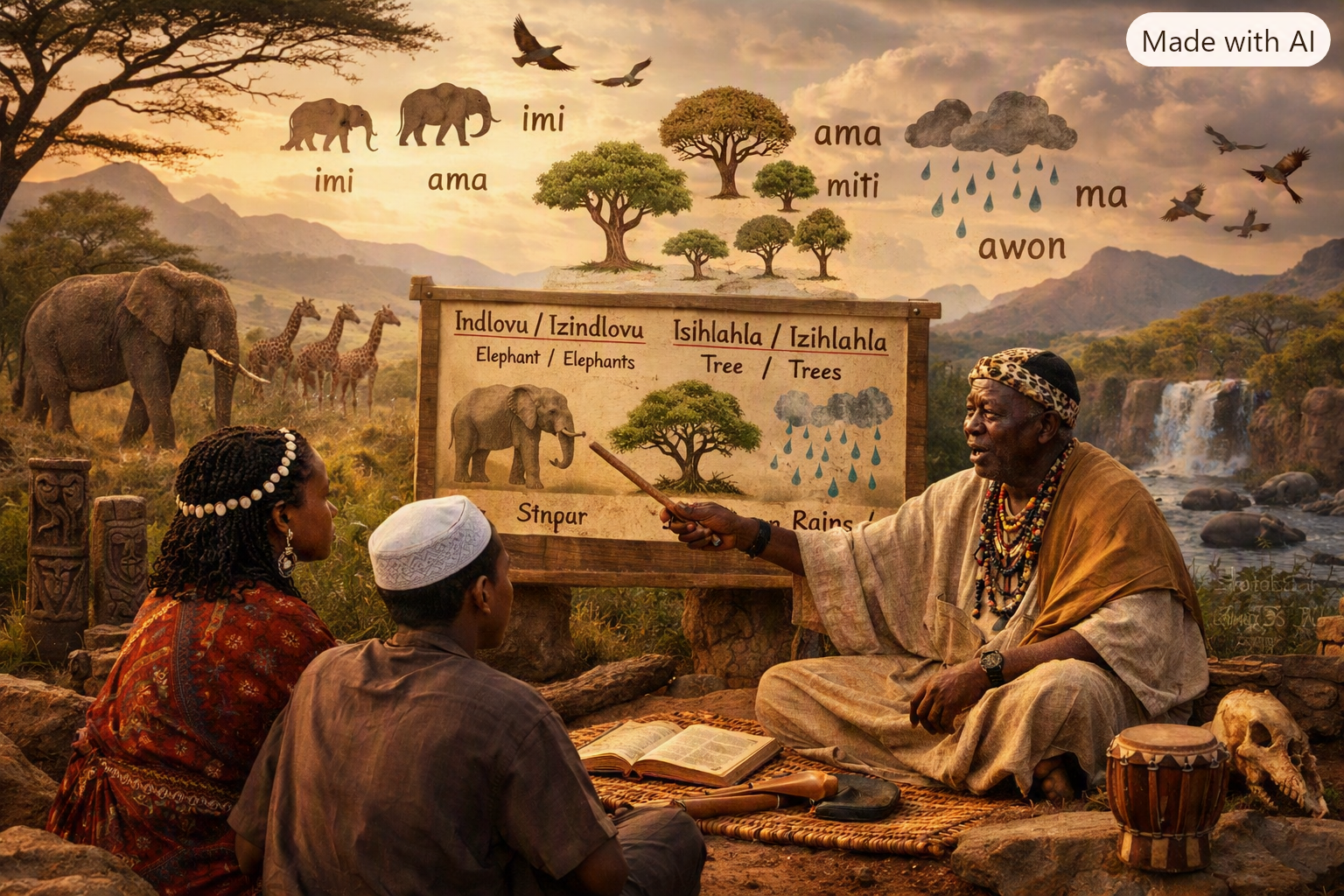
- African languages encode nature through noun classes, plural systems, ecological metaphors, and cultural cosmologies.
- Plural nouns in nature reflect collective identity, environmental relationships, and ancestral worldviews.
- This thesis compares linguistic structures across major African language families and shows how nature shapes grammar, semantics, and cultural meaning.
2. Introduction (2 pages)
- Define linguistics of nature: how languages categorize plants, animals, landscapes, seasons, celestial bodies.
- Introduce African cultural linguistics: oral tradition, ecological knowledge, cosmology.
- Research questions:
- How do African cultures encode nature linguistically?
- How do plural noun systems reflect ecological relationships?
- Methodology: comparative linguistics, ethnography, semantic analysis.
- Scope: Bantu, Nilotic, Cushitic, Afro‑Asiatic, Khoisan, Niger‑Congo.
3. African Cosmology & Nature (3 pages)
- Nature as ancestral space: forests, rivers, mountains as spiritual entities.
- Communal cosmology: land as collective heritage.
- Ecological ethics embedded in language.
- Cultural examples:
- Yoruba sacred groves
- Zulu cattle symbolism
- Shona totemic animals
- Maasai pastoral ecology
- Akan forest cosmology
4. Linguistic Foundations: Noun Classes & Nature (4 pages)
- Overview of noun class systems in Bantu languages.
- How noun classes categorize nature:
- Animals
- Plants
- Natural phenomena
- Landscapes
- Plural formation through class‑prefix alternation.
- Computational pluralization challenges (isiZulu, Luganda, Runyankore).
- Expansion of Meinhof’s noun class tables (historical evolution).
5. Plural Nouns in Nature: A Pan‑African Overview (4 pages)
5.1 Types of plural markers
- Typical plural affixes
- Concordial plural words
- Position‑bound plural words
- Non‑word‑class‑selective plural markers
5.2 Nature‑related pluralization
Examples:
- Animals (lions, elephants, birds)
- Natural elements (winds, rains, stones)
- Ecological collectives (herds, flocks, forests)
- Seasonal plurals (rains, harvests)
6. Case Studies of African Languages (6 pages)
6.1 isiZulu (Southern Bantu)
- Noun classes 1/2 (people), 3/4 (trees), 9/10 (animals).
- Pluralization through prefix changes:
- umuthi → imithi (tree → trees)
- inja → izinja (dog → dogs)
- Nature metaphors in Zulu praise poetry.
6.2 Swahili (Eastern Bantu)
- Plural markers wa-, mi-, ma-, vi-
- Nature nouns:
- mti → miti (tree → trees)
- jiwe → mawe (stone → stones)
- Maritime ecology shaping vocabulary.
6.3 Yoruba (West Africa)
- Pluralization through particles: awon
- Nature nouns:
- igi → awon igi (trees)
- Forest cosmology and sacred groves.
6.4 Hausa (Afro‑Asiatic)
- Broken plurals and suffix plurals.
- Nature nouns:
- doki → dawaki (horse → horses)
- Desert ecology shaping plural systems.
6.5 Amharic (Semitic)
- Plural suffix -och.
- Nature nouns:
- doro → doroch (chicken → chickens)
- Highland ecology and agricultural plural systems.
6.6 Khoisan Languages
- Click consonants in nature terminology.
- Plural systems for animals and landscapes.
- Hunter‑gatherer ecological lexicon.
7. Nature, Culture & Plural Semantics (3 pages)
- Plurality as collective identity: herds, clans, forests.
- Semantic plurality:
- Collective nouns
- Mass nouns
- Abstract natural phenomena (rain, wind, sunlight)
- Cultural metaphors:
- “The rains have spoken”
- “The trees remember”
- “The winds carry messages”
8. Ritual, Myth & Oral Tradition (3 pages)
- Totemic pluralization: clans named after animals.
- Ritual language: plural spirits, plural ancestors.
- Proverbs and idioms:
- “The rivers know the path”
- “The mountains watch over us”
- Oral storytelling and ecological plural nouns.
9. Ecological Linguistics (3 pages)
- Languages with many words for specific plants or animals.
- Seasonal plural nouns:
- Rains (East Africa)
- Harvests (Southern Africa)
- Landscape pluralization: hills, valleys, plains, savannas.
- Climate and environment shaping grammar.
10. Modern Change & Urban Influence (2 pages)
- English influence on African plural systems.
- Code‑switching in nature terminology.
- Borrowed plural forms in urban slang.
- Climate change influencing new ecological vocabulary.
11. Comparative Table of Plural Systems (1 page)
| Language | Plural Strategy | Nature Examples |
|---|---|---|
| isiZulu | Prefix alternation | inja/izinja, umuthi/imithi |
| Swahili | Class prefixes | mti/miti, jiwe/mawe |
| Yoruba | Particle awon | igi/awon igi |
| Hausa | Broken plurals | doki/dawaki |
| Amharic | Suffix -och | doro/doroch |
| Khoisan | Lexical plural forms | animal & landscape plurals |
12. Conclusion (1 page)
- African plural systems reveal deep ecological knowledge.
- Nature is linguistically encoded through noun classes, plural markers, and cultural metaphors.
- African languages preserve environmental identity and collective memory.
- Plural nouns in nature show how language, culture, and ecology are inseparable.
13. References (1 page)
A structured list of academic sources you can expand:
- Mohr, S. Nominal Pluralization and Countability in African Varieties of English
- Byamugisha, Keet & DeRenzi. Pluralizing Nouns across Agglutinating Bantu Languages
- Lesage, J. Four Types of Plural Markers in Northern Sub‑Saharan Africa
- Nurse & Philippson. The Bantu Languages
- Heine & König. The Languages of Africa
- Finnegan. Oral Literature in Africa






Be First to Comment