
Introduction
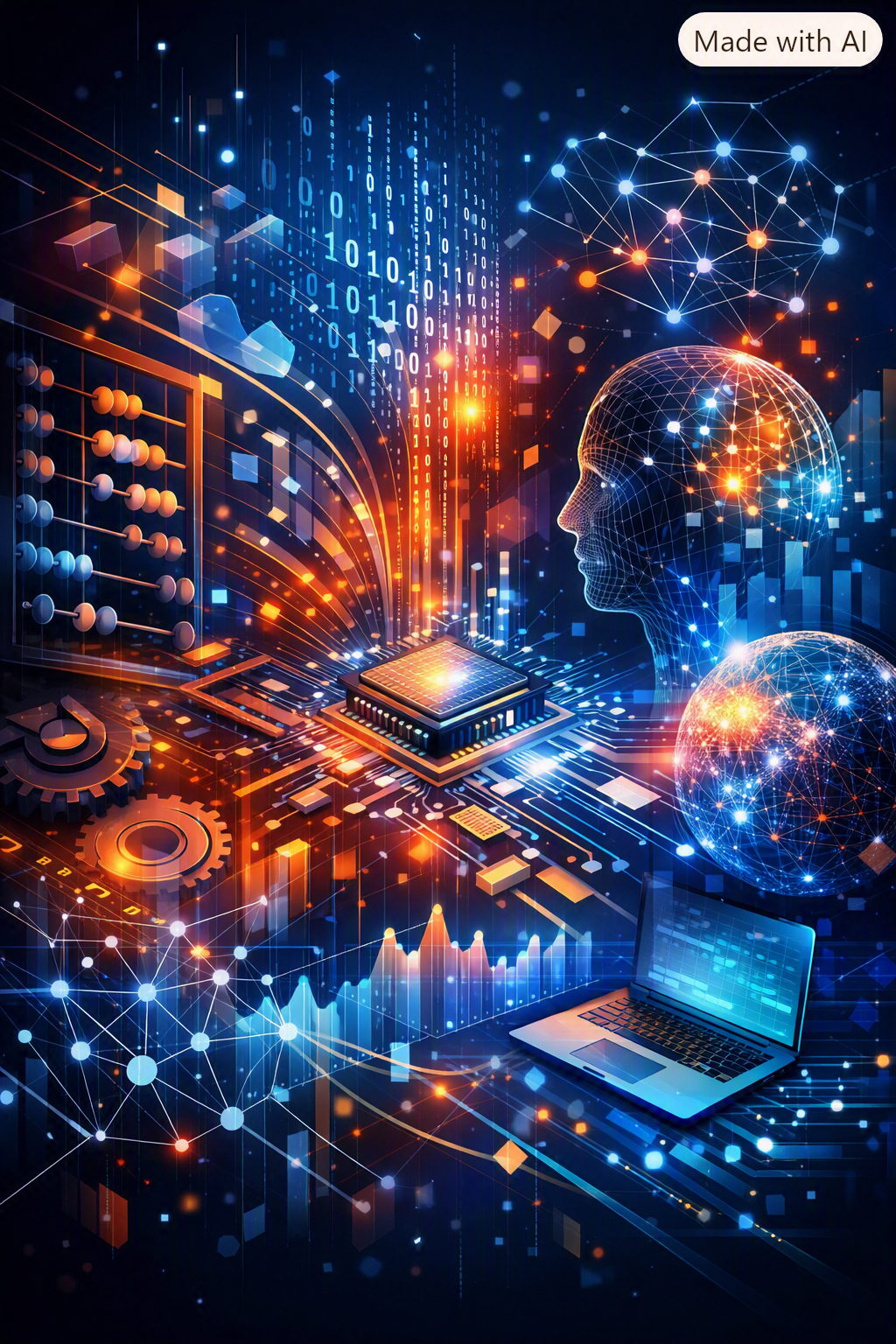
Computation is the practice of transforming information according to well‑defined rules. It began as a way to extend human reasoning and calculation, and has evolved into the core infrastructure of our economic, scientific, and social systems. Today, computation is not just about numbers—it is about modeling reality, automating decisions, and shaping how we live and relate to one another.
Origins of computation
Early counting and notation
- Concrete counting practices: Early civilizations used tally sticks, knots in ropes, and one‑to‑one correspondence to keep track of quantities such as grain, livestock, and trade.
- Numeral systems: The development of positional numeral systems—especially the Hindu–Arabic numerals and the concept of zero—made systematic calculation possible and laid the foundation for algorithmic thinking.
Mechanical aids
- Abacus:The abacus, dating back at least to around 1100 BCE, is one of the earliest known devices explicitly designed for calculation, turning abstract quantities into manipulable beads on rods.
- Early mechanical calculators:Devices by Schickard, Pascal, and Leibniz in the 17th century mechanized arithmetic operations (addition, subtraction, multiplication, division), showing that calculation could be embodied in physical mechanisms rather than only in human minds.
From machines to theory: the history of computing
19th‑century conceptual breakthroughs
- Babbage’s engines:Charles Babbage’s Difference Engine and Analytical Engine introduced the idea of a general‑purpose machine controlled by instructions (programs) and capable of symbolic manipulation, not just fixed numerical tasks.
- Ada Lovelace:Lovelace’s notes on the Analytical Engine articulated the notion that such a machine could operate on symbols beyond numbers—anticipating modern views of computation as general symbol processing.
20th‑century foundations
- Turing and formal computation:Alan Turing’s model of a “universal machine” defined computation in abstract terms: any effectively calculable process could be represented as a sequence of discrete steps on symbolic data. This gave a rigorous foundation to what it means for a process to be computable.
- Electronic computers:Machines like ENIAC and the Manchester Baby transformed computation from mechanical and electromechanical devices into fully electronic systems, enabling orders‑of‑magnitude speed increases and programmability.
The hardware and software revolutions
- Transistors and microchips:The invention of the transistor and integrated circuits shrank computers from room‑sized machines to desktop and then pocket‑sized devices, driving Moore’s Law and making computation ubiquitous.
- Programming languages and operating systems:From assembly to high‑level languages (C, Java, Python) and modern operating systems, software abstracted away hardware details and allowed complex applications—databases, networks, AI systems—to be built on top of general‑purpose machines.
The networked and intelligent era
- Internet and the Web:Networking computers through ARPANET and later the World Wide Web turned computation into a global, distributed system, enabling real‑time communication, cloud services, and large‑scale data processing.
- Artificial intelligence and data‑driven computation:Modern AI, machine learning, and data analytics treat computation as a way to discover patterns, make predictions, and automate decisions across domains—from finance and logistics to medicine and language.
Significance of computation in the modern world
Economic and industrial impact
- Automation and productivity: Computation powers automation in manufacturing, logistics, and services, reducing manual effort and enabling just‑in‑time supply chains, predictive maintenance, and optimized resource use.
- Digital economies: Financial markets, e‑commerce platforms, and digital payment systems rely on continuous computation for transactions, risk modeling, fraud detection, and personalized pricing.
- Innovation and entrepreneurship: Software platforms and cloud infrastructure lower the barrier to entry for new businesses, allowing small teams to build globally scalable products.
Scientific and technological significance
- Simulation and modeling: Computational models are central to climate science, astrophysics, genomics, epidemiology, and engineering. They allow us to simulate complex systems that are impossible to fully experiment on in the physical world.
- Data analysis and discovery: Large‑scale computation enables the analysis of massive datasets—from particle physics experiments to social networks—revealing patterns and structures that would be invisible to human inspection alone.
- Design and optimization: Computation supports computer‑aided design (CAD), optimization of structures and processes, and rapid prototyping, accelerating innovation cycles in engineering and architecture.
Social and cultural significance
- Communication and community: Social media, messaging apps, and video platforms are computational systems that mediate how people connect, organize, and express themselves, reshaping public discourse and identity.
- Information access: Search engines, digital libraries, and online education platforms make knowledge globally accessible, changing how people learn and how expertise is distributed.
- Media and creativity: Computation underlies digital art, music production, film editing, and interactive media, expanding creative possibilities and blurring boundaries between creator and audience.
Political, ethical, and existential dimensions
- Governance and policy: Governments use computational systems for census data, tax collection, public service delivery, and security. At the same time, algorithmic decision‑making raises questions about transparency, fairness, and accountability.
- Privacy and surveillance: The ability to collect, store, and analyze personal data at scale creates both powerful tools (e.g., health monitoring, fraud prevention) and serious risks (e.g., mass surveillance, data breaches).
- Work, identity, and meaning: As computation automates more tasks, societies must grapple with changing labor markets, new skill requirements, and questions about what uniquely human roles remain in a highly automated world.
Computation as a way of thinking
Beyond machines and software, computation has become a mindset:
- Algorithmic thinking: Breaking problems into discrete steps, specifying clear rules, and reasoning about efficiency and correctness are now core skills in many fields, not just computer science.
- Systems perspective: Viewing organizations, ecosystems, and societies as interacting information‑processing systems helps us understand feedback loops, emergent behavior, and unintended consequences.
- Formalization and abstraction: Computation encourages precise definitions and abstractions, which can clarify complex phenomena but also risk oversimplifying human realities if used uncritically.
Conclusion
Computation began as a way to count and calculate more reliably; it evolved into mechanical devices, then electronic machines, then global networks and intelligent systems. Today, it is woven into nearly every aspect of modern life—economy, science, culture, politics, and personal identity. Its significance lies not only in what computers do, but in how computational ways of thinking shape our choices, our institutions, and our vision of the future.



Be First to Comment