
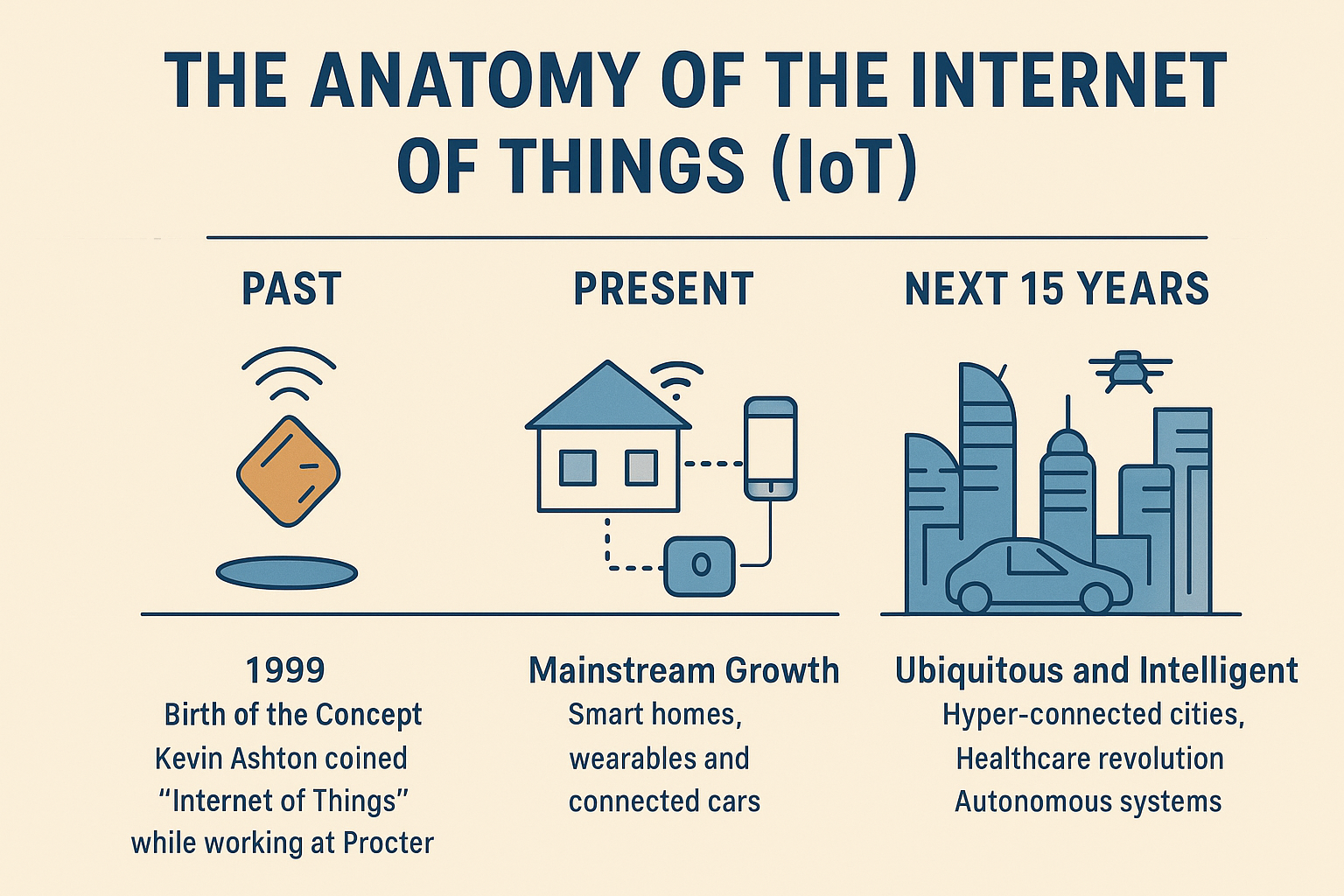
The Internet of Things (IoT) has evolved from a conceptual buzzword into one of the most transformative forces of the 21st century. From its modest beginnings in the late 1990s, IoT has grown into a global ecosystem connecting billions of devices, shaping industries, economies, and daily life. To understand where IoT is headed in the next 15 years, it’s important to explore its anatomy, history, and future trajectory.
The Anatomy of IoT
At its core, IoT is not just about devices — it’s a system of interlinked components that work together to generate, share, and act upon data. Its anatomy can be broken down into:
- Devices and Sensors
- Physical objects equipped with sensors or actuators.
- Examples: smart thermostats, wearable fitness trackers, connected vehicles.
- Connectivity Layer
- The networks that allow devices to “talk” to each other.
- Includes Wi-Fi, 5G, LPWAN (Low-Power Wide-Area Networks), and satellite internet.
- Edge Computing and Gateways
- Data processing closer to the source of information for faster decision-making.
- Reduces reliance on centralized servers.
- Cloud Infrastructure
- Centralized storage and processing power to analyze vast amounts of IoT data.
- Supports AI, analytics, and scalability.
- Applications and Services
- The user-facing layer that delivers real-world value.
- Smart homes, predictive maintenance in factories, connected healthcare, smart cities.
- Security and Privacy Framework
- Encryption, authentication, and compliance measures to safeguard IoT ecosystems.
A Brief History of IoT
- 1999 – Birth of the Concept:
Kevin Ashton, working at Procter & Gamble, coined the term “Internet of Things” while describing how RFID (radio-frequency identification) tags could connect supply chain items to the internet. - 2000s – Early Experimentation:
IoT was mostly confined to research and niche applications such as logistics, industrial monitoring, and “smart” appliances. - 2010s – Mainstream Growth:
Advances in smartphones, cloud computing, and cheap sensors accelerated adoption. Smart home devices, wearables, and connected cars entered the consumer market. - 2020s – The Expansion Era:
IoT became a backbone for Industry 4.0, healthcare, smart agriculture, and energy grids. The rise of 5G and AI-driven IoT enabled real-time applications at scale.
The Next 15 Years: IoT in 2040
Looking ahead, IoT will become even more ubiquitous, intelligent, and human-centered. Here’s how it may look:
- Hyper-Connected Cities
- Traffic, waste management, energy distribution, and safety will be fully automated through IoT systems.
- Entire urban areas will function as “living organisms” guided by real-time data.
- Healthcare Revolution
- Wearable biosensors and implantable IoT devices will monitor health continuously.
- AI-assisted IoT will predict and prevent diseases before symptoms appear.
- Autonomous Systems Everywhere
- IoT will merge with robotics, enabling fleets of autonomous vehicles, drones, and delivery systems.
- Green IoT for Sustainability
- Smart grids, precision agriculture, and energy-efficient IoT devices will reduce environmental impact.
- Integration with Human Augmentation
- Brain-machine IoT interfaces may connect human neural activity with digital ecosystems, reshaping work and communication.
- Quantum and Secure IoT
- Quantum computing and next-gen cryptography will address security challenges, ensuring trust in a world of trillions of connected nodes.
Conclusion
From its inception in 1999 to a projected ubiquitous role in 2040, IoT reflects humanity’s ambition to connect everything — from household devices to global infrastructure. The anatomy of IoT will evolve with each technological leap, integrating AI, quantum computing, and biotechnology, transforming the world into a seamlessly intelligent ecosystem.
IoT is no longer just about things; it’s about the future of human interaction with technology.

Be First to Comment