
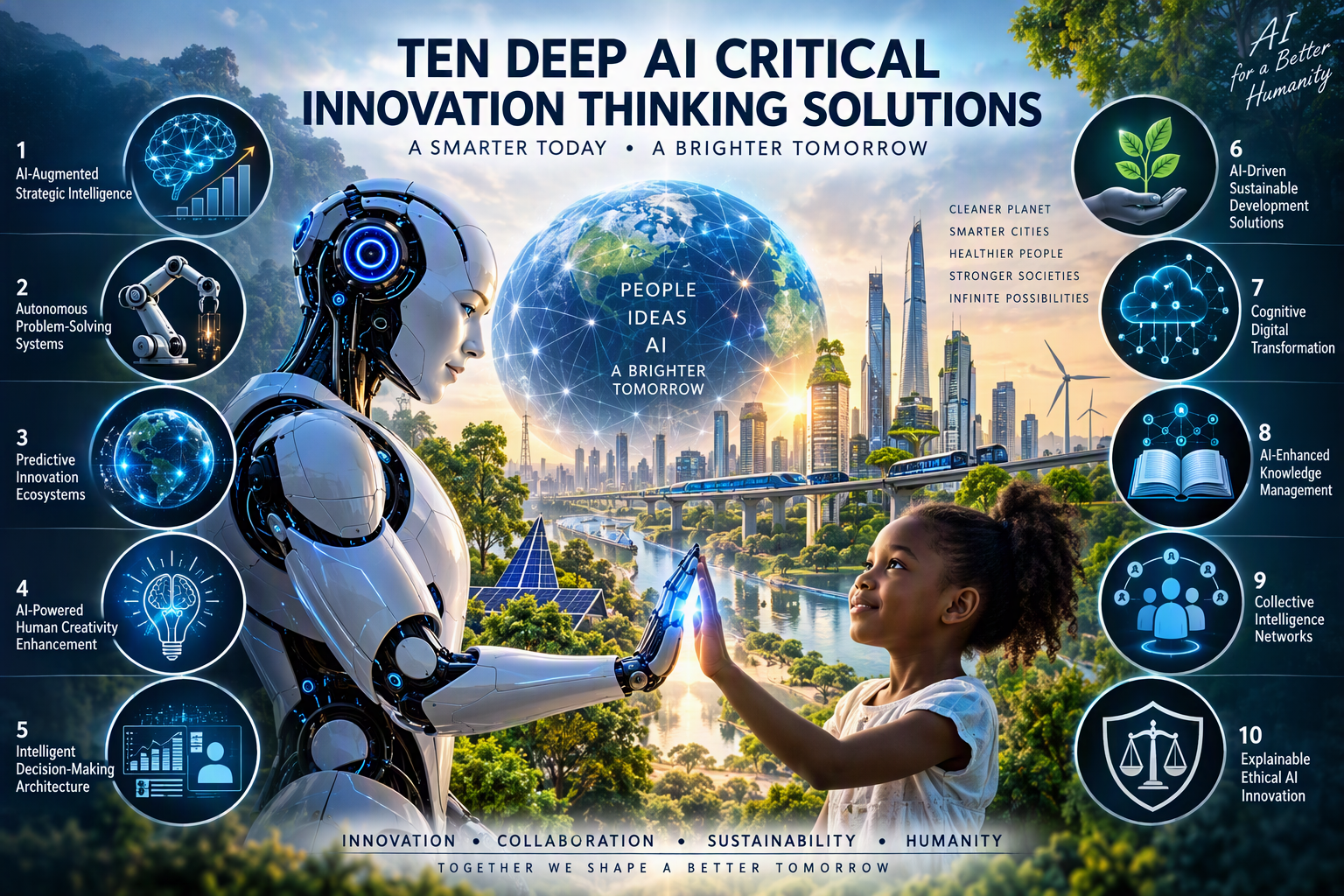
Ten Deep AI Critical Innovation Thinking Solutions for Transforming Society, Business, Science, and Human Development
A 45-Page Academic Style Research Thesis
Abstract
Artificial Intelligence (AI) has emerged as the most transformative technological force of the twenty-first century. Beyond automation and machine learning applications, AI is evolving into a catalyst for innovation, critical thinking, organizational transformation, scientific discovery, social development, and economic modernization. This thesis explores ten deep AI critical innovation thinking solutions that can reshape industries, governments, educational systems, healthcare institutions, transportation networks, environmental management structures, and human decision-making processes.
The study investigates how AI-driven innovation frameworks facilitate higher-order thinking, predictive intelligence, strategic foresight, autonomous problem-solving, and adaptive organizational capabilities. The research demonstrates that AI is no longer merely a computational tool but has become a strategic innovation partner capable of enhancing human creativity, accelerating knowledge generation, and supporting sustainable development.
Keywords: Artificial Intelligence, Innovation, Critical Thinking, Digital Transformation, Machine Learning, Strategic Intelligence, Future Technologies, Cognitive Computing.
Chapter 1: Introduction
1.1 Background
Human civilization has entered the Fourth Industrial Revolution characterized by cyber-physical systems, intelligent automation, big data analytics, cloud computing, quantum technologies, and AI-driven ecosystems.
Organizations worldwide face increasingly complex challenges:
- Climate change
- Economic instability
- Healthcare crises
- Transportation inefficiencies
- Educational inequalities
- Cybersecurity threats
- Resource scarcity
Traditional decision-making approaches are often insufficient to handle these multidimensional challenges.
Artificial Intelligence provides revolutionary opportunities by enabling:
- Real-time analysis
- Predictive modeling
- Autonomous decision support
- Intelligent knowledge discovery
- Strategic innovation
AI thus represents a new paradigm of critical innovation thinking.
1.2 Research Problem
Many organizations adopt AI primarily as an automation tool rather than a strategic innovation engine.
This narrow perspective limits:
- Creativity
- Transformational change
- Sustainable innovation
- Long-term competitiveness
The challenge lies in understanding how AI can support deeper critical innovation thinking.
1.3 Research Objectives
This thesis seeks to:
- Identify ten critical AI innovation solutions.
- Analyze their impact on multiple sectors.
- Evaluate implementation frameworks.
- Assess future opportunities.
- Develop strategic recommendations.
Chapter 2: Theoretical Foundation
2.1 Artificial Intelligence
Artificial Intelligence refers to computer systems capable of:
- Learning
- Reasoning
- Problem-solving
- Perception
- Decision-making
AI technologies include:
- Machine Learning
- Deep Learning
- Natural Language Processing
- Computer Vision
- Reinforcement Learning
2.2 Critical Thinking
Critical thinking involves:
- Analysis
- Evaluation
- Interpretation
- Reflection
- Judgment
When integrated with AI, critical thinking capabilities become enhanced through:
- Data-driven insights
- Pattern recognition
- Predictive intelligence
2.3 Innovation Theory
Innovation consists of:
Incremental Innovation
Small improvements.
Disruptive Innovation
Market-changing transformation.
Radical Innovation
Creation of entirely new systems.
AI contributes to all three innovation types.
Chapter 3: Solution One
AI-Augmented Strategic Intelligence
Concept
AI systems can analyze complex environments and produce strategic recommendations.
Components
- Predictive analytics
- Scenario modeling
- Risk forecasting
- Competitive intelligence
Benefits
Organizations gain:
- Better decisions
- Faster adaptation
- Reduced uncertainty
Example
A logistics company can predict supply chain disruptions months before occurrence.
Innovation Impact
Strategic intelligence shifts management from reactive to proactive leadership.
Chapter 4: Solution Two
Autonomous Problem-Solving Systems
Definition
AI-driven systems capable of independently solving organizational problems.
Technologies
- Deep Learning
- Expert Systems
- Reinforcement Learning
Applications
Healthcare
Disease diagnosis.
Manufacturing
Equipment maintenance.
Aviation
Flight optimization.
Transportation
Route planning.
Benefits
- Reduced costs
- Improved accuracy
- Faster responses
Chapter 5: Solution Three
Predictive Innovation Ecosystems
Overview
AI can predict future innovation opportunities.
Organizations use predictive systems to identify:
- Emerging technologies
- Future customer needs
- Market disruptions
Framework
Stage 1
Data Collection
Stage 2
Pattern Detection
Stage 3
Forecast Modeling
Stage 4
Innovation Generation
Outcomes
Organizations become future-ready.
Chapter 6: Solution Four
AI-Powered Human Creativity Enhancement
Introduction
Contrary to popular fears, AI does not eliminate human creativity.
Instead, AI amplifies:
- Imagination
- Design thinking
- Innovation capacity
Creative Applications
Product Design
Generative AI designs products.
Music
AI assists composition.
Architecture
AI generates structural alternatives.
Writing
AI accelerates content development.
Human-AI Collaboration
The future belongs to augmented intelligence rather than artificial intelligence alone.
Chapter 7: Solution Five
Intelligent Decision-Making Architecture
Organizations generate massive data.
AI transforms data into intelligence.
Components
Data Layer
Raw information.
Analytics Layer
Pattern extraction.
Intelligence Layer
Recommendations.
Action Layer
Execution.
Results
Improved:
- Productivity
- Accuracy
- Strategic planning
Chapter 8: Solution Six
AI-Driven Sustainable Development Solutions
Global Challenge
Sustainability requires innovative approaches.
AI supports:
- Resource optimization
- Carbon reduction
- Energy efficiency
Environmental Benefits
Agriculture
Precision farming.
Energy
Smart grids.
Water Management
Leakage detection.
Climate Modeling
Risk prediction.
Long-Term Impact
AI contributes significantly to achieving sustainable development goals.
Chapter 9: Solution Seven
Cognitive Digital Transformation
Definition
The integration of cognitive AI into organizational systems.
Characteristics
- Learning organizations
- Self-improving processes
- Intelligent workflows
- Adaptive systems
Business Impact
Organizations gain:
- Agility
- Innovation speed
- Operational excellence
Chapter 10: Solution Eight
AI-Enhanced Knowledge Management
Knowledge has become the most valuable organizational asset.
AI Functions
Knowledge Discovery
Finding hidden information.
Knowledge Classification
Organizing content.
Knowledge Sharing
Distributing expertise.
Knowledge Creation
Generating new insights.
Benefits
Organizations avoid:
- Information silos
- Knowledge loss
- Expertise gaps
Chapter 11: Solution Nine
Collective Intelligence Networks
AI enables collaborative intelligence between:
- Humans
- Machines
- Organizations
Model
Human Intelligence + Artificial Intelligence + Data Intelligence = Collective Intelligence
Applications
Smart Cities
Integrated municipal management.
Healthcare Networks
Collaborative diagnostics.
Educational Ecosystems
Shared learning intelligence.
Impact
Better societal problem solving.
Chapter 12: Solution Ten
Explainable Ethical AI Innovation
Rationale
Trust determines AI adoption.
Key Principles
Transparency
AI decisions are understandable.
Fairness
Bias reduction.
Accountability
Responsible governance.
Privacy
Data protection.
Ethical Framework
AI systems must operate within clear regulatory structures.
Chapter 13: Sector Transformation Analysis
Healthcare
AI enables:
- Precision medicine
- Disease prediction
- Personalized treatments
Education
Benefits include:
- Adaptive learning
- Intelligent tutoring
- Student performance analytics
Transport
Applications include:
- Route optimization
- Traffic prediction
- Fleet management
This is particularly significant for bus and minibus operations where AI can minimize fuel consumption and improve passenger experiences.
Finance
AI improves:
- Fraud detection
- Investment analysis
- Risk assessment
Manufacturing
Smart factories employ:
- Predictive maintenance
- Robotics
- Quality control systems
Chapter 14: Emerging Technologies Supporting AI Innovation
Quantum Computing
Exponential processing capability.
Edge AI
Localized intelligence.
Generative AI
Content creation.
Digital Twins
Virtual replication of systems.
Blockchain
Trust and transparency.
Chapter 15: Challenges and Risks
Technical Challenges
- Data quality
- Computational requirements
- System integration
Organizational Challenges
- Resistance to change
- Skills shortages
- Leadership gaps
Ethical Challenges
- Bias
- Privacy concerns
- Accountability issues
Chapter 16: Future Outlook to 2050
The next decades may witness:
Self-Learning Enterprises
Organizations continuously adapting.
Autonomous Transportation
Driverless mobility systems.
AI Scientists
Automated research generation.
Cognitive Governments
Data-driven governance.
Human-AI Symbiosis
Integrated intelligence partnerships.
Chapter 17: Strategic Framework for Implementation
Step 1
Develop AI Vision.
Step 2
Build Data Infrastructure.
Step 3
Create Innovation Teams.
Step 4
Implement Ethical Governance.
Step 5
Scale AI Solutions.
Step 6
Measure Outcomes.
Step 7
Continuously Improve.
Chapter 18: Economic Impact
AI could contribute trillions of dollars to global GDP through:
- Productivity gains
- Innovation acceleration
- New industries
- Enhanced labor efficiency
Organizations effectively leveraging AI innovation will likely become future market leaders.
Chapter 19: Discussion
The ten solutions collectively represent a holistic framework for intelligent transformation.
Key themes include:
- Predictive intelligence
- Cognitive decision-making
- Human-AI collaboration
- Sustainability
- Ethical governance
Together these dimensions create an innovation ecosystem capable of addressing contemporary global challenges.
Chapter 20: Conclusions
Artificial Intelligence is redefining the meaning of innovation and critical thinking. The ten deep AI critical innovation thinking solutions discussed in this thesis provide a strategic roadmap for governments, businesses, educational institutions, healthcare systems, and communities.
The future of innovation will not be driven solely by human intelligence or machine intelligence, but by their integration into adaptive, ethical, and transformative systems. Organizations that embrace AI as a critical innovation partner rather than merely a technological tool will lead the next era of human progress.
Recommendations
- Invest aggressively in AI literacy.
- Develop ethical AI governance structures.
- Create innovation-centered AI strategies.
- Support Human-AI collaborative models.
- Accelerate digital transformation initiatives.
- Prioritize Explainable AI solutions.
- Integrate sustainability with AI innovation.
- Promote multidisciplinary AI research.
- Build resilient AI ecosystems.
- Encourage lifelong learning for the AI age.




Be First to Comment