
The Internet of Things (IoT) has quickly moved from being a buzzword in tech circles to a reality that shapes our daily lives. From smart home devices and wearable fitness trackers to industrial sensors and connected vehicles, IoT is redefining how humans, machines, and systems interact. But what exactly is IoT, and how does it really work? Let’s break it down.
What is the Internet of Things?
The Internet of Things (IoT) refers to the network of physical devices—“things”—that are embedded with sensors, software, and connectivity capabilities, enabling them to collect, exchange, and act upon data.
In simple terms, IoT allows everyday objects—like refrigerators, thermostats, vehicles, and industrial machines—to connect to the internet, share information, and even make decisions with little to no human input.
How Does IoT Actually Work?
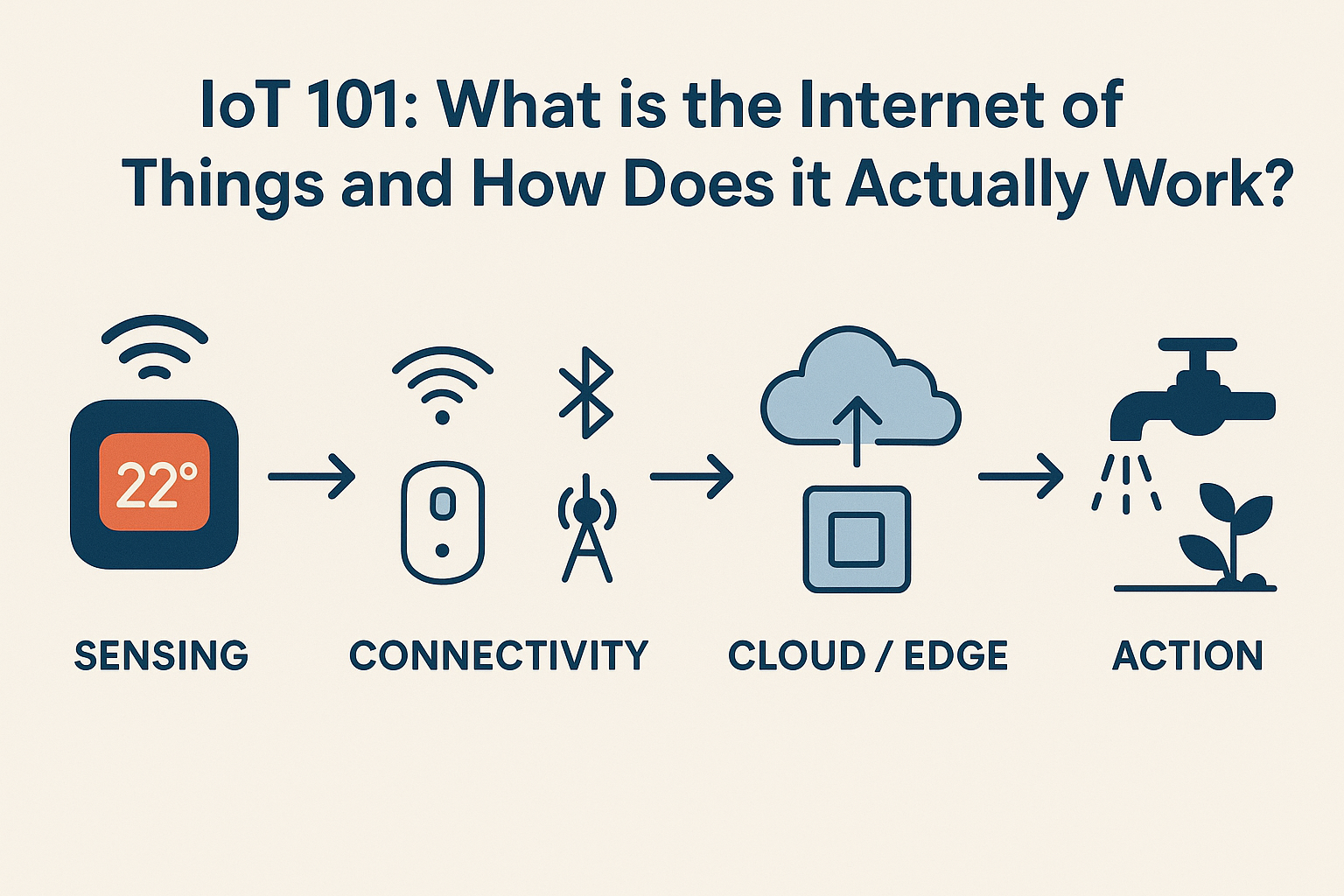
IoT systems typically follow four core stages of operation:
1. Sensing and Data Collection
IoT devices are equipped with sensors that monitor physical conditions such as temperature, humidity, motion, location, light, or pressure. For example, a smart thermostat senses room temperature, while a GPS tracker senses location.
2. Connectivity
The data collected by sensors needs to be transmitted. Devices connect through different communication methods, including:
- Wi-Fi – Common in homes and offices.
- Bluetooth / BLE – Short-range, low-energy connections.
- Cellular (4G/5G) – Best for wide-area, mobile coverage.
- LPWAN (LoRa, NB-IoT, Sigfox) – Designed for long-range, low-power use cases.
3. Data Processing
Once transmitted, the data is processed either:
- Locally (Edge Computing) – Data is processed directly on the device or nearby gateway for faster response times.
- In the Cloud – Data is sent to centralized servers for storage, analysis, and decision-making.
4. Action and User Interaction
Finally, the IoT system takes action or sends insights.
- A smart irrigation system may turn on sprinklers when soil moisture is low.
- A fitness tracker may alert you to move after detecting inactivity.
- A factory sensor may shut down a machine to prevent overheating.
Everyday Examples of IoT
- Smart Homes: Voice assistants, smart lights, thermostats, and appliances.
- Healthcare: Wearables tracking heart rate, oxygen levels, and activity.
- Transportation: Connected cars, fleet management, GPS tracking.
- Industry (IIoT): Predictive maintenance sensors in factories.
- Agriculture: Soil, weather, and crop monitoring sensors.
Why Does IoT Matter?
The promise of IoT lies in efficiency, automation, and smarter decision-making. It reduces human effort, minimizes costs, and creates opportunities for innovation in every industry.
- Businesses use IoT for predictive maintenance to cut downtime.
- Cities implement smart infrastructure for energy savings and traffic management.
- Individuals enjoy personal convenience through connected devices.
Challenges and Risks of IoT
Despite its potential, IoT comes with challenges:
- Security & Privacy: More devices mean more entry points for hackers.
- Interoperability: Devices from different manufacturers often struggle to “talk” to each other.
- Scalability: Billions of devices require robust networks and cloud systems.
The Future of IoT
Looking ahead, IoT will become even more powerful with AI, 5G, and edge computing. Imagine cities where traffic lights respond in real-time to congestion, hospitals where doctors monitor patients remotely, and factories that run with near-zero human intervention.
By 2030, experts predict over 25 billion connected devices, making IoT one of the pillars of digital transformation.
✅ In Summary:
The Internet of Things connects the physical and digital worlds by using sensors, connectivity, and intelligent systems. It works by sensing data, transmitting it, analyzing it, and enabling action. While challenges remain, IoT continues to revolutionize industries, homes, and societies—quietly but powerfully shaping the way we live.



Be First to Comment