
Introduction
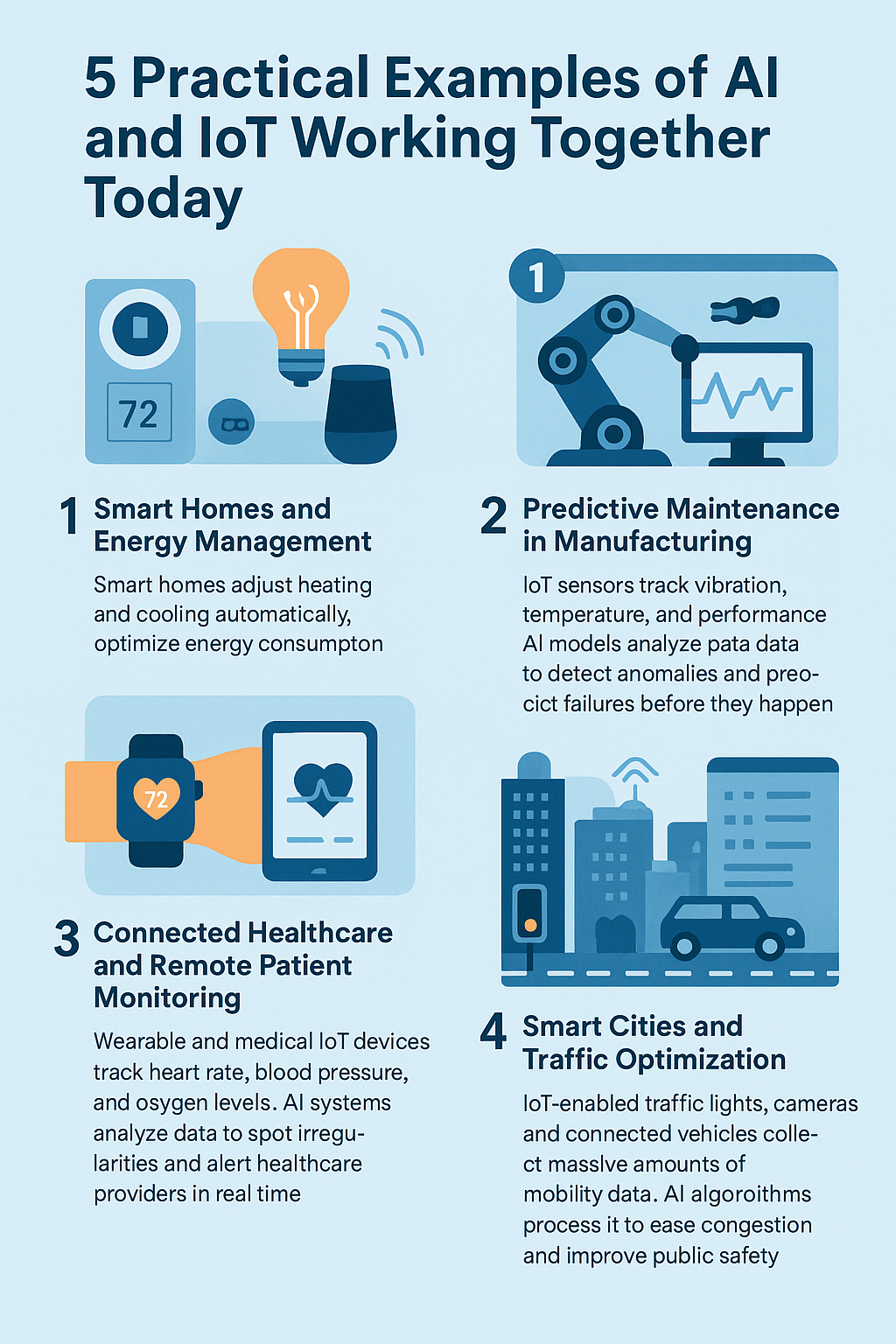
In an increasingly interconnected world, two technological titans, Artificial Intelligence (AI) and the Internet of Things (IoT), are converging to create a synergy that is revolutionizing industries and daily life. While IoT devices act as the sensory organs, collecting vast amounts of data from the physical world, AI serves as the brain, processing, analyzing, and drawing intelligent insights from this data. This powerful combination, often referred to as the Artificial Intelligence of Things (AIoT), enables systems to not only collect information but also to learn, adapt, and make autonomous decisions, leading to unprecedented levels of efficiency, automation, and innovation. This article explores five practical and impactful examples where the integration of AI and IoT is already transforming various sectors, demonstrating the profound capabilities of this symbiotic relationship.
- Predictive Maintenance: Anticipating Failure, Maximizing Uptime
One of the most impactful applications of AI and IoT convergence is in predictive maintenance. Traditionally, maintenance was either reactive (fixing things after they broke) or preventive (scheduled maintenance regardless of actual need). Both approaches lead to inefficiencies, unexpected downtime, and increased costs. AIoT transforms this by enabling systems to predict equipment failure before it occurs, allowing for timely and targeted maintenance interventions.
IoT sensors embedded in machinery, from industrial robots to wind turbines, continuously collect data on various parameters such as vibration, temperature, pressure, and sound [1]. This constant stream of data provides a real-time health check of the equipment. However, the sheer volume and velocity of this data make it impossible for humans to analyze effectively. This is where AI steps in.
AI algorithms, particularly those leveraging machine learning, analyze this sensor data to identify subtle patterns and anomalies that indicate potential impending failures. These algorithms are trained on historical data, including past failures and maintenance records, to learn what constitutes normal operation and what signals a deviation towards a fault. For instance, in the case of wind turbines, AI can process data from hundreds of sensors to detect minute changes in operational characteristics that might signify a bearing defect or a blade imbalance [2].
Once a potential issue is identified, the AI system can trigger alerts, generate automated work orders, and even prioritize maintenance tasks based on the severity of the predicted failure and its potential impact on operations. This proactive approach significantly reduces unscheduled downtime, extends the lifespan of equipment, optimizes maintenance schedules, and ultimately leads to substantial cost savings. The ability to anticipate and address issues before they escalate is a game-changer for industries reliant on heavy machinery and continuous operation.
- Smart City Management: Intelligent Urban Environments
Smart cities leverage AI and IoT to enhance urban living, improve infrastructure efficiency, and address challenges like traffic congestion and energy consumption. IoT devices deployed across a city collect diverse data, and AI analyzes this data to enable intelligent decision-making and automated responses.
One prominent example is smart street lighting. Traditional streetlights operate on fixed schedules, often illuminating empty streets or remaining dim when more light is needed. In a smart city, IoT-enabled streetlights are equipped with sensors that detect real-time conditions such, as pedestrian and vehicle traffic, and even ambient light levels [3]. This data is fed to AI algorithms that can dynamically adjust the brightness of the lights, dimming them during periods of low activity and increasing illumination when traffic or pedestrian presence is high. This not only enhances public safety but also leads to significant energy savings, with some systems reporting up to 80% reduction in energy expenses [3].
Beyond lighting, AI and IoT are transforming traffic management. IoT sensors embedded in roads or mounted on traffic lights collect data on vehicle flow, congestion points, and accident occurrences. AI algorithms analyze this real-time traffic data to optimize traffic signal timings, reroute vehicles to less congested paths, and provide predictive traffic information to commuters. This intelligent management reduces commute times, lowers fuel consumption, and decreases carbon emissions, contributing to a more sustainable and efficient urban environment. The integration of AI and IoT in smart cities creates a responsive and adaptive urban ecosystem that improves the quality of life for its residents.
- Proactive Healthcare and Patient Monitoring: A New Era of Wellness
The healthcare industry is undergoing a profound transformation with the integration of AI and IoT, moving from a reactive, episodic care model to a proactive, continuous monitoring approach. This shift is particularly evident in patient monitoring, where AIoT is enabling earlier detection of health issues, personalized interventions, and improved patient outcomes.
Wearable IoT sensors, such as smartwatches, fitness trackers, and specialized medical devices, continuously collect a wealth of physiological data from individuals. This data includes heart rate, blood pressure, glucose levels, sleep patterns, activity levels, and even electrocardiogram (ECG) readings [4]. This constant stream of real-time data provides an unprecedented view into a patient’s health status, both in clinical settings and in their daily lives.
AI algorithms are then applied to this massive dataset to identify subtle changes, trends, and anomalies that might indicate the onset of a health condition or the worsening of an existing one. For example, AI can detect irregular heart rhythms, predict the likelihood of a diabetic crisis based on glucose fluctuations, or identify early signs of respiratory distress. By analyzing patterns that might be imperceptible to the human eye, AI can alert healthcare providers to potential issues before they become critical emergencies.
This proactive monitoring allows for timely interventions, often preventing hospitalizations and improving the effectiveness of treatment plans. It also empowers individuals to take a more active role in managing their own health, providing them with actionable insights and personalized recommendations. The synergy of AI and IoT in healthcare is not only enhancing patient care but also making healthcare more accessible, efficient, and preventive.
- Autonomous Vehicles and Logistics: The Future of Transportation
The dream of self-driving cars and fully automated logistics networks is rapidly becoming a reality, thanks to the powerful combination of AI and IoT. Autonomous vehicles (AVs) are essentially IoT devices on wheels, equipped with an array of sensors that collect vast amounts of data about their surroundings, while AI acts as the sophisticated brain that processes this data to enable safe and efficient navigation.
AVs are fitted with various IoT sensors, including cameras, radar, lidar, and ultrasonic sensors, which continuously gather information about other vehicles, pedestrians, road conditions, traffic signs, and obstacles [5]. This raw sensor data is then fed into AI models, particularly those leveraging deep learning and computer vision, which interpret the environment in real-time. AI algorithms perform tasks such as object detection, classification, tracking, and prediction of movement, allowing the vehicle to understand its surroundings and anticipate potential hazards.
Beyond individual vehicles, AI and IoT are revolutionizing the entire logistics and supply chain industry. IoT devices track cargo, monitor vehicle performance, and provide real-time location data. AI algorithms analyze this data to optimize delivery routes, manage fleet operations, predict maintenance needs for vehicles, and even automate warehouse processes. For example, AI can dynamically adjust routes based on real-time traffic conditions or weather patterns, ensuring timely deliveries and reducing fuel consumption. In warehouses, IoT-enabled robots guided by AI can efficiently sort, move, and store goods, significantly increasing operational speed and accuracy.
This integration leads to enhanced safety, reduced operational costs, improved efficiency, and a more sustainable transportation ecosystem. As AI and IoT technologies continue to advance, autonomous vehicles and intelligent logistics systems are poised to redefine how goods and people move across the globe.
- Smart Building Energy Management: Optimizing Consumption for Sustainability
Energy consumption in buildings accounts for a significant portion of global energy use and greenhouse gas emissions. The integration of AI and IoT offers a powerful solution for optimizing energy management in commercial and residential buildings, leading to substantial savings and increased sustainability.
IoT sensors deployed throughout a smart building collect data on various environmental factors and occupancy patterns. These sensors monitor temperature, humidity, light levels, CO2 levels, and the presence of people in different zones [6]. This granular data provides a comprehensive picture of energy usage and demand within the building.
AI algorithms then analyze this real-time data to make intelligent decisions about heating, ventilation, and air conditioning (HVAC) systems, lighting, and other energy-consuming appliances. For instance, AI can learn occupancy schedules and adjust HVAC settings to pre-cool or pre-heat spaces only when they are expected to be occupied, rather than maintaining constant temperatures. It can also integrate with weather forecasts to anticipate external temperature changes and optimize energy use accordingly. In lighting, AI can dim or turn off lights in unoccupied areas or when sufficient natural light is available, further reducing consumption.
Beyond simple automation, AI-powered energy management systems can identify inefficiencies, predict peak demand periods, and even detect faulty equipment that might be consuming excessive energy. By continuously learning and adapting to the building’s unique characteristics and occupant behavior, these systems can achieve significant energy reductions, often ranging from 20% to 40% or more [6]. This not only translates to lower utility bills but also contributes to a reduced carbon footprint, making buildings more environmentally friendly and sustainable. The fusion of AI and IoT is transforming buildings into intelligent, energy-efficient ecosystems.
Conclusion
The convergence of Artificial Intelligence and the Internet of Things is not merely a technological trend; it is a fundamental shift in how we interact with our physical world and manage its complexities. From predicting machinery failures and optimizing urban infrastructure to revolutionizing healthcare, transportation, and energy management, AIoT is proving to be a transformative force across diverse sectors. The examples highlighted in this article demonstrate the tangible benefits of this synergy: enhanced efficiency, significant cost savings, improved safety, greater sustainability, and a new era of intelligent automation.
As IoT devices become more ubiquitous and AI algorithms grow more sophisticated, the potential for further innovation is immense. The symbiotic relationship between AI and IoT will continue to drive advancements, creating smarter environments, more responsive systems, and ultimately, a more connected and intelligent future. The Artificial Intelligence of Things is not just a concept; it is the operational reality that is shaping the world around us, one intelligent interaction at a time.



Be First to Comment