Introduction
Agriculture, the bedrock of human civilization, has undergone several transformative periods throughout history. From the initial domestication of plants and animals approximately 12,000 years ago in the Fertile Crescent to the Green Revolution of the 20th century, each era has brought forth innovations that have dramatically reshaped how we produce food. Today, we stand at the precipice of a fourth agricultural revolution, driven by the convergence of the Internet of Things (IoT) and Artificial Intelligence (AI). These cutting-edge technologies are creating unprecedented efficiencies, promising to fundamentally alter farming practices and address the pressing challenges of a growing global population and environmental sustainability.
The global population is projected to reach over 8.1 billion by 2025, with an additional 2 billion people expected in the next three decades. This demographic shift, coupled with the increasing frequency of extreme weather events due to climate change, rising input costs, and the prevalence of monocultures susceptible to pests and diseases, places immense pressure on food production systems. Traditional farming methods, while historically effective, are increasingly proving insufficient to meet these escalating demands. The innovations brought forth by IoT and AI offer a viable pathway to not only increase yields but also to minimize environmental impact and enhance the resilience of agricultural systems.
This article delves into the transformative power of IoT and AI in modern agriculture, exploring how these technologies are enabling precision farming, real-time monitoring, and data-driven decision-making. We will examine specific applications, highlight the benefits they offer, and discuss the challenges that need to be addressed for their widespread adoption. By integrating historical data with real-time insights from novel devices, farmers can refine their strategies for planting, watering, pest management, and harvesting, leading to significant increases in productivity and a more sustainable future for agriculture.
The Basics of AI and IoT Technology in Agriculture
Artificial Intelligence (AI) and the Internet of Things (IoT) are two distinct yet complementary technologies that are rapidly transforming various industries, including agriculture. In essence, IoT refers to a network of interconnected physical devices, sensors, and other objects embedded with software and other technologies for the purpose of connecting and exchanging data with other devices and systems over the internet. In agriculture, these digitally enabled devices collect and transmit vast amounts of data from the farm environment.
AI, on the other hand, involves the development of computer systems capable of performing tasks that typically require human intelligence. This includes learning from data, recognizing patterns, making decisions, and solving problems. When integrated with IoT, AI algorithms can process and analyze the enormous datasets collected by IoT sensors, extracting valuable insights and enabling predictive analytics and automated actions.
Data collection in smart farming is comprehensive, encompassing humidity levels, pest prevalence, rainfall, soil moisture, and temperature. This broad spectrum of data is gathered through various technologies, including geographic information systems. More specific data is collected by unmanned ground vehicles (UGVs) and unmanned aerial vehicles (UAVs) equipped with specialized sensors such as visual (RGB), light detection and ranging (LiDAR), thermal, multispectral, and hyperspectral cameras, as well as by stationary wireless sensors. This raw data is then analyzed by sophisticated machine learning and deep learning programs [1].
Mike Flaxman, vice president of product at HEAVY.AI, emphasizes the overwhelming nature of this data without AI: “That data would be completely overwhelming if it weren’t for AI being able to organize it.” He further explains the need for AI to filter through terabytes of data to monitor routine conditions and identify exceptional circumstances. The interaction of various types of data leads to more exacting analysis, allowing for a deeper understanding of farm conditions and potential issues [1].
Key Components of Smart Farming Systems:
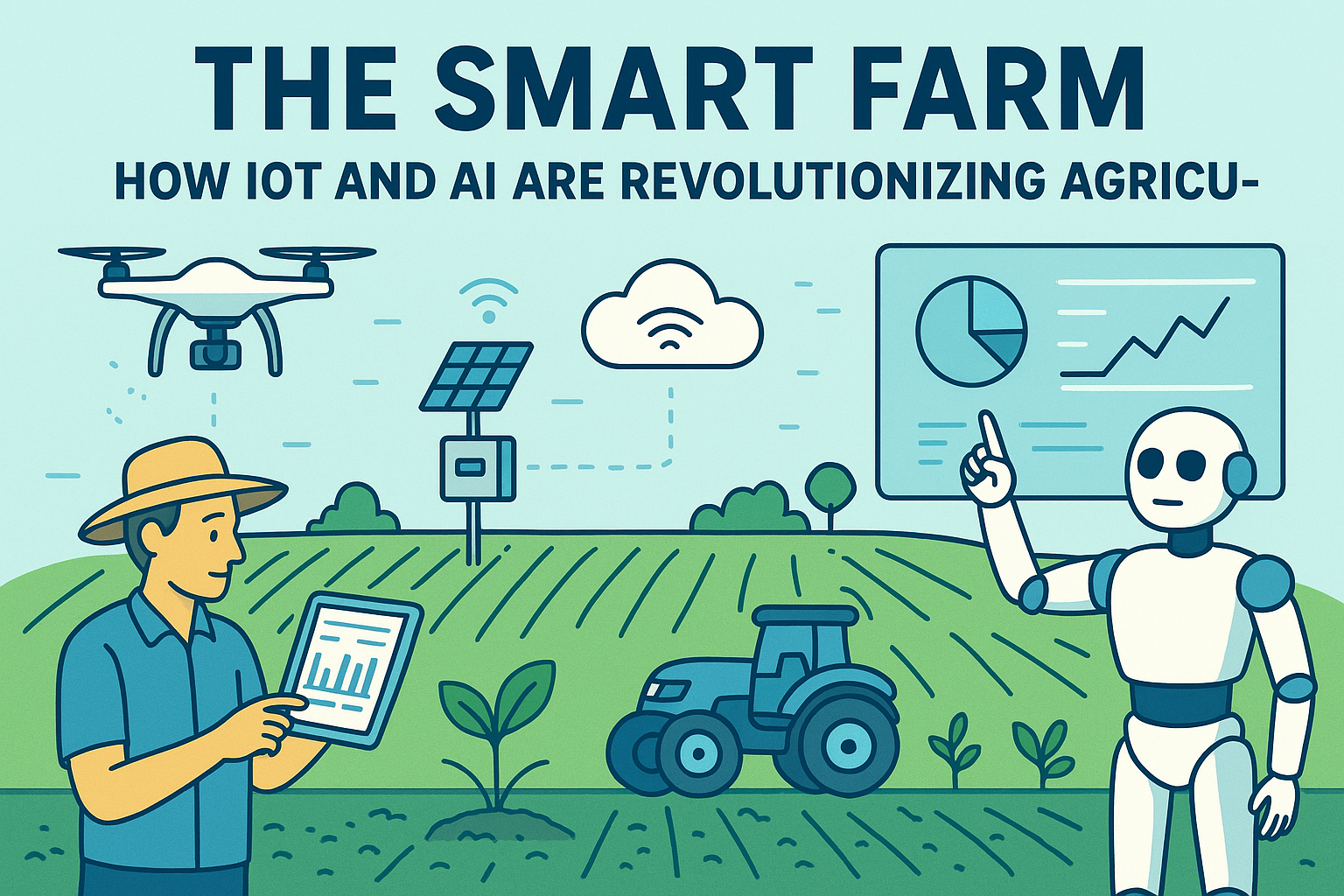
•Sensors: These are the eyes and ears of the smart farm, collecting real-time data on a multitude of parameters. This includes soil sensors (pH, moisture, nutrient levels), weather stations (temperature, humidity, rainfall, wind speed), and crop sensors (plant health, growth stage, disease detection).
•Connectivity: IoT devices rely on robust communication networks to transmit data to central processing units. This can involve Wi-Fi, cellular networks (4G/5G), LoRaWAN, or satellite communication, especially in remote agricultural areas.
•Data Platforms and Cloud Computing: The collected data is stored, processed, and analyzed on cloud-based platforms. These platforms provide the computational power and storage necessary to handle large datasets and run complex AI algorithms.
•Artificial Intelligence and Machine Learning: AI algorithms, particularly machine learning models, are at the heart of smart farming. They analyze historical and real-time data to identify patterns, predict outcomes (e.g., crop yield, disease outbreaks), and recommend optimal actions.
•Actuators and Robotics: Based on AI-driven insights, actuators and robotic systems can automate various farming tasks. This includes automated irrigation systems, precision sprayers, robotic harvesters, and autonomous vehicles for planting and monitoring.
This synergy between IoT and AI enables a shift from traditional, reactive farming practices to proactive, data-driven decision-making, leading to increased efficiency, reduced waste, and improved yields. The technology has advanced to a point where users can pose natural language queries to these programs and receive visual representations of the answers, such as maps depicting specific qualities [1].
Applications of IoT and AI in Smart Farming
The integration of IoT and AI has led to a wide array of applications that are transforming every stage of the agricultural process, from planting to harvesting and beyond. These applications empower farmers with unprecedented levels of control, efficiency, and insight.
1. Precision Agriculture and Crop Monitoring
Precision agriculture is perhaps the most significant application of IoT and AI in farming. By collecting granular data on soil conditions, weather patterns, and crop health, farmers can make highly localized and optimized decisions. IoT sensors deployed across fields provide real-time data on soil moisture, nutrient levels, and pH. This data, when analyzed by AI algorithms, allows for precise irrigation and fertilization, ensuring that crops receive exactly what they need, when they need it. This minimizes waste of water and fertilizers, leading to significant cost savings and reduced environmental impact.
AI is highly effective in analyzing aerial images captured by drones and satellites for subtle spectral changes that indicate the early onset of disease or pest infestation. Even a decade ago, AI analysis could detect sugar beet diseases with up to 90% accuracy [1]. Valeria Kogan, founder and CEO of Fermata, highlights the efficiency of AI in pest and disease detection: “AI is trained on high-quality datasets of thousands of examples of different pests and diseases for various plants. In our products, we use deep learning and neural networks to analyze the visual data and identify pests and diseases.” She contrasts this with traditional methods: “Normally, people called scouts walk through the greenhouse or fields and look at every single leaf of every single plant to identify the abnormalities. Of course, this is very hard work; scouts miss things and eventually, 30% of harvests are lost on average due to late reaction to pests and diseases.” With AI detection, affected areas can be rapidly identified and treated, reducing resource use and environmental contamination. Lisa Avvocato, vice president of global marketing for Sama, notes, “you only spray quadrant one. In the past, you were spraying pesticides across your entire field” [1].
2. Automated Irrigation and Water Management
Water scarcity is a growing concern globally, making efficient water management crucial for sustainable agriculture. IoT-enabled smart irrigation systems utilize soil moisture sensors and weather data to determine the optimal amount of water required for crops. AI algorithms then process this data to create precise irrigation schedules, activating sprinklers or drip irrigation systems only when and where necessary. This not only conserves water but also prevents over-watering, which can lead to nutrient leaching and root diseases.
3. Smart Pest and Weed Management
Pests and weeds pose a significant threat to crop yields, often leading to substantial economic losses for farmers. Traditional methods of pest and weed control often involve widespread application of pesticides and herbicides, which can be costly and environmentally damaging. IoT sensors and AI-powered imaging systems can detect and identify pests and weeds early, allowing for targeted interventions. Robotic technologies, including unmanned ground vehicles (UGVs) and unmanned aerial vehicles (UAVs) equipped with visual detection technology, can precisely identify and remove weeds or spray pesticides in targeted areas, minimizing the use of chemicals and protecting beneficial insects [1].
Detecting weeds, which compete with crops for essential nutrients and water, is particularly critical. Farmers in the U.S. spend approximately $26 billion annually on herbicides, sometimes accounting for nearly two-thirds of their annual expenses. AI technology enables precise targeting of weeds, avoiding harm to nearby plants and reducing the need for aerial broadcasting of herbicidal compounds. Avvocato emphasizes the challenge of distinguishing between crops and weeds in early stages due to their visual similarity, underscoring the need for high-quality images for accurate AI identification [1].
4. Livestock Monitoring and Management
IoT and AI are also revolutionizing livestock farming, enabling farmers to monitor the health, location, and behavior of their animals in real-time. Wearable sensors on animals can track vital signs, activity levels, and even detect early signs of illness, allowing farmers to intervene promptly. This leads to improved animal welfare, reduced mortality rates, and increased productivity. AI algorithms can analyze behavioral patterns to identify anomalies, such as changes in feeding habits or lameness, providing early warnings to farmers.
5. Automated Harvesting and Quality Control
The harvesting process, traditionally labor-intensive, is becoming increasingly automated with the help of AI and robotics. Robotic arms equipped with image recognition technology can identify ripe produce and harvest it with greater precision than manual labor or traditional machinery, reducing damage and waste. One study demonstrated a robotic arm successfully picking ripe tomatoes 89% of the time using image recognition [1]. After harvesting, AI-powered systems can sort produce by quality, size, and ripeness using image recognition techniques. For example, one research team successfully sorted hazelnuts by size and damage level with up to 96% accuracy [1]. This automation streamlines the post-harvest process, improves product quality, and reduces labor costs.
6. Predictive Analytics and Decision Support
Beyond real-time monitoring, AI’s true power lies in its ability to provide predictive analytics and decision support. By analyzing historical data, current conditions, and external factors like market prices and weather forecasts, AI models can predict future trends and recommend optimal strategies. This can include predicting crop yields, identifying the best time for planting or harvesting, optimizing resource allocation, and even forecasting market demand for agricultural products. This data-driven approach empowers farmers to make informed decisions that maximize profitability and minimize risks.
Benefits of Smart Farming
The adoption of IoT and AI in agriculture offers a multitude of benefits that extend beyond increased yields and efficiency. These advantages contribute to a more sustainable, resilient, and profitable agricultural sector.
1. Increased Efficiency and Productivity
By automating tasks, optimizing resource allocation, and providing real-time insights, smart farming significantly boosts operational efficiency. Farmers can achieve higher yields with fewer inputs, reducing labor costs, water consumption, and fertilizer use. Precision irrigation and fertilization, for instance, ensure that resources are applied only where and when needed, minimizing waste and maximizing their impact.
2. Enhanced Sustainability and Environmental Protection
Smart farming practices contribute significantly to environmental sustainability. Reduced use of water, fertilizers, and pesticides minimizes runoff and pollution, protecting soil health and water quality. By optimizing resource use, smart farms lower their carbon footprint and promote more eco-friendly agricultural practices. The ability to precisely target interventions for pests and diseases also reduces the overall chemical load on the environment.
3. Improved Crop Quality and Yields
Real-time monitoring of crop health, soil conditions, and environmental factors allows farmers to address issues proactively, preventing crop damage and optimizing growth conditions. This leads to healthier crops, improved quality, and ultimately, higher yields. AI-driven analytics can identify subtle changes in plant health that might be missed by the human eye, enabling early intervention and preventing widespread problems.
4. Reduced Costs and Increased Profitability
While the initial investment in smart farming technologies can be substantial, the long-term cost savings are significant. Reduced input costs (water, fertilizer, pesticides), lower labor expenses due to automation, and minimized crop losses contribute to increased profitability for farmers. The ability to make data-driven decisions also helps farmers optimize their operations for maximum economic return.
5. Better Decision-Making through Data Insights
The vast amounts of data collected by IoT sensors, combined with AI-powered analytics, provide farmers with unprecedented insights into their operations. This data-driven approach replaces traditional guesswork with precise, actionable information, enabling farmers to make more informed decisions regarding planting schedules, harvesting times, resource allocation, and risk management. The ability to predict potential issues before they escalate is a game-changer for modern agriculture.
6. Enhanced Food Security
As the global population continues to grow, ensuring adequate food supply is a critical challenge. Smart farming, by increasing productivity and efficiency, plays a vital role in enhancing food security. By maximizing yields and minimizing waste, these technologies help produce more food with existing resources, contributing to a more stable and reliable food supply for a growing world.
7. Increased Resilience to Climate Change
Climate change presents significant challenges to agriculture, with unpredictable weather patterns and increased frequency of extreme events. Smart farming technologies, particularly those that enable precise water management and early disease detection, enhance the resilience of agricultural systems to these challenges. By adapting quickly to changing conditions and mitigating risks, farmers can better withstand the impacts of climate change and ensure consistent production.
Challenges and Future Perspectives
Despite the immense potential of IoT and AI in revolutionizing agriculture, several challenges need to be addressed for their widespread adoption and full realization of benefits.
Challenges:
•High Infrastructure Costs: The initial investment in IoT sensors, AI platforms, and automated machinery can be substantial, posing a barrier for small and medium-sized farms. This is particularly true for large-scale arable crops and extensive grasslands, where the high cost of sensors, data storage, and AI-powered analytics platforms can be prohibitive [2].
•Limited Interoperability: Different manufacturers often use proprietary systems, leading to a lack of interoperability between various IoT devices and software platforms. This fragmentation makes it difficult for farmers to integrate diverse technologies into a unified system, hindering seamless data exchange and analysis. The agricultural sector generates massive volumes of data from diverse sources, including IoT sensors, satellite imagery, UAVs, and farm management software. However, integrating these datasets into a unified decision-makingmaking framework remains complex due to varying data formats, interoperability protocols, and AI-driven data fusion techniques [2].
•Connectivity Constraints in Rural Areas: Many agricultural regions lack robust internet infrastructure, making it challenging to deploy and maintain IoT devices that rely on consistent connectivity for data transmission. Wireless sensor networks (WSNs), IoT gateways, and cloud-based analytics platforms must be designed with limited connectivity, ensuring reliable data transmission and processing [2].
•Data Privacy and Security Concerns: The collection of vast amounts of sensitive agricultural data raises concerns about data privacy, ownership, and cybersecurity. Farmers need assurances that their data will be protected from unauthorized access and misuse. Policy interventions are needed to ensure fair data ownership, cybersecurity, and equitable access to smart farming tools, especially in developing regions [2].
•Lack of Technical Expertise: Implementing and managing smart farming technologies requires a certain level of technical expertise, which may not be readily available in farming communities. Training and education programs are crucial to bridge this knowledge gap.
•Ethical Considerations: The increased use of automated agricultural machinery and AI raises concerns about the displacement of traditional farming jobs, data ownership rights, and algorithmic transparency. Moreover, the energy consumption of IoT devices and electronic waste from sensor networks present additional sustainability challenges that must be managed [2].
Future Perspectives:
•Edge AI: To address connectivity issues and enable faster decision-making, there will be a growing emphasis on Edge AI, where AI processing occurs directly on the devices (at the
edge) rather than in the cloud. This reduces latency and reliance on constant internet connectivity [2].
•Blockchain for Data Governance: Blockchain technology could play a crucial role in ensuring data transparency, security, and ownership in smart farming ecosystems. Decentralized data governance models can empower farmers with greater control over their data [2].
•Autonomous Platforms: The development of fully autonomous farming platforms, including self-driving tractors and robotic harvesters, will continue to advance, further automating agricultural processes and reducing the need for manual labor.
•Integration with Remote Sensing: The synergy between IoT, AI, and remote sensing technologies (satellite imagery, drones) will become even more sophisticated, providing a holistic view of farm conditions and enabling more precise interventions.
•Sustainable and Regenerative Agriculture: Smart farming technologies will increasingly be used to support sustainable and regenerative agricultural practices, focusing on soil health, biodiversity, and resource conservation.
•Policy and Regulatory Frameworks: Governments and international organizations will need to develop comprehensive policies and regulatory frameworks to address the ethical, social, and economic implications of smart farming, ensuring equitable access and responsible deployment of these technologies.
Conclusion
The convergence of IoT and AI is ushering in a new era for agriculture, one characterized by unprecedented levels of precision, efficiency, and sustainability. From optimizing crop yields and conserving precious resources to enhancing food security and building resilience against climate change, smart farming technologies offer transformative solutions to the complex challenges facing the global food system. While hurdles such as high costs, interoperability issues, and connectivity limitations remain, ongoing advancements in areas like Edge AI, blockchain, and autonomous platforms, coupled with supportive policy frameworks, are paving the way for wider adoption.
The smart farm is not merely a futuristic concept; it is rapidly becoming a reality, empowering farmers with the tools and insights needed to feed a growing world while safeguarding our planet’s resources. By embracing these technological innovations, agriculture can continue its evolution, ensuring a more productive, sustainable, and secure future for generations to come.




Be First to Comment