
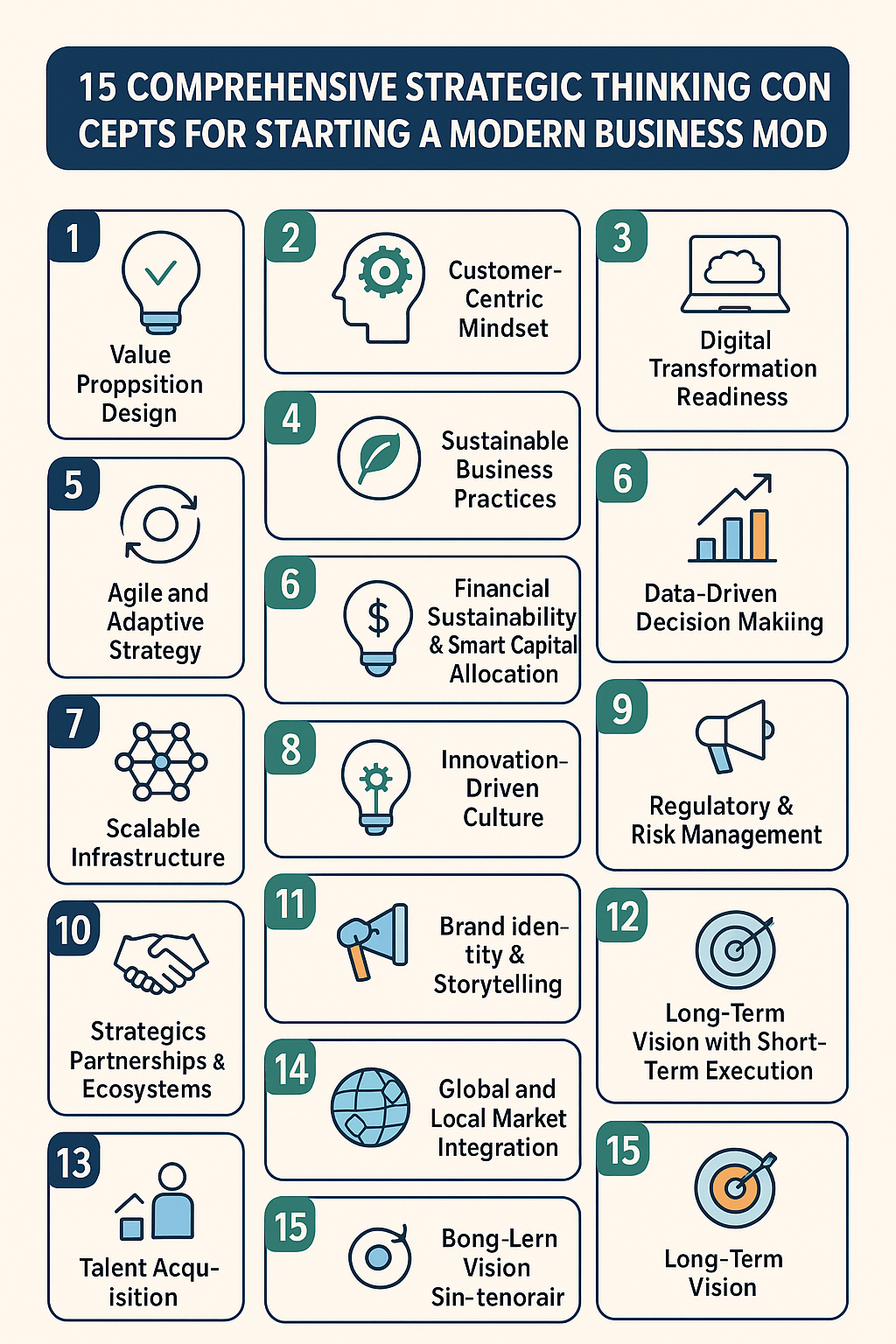
The landscape of business has fundamentally transformed in the digital age. Today’s entrepreneurs face unprecedented opportunities and challenges that require sophisticated strategic thinking to navigate successfully. Building a modern business model demands more than just a good product or service—it requires a deep understanding of interconnected systems, emerging technologies, and evolving consumer behaviors.
This comprehensive guide explores fifteen critical strategic thinking concepts that form the foundation of successful modern business ventures. These frameworks will help entrepreneurs develop robust strategies that can adapt, scale, and thrive in today’s dynamic marketplace.
1. Platform Economy Dynamics
Modern businesses increasingly operate within or as platforms that connect multiple stakeholders. Understanding platform dynamics is crucial for creating sustainable competitive advantages.
Core Principles:
- Network effects create exponential value as more users join
- Multi-sided markets require careful balance between different user groups
- Data becomes a strategic asset that improves with scale
- Winner-takes-most dynamics often emerge in platform markets
Strategic Applications: Consider how your business can facilitate connections between customers, suppliers, or service providers rather than simply selling products. Amazon transformed from an online bookstore to a platform connecting millions of sellers with buyers. Similarly, Uber doesn’t own cars but connects drivers with riders through technology.
Implementation Framework: Start by identifying underserved connections in your industry. Map out potential network participants and design incentives that encourage participation from all sides. Focus on reducing friction and transaction costs while capturing value through the facilitation service.
2. Value Ecosystem Orchestration
Modern businesses don’t operate in isolation but within complex ecosystems of partners, suppliers, customers, and competitors. Strategic thinking requires understanding and orchestrating these relationships.
Core Principles:
- Value creation happens across organizational boundaries
- Partnerships can provide capabilities faster than internal development
- Ecosystem health determines individual business success
- Control points within ecosystems provide strategic leverage
Strategic Applications: Apple’s success stems from orchestrating an ecosystem of app developers, accessory manufacturers, and content creators around its hardware platforms. The company maintains control over key elements while enabling thousands of partners to create value.
Implementation Framework: Map your current ecosystem and identify gaps where partnerships could accelerate growth. Develop clear value propositions for potential partners and create frameworks for collaboration that benefit all parties while protecting your strategic interests.
3. Digital-First Customer Experience Design
Customer expectations have been shaped by digital-native companies that prioritize user experience. Every business must think digitally about customer interactions, regardless of industry.
Core Principles:
- Customer journey spans multiple touchpoints and channels
- Personalization at scale requires data and automation
- Friction reduction drives conversion and retention
- Omnichannel consistency builds trust and loyalty
Strategic Applications: Traditional banks like JPMorgan Chase have invested billions in digital transformation to compete with fintech startups. They’ve reimagined everything from account opening to loan applications through a digital-first lens while maintaining physical branches where valuable.
Implementation Framework: Begin by mapping your complete customer journey from awareness to advocacy. Identify pain points and friction areas, then prioritize digital solutions that eliminate barriers. Invest in data collection and analysis capabilities to enable personalization and continuous improvement.
4. Agile Business Model Innovation
The pace of change requires businesses to continuously evolve their models. Strategic thinking must incorporate systematic approaches to testing and iterating business model components.
Core Principles:
- Hypothesis-driven experimentation reduces risk
- Minimum viable products enable rapid learning
- Pivot capabilities prevent sunk cost fallacies
- Continuous innovation maintains competitive advantage
Strategic Applications: Netflix has repeatedly reinvented its business model, from DVD-by-mail to streaming to content creation. Each transition was driven by data about changing customer behaviors and technological capabilities.
Implementation Framework: Establish processes for regular business model review and experimentation. Create small-scale tests for new revenue streams, customer segments, or value propositions. Develop metrics that distinguish between execution problems and fundamental model issues.
5. Data-Driven Decision Architecture
Modern businesses generate unprecedented amounts of data. Strategic advantage comes from building systems and cultures that turn data into actionable insights and automated decisions.
Core Principles:
- Data collection must align with strategic objectives
- Real-time insights enable rapid response to market changes
- Predictive analytics inform proactive strategies
- Data governance ensures quality and compliance
Strategic Applications: Amazon’s recommendation engine drives approximately 35% of its revenue by using customer data to predict and influence purchasing decisions. The company has built data collection and analysis into every aspect of its operations.
Implementation Framework: Start by identifying the key decisions that drive your business outcomes. Design data collection systems that provide relevant information for these decisions. Invest in analytical capabilities and train teams to use data effectively in their daily work.
6. Sustainable Competitive Moats
Traditional competitive advantages like location or exclusive supplier relationships have eroded. Modern moats require different strategic thinking about defensibility.
Core Principles:
- Network effects create self-reinforcing advantages
- Data moats strengthen with usage and time
- Switching costs can be technical, social, or economic
- Brand moats require consistent value delivery
Strategic Applications: Tesla’s competitive moat combines multiple elements: a supercharger network (network effect), over-the-air updates (switching costs), battery technology (innovation), and brand cachet (customer loyalty). No single element would be sufficient alone.
Implementation Framework: Analyze your current competitive position and identify which advantages are most defensible long-term. Invest in building multiple, overlapping moats rather than relying on a single competitive advantage. Regularly assess how technological or market changes might erode your position.
7. Stakeholder Capitalism Integration
Modern businesses must balance the interests of multiple stakeholders including employees, customers, communities, and shareholders. This broader perspective creates both challenges and opportunities.
Core Principles:
- Multiple stakeholder groups influence long-term success
- Social and environmental impact affect business sustainability
- Employee engagement drives customer experience
- Community relationships provide operational stability
Strategic Applications: Patagonia has built stakeholder capitalism into its core strategy, from environmental activism to supply chain transparency. This approach has created fierce customer loyalty and attracted top talent, directly contributing to business performance.
Implementation Framework: Identify all stakeholder groups that affect or are affected by your business. Develop specific value propositions for each group and metrics to track your performance. Integrate stakeholder considerations into major business decisions and communicate your approach transparently.
8. Technology Convergence Exploitation
Modern strategic thinking requires understanding how different technologies combine to create new possibilities. Success often comes from connecting previously separate technological capabilities.
Core Principles:
- Convergence creates opportunities at technology intersections
- Timing technology adoption affects competitive positioning
- Technical capabilities must align with market readiness
- Platform technologies enable multiple applications
Strategic Applications: Smartphone success resulted from convergence of multiple technologies: mobile processors, touchscreens, wireless networks, batteries, and software platforms. Companies that recognized this convergence early gained significant advantages.
Implementation Framework: Monitor emerging technologies in adjacent industries and consider how they might combine with your capabilities. Develop partnerships or investments in key technologies before they become mainstream. Create internal processes for evaluating and adopting new technologies systematically.
9. Global-Local Strategy Balance
Digital connectivity has created global opportunities while local differences remain important. Strategic thinking must balance global scale with local relevance.
Core Principles:
- Global platforms enable local customization
- Cultural differences affect product acceptance
- Regulatory environments vary significantly by region
- Local partnerships accelerate market entry
Strategic Applications: Netflix’s global expansion strategy maintains a consistent platform while creating region-specific content. The company invests heavily in local production while leveraging global technology and data capabilities.
Implementation Framework: Identify which elements of your business model can be standardized globally and which require local adaptation. Develop capabilities for rapid localization while maintaining operational efficiency. Consider partnerships or acquisitions to gain local market knowledge.
10. Circular Economy Principles
Linear “take-make-dispose” models are becoming unsustainable. Strategic thinking must incorporate circular approaches that minimize waste and maximize resource utilization.
Core Principles:
- Waste from one process becomes input for another
- Product design affects entire lifecycle costs
- Service models can replace ownership models
- Collaboration enables resource sharing
Strategic Applications: Interface Inc. redesigned its carpet manufacturing to be fully circular, using recycled materials and designing products for reuse. This approach reduced costs while creating competitive differentiation and meeting customer sustainability requirements.
Implementation Framework: Analyze your value chain to identify waste streams and resource inefficiencies. Design products and services for durability, repairability, and recyclability. Explore partnerships that enable resource sharing or waste utilization across companies.
11. Community-Centric Growth Models
Modern businesses increasingly succeed by building communities around shared interests or values rather than just selling products or services.
Core Principles:
- Communities create emotional connections beyond transactions
- User-generated content reduces marketing costs
- Community feedback improves product development
- Network effects strengthen community value
Strategic Applications: Peloton built a fitness community around its hardware products, creating subscription revenue and customer loyalty that extends far beyond the initial equipment purchase. The community aspect became a significant competitive moat.
Implementation Framework: Identify shared interests, values, or challenges among your customers that extend beyond your products. Create platforms and events that enable community formation. Provide tools and incentives for community members to create value for each other.
12. Subscription Economy Mastery
Recurring revenue models provide predictability and customer lifetime value optimization opportunities. Strategic thinking must address both customer acquisition and retention in subscription contexts.
Core Principles:
- Customer lifetime value drives acquisition investment levels
- Retention requires continuous value delivery
- Pricing strategy affects both adoption and retention
- Usage data enables proactive customer success
Strategic Applications: Microsoft’s transformation to cloud-based subscriptions fundamentally changed its business model from one-time license sales to ongoing service relationships. This shift required new capabilities in customer success and continuous product development.
Implementation Framework: Analyze whether your products or services could be delivered through subscription models. Develop capabilities in customer onboarding, usage monitoring, and proactive retention. Design pricing that captures value while encouraging adoption and long-term retention.
13. API-First Business Architecture
Application Programming Interfaces (APIs) enable businesses to connect with partners, developers, and other systems. Strategic thinking must consider how API strategies can accelerate growth and create new value streams.
Core Principles:
- APIs enable third-party innovation on your platform
- Data and functionality sharing creates ecosystem value
- Developer communities extend your capabilities
- API monetization creates new revenue streams
Strategic Applications: Stripe’s payment processing success comes largely from its developer-friendly APIs that make it easy for businesses to integrate payment functionality. The company focused on developer experience as a key competitive advantage.
Implementation Framework: Identify which of your capabilities could provide value to other businesses if made accessible through APIs. Invest in developer tools and documentation to encourage adoption. Consider both free and paid API tiers to balance ecosystem growth with revenue generation.
14. Resilience and Antifragility Design
Modern businesses face increasing volatility and uncertainty. Strategic thinking must build resilience to withstand shocks and antifragility to benefit from disorder.
Core Principles:
- Diversification reduces concentration risk
- Redundancy prevents single points of failure
- Adaptability enables response to unexpected changes
- Optionality provides upside in uncertain situations
Strategic Applications: Amazon’s diversification across retail, cloud computing, advertising, and logistics creates resilience against downturns in any single market. The company’s decentralized structure enables rapid response to opportunities and threats.
Implementation Framework: Identify your business’s key vulnerabilities and single points of failure. Develop contingency plans and backup systems for critical operations. Create options for future growth that don’t require large upfront investments but can be scaled quickly when opportunities arise.
15. Purpose-Driven Strategy Integration
Modern consumers and employees increasingly choose companies based on values and purpose beyond profit. Strategic thinking must integrate authentic purpose into business operations and decision-making.
Core Principles:
- Purpose guides strategic decision-making
- Authentic commitment requires operational alignment
- Stakeholder trust depends on consistent action
- Purpose differentiation creates competitive advantage
Strategic Applications: Ben & Jerry’s has maintained its social mission while growing into a global brand, using purpose to guide decisions about suppliers, ingredients, and social activism. This authentic commitment has created strong brand loyalty and attracted value-aligned employees.
Implementation Framework: Define your company’s core purpose beyond profit maximization. Evaluate how this purpose can guide strategic decisions and operational practices. Communicate your purpose authentically and demonstrate commitment through consistent actions rather than just marketing messages.
Conclusion: Integrating Strategic Concepts
These fifteen strategic thinking concepts are interconnected and mutually reinforcing. Modern business success requires integration across multiple frameworks rather than focusing on any single approach. The key is developing organizational capabilities that can execute on several concepts simultaneously while maintaining focus on customer value creation.
As you develop your business strategy, consider how these concepts apply to your specific situation and industry. Start with those most relevant to your current challenges, then gradually incorporate additional frameworks as your business grows and evolves. Remember that strategic thinking is an ongoing process that requires continuous learning and adaptation as markets and technologies change.
The businesses that thrive in the coming decade will be those that master the integration of these strategic concepts while maintaining the agility to evolve as new challenges and opportunities emerge. The foundation you build today using these frameworks will determine your capacity to adapt and grow in an increasingly complex and connected world.






Be First to Comment