
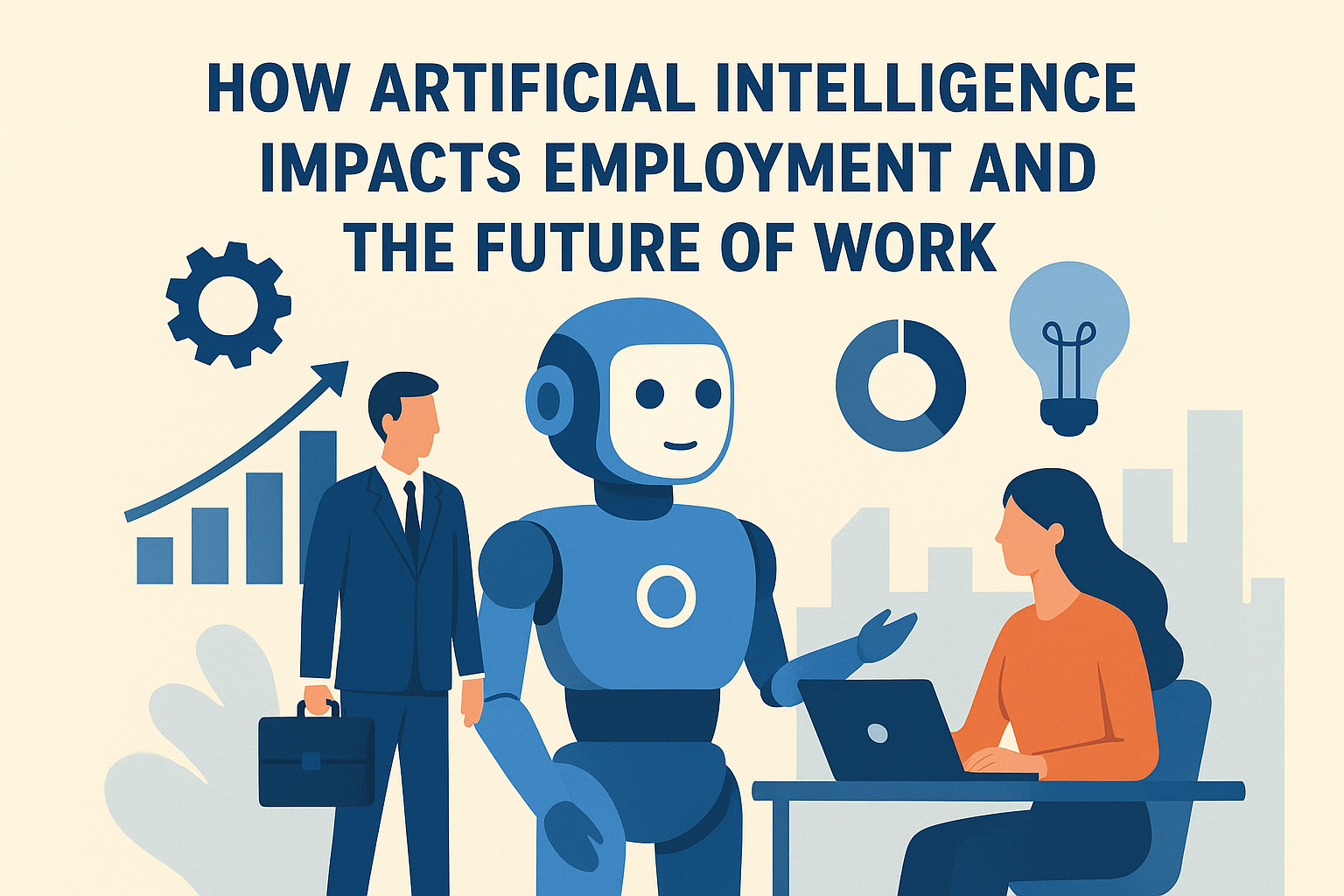
Artificial Intelligence (AI) is reshaping industries, economies, and societies, with profound implications for employment and the future of work. As AI technologies advance, they are transforming how work is performed, creating both opportunities and challenges. This article explores the multifaceted impact of AI on jobs, workforce dynamics, and the evolving nature of work.
The Dual Nature of AI’s Impact on Employment
AI’s influence on employment is a double-edged sword: it eliminates some jobs through automation while creating new roles and enhancing productivity in others. The net effect depends on how industries, governments, and workers adapt.
Job Displacement Through Automation
AI-driven automation is replacing repetitive, predictable tasks across sectors. Manufacturing, logistics, and administrative roles are particularly vulnerable. For example, robotic process automation (RPA) handles data entry, while AI-powered chatbots manage customer service inquiries. A 2023 McKinsey report estimated that up to 30% of current jobs could be automated by 2030, with low-skill, repetitive roles at the highest risk.
However, displacement is not universal. Jobs requiring creativity, emotional intelligence, or complex problem-solving—such as teaching, healthcare, or strategic management—are less susceptible to automation. The challenge lies in supporting workers in transitioning away from automatable roles.
Job Creation and Transformation
AI is also a catalyst for job creation. It has spurred demand for roles like data scientists, AI ethicists, and machine learning engineers. Beyond technical positions, AI enhances existing jobs by augmenting human capabilities. For instance, doctors use AI diagnostic tools to improve accuracy, and marketers leverage AI analytics for targeted campaigns. These transformations often require workers to upskill, blending domain expertise with AI literacy.
Moreover, AI drives innovation in industries like renewable energy, autonomous vehicles, and personalized education, creating entirely new job categories. The World Economic Forum’s 2023 Future of Jobs Report predicted that AI and related technologies could create 97 million new jobs by 2025, offsetting losses in other areas.
The Skills Shift: Preparing for an AI-Driven Workforce
The rise of AI demands a workforce with new skills. Technical proficiency in coding, data analysis, and AI model development is increasingly valuable. However, “soft skills” like adaptability, critical thinking, and collaboration are equally critical, as AI cannot replicate human judgment or interpersonal dynamics.
Upskilling and Reskilling
To remain competitive, workers must engage in lifelong learning. Governments and companies are investing in reskilling programs to bridge the gap. For example, initiatives like Amazon’s Upskilling 2025 program aim to train employees in AI-related fields. Online platforms like Coursera and edX offer accessible courses in AI, data science, and digital literacy, enabling workers to adapt.
Education System Overhaul
Traditional education systems must evolve to prepare students for an AI-driven economy. Curricula should emphasize STEM (science, technology, engineering, math), but also interdisciplinary skills like ethics and communication. Some countries, like Finland, have integrated AI literacy into school programs, teaching students to understand and interact with AI systems.
Economic and Social Implications
AI’s impact extends beyond individual jobs to broader economic and social structures.
Widening Inequality
Without intervention, AI could exacerbate income inequality. High-skill workers in AI-driven fields may command premium salaries, while low-skill workers face job losses. Regions with less access to AI education or infrastructure risk falling behind. Policymakers must address this through inclusive education, universal basic income experiments, or progressive taxation to redistribute AI’s economic gains.
Redefining Work-Life Balance
AI is enabling flexible work models, such as remote work and gig platforms powered by algorithms. Tools like AI-driven scheduling optimize productivity, but they also raise concerns about surveillance and worker autonomy. For instance, gig workers on platforms like Uber are subject to AI-driven performance metrics, which can create pressure and reduce control.
Ethical Considerations
AI’s integration into workplaces raises ethical questions. Bias in hiring algorithms, for example, can perpetuate discrimination if not carefully designed. Transparency, fairness, and accountability in AI systems are essential to ensure equitable outcomes. Organizations like the Partnership on AI advocate for responsible AI development to address these concerns.
The Future of Work: A Human-AI Collaboration
The future of work is not about humans versus machines but about collaboration. AI can handle data-intensive tasks, freeing humans to focus on creativity, strategy, and empathy-driven roles. Hybrid work models, where AI augments human decision-making, are already emerging in fields like finance, healthcare, and education.
Policy Recommendations
To navigate AI’s impact, stakeholders must act proactively:
- Governments: Invest in education, reskilling programs, and safety nets for displaced workers.
- Businesses: Adopt ethical AI practices and prioritize employee upskilling.
- Individuals: Embrace lifelong learning and adaptability to stay relevant.
A New Work Paradigm
AI is redefining the meaning of work itself. As routine tasks are automated, work may increasingly center on innovation, relationships, and societal impact. This shift could lead to shorter workweeks, greater emphasis on purpose-driven careers, and a reimagining of productivity metrics.
Conclusion
AI’s impact on employment is transformative, with the potential to both disrupt and enrich the world of work. By addressing challenges like job displacement and inequality while embracing opportunities for innovation and collaboration, society can harness AI to create a future where work is more meaningful and inclusive. The key lies in proactive adaptation—through education, policy, and ethical AI development—to ensure that the benefits of AI are shared broadly.





Be First to Comment