
Introduction
Radio waves represent one of humanity’s most transformative discoveries, fundamentally reshaping communication, entertainment, science, and our understanding of the universe itself. These invisible electromagnetic waves, which now carry everything from music and news to satellite data and astronomical observations, emerged from a century of theoretical speculation and experimental triumph. The story of radio waves intertwines physics, invention, and language, revealing how scientific breakthroughs acquire their names and meanings through a complex interplay of technical precision and cultural adoption.
The Theoretical Foundations: Maxwell’s Equations
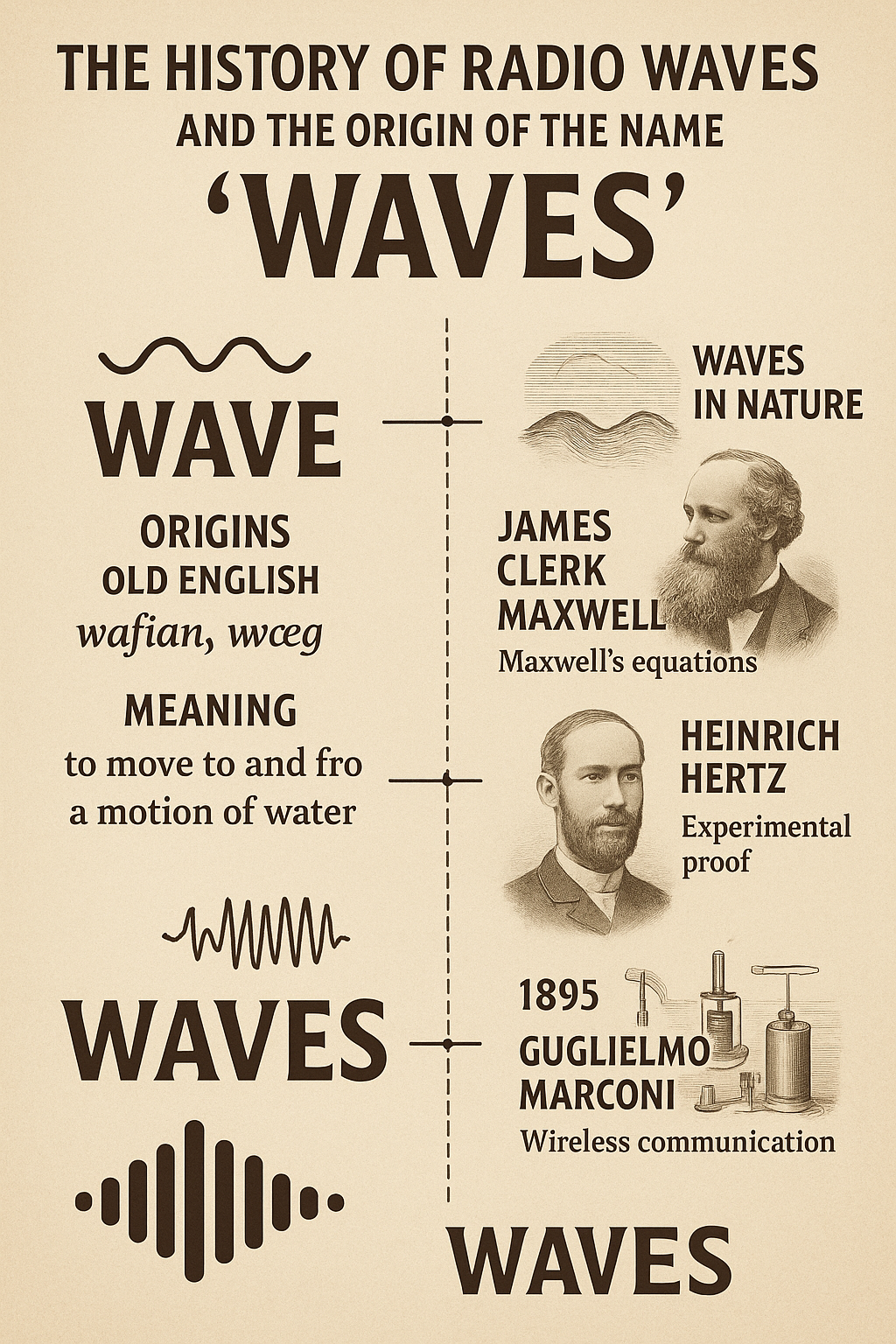
The intellectual journey toward radio waves began not in a laboratory but in the realm of pure mathematics. In the 1860s, Scottish physicist James Clerk Maxwell unified the separate phenomena of electricity and magnetism into a single comprehensive theory. Working at King’s College London, Maxwell developed a set of equations that described how electric and magnetic fields interact and propagate through space.
Maxwell’s equations predicted something extraordinary: oscillating electric charges should produce self-sustaining waves of electromagnetic energy that travel through space at a specific speed. When Maxwell calculated this speed, he found it matched the known speed of light with remarkable precision. This led him to propose in 1864 that light itself was an electromagnetic wave, a revolutionary insight that unified optics with electromagnetism.
More importantly for our story, Maxwell’s theory predicted that electromagnetic waves could exist at any frequency, not just those corresponding to visible light. This meant the electromagnetic spectrum should extend far beyond what human eyes could detect, encompassing wavelengths much longer than light. These theoretical long-wavelength electromagnetic waves awaited experimental confirmation for more than two decades.
Hertz’s Experimental Triumph
The experimental validation of Maxwell’s predictions came through the work of German physicist Heinrich Hertz between 1886 and 1888. Working at the Karlsruhe Polytechnic, Hertz designed an ingenious apparatus consisting of a spark-gap transmitter and a simple loop receiver. When high voltage created sparks across the transmitter gap, the receiver loop produced smaller sparks, demonstrating that invisible waves had traveled through the air between them.
Hertz systematically studied these waves, measuring their velocity, wavelength, and frequency. He demonstrated that they traveled at the speed of light and exhibited reflection, refraction, and polarization—all properties of waves predicted by Maxwell’s equations. Through these experiments, Hertz proved beyond doubt that electromagnetic waves existed and could be artificially generated and detected.
Interestingly, Hertz himself saw little practical value in his discovery. When asked about potential applications, he reportedly replied that his work had none, stating it was merely an experiment proving that Maxwell was correct. This remarkable understatement would soon be contradicted by inventors and engineers who recognized the revolutionary potential of these waves for communication.
The Birth of Wireless Communication
While Hertz focused on confirming electromagnetic theory, others quickly recognized the practical possibilities of his waves. In the 1890s, multiple inventors across Europe worked to develop systems for wireless communication. The Italian inventor Guglielmo Marconi proved particularly successful, combining existing technologies into increasingly effective wireless telegraph systems.
Marconi’s crucial innovation was recognizing that grounding one end of both the transmitter and receiver dramatically increased transmission range. By 1896, he was demonstrating wireless transmission over several kilometers. Moving to England, where he found greater support than in Italy, Marconi rapidly improved his systems. In 1899, he achieved wireless communication across the English Channel, and in 1901, he successfully transmitted signals across the Atlantic Ocean from Cornwall, England to Newfoundland, Canada—a distance of approximately 3,500 kilometers.
These achievements electrified the public imagination and demonstrated that Hertz’s waves could revolutionize long-distance communication. The wireless telegraph eliminated the need for expensive submarine cables and allowed ships at sea to communicate with shore stations, dramatically improving maritime safety. The new technology needed a name, and various terms competed for adoption.
The Etymology of “Radio”
The term “radio” has a fascinating linguistic history rooted in Latin. The word derives from the Latin “radius,” meaning ray, spoke of a wheel, or beam of light. This Latin root gave rise to several related concepts: radiation (something that radiates outward from a source), radial (extending from a center), and eventually, radio.
Initially, the technology Hertz discovered was called “Hertzian waves” in scientific circles, honoring their discoverer. However, this technical term proved cumbersome for popular use. Various alternatives emerged in different countries and contexts. In Britain, “wireless telegraphy” and simply “wireless” became common terms. In the United States and other regions, different terminology evolved.
The specific term “radio” gained prominence through several converging factors. The French term “radioconducteur” (radio-conductor) was coined for early detectors of electromagnetic waves. The prefix “radio-” naturally connected to the concept of radiation—the outward spreading of energy from a source. As the technology evolved from telegraphy to voice transmission, the term “radiotelephone” emerged, which was eventually shortened to simply “radio.”
By the 1920s, as broadcasting to the general public became widespread, “radio” had become the dominant term in American English for both the technology and the receiver devices. British English retained “wireless” for a longer period, though “radio” eventually became standard there as well. The International Telecommunication Union officially adopted terminology using “radio” in technical contexts.
The Meaning of “Waves”
The term “waves” in “radio waves” deserves its own examination. In physics, a wave describes a disturbance or oscillation that travels through space and matter, transferring energy without transferring mass. The concept unifies diverse phenomena: water waves on the ocean surface, sound waves in air, seismic waves through the Earth, and electromagnetic waves through space.
The wave metaphor emerged from observable phenomena like water ripples, which provided an intuitive model for understanding how energy and information could propagate through a medium. When physicists debated whether light consisted of particles or waves in the 17th through 19th centuries, the wave theory eventually triumphed (though 20th-century quantum mechanics would reveal a more complex wave-particle duality).
Radio waves are electromagnetic waves characterized by their position on the electromagnetic spectrum. They occupy the portion with the longest wavelengths and lowest frequencies, ranging from wavelengths of about one millimeter to over 100 kilometers. The wave nature manifests in their behavior: they oscillate with specific frequencies, exhibit interference patterns when multiple waves combine, and can be reflected, refracted, and diffracted around obstacles.
The mathematical description of radio waves involves sinusoidal functions—waves that oscillate smoothly between maximum and minimum values. These oscillations occur in perpendicular electric and magnetic fields that sustain each other as they propagate through space at light speed. The frequency of oscillation determines the wave’s characteristics and applications: lower frequencies travel farther and penetrate obstacles better, while higher frequencies can carry more information.
Classification and Spectrum
As understanding of electromagnetic waves developed, scientists and engineers divided the radio spectrum into bands based on wavelength and frequency. This classification system, standardized internationally, includes:
Very Low Frequency (VLF): 3-30 kHz, used for submarine communication and navigation systems due to their ability to penetrate seawater.
Low Frequency (LF): 30-300 kHz, used for navigation beacons and time signals, offering good ground-wave propagation.
Medium Frequency (MF): 300-3000 kHz, includes the AM radio broadcast band, with waves that reflect off the ionosphere at night for long-distance reception.
High Frequency (HF): 3-30 MHz, used for shortwave broadcasting and amateur radio, capable of worldwide propagation via ionospheric reflection.
Very High Frequency (VHF): 30-300 MHz, used for FM radio, television broadcasting, and aircraft communication, with line-of-sight propagation characteristics.
Ultra High Frequency (UHF): 300-3000 MHz, used for television, mobile phones, GPS, and WiFi, allowing more information capacity but requiring more transmission power.
Super High Frequency (SHF) and Extremely High Frequency (EHF): Above 3 GHz, used for satellite communications, radar, and modern high-speed wireless data transmission.
This classification reflects both the physical properties of waves at different frequencies and their practical applications. The term “radio waves” technically encompasses this entire range, though in everyday usage it often refers specifically to frequencies used for broadcasting.
The Evolution of Understanding
The comprehension of radio waves deepened throughout the 20th century. Scientists discovered the ionosphere—layers of ionized particles in Earth’s upper atmosphere that reflect certain radio frequencies, enabling long-distance communication. This discovery explained why radio signals could travel beyond the horizon and across oceans, solving a mystery that initially puzzled early wireless operators.
Researchers learned that radio waves interact with matter in complex ways depending on frequency, wavelength, and the material’s properties. Some materials absorb radio waves, converting their energy to heat (the principle behind microwave ovens). Other materials reflect or transmit them, leading to applications in radar, medical imaging, and materials science.
The quantum mechanical understanding of electromagnetic radiation revealed that radio waves, like all electromagnetic waves, can exhibit both wave and particle (photon) properties. However, at radio frequencies, the photon energy is so low that wave properties dominate in practical applications, and classical wave theory provides excellent predictions of behavior.
Applications and Cultural Impact
Radio waves transformed human civilization in ways their early discoverers could scarcely imagine. Broadcasting created mass media, bringing news, entertainment, and culture into homes worldwide. The “Golden Age of Radio” in the 1930s and 1940s saw families gathering around receivers for dramas, comedies, and news programs, creating shared cultural experiences across vast distances.
Beyond entertainment, radio waves enabled technologies that shaped modern life: radar systems that detect aircraft and weather patterns; satellite communications that provide global telephone and television services; GPS navigation that pinpoints locations worldwide; WiFi and cellular networks that provide ubiquitous wireless internet access; radio astronomy that reveals the structure and history of the universe; and medical technologies like MRI that peer inside the human body.
Each application exploits specific properties of radio waves at particular frequencies. The versatility of the electromagnetic spectrum continues to drive innovation, with new applications emerging as technology advances and our understanding deepens.
Radio Astronomy: Listening to the Universe
One of the most profound applications of radio waves emerged in the 1930s when Karl Jansky, working for Bell Telephone Laboratories, detected radio emissions from the center of the Milky Way galaxy. This accidental discovery founded the field of radio astronomy, which revealed an invisible universe of radio-emitting celestial objects.
Radio telescopes have since detected emissions from distant galaxies, quasars, pulsars, and the cosmic microwave background radiation—the faint afterglow of the Big Bang itself. These observations are possible because many cosmic phenomena produce radio waves that travel unimpeded across intergalactic space. Unlike visible light, radio waves penetrate cosmic dust clouds, allowing astronomers to observe regions hidden from optical telescopes.
The discovery that the universe broadcasts across the radio spectrum added another layer of meaning to the term “radio waves”—they are not merely human technological creations but fundamental components of cosmic physics, generated by processes ranging from stellar magnetic fields to the violent deaths of massive stars.
Modern Perspectives and Quantum Theory
Contemporary physics views radio waves as quantized electromagnetic radiation, consisting of photons at specific frequencies. While individual radio-frequency photons carry minuscule energy compared to visible light or X-ray photons, radio transmitters generate them in enormous quantities, producing macroscopic effects easily detected and measured.
The quantum perspective helps explain phenomena at the frontier of radio technology. Superconducting circuits operating at radio frequencies exhibit quantum behaviors, forming the basis of quantum computing approaches. Radio-frequency engineering increasingly confronts quantum limits, where classical wave theory becomes inadequate and quantum mechanical descriptions become necessary.
This quantum understanding represents a return, in some sense, to particle theories of radiation, but with profound differences from early corpuscular theories. The modern synthesis recognizes wave-particle duality as fundamental, with neither description alone capturing the complete nature of electromagnetic radiation.
The Continuing Evolution of Terminology
Language surrounding radio waves continues evolving with technology. Terms like “RF” (radio frequency), “wireless,” “WiFi,” “cellular,” and “electromagnetic spectrum” coexist and sometimes compete in popular usage. Each term emphasizes different aspects: “wireless” stresses the absence of physical connections, “RF” emphasizes the frequency range, while “radio” retains its connection to both broadcasting and the broader phenomenon of electromagnetic radiation.
In scientific contexts, precise terminology matters. “Radio waves” specifically denotes electromagnetic radiation within a defined frequency range, distinct from microwaves, infrared, visible light, and other portions of the spectrum. Yet in casual conversation, boundaries blur—microwave ovens operate at radio frequencies, and “radio” telescopes detect what physicists might technically classify as microwaves.
This linguistic flexibility reflects the practical nature of the terms. They evolved not from rigid scientific definitions but from the needs of engineers, inventors, regulators, and the public to communicate about new technologies. The history of the term “radio waves” thus mirrors the history of the technology itself: emerging from theoretical physics, developed through experimental discovery, commercialized by inventors and entrepreneurs, and ultimately integrated into everyday language and life.
Conclusion
The history of radio waves encompasses one of science’s greatest intellectual achievements: the prediction, discovery, and application of invisible electromagnetic radiation. From Maxwell’s theoretical insights through Hertz’s experimental confirmation to Marconi’s practical demonstrations and beyond, radio waves emerged from pure physics to reshape human civilization.
The name itself—”radio waves”—carries this history within its syllables. “Radio,” from Latin roots meaning ray or beam, captures the essence of radiation spreading from a source. “Waves” describes the oscillating nature of electromagnetic disturbances propagating through space. Together, the term encapsulates both the physical nature of the phenomenon and its historical development from scientific curiosity to ubiquitous technology.
Today, radio waves surround us constantly, carrying voices, data, and entertainment through the air. They connect us to each other and to the cosmos, enabling communications across continents and revealing the structure of the universe itself. The invisible electromagnetic radiation that Maxwell predicted and Hertz discovered has become so thoroughly integrated into modern life that we scarcely notice its presence—yet civilization as we know it would be impossible without it.
Understanding the history and meaning of radio waves enriches our appreciation of both the physics underlying our technological world and the complex process by which scientific discoveries acquire their names and meanings. The story of radio waves reminds us that today’s fundamental technologies were once theoretical possibilities, then experimental curiosities, and finally transformative innovations that redefined human capabilities and connections across time and space.






Be First to Comment