
Introduction
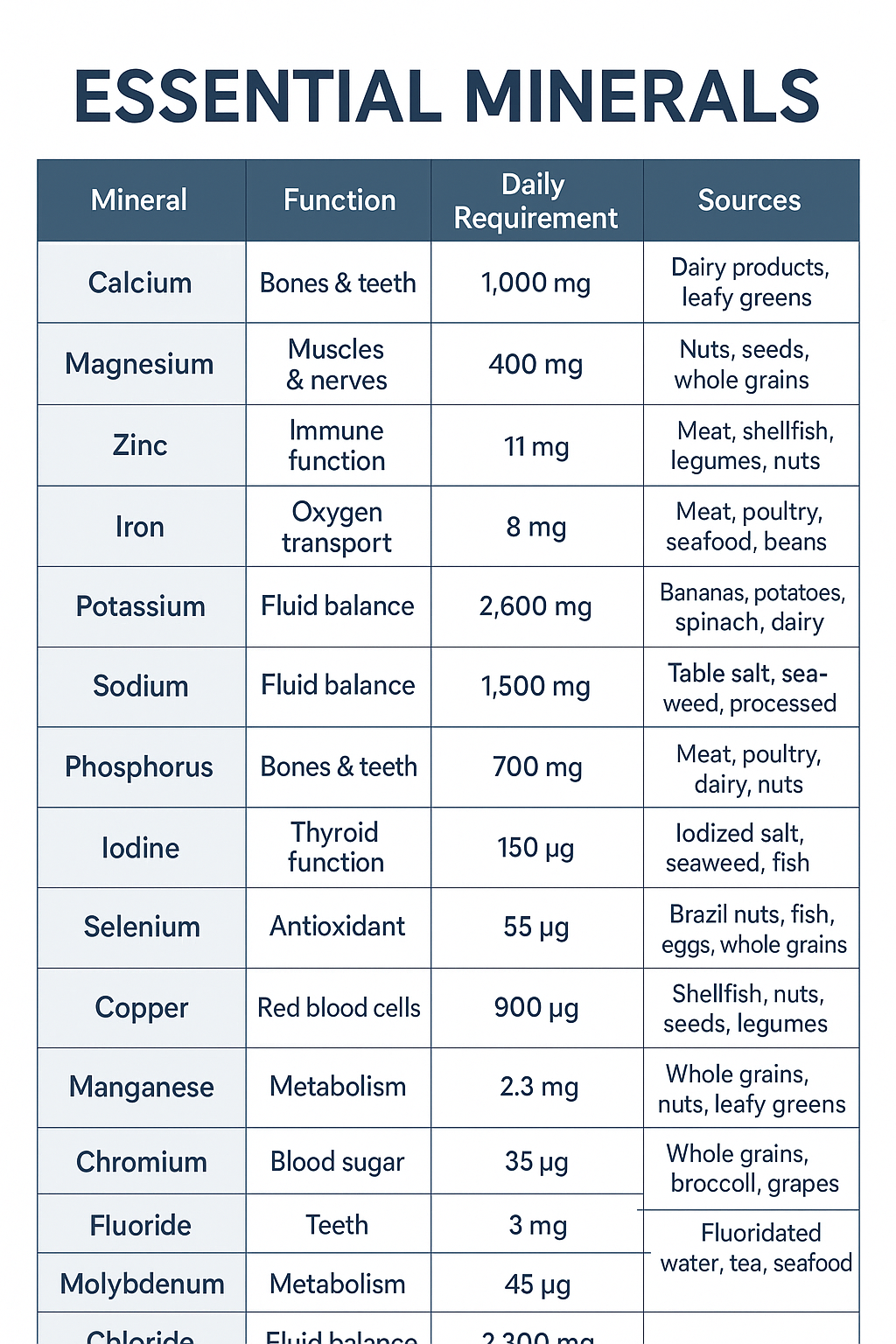
Minerals are natural elements found in the earth and are essential for the human body’s proper growth, development, and physiological functions. They act as building blocks for bones, teeth, muscles, and blood, and they regulate nerve function, metabolism, and hydration. Since the body cannot produce minerals, they must be obtained through food. The required amount varies by age, sex, and health status.
1. Calcium (Ca)
Importance:
Calcium is the most abundant mineral in the human body. It is vital for strong bones and teeth, muscle contractions, nerve signaling, and blood clotting.
Recommended Daily Intake:
- Children (1–8 years): 700–1,000 mg
- Teens (9–18 years): 1,300 mg
- Adults (19–50 years): 1,000 mg
- Older Adults (51+): 1,200 mg
Best Food Sources:
- Dairy products: milk, yogurt, cheese
- Leafy greens: kale, spinach, broccoli
- Fish with bones: sardines, salmon
- Fortified foods: cereals, plant-based milks
2. Magnesium (Mg)
Importance:
Magnesium supports muscle and nerve function, helps regulate blood pressure, maintains a steady heartbeat, and contributes to bone strength and energy production.
Recommended Daily Intake:
- Men (19–30 years): 400 mg
- Men (31+ years): 420 mg
- Women (19–30 years): 310 mg
- Women (31+ years): 320 mg
Best Food Sources:
- Nuts and seeds: almonds, cashews, pumpkin seeds
- Whole grains: brown rice, oats
- Legumes: black beans, lentils
- Leafy greens: spinach, Swiss chard
3. Zinc (Zn)
Importance:
Zinc is essential for immune function, wound healing, cell growth, and reproductive health. It also supports taste and smell senses.
Recommended Daily Intake:
- Men: 11 mg
- Women: 8 mg
Best Food Sources:
- Meat: beef, lamb, pork
- Seafood: oysters, crab, shrimp
- Legumes: chickpeas, lentils
- Nuts and seeds: pumpkin seeds, cashews
4. Iron (Fe)
Importance:
Iron is crucial for producing hemoglobin, the protein in red blood cells that carries oxygen throughout the body.
Recommended Daily Intake:
- Men (19+): 8 mg
- Women (19–50): 18 mg
- Women (51+): 8 mg
Best Food Sources:
- Red meat and liver
- Poultry and fish
- Beans, lentils, tofu
- Spinach and fortified cereals
5. Potassium (K)
Importance:
Potassium helps maintain normal fluid balance, supports nerve signals, and regulates muscle contractions and heart rhythm.
Recommended Daily Intake:
- Adults: 2,600–3,400 mg
Best Food Sources:
- Fruits: bananas, oranges, avocados
- Vegetables: potatoes, spinach, tomatoes
- Beans and lentils
- Dairy: milk, yogurt
6. Sodium (Na)
Importance:
Sodium helps control blood pressure, maintain fluid balance, and is essential for muscle and nerve function. However, excessive intake can cause hypertension.
Recommended Daily Intake:
- Adults: 1,500–2,300 mg (maximum)
Best Food Sources:
- Table salt (in moderation)
- Seaweed, pickles, olives
- Processed foods (limit intake)
7. Phosphorus (P)
Importance:
Phosphorus works with calcium to form strong bones and teeth. It also helps produce energy and maintain cell membranes.
Recommended Daily Intake:
- Adults: 700 mg
Best Food Sources:
- Meat, poultry, fish
- Dairy products
- Nuts and seeds
- Whole grains
8. Iodine (I)
Importance:
Iodine is needed for thyroid hormone production, which regulates metabolism, growth, and development.
Recommended Daily Intake:
- Adults: 150 µg (micrograms)
Best Food Sources:
- Iodized salt
- Seaweed
- Fish and shellfish
- Dairy and eggs
9. Selenium (Se)
Importance:
Selenium acts as an antioxidant, protecting cells from damage, and plays a role in immune system function and thyroid health.
Recommended Daily Intake:
- Adults: 55 µg
Best Food Sources:
- Brazil nuts (very rich)
- Tuna, sardines
- Eggs and brown rice
- Whole grains
10. Copper (Cu)
Importance:
Copper helps in the formation of red blood cells, maintains healthy bones, nerves, and immune function, and works with iron to prevent anemia.
Recommended Daily Intake:
- Adults: 900 µg
Best Food Sources:
- Shellfish
- Nuts and seeds
- Whole grains
- Dark chocolate
11. Manganese (Mn)
Importance:
Manganese supports bone formation, blood clotting, and enzyme function involved in metabolism.
Recommended Daily Intake:
- Men: 2.3 mg
- Women: 1.8 mg
Best Food Sources:
- Whole grains, nuts
- Leafy greens
- Pineapple, tea
12. Chromium (Cr)
Importance:
Chromium helps the body regulate blood sugar by enhancing insulin activity.
Recommended Daily Intake:
- Men: 35 µg
- Women: 25 µg
Best Food Sources:
- Whole grains
- Broccoli
- Grapes, orange juice
- Meat and poultry
13. Fluoride (F)
Importance:
Fluoride strengthens tooth enamel and helps prevent cavities.
Recommended Daily Intake:
- Adults: 3–4 mg
Best Sources:
- Fluoridated water
- Tea
- Seafood
14. Molybdenum (Mo)
Importance:
Molybdenum helps enzymes break down amino acids and toxins.
Recommended Daily Intake:
- Adults: 45 µg
Best Food Sources:
- Legumes (lentils, beans)
- Whole grains
- Nuts
15. Chloride (Cl)
Importance:
Chloride works with sodium and potassium to maintain proper fluid balance and stomach acid (HCl) production.
Recommended Daily Intake:
- Adults: 2,300 mg
Best Food Sources:
- Table salt
- Seaweed
- Tomatoes, celery
Special Note on Children and Older Adults
- Children require smaller doses based on body weight but need balanced mineral intake for growth.
- Older adults often absorb minerals less efficiently; hence, nutrient-rich diets or supplements may be needed.
Conclusion
Minerals are the unsung heroes of human health, working silently to maintain every cellular and metabolic process in the body. A balanced diet rich in fruits, vegetables, lean meats, legumes, nuts, and dairy can supply most of these essential nutrients naturally. Moderation and variety remain key — excessive intake can be as harmful as deficiency. A nutrient-conscious lifestyle ensures stronger bones, better immunity, and longer, healthier life.





Be First to Comment