
Anatomy, History, Tutorial, Significance, and Future of Rare Earth Elements in Modern Civilization
Table of Contents
- Introduction to Rare Earth Minerals
- Definition and Scientific Classification
- Discovery and Historical Development
- Geological Formation of Rare Earth Elements
- Atomic Anatomy and Chemical Structure
- The 17 Rare Earth Elements Overview
- Light Rare Earth Elements (LREEs)
- Heavy Rare Earth Elements (HREEs)
- Mining and Extraction Processes
- Refining and Separation Technologies
- Global Rare Earth Deposits
- China and Rare Earth Dominance
- Rare Earths in Electronics
- Rare Earths in Renewable Energy
- Rare Earths in Electric Vehicles
- Rare Earths in Artificial Intelligence Infrastructure
- Rare Earths in Aerospace and Defense
- Rare Earths in Medical Technology
- Rare Earths in Telecommunications and Data Centers
- Economic and Geopolitical Importance
- Environmental Challenges and Toxicity
- Recycling and Sustainable Solutions
- Future Technologies Powered by Rare Earths
- Africa and South Africa’s Rare Earth Potential
- Strategic Risks and Global Competition
- Conclusion and Future Outlook
1. Introduction to Rare Earth Minerals
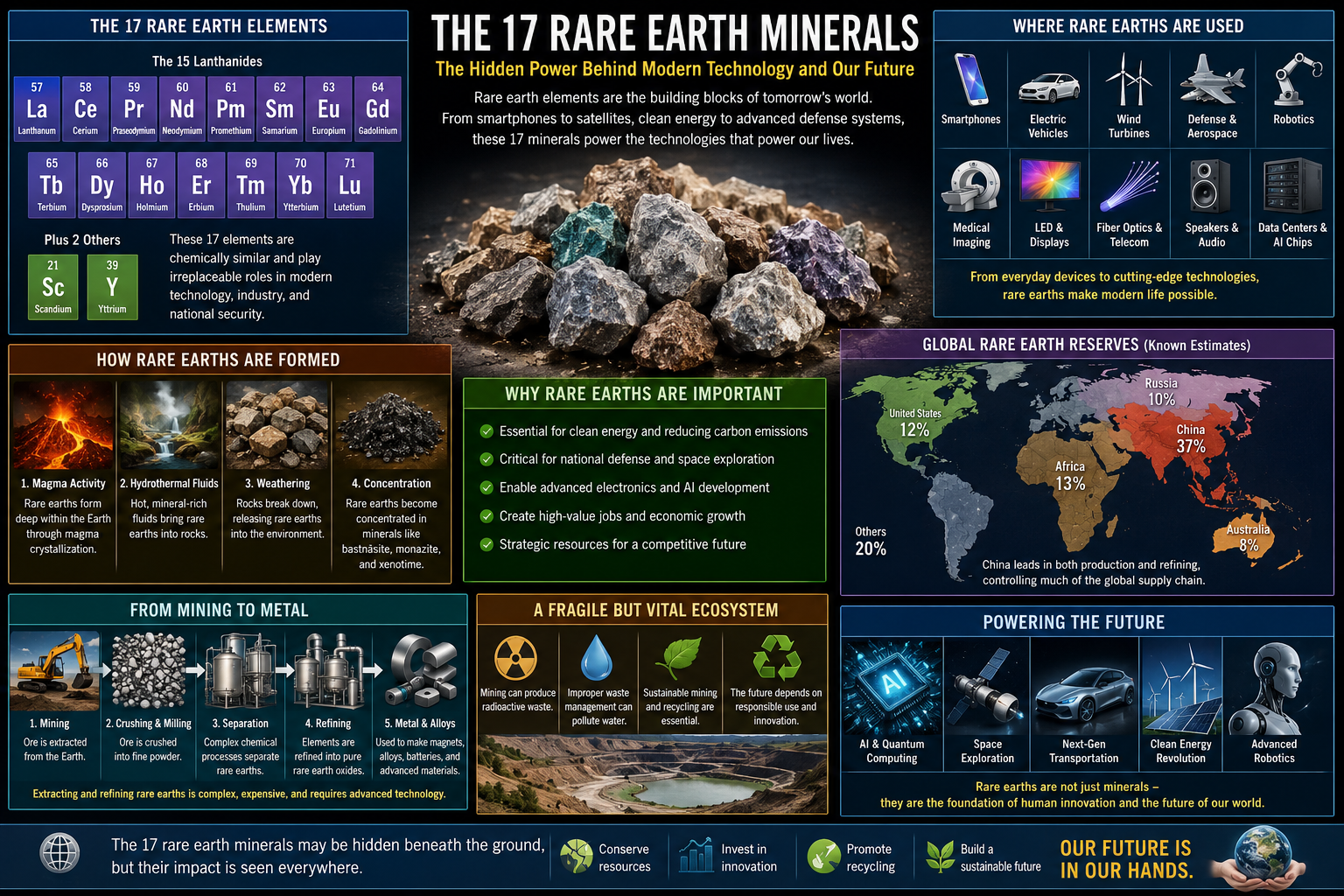
Rare earth minerals are among the most strategically important materials in modern civilization. Although many people rarely hear about them, these elements are the invisible foundation of modern technologies including smartphones, electric vehicles, satellites, robotics, wind turbines, missiles, fiber optics, quantum computing, and artificial intelligence infrastructure.
The term “rare earth” refers to a group of 17 chemically similar metallic elements found within the Earth’s crust. These minerals are not actually extremely rare in abundance, but they are difficult to mine economically because they are dispersed and mixed with other minerals.
Today, rare earth elements have become the “new oil” of the technological age because nations and industries depend heavily on them for economic growth, military strength, and digital transformation.
2. Definition and Scientific Classification
The 17 rare earth elements consist of:
The 15 Lanthanides:
- Lanthanum (La)
- Cerium (Ce)
- Praseodymium (Pr)
- Neodymium (Nd)
- Promethium (Pm)
- Samarium (Sm)
- Europium (Eu)
- Gadolinium (Gd)
- Terbium (Tb)
- Dysprosium (Dy)
- Holmium (Ho)
- Erbium (Er)
- Thulium (Tm)
- Ytterbium (Yb)
- Lutetium (Lu)
Plus:
- Scandium (Sc)
- Yttrium (Y)
These elements are located in the periodic table within the lanthanide series.


7
3. Discovery and Historical Development
The history of rare earths began in 1787 in the village of Ytterby in Sweden, where unusual black minerals were discovered in a quarry.
Several rare earth elements were later isolated by chemists during the 19th century. Scientists struggled for decades because the elements had extremely similar chemical behaviors.
Important milestones include:
| Year | Event |
|---|---|
| 1787 | Discovery of Ytterbite mineral in Sweden |
| 1803 | Cerium discovered |
| 1885 | Praseodymium and Neodymium isolated |
| 1940s | Rare earths used in military radar systems |
| 1980s | China begins industrial-scale production |
| 2000s | Rise of smartphones and green energy demand |
| 2020s | AI, EVs, and renewable energy increase global competition |
Rare earths became critically important during the digital revolution and green energy transition.
4. Geological Formation of Rare Earth Elements
Rare earth minerals form through geological processes involving:
- Magma crystallization
- Hydrothermal activity
- Weathering and sedimentation
- Carbonatite intrusions
Major rare earth-bearing minerals include:
- Bastnäsite
- Monazite
- Xenotime
- Loparite
These deposits may take hundreds of millions of years to form.


8
5. Atomic Anatomy and Chemical Structure
Rare earth elements possess unique electron configurations, particularly involving the filling of the 4f electron shell.
This gives them special properties such as:
- Magnetism
- Luminescence
- Catalytic behavior
- Heat resistance
- Electrical conductivity
Their atomic structures allow them to manipulate energy, light, and magnetic fields efficiently.
For example:
| Element | Atomic Number | Key Property |
|---|---|---|
| Neodymium | 60 | Powerful magnetism |
| Europium | 63 | Red phosphorescence |
| Cerium | 58 | Catalytic activity |
| Dysprosium | 66 | High-temperature magnetic stability |
6. The 17 Rare Earth Elements Overview
Light Rare Earth Elements (LREEs)
- Lanthanum
- Cerium
- Praseodymium
- Neodymium
- Samarium
Heavy Rare Earth Elements (HREEs)
- Europium
- Gadolinium
- Terbium
- Dysprosium
- Holmium
- Erbium
- Thulium
- Ytterbium
- Lutetium
- Yttrium
Heavy rare earths are generally more valuable because they are scarcer and technologically critical.
7. Light Rare Earth Elements (LREEs)
Lanthanum (La)
Used in:
- Camera lenses
- Battery electrodes
- Petroleum refining
Cerium (Ce)
Used in:
- Catalytic converters
- Glass polishing
- Self-cleaning ovens
Neodymium (Nd)
One of the most important rare earths.
Used in:
- Electric motors
- Wind turbines
- Headphones
- Hard drives


8
8. Heavy Rare Earth Elements (HREEs)
Dysprosium (Dy)
Critical for:
- Heat-resistant magnets
- Military systems
- Jet engines
Terbium (Tb)
Used in:
- Green display phosphors
- Energy-efficient lighting
Europium (Eu)
Essential for:
- LED screens
- Television displays
- Fluorescent lighting
Heavy rare earths are central to miniaturization and high-performance electronics.
9. Mining and Extraction Processes
Rare earth mining involves:
- Exploration
- Drilling
- Blasting
- Crushing
- Chemical separation
- Refining
Extraction methods include:
- Open-pit mining
- Underground mining
- Heap leaching
The process is chemically intensive and environmentally challenging.
10. Refining and Separation Technologies
Separation is one of the most difficult industrial processes because rare earth elements are chemically similar.
Technologies include:
- Solvent extraction
- Ion exchange
- Electrolysis
- Magnetic separation
A single refining plant may require thousands of extraction stages.
11. Global Rare Earth Deposits
Major producers include:
| Country | Importance |
|---|---|
| China | Largest producer |
| Australia | Major exporter |
| United States | Growing production |
| Myanmar | Heavy rare earth source |
| Russia | Strategic reserves |
| South Africa | Significant untapped potential |
Important mining regions include:
- Bayan Obo (China)
- Mountain Pass (USA)
- Mount Weld (Australia)
12. China and Rare Earth Dominance
China controls much of the global rare earth supply chain due to:
- Early investment
- Low-cost refining
- Strategic industrial policy
- Government support
China dominates:
- Mining
- Processing
- Magnet manufacturing
This has created geopolitical tensions because modern economies depend heavily on Chinese rare earth exports.
13. Rare Earths in Electronics
Modern electronics cannot function efficiently without rare earth elements.
Applications include:
- Smartphones
- Computer chips
- Speakers
- Microphones
- Displays
- Fiber optics
Neodymium magnets are crucial for compact devices.


8
14. Rare Earths in Renewable Energy
Green technologies rely heavily on rare earth minerals.
Examples:
- Wind turbines
- Solar technologies
- Energy storage
- Smart grids
A single large wind turbine may contain hundreds of kilograms of neodymium magnets.
These elements are essential for reducing fossil fuel dependence.
15. Rare Earths in Electric Vehicles
Electric vehicles depend on:
- Neodymium
- Dysprosium
- Praseodymium
These elements power:
- EV motors
- Batteries
- Charging systems
Companies such as Tesla and BYD depend heavily on rare earth supply chains.
16. Rare Earths in Artificial Intelligence Infrastructure
Artificial intelligence systems require:
- Data centers
- High-speed processors
- Cooling systems
- Advanced semiconductors
Rare earth elements enable:
- GPU manufacturing
- High-performance magnets
- Precision robotics
- Quantum systems
AI expansion is dramatically increasing demand for rare earth minerals worldwide.
17. Rare Earths in Aerospace and Defense
Defense technologies depend heavily on rare earths.
Applications include:
- Missile guidance systems
- Radar
- Jet engines
- Satellites
- Laser weapons
- Drones
Modern fighter aircraft contain hundreds of kilograms of rare earth materials.
This makes rare earths strategic national security assets.


7
18. Rare Earths in Medical Technology
Medical applications include:
- MRI scanners
- Cancer treatments
- Surgical lasers
- Medical imaging
- Diagnostic systems
Gadolinium is widely used as an MRI contrast agent.
Gadolinium plays an important role in modern healthcare diagnostics.
19. Rare Earths in Telecommunications and Data Centers
Rare earths enable:
- 5G infrastructure
- Internet cables
- Cloud computing
- Optical communication
- Servers
Large-scale data centers supporting AI and cloud services require advanced rare earth-based components.
Companies like NVIDIA and TSMC indirectly depend on rare earth supply chains.
20. Economic and Geopolitical Importance
Rare earths have become strategic economic weapons.
Nations compete for:
- Resource security
- Industrial leadership
- Military superiority
- Technological independence
The global rare earth market is worth billions of dollars and is expected to grow significantly with the rise of AI and renewable energy.
21. Environmental Challenges and Toxicity
Major environmental concerns include:
- Radioactive waste
- Water pollution
- Soil contamination
- Acid drainage
- Air pollution
Mining operations may release:
- Thorium
- Uranium
- Toxic chemicals
Sustainable mining practices are becoming increasingly important.
22. Recycling and Sustainable Solutions
Future solutions include:
- Urban mining
- Electronic waste recycling
- Green chemistry extraction
- Circular economy systems
Scientists are developing methods to recover rare earths from:
- Old electronics
- Batteries
- Wind turbines
Recycling could reduce dependence on newly mined resources.
23. Future Technologies Powered by Rare Earths
Emerging technologies include:
- Quantum computing
- Autonomous robots
- Space mining
- Fusion energy
- Advanced AI chips
- Brain-computer interfaces
Rare earth elements will remain foundational materials for the Fourth Industrial Revolution.
24. Africa and South Africa’s Rare Earth Potential
Africa possesses large untapped mineral wealth.
Countries with rare earth potential include:
- South Africa
- Namibia
- Tanzania
- Madagascar
South Africa’s mining expertise and geological resources may position it as an important future supplier.
This could:
- Create jobs
- Increase exports
- Improve industrialization
- Support energy transition projects


7
25. Strategic Risks and Global Competition
Key global risks include:
- Supply shortages
- Trade wars
- Resource nationalism
- Environmental regulations
- Technological dependency
Countries are now investing heavily in:
- Domestic mining
- Recycling
- Alternative materials
- Strategic reserves
Rare earths may become one of the defining geopolitical resources of the 21st century.
26. Conclusion and Future Outlook
Rare earth minerals are the invisible backbone of modern civilization. They power:
- Digital communication
- Renewable energy
- Artificial intelligence
- Medical systems
- National defense
- Transportation
Although they are called “rare,” their true rarity lies in the complexity of extracting and refining them economically and sustainably.
The future world economy, AI revolution, green energy transition, and advanced technologies will depend heavily on secure access to rare earth minerals.
Countries that master:
- Rare earth extraction
- Refining
- Recycling
- Manufacturing
will likely dominate future technological and economic systems.
The 17 rare earth elements are therefore not simply minerals — they are strategic building blocks of the future technological civilization.
Final Summary
Key Lessons
- Rare earth elements are essential to modern technologies.
- They are critical for AI, EVs, renewable energy, and defense.
- China currently dominates the global supply chain.
- Environmental sustainability is a major challenge.
- Africa holds significant future opportunities.
- Recycling and innovation will shape the next generation of rare earth industries.




Be First to Comment