
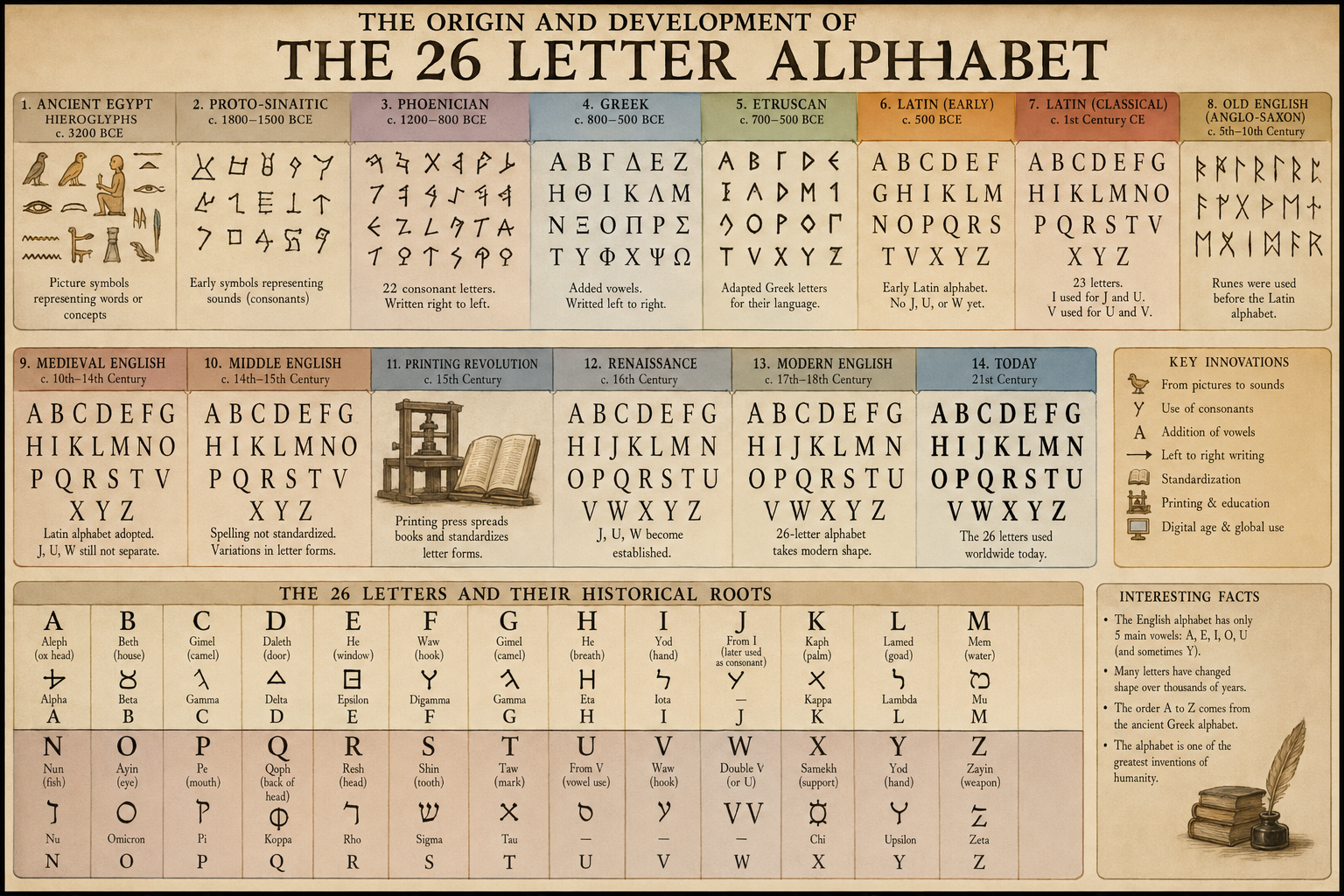
From Pictograph to Modern Type: Four Thousand Years of Written Form
Abstract
This thesis traces the historical origin and subsequent development of the twenty-six letters that constitute the modern English alphabet, from their earliest ancestral forms in the pictographic writing systems of the ancient Near East through to their standardized shapes in contemporary typography. The study proceeds chronologically, examining the transition from logographic and syllabic writing to the first true alphabetic system devised by Semitic-speaking workers in the Sinai Peninsula around 1900–1700 BCE, its refinement by Phoenician traders, its transformative adoption by the Greeks who introduced vowel symbols, its transmission through the Etruscans of the Italian peninsula, and its final codification by the Romans into the Latin alphabet that forms the direct ancestor of the script used today.
Beyond the macro-historical narrative, this thesis undertakes a letter-by-letter etymological and paleographic analysis of all twenty-six characters, tracing each symbol’s pictographic origin, its Phoenician consonantal value, its Greek transformation, and its Latin finalization. It further examines the medieval additions and separations that shaped the alphabet’s modern inventory, notably the late differentiation of I from J and V from U and W, developments that were not completed in common usage until the seventeenth century. The thesis concludes with an examination of the printing press as a standardizing force and a discussion of the alphabet’s present status as the most widely used writing system on Earth.
The research draws on the established consensus of historical linguistics and paleography, synthesizing findings on Proto-Sinaitic inscriptions, Phoenician epigraphy, Greek and Etruscan comparative alphabets, and Latin monumental capitals, in order to present a single continuous developmental account of a writing system that has, with modification, served written communication for close to four millennia.
Table of Contents
- Introduction — The Alphabet as Human Invention
- Before the Alphabet — Writing in the Ancient World
- The Proto-Sinaitic Script — Birth of the Alphabetic Principle
- The Phoenician Alphabet — Consonants and Commerce
- The Greek Adaptation — The Vowel Revolution
- The Etruscan Bridge
- Rome and the Latin Alphabet
- The Twenty-Six Letters — A Character-by-Character History
- The Medieval Alphabet — Scripts, Splits, and Additions
- The Wider Alphabetic Family — Runic, Cyrillic, and Beyond
- The Printing Press and the Standardization of Letterforms
- The Modern Twenty-Six-Letter Alphabet
- Conclusion — Continuity and Change in a Four-Thousand-Year System
- Appendix — The Twenty-Six Letters in Modern Use
- References
Chapter 1: Introduction — The Alphabet as Human Invention
Of all the technologies devised by human beings, few have proven as durable or as consequential as the alphabet. A system of no more than a few dozen abstract marks, each corresponding in principle to a single sound of speech, the alphabet allows the entire vocabulary of a language, indeed the entire range of human thought expressible in that language, to be recorded using a strikingly small inventory of symbols. This economy distinguishes the alphabetic principle from the thousands of signs required by logographic systems such as Chinese characters, and from the syllabaries of scores of signs used in systems such as Japanese kana or Linear B.
The twenty-six letters that make up the modern English alphabet are not a modern invention. They are the latest stage of a continuous developmental chain stretching back nearly four thousand years, a chain that passes through the deserts of the Sinai Peninsula, the port cities of the Phoenician coast, the city-states of archaic Greece, the hill towns of Etruria, and the forum of ancient Rome, before passing through medieval scriptoria and Renaissance print shops to arrive, largely unchanged in its essential letterforms, on the page or screen in front of the reader today.
This thesis has two purposes. The first is to present, in a single continuous narrative, the historical development of the alphabet as a system, from its pre-alphabetic antecedents to its present form. The second is to descend from the level of the system to the level of the individual letter, tracing the specific pictographic origin, Phoenician name, Greek transformation, and Latin finalization of each of the twenty-six characters in turn. Taken together, these two levels of analysis, the systemic and the particular, offer a comprehensive account of how the alphabet came to be discovered, and how it developed thereafter.
1.1 Defining Terms: Alphabet, Abjad, and Writing System
Before tracing the history, it is necessary to be precise about terminology. A true alphabet is a writing system in which symbols represent both consonant and vowel sounds as separate, independent units. This distinguishes it from an abjad, a consonantal writing system such as Phoenician or Hebrew in which vowels are largely unmarked or only partially indicated, and from an abugida, a system such as Devanagari in which vowels are marked as obligatory diacritics attached to consonant symbols. By this definition, the honor of having invented the first true alphabet belongs to the Greeks, who took a Phoenician abjad and, in adapting it to a language with a very different phonological structure, created dedicated vowel letters for the first time in the historical record.
Understanding this distinction matters because it clarifies what is being traced in this thesis. The story is not simply the story of a single invention at a single moment, but of a layered process: the invention of the alphabetic principle itself among Semitic-speaking peoples, the refinement of that principle into a fully-fledged trading script by the Phoenicians, and the transformation of that abjad into a true alphabet by the Greeks. Only after these three stages had occurred did the system pass, via the Etruscans, into the hands of the Romans, who gave it the specific letter inventory and shapes that most directly underlie the twenty-six letters used in English and many other languages today.
1.2 Scope, Sources, and Method
This thesis is a work of synthesis rather than of primary archaeological or epigraphic discovery. It draws together findings that are individually well established within the disciplines of historical linguistics, paleography, and the archaeology of writing, and arranges them into a single continuous narrative organized around the specific goal of explaining the twenty-six letters of the modern English alphabet. Where the scholarly record contains genuine uncertainty, for instance in the precise dating of the earliest Proto-Sinaitic inscriptions or in the exact mechanism by which the alphabet passed from Phoenician to Greek hands, this thesis presents the range of scholarly opinion rather than asserting false precision. Where the record is well established, for instance in the Etruscan mediation of the alphabet’s transmission to Rome or in the late medieval separation of J from I and U from V, the thesis presents the settled consensus directly.
The method of the thesis is comparative and chronological. Each chapter takes up a successive stage in the alphabet’s history, examines the surviving evidence for that stage, and identifies the specific mechanism, whether cognitive innovation, trade contact, political reform, or technological change, by which the writing system was carried forward into its next stage of development. Chapter 8 then applies this same method at the level of the individual letter, allowing the reader to trace any single character of the modern alphabet back through every stage of the broader narrative established in the preceding chapters.
1.3 Why Twenty-Six?
It is worth noting at the outset that the number twenty-six is itself a historical accident rather than a fixed or necessary quantity. The Phoenician abjad had twenty-two letters. The classical Greek alphabet, in its Ionic form that became standard, had twenty-four. Classical Latin had twenty-three letters, lacking dedicated symbols for the sounds now written J, U, and W. The letter inventory of twenty-six reached its current size only in the early modern period, when J was differentiated from I and W and the vowel-only U were differentiated from V. Different languages that use variants of the Latin alphabet today employ different numbers of letters, from the twenty-one of Italian to the twenty-nine of Spanish including ñ, illustrating that twenty-six is a feature of the English recension of the alphabet specifically, not an inherent property of the alphabetic system itself.
Chapter 2: Before the Alphabet — Writing in the Ancient World
To appreciate the significance of the alphabetic breakthrough, it is necessary first to understand the writing systems that preceded it, and against which it represented so radical a simplification.
2.1 Cuneiform and the Sumerian Precedent
The earliest writing system known to history is Sumerian cuneiform, developed in Mesopotamia from around 3400 to 3200 BCE. Cuneiform began as a system of pictographs impressed into clay with a reed stylus, used initially for administrative record-keeping of grain, livestock, and labor. Over centuries, the pictographs became increasingly abstract wedge-shaped marks, and the system evolved to represent not only whole words (logograms) but also syllables. By its mature form, cuneiform required a scribe to master several hundred distinct signs, a task requiring years of dedicated training in scribal schools. The complexity of cuneiform meant that literacy remained the preserve of a professional scribal class throughout its long history, which extended for more than three thousand years until its final disuse in the first century CE.
2.2 Egyptian Hieroglyphs and the Seeds of the Alphabetic Idea
Egyptian hieroglyphic writing, emerging at a similar early date to cuneiform, is of particular importance to the history of the alphabet because it contained within it, embedded among hundreds of logographic and syllabic signs, a small subset of roughly twenty-four uniliteral signs, each representing a single consonantal sound. These uniliteral signs functioned somewhat like an alphabet within the larger, far more cumbersome hieroglyphic system, but the Egyptians never isolated or promoted this subset into an independent, standalone writing system for general use. It would take a group of outsiders, familiar with Egyptian writing but not bound by its scribal traditions, to make that conceptual leap.
2.3 Classifying Writing Systems
It is useful, before proceeding, to classify the major categories of writing system that have been devised across human history, since the alphabet represents only one of several distinct solutions to the underlying problem of representing spoken language in visible, durable form. Logographic systems, such as Chinese characters or the core of Egyptian hieroglyphic and Sumerian cuneiform writing, use a distinct symbol, or combination of symbols, for each word or meaningful word-part, requiring a very large inventory of signs, often numbering in the thousands, but allowing a single symbol to be read across mutually unintelligible dialects or even distinct but related languages, since the symbol is tied to meaning rather than to a specific pronunciation. Syllabic systems, such as Japanese kana or the Linear B script of Mycenaean Greece, use a distinct symbol for each syllable of the language, typically requiring several dozen to a few hundred signs, a considerable reduction from logographic systems but still substantially more than a true alphabet requires. Alphabetic systems, by contrast, break speech down to the level of the individual consonant and vowel sound, typically requiring only twenty to forty signs to represent an entire language, the smallest inventory of any major writing system category and the category to which the subject of this thesis belongs.
| System Type | Unit Represented | Typical Sign Count | Example |
|---|---|---|---|
| Logographic | Word or morpheme | Several thousand | Chinese characters |
| Syllabic | Syllable | 40–200 | Japanese kana, Linear B |
| Abjad | Consonant only | 20–30 | Phoenician, Hebrew |
| Abugida | Consonant + inherent vowel | 30–50 base signs | Devanagari, Ge’ez |
| Alphabet | Consonant and vowel, independently | 20–40 | Greek, Latin, Cyrillic |
2.4 The Cognitive Leap Required
The invention of a true alphabetic principle required a specific cognitive insight: that the sounds of speech could be broken down into a small, finite inventory of discrete consonantal units, and that each unit could be assigned a single, simple symbol, with that symbol chosen on the acrophonic principle, meaning that the symbol depicted an object whose name in the relevant language began with the sound in question. This is precisely the innovation credited to the creators of the Proto-Sinaitic script, examined in the following chapter.
Chapter 3: The Proto-Sinaitic Script — Birth of the Alphabetic Principle
3.1 Discovery and Archaeological Context
The earliest known alphabetic inscriptions were discovered in the early twentieth century at Serabit el-Khadim, a turquoise-mining site in the Sinai Peninsula, by the British Egyptologist Sir William Matthew Flinders Petrie during excavations conducted in 1904 and 1905. The inscriptions, carved into rock faces and votive objects near a temple dedicated to the Egyptian goddess Hathor, were found alongside Egyptian hieroglyphic texts, indicating a period of sustained contact between Egyptian administrators and a Semitic-speaking labor force employed at the mines. Subsequent scholarship, particularly the decipherment work of the Egyptologist Alan Gardiner in 1916, established that these inscriptions, now known as Proto-Sinaitic, represented an early Semitic alphabet whose letter-forms were visibly derived from Egyptian hieroglyphic signs, but which were used to spell Semitic words according to the acrophonic principle rather than the Egyptian principle.
3.2 The Acrophonic Principle in Practice
The mechanism by which the Proto-Sinaitic alphabet was constructed can be illustrated with reference to individual signs. A hieroglyph depicting an ox head, which the Egyptians used with an Egyptian phonetic or logographic value, was borrowed by Semitic-speaking workers and given the Semitic word for ox, aleph, as its name; the symbol was then used to represent the first sound of that word, the glottal stop. A hieroglyph depicting a house was borrowed and named with the Semitic word for house, bet, and used to represent the consonant b. A sign depicting water was named mem, the Semitic word for water, and used for the consonant m. This same procedure, applied systematically across the consonantal inventory of the Semitic language spoken by the inscription-makers, yielded an alphabet of around twenty-two to twenty-seven signs, each with a name, a shape derived from a recognizable pictograph, and a single consonantal sound value.
3.3 Dating and Historical Debate
Dating of the Proto-Sinaitic inscriptions has been the subject of ongoing scholarly debate, with estimates ranging from approximately 1900 BCE to 1700 BCE, based on comparison with dated Egyptian inscriptions found at the same site and on paleographic comparison with later Semitic scripts. Related early alphabetic inscriptions have since been found at other sites in Egypt and the Levant, including short inscriptions from Wadi el-Hol in Upper Egypt that some scholars date even earlier, suggesting that the alphabetic principle may have developed among Semitic-speaking populations resident in Egypt before being carried to the Sinai mining communities. Regardless of the precise date and location of the very first alphabetic mark ever made, the broad scholarly consensus places the invention of the alphabetic principle among West Semitic speakers in the Egyptian cultural sphere in the early second millennium BCE.
3.4 From Proto-Sinaitic to Proto-Canaanite
Over the following centuries, the alphabetic script carried by Semitic populations back into Canaan developed into what paleographers term the Proto-Canaanite script, attested in scattered inscriptions across the Levant from roughly 1700 to 1000 BCE. This period saw the gradual standardization of letter shapes and a reduction and fixing of the sign inventory to twenty-two consonants, the number that would characterize the Phoenician alphabet proper. It is this standardized twenty-two-letter Canaanite script, refined over some seven centuries, that the Phoenicians inherited and that they, in turn, spread across the Mediterranean world through their extensive maritime trade networks.
Chapter 4: The Phoenician Alphabet — Consonants and Commerce
4.1 The Phoenicians as Transmitters
The Phoenicians, a Semitic-speaking, seafaring people based in the city-states of the eastern Mediterranean coast, most notably Tyre, Sidon, and Byblos, inherited the Canaanite alphabetic tradition and, from around 1200 to 1000 BCE onward, refined it into the specific twenty-two letter consonantal script that historians call the Phoenician alphabet. The Phoenicians did not merely preserve this script; they became its principal distributors, carrying it to every port and trading post they visited across the Mediterranean basin, from the Levant to the Iberian Peninsula, as a natural consequence of their commercial activity. It is largely owing to this trading network, rather than to any deliberate program of cultural transmission, that the alphabet spread as widely and as rapidly as it did during the early first millennium BCE.
4.2 Structure of the Phoenician Alphabet
The Phoenician alphabet consisted of twenty-two letters, all representing consonants, written from right to left. Each letter had a name derived from an object whose name began with the relevant sound, a direct continuation of the acrophonic naming convention inherited from Proto-Sinaitic and Proto-Canaanite practice. The letters aleph, bet, gimel, dalet, he, waw, zayin, heth, teth, yodh, kaph, lamedh, mem, nun, samekh, ayin, pe, tsade, qoph, resh, shin, and taw together constituted the full inventory. This same basic set of twenty-two consonants, with only modest changes in name, form, and sound, underlies the Hebrew and Aramaic alphabets to the present day, situating the Phoenician system as the common ancestor not only of the Latin alphabet but of the entire family of Semitic scripts still in use.
4.3 Why No Vowels?
The absence of vowel symbols in the Phoenician alphabet was not an oversight but a reasonable adaptation to the structure of Semitic languages, in which consonantal roots carry the core lexical meaning of a word while vowel patterns indicate grammatical modifications; a literate reader familiar with the language could generally supply the correct vowels from context. This economy of twenty-two signs, without any dedicated vowel notation, made Phoenician writing considerably simpler to learn than either cuneiform or hieroglyphics, a simplicity that was almost certainly a significant factor in the alphabet’s rapid adoption by merchants, sailors, and eventually entire foreign populations who had no prior literate tradition of their own.
4.4 The Geography of Transmission
The specific pattern by which the Phoenician alphabet spread across the Mediterranean closely mirrors the pattern of Phoenician commercial expansion documented archaeologically from the tenth century BCE onward. Phoenician trading posts and colonies were established along the coasts of Cyprus, the Aegean islands, Sicily, Sardinia, the North African coast, most famously at Carthage, and the Iberian Peninsula, and alphabetic inscriptions of clearly Phoenician derivation, whether in the Phoenician language itself or in the languages of the trading partners who adopted the script, appear at many of these same sites within a few generations of the establishment of trade contact. This close correspondence between the archaeological footprint of Phoenician commerce and the geographic spread of alphabetic writing provides strong independent evidence that the alphabet was carried, quite literally, in the ships and among the merchants of a single trading civilization, rather than spreading through any centralized program of cultural transmission or conquest.
4.5 Transmission to the Aegean
Phoenician contact with the Aegean world is attested archaeologically from at least the ninth century BCE, and it was through this contact, whether via Phoenician settlement, trade, or intermarriage with Greek populations, that the alphabet passed into Greek hands. The precise mechanism and date of this transmission remain subjects of scholarly discussion, but the earliest datable Greek alphabetic inscriptions appear from the eighth century BCE, and their letter forms are so close to Phoenician models that the connection is not seriously disputed. This transmission marks the point at which the writing system ceases to be purely a Semitic Levantine phenomenon and becomes the shared inheritance of the wider Mediterranean and, eventually, European world.
Chapter 5: The Greek Adaptation — The Vowel Revolution
5.1 A Structural Problem
Greek, unlike Phoenician, is an Indo-European language in which vowel distinctions carry substantial grammatical and lexical weight; a purely consonantal script of the Phoenician type would have been poorly suited to writing Greek unambiguously. The Greeks who adopted the Phoenician script solved this problem through an elegant repurposing: several Phoenician consonant letters represented sounds that did not exist as distinct phonemes in Greek, and rather than discard these superfluous letters, Greek scribes reassigned them to represent vowel sounds. This single innovation, arguably one of the most consequential in the entire history of writing, converted a consonantal abjad into the world’s first true alphabet, a system in which vowels and consonants are both given independent, equal-status symbols.
5.2 Specific Vowel Reassignments
The Phoenician letter aleph, representing a glottal stop consonant not distinctively used in Greek in the same way, became the Greek alpha, representing the vowel a. The Phoenician he became the Greek epsilon, representing e. The Phoenician yodh became the Greek iota, representing i. The Phoenician ayin, a pharyngeal consonant absent from Greek, became the Greek omicron, representing o. The Phoenician waw was split in its Greek usage to yield both the consonant digamma, representing the sound w, later lost in most Greek dialects, and the vowel upsilon, representing u. These five reassignments, aleph to alpha, he to epsilon, yodh to iota, ayin to omicron, and waw to upsilon, together with later Greek innovations, gave Greek its full complement of vowel letters and completed the transformation from abjad to alphabet.
5.3 Direction of Writing and Further Innovation
Early Greek inscriptions show a period of variable and even boustrophedon writing direction, in which lines alternated between right-to-left and left-to-right, mirroring the plough turning at the end of a furrow, before Greek writing settled into the consistent left-to-right direction that the Latin alphabet, and English by extension, inherited. The Greeks also introduced several entirely new letters not present in the Phoenician model, including phi, chi, and psi, to represent sounds specific to the Greek language, demonstrating that the borrowed script was actively adapted rather than passively copied.
5.4 Eastern and Western Greek Alphabets
During the archaic period, Greek city-states did not use a single uniform alphabet; rather, regional variants existed, conventionally classified by scholars into an Eastern group, associated with Ionia and the islands, and a Western group, associated with Euboea and the cities of central Greece. It was the Eastern, Ionic variant that Athens formally adopted as its official script in 403 BCE, and this Ionic alphabet subsequently became the standard classical Greek alphabet of twenty-four letters used throughout the Hellenistic and later Greek-speaking world. Crucially for the history traced in this thesis, however, it was not the Ionic variant that most directly influenced the Latin alphabet, but rather the Western Greek alphabet, carried to Italy by Greek colonists who settled the southern Italian coast and Sicily from the eighth century BCE onward, a region the Romans knew as Magna Graecia.
Chapter 6: The Etruscan Bridge
6.1 Etruscan Civilization and Contact with Greek Colonists
The Etruscans, a non-Indo-European-speaking people who dominated much of central Italy before the rise of Rome, adopted the Western Greek alphabet from Greek colonial settlements in Italy, most likely via the important Greek colony of Cumae, near modern Naples, in the eighth century BCE. The Etruscan alphabet, attested in inscriptions from around 700 BCE onward, closely follows the Western Greek letter forms and ordering, adapted to the specific phonology of the Etruscan language, which lacked the sounds represented by certain Greek letters such as beta, delta, and gamma in their voiced forms, since Etruscan appears not to have distinguished voiced from voiceless stop consonants in the same way.
6.2 The Etruscan Alphabet as Intermediary
The historical importance of the Etruscan alphabet lies not in its own subsequent fate, since the Etruscan language and its script eventually fell out of use following the Roman absorption of Etruria, but in its role as the direct model from which the Romans derived their own alphabet. The Romans, whose early history was substantially shaped by Etruscan political and cultural influence during the period of the Etruscan kings of Rome traditionally dated to the sixth century BCE, adopted writing via Etruscan intermediaries rather than directly from Greek colonists, a fact confirmed by the specific letter shapes and by certain idiosyncrasies of the early Latin alphabet that mirror Etruscan rather than direct Greek practice.
6.3 Evidence: The Duenos Inscription and Early Latin
Some of the earliest surviving Latin inscriptions, such as the Duenos inscription, conventionally dated to the sixth or seventh century BCE, and the Praeneste fibula, display letter forms transitional between Etruscan and classical Latin models, providing direct epigraphic evidence for the Etruscan-mediated transmission of the alphabet into the Latin-speaking world. This chain of transmission, Phoenician to Western Greek to Etruscan to Latin, explains why the Latin alphabet shares its basic letter order and many individual letter shapes with Greek, while differing in the specific values and additional letters that Roman scribes introduced to suit the sounds of their own language.
Chapter 7: Rome and the Latin Alphabet
7.1 The Early Latin Alphabet
The Latin alphabet as used during the Roman Republic contained twenty-one letters: A, B, C, D, E, F, Z, H, I, K, L, M, N, O, P, Q, R, S, T, V, and X. Notably, the letter C, derived from the Greek gamma via Etruscan, was initially used to represent both the voiced sound g and the voiceless sound k, since Etruscan lacked the voiced-voiceless distinction and Latin at first inherited that ambiguity. Around the third century BCE, the Latin alphabet was reformed by adding a new letter, G, created by adding a small stroke to the letter C, specifically to distinguish the voiced g sound, freeing C to represent only the voiceless k sound. This reform is traditionally credited to a scribe named Spurius Carvilius Ruga, and it inserted G into the alphabet in the position formerly occupied by the largely unused Greek-derived letter Z, which had been dropped from ordinary Latin use since the sound it represented did not occur natively in the language of the period.
7.2 The Later Addition of Y and Z
By the first century BCE, Roman contact with Greek culture and literature had intensified to the point that Latin needed to represent Greek loanwords with greater phonetic fidelity, particularly Greek upsilon and zeta. The Romans accordingly reintroduced Z at the end of the alphabet and added a new letter, Y, adapted directly from Greek upsilon, also placed at the end of the alphabet, specifically to transliterate Greek words. These two letters, Y and Z, were thus largely reserved in classical Latin for Greek loanwords, and their position at the very end of the twenty-three-letter classical Latin alphabet, distinct from the ordering of the native Latin letters that preceded them, is a direct trace of their later and secondary introduction.
7.3 The Classical Latin Alphabet: Twenty-Three Letters
The Latin alphabet of the classical period, as used for monumental inscriptions such as those on the Roman triumphal arches and public buildings, and codified in the elegant capital letterforms that survive on monuments including Trajan’s Column, thus comprised twenty-three letters: A, B, C, D, E, F, G, H, I, K, L, M, N, O, P, Q, R, S, T, V, X, Y, and Z. This twenty-three-letter inventory is the direct ancestor of the modern twenty-six-letter alphabet, lacking only the later medieval additions of J, U as distinct from V, and W, which are examined in Chapter 9.
7.4 Monumental Capitals and the Aesthetic Legacy of Rome
The specific shapes of Roman monumental capital letters, as carved by professional letterers on public inscriptions during the first and second centuries CE, established a standard of proportion, stroke contrast, and serif construction that has influenced Western letterforms ever since. The capital letters used in modern printed and digital typefaces, including the very letters in which this thesis is set, remain recognizably descended from these Roman inscriptional capitals, making the Roman contribution to the alphabet’s history a matter not only of letter inventory but of enduring visual form.
The Roman capital, cut with a chisel into stone by skilled letterers of the first century, established a canon of proportion that later scribes, printers, and type designers would return to again and again as the touchstone of authoritative and legible lettering.
Chapter 8: The Twenty-Six Letters — A Character-by-Character History
This chapter descends from the systemic history recounted above to the level of the individual letter. For each of the twenty-six letters of the modern English alphabet, the following entries trace, where the historical and paleographic record allows, the letter’s Proto-Sinaitic or Proto-Canaanite pictographic origin, its Phoenician name and consonantal value, its transformation in Greek, and its fate in Latin and beyond. Letters that entered the alphabet only in the medieval or early modern period, namely J, U, and W, are treated separately with reference to the letters from which they were split.
8.1 Overview Table: Pictograph to Modern Letter
| Letter | Pictograph Meaning | Phoenician Name | Greek Name |
|---|---|---|---|
| A | Ox head | aleph | alpha |
| B | House | bet | beta |
| C / G | Throwing stick | gimel | gamma |
| D | Door | dalet | delta |
| E | Person calling / window | he | epsilon |
| F | Hook or peg | waw | digamma |
| H | Fence | heth | eta |
| I / J | Arm or hand | yodh | iota |
| K | Open hand | kaph | kappa |
| L | Ox goad | lamedh | lambda |
| M | Water | mem | mu |
| N | Snake | nun | nu |
| O | Eye | ayin | omicron |
| P | Mouth | pe | pi |
| Q | Knot / needle’s eye | qoph | qoppa |
| R | Head | resh | rho |
| S | Bow / teeth | shin | sigma |
| T | Mark | taw | tau |
| U / V / W | Hook or peg | waw | upsilon |
| X | (Western Greek innovation) | — | chi |
| Y | (Greek vowel, no pictograph) | — | upsilon |
| Z | Weapon or tool | zayin | zeta |
A — From Ox to Vowel. The letter A descends from the Proto-Sinaitic pictograph of an ox head, named aleph, the Semitic word for ox, and used for a glottal-stop consonant. The Phoenicians preserved this sign essentially unchanged in shape and consonantal function. When the Greeks adopted the letter, they had no equivalent glottal-stop phoneme requiring separate notation, and repurposed the sign as alpha, representing the vowel a. The Etruscans and Romans preserved this vowel value unchanged, and the letter’s shape, rotated from its original orientation, became the A recognizable today. The letter’s position as the first letter of the alphabet has remained constant since Phoenician times, and it is the reason the word alphabet itself derives from the names alpha and beta.
B — The House Sign. B derives from the Proto-Sinaitic pictograph of a house floor plan, named bet, the Semitic word for house, giving the consonant b. The Phoenicians retained this shape and value. The Greeks adopted it as beta with the same consonantal value, and it passed through Etruscan into Latin with its sound and approximate shape intact, though the Etruscans, lacking the b sound in their own language, did not use the letter productively themselves; it survived in the alphabet’s inherited order and was reactivated with full phonetic value by Latin speakers.
C — One Letter, Two Sounds, Then a Split. C traces to the Proto-Sinaitic pictograph of a throwing stick or possibly a camel, named gimel, representing the consonant g. In Greek this became gamma, retaining the g sound. Etruscan, lacking a voiced g, used the descendant of this letter for the k sound instead, and Rome inherited this Etruscan usage, employing C for the k sound in early Latin. Because the same letter was thus called upon to represent both g and k sounds in early Latin, the alphabet was later reformed by creating the new letter G specifically for the voiced sound, leaving C dedicated to the voiceless k sound, the value it has retained, with later softening before front vowels in many Romance and Germanic languages, into modern English.
D — The Door. D descends from the Proto-Sinaitic pictograph of a door, named dalet, giving the consonant d. The Phoenicians preserved this triangular door-shape and consonantal value. The Greeks adopted it as delta, keeping the d sound and, notably, keeping the triangular shape essentially unaltered, which is why the Greek capital delta still resembles a triangle. Etruscan and Latin usage rounded the triangular form into the curved D familiar today, while preserving the original d sound without interruption across the entire transmission chain.
E — From Consonant to the Most Common English Letter. E derives from a Proto-Sinaitic sign generally identified as a pictograph of a person calling out or possibly a window, named he, representing a consonantal h sound in Phoenician. The Greeks, needing a symbol for the vowel e and having no equivalent use for this particular consonant, reassigned the sign to represent that vowel, naming it epsilon. This vowel value was preserved through Etruscan and Latin transmission into the modern letter E, which today is the single most frequently used letter in written English.
F — The Vanished Digamma. F derives from the Proto-Sinaitic and Phoenician letter waw, a pictograph of a hook or peg, which in Phoenician represented the consonant w. The Greeks split this letter’s function, creating digamma to preserve a w-type consonant sound in early Greek dialects, though digamma was later dropped from most Greek alphabets as the w sound disappeared from spoken Greek. The Etruscans, however, retained digamma and used it, in combination with a following letter, to represent an f sound, and the Romans inherited this Etruscan f value directly, giving Latin, and subsequently English, the letter F with its familiar shape and sound.
G — A Roman Invention. Unlike nearly every other letter in this chapter, G was not inherited from Phoenician or Greek but was created by the Romans themselves in the third century BCE, by adding a distinguishing stroke to the letter C in order to represent the voiced g sound that C alone had previously been forced to share with the voiceless k sound. G was inserted into the alphabet at the position formerly held by the letter Z, which had fallen out of use in early Latin, explaining G’s seventh position among the twenty-six modern letters.
H — The Fence That Became an Aspirate. H derives from the Proto-Sinaitic pictograph of a fence or wall, named heth, representing a strong pharyngeal or aspirated h-type consonant in Phoenician. The Greeks initially used the descendant of this letter, eta, for an aspirated h sound in some dialects, but in the standard Ionic alphabet later adopted by Athens, eta came to represent a long e vowel instead, the h sound being marked, where needed, by a diacritic mark rather than a full letter. It was the Western Greek alphabet, transmitted via the Etruscans, that preserved heth’s original consonantal h value, which the Etruscans and then the Romans retained, giving Latin and English their letter H with its aspirate sound intact.
I — The Long-Serving Vowel and Consonant Combined. I derives from the Proto-Sinaitic pictograph of an arm or hand, named yodh, representing the consonant y in Phoenician. The Greeks reassigned this sign to the vowel i, naming it iota, since Greek had no distinct need for the specific consonant sound in that position once other letters covered related sounds. Latin inherited this vowel value, but for many centuries the single Latin letter I was used to represent both the vowel i and the closely related consonant sound y, later j, without a distinct symbol, a dual usage not formally resolved until the letter J was separated out in the medieval and early modern periods.
J — The Youngest Letter. J is the most recently created of the twenty-six letters. It began as a stylistic variant of the letter I, specifically a lengthened or tailed form used by medieval scribes at the end of Roman numerals, for example writing the numeral three as iij rather than iii, purely as a decorative or clarifying convention with no distinct sound value of its own. From the fourteenth century onward, and particularly through the influence of the French and Italian printer and grammarian traditions of the sixteenth century, this tailed form of I began to be used systematically to represent the consonant sound that the plain letter I had previously shared with the vowel i, formalizing a distinction between vowel I and consonant J. J was not consistently treated as a fully separate letter of the English alphabet, with its own place in dictionaries and alphabetical listings, until the eighteenth century.
K — A Letter Rome Rarely Used. K derives from the Proto-Sinaitic pictograph of an open hand, named kaph, giving the consonant k in Phoenician. The Greeks adopted it as kappa with the same sound. The Etruscans and early Romans inherited K, but because the letter C had already come to serve the k sound in most positions in early Latin, K saw only limited use in classical Latin, largely confined to a small number of traditional words and abbreviations such as Kalendae. The letter nonetheless remained formally part of the Latin alphabet and was carried forward into English, where it later regained more extensive use, particularly before the vowels e and i, where C had softened in sound in many derived languages.
L — The Ox Goad. L derives from the Proto-Sinaitic pictograph generally identified as an ox goad or shepherd’s crook, named lamedh, giving the consonant l in Phoenician. The Greeks adopted it as lambda with the same sound and a broadly similar angular shape. The Etruscans and Romans continued this consonantal value without significant alteration, giving Latin and English their letter L with an essentially unbroken sound value across the entire chain of transmission from Proto-Sinaitic times to the present.
M — Water Made Solid. M derives from the Proto-Sinaitic pictograph of water, rendered as a wavy line, named mem, the Semitic word for water, giving the consonant m. This value passed into Phoenician, then into Greek as mu, then through Etruscan into Latin, with the letter’s zigzag shape gradually straightening into the familiar angular M over the course of this transmission, but its consonantal sound value remaining constant throughout, one of the most stable letters in the entire alphabet’s history.
N — The Snake. N derives from the Proto-Sinaitic pictograph of a snake, named nun, giving the consonant n in Phoenician. The Greeks adopted it as nu with the same sound, and Etruscan and Latin transmission preserved both the sound and a recognizably similar angular shape, yielding the modern letter N with a lineage as continuous and stable as that of M.
O — The Eye. O derives from the Proto-Sinaitic pictograph of an eye, named ayin, a Semitic word that also means eye, representing a pharyngeal consonant in Phoenician not native to Greek phonology. The Greeks, having no use for this consonant, reassigned the sign to the vowel o, naming it omicron, meaning little o, to distinguish it from the later Greek letter omega, meaning big o, which represented a long o vowel not paralleled in the letters inherited by Latin. The circular shape of the original eye pictograph is preserved essentially unchanged in the modern letter O, making it one of the most visually stable letters across the entire history traced in this thesis.
P — The Mouth. P derives from the Proto-Sinaitic pictograph of a mouth, named pe, giving the consonant p in Phoenician. The Greeks adopted it as pi with the same sound, though the Greek pi retained a more angular, table-like shape while the Latin descendant P developed its characteristic rounded loop at the top of the vertical stroke, a shape difference between Greek and Latin capital letters that persists to the present day despite the shared sound and shared ultimate origin.
Q — The Knot or Needle’s Eye. Q derives from the Proto-Sinaitic pictograph variously identified as a knot of thread, a needle’s eye, or possibly a monkey, named qoph, giving a consonant similar to k but produced further back in the throat, a distinct phoneme in Phoenician not present in Greek. The Greeks adopted the letter as qoppa, using it for a time before its sound merged with that of kappa in most Greek dialects, leading to qoppa’s disuse in the classical Greek alphabet, though it survived as a numeral symbol. The Western Greek alphabet transmitted to the Etruscans retained qoppa, however, and the Etruscans and Romans preserved it as Q, conventionally always followed by the letter U in Latin and in modern English, a spelling convention that echoes the letter’s ancient association with a rounded, back-of-mouth articulation.
R — The Head. R derives from the Proto-Sinaitic pictograph of a human head, named resh, the Semitic word for head, giving the consonant r in Phoenician. The Greeks adopted it as rho with the same sound, and Etruscan and Latin transmission preserved both sound and a broadly similar shape, with the distinctive descending leg of the Latin R added during the Etruscan or early Latin stage of transmission to distinguish it more clearly from the letter P, which shares its rounded upper loop.
S — The Zigzag. S derives from a Proto-Sinaitic pictograph generally identified with a sign meaning bow or possibly a zigzag representation of teeth, named shin, giving a sibilant consonant sound in Phoenician. The Greeks adopted a form of this letter as sigma, retaining the sibilant s sound, and Etruscan and Latin transmission preserved this value into the modern S, whose graceful curved shape descends, through a long process of simplification, from the original angular zigzag of the Semitic sign.
T — The Mark. T derives from the Proto-Sinaitic pictograph of a simple cross or mark, named taw, the Semitic word for mark or signature, giving the consonant t in Phoenician, and notably the final letter of the twenty-two-letter Phoenician alphabet. The Greeks adopted it as tau with the same sound and a similar cross-like shape, and Etruscan and Latin transmission preserved both the sound and the shape essentially without alteration, making T among the most visually unchanged letters across the entire four-thousand-year history traced in this thesis.
U — Splitting the Hook. U, like J, is a letter separated out of an earlier, dual-purpose symbol rather than inherited as a distinct sign from Phoenician or Greek. Its ultimate ancestor is the same Proto-Sinaitic and Phoenician letter waw, the hook or peg sign, that also gave rise to F and, via the Greek adaptation, to the vowel upsilon and the Latin consonant V. In classical Latin, the single letter V served to represent both the vowel u sound and the closely related consonant sound v, without distinction, a dual usage that persisted through the medieval period. From roughly the fourteenth century onward, scribes began to distinguish a rounded form, u, for the vowel value and a pointed form, v, for the consonant value, though for a long period the two forms were treated as positional variants of a single letter. Only in the sixteenth and seventeenth centuries, through the influence of Renaissance grammarians, did U and V become fully separate letters with fixed, sound-based rather than position-based assignment, a process completed in general English usage by the eighteenth century.
V — The Consonant Twin of U. V shares its ultimate origin with U and F in the Phoenician letter waw. The Greeks used their version of waw, digamma, for a consonantal w sound before it fell out of general Greek use, while a separate Greek letter, upsilon, descended from the same ultimate source and represented the vowel u. In Latin, V served as the single symbol for both vowel and consonant values of this common ancestral sign until the medieval and early modern separation of U and V left V as the dedicated consonant, pronounced as a v sound in English and in most Romance and Germanic languages that use the Latin alphabet.
W — Doubled to Make a New Sound. W is, both etymologically and in name, a doubled form of the letter that in Latin represented the u and v values, reflecting the fact that Old English and other early Germanic languages required a distinct symbol for a w consonant sound not adequately represented by a single Latin V or U. Medieval scribes writing Old English and early Anglo-Norman French texts began to write two consecutive V shapes, VV, to represent this w sound, and by the eleventh and twelfth centuries this doubled form had become conventionalized into a single ligature letter, literally double-u, the name by which the letter is still known in English. W was formally incorporated as a distinct member of the alphabet in English usage by the late medieval period, making it, alongside J, one of the two youngest letters in the modern twenty-six-letter inventory.
X — Borrowed for a Compound Sound. X derives from a Western Greek letter, chi, itself apparently an innovation of Greek scribes rather than a direct Phoenician inheritance, used in Western Greek alphabets to represent a ks sound. The Etruscans adopted this letter with its ks value, and the Romans inherited it directly, placing X near the end of the Latin alphabet, a position it has retained into the modern twenty-six letter English alphabet, where it continues to represent, in most contexts, the same compound ks sound it carried in Western Greek and Etruscan usage well over two thousand years ago.
Y — A Greek Import for Foreign Words. Y derives directly from the Greek letter upsilon, itself descended from the Phoenician waw, but was not part of the earliest Latin alphabet inherited via the Etruscans. Y was introduced into Latin during the late Republic, in the first century BCE, specifically to allow more accurate transliteration of Greek loanwords containing the upsilon vowel, a sound distinct from any native Latin vowel. Because of this late and specialized introduction, Y was placed near the very end of the Latin alphabet, a position it still occupies in the modern twenty-six-letter English alphabet, and it retains, in English, both vowel-like values, as in the word gym, and a consonantal value, as in the word yellow, reflecting its complex dual heritage.
Z — Twice Dropped, Twice Restored. Z derives from the Phoenician letter zayin, itself descended from a Proto-Sinaitic pictograph generally identified with a weapon or tool, giving a sibilant consonant sound in Phoenician. The Greeks adopted it as zeta with a similar sibilant or affricate sound, positioned early in the Greek alphabet, close to its ancestral Phoenician position. Early Latin, however, had little use for the specific sound zeta represented and dropped the letter from ordinary use, a gap later filled by the newly created letter G. When later contact with Greek literature and vocabulary required Latin to transliterate Greek words containing zeta, the letter Z was reintroduced into Latin, but placed at the very end of the alphabet rather than restored to its earlier position, explaining Z’s position as the twenty-sixth and final letter of the modern English alphabet.
Chapter 9: The Medieval Alphabet — Scripts, Splits, and Additions
9.1 From Roman Capitals to Medieval Minuscule
Following the decline of the Western Roman Empire, the Latin alphabet continued in use across the emerging kingdoms of medieval Europe, but its written form diversified considerably as regional scribal traditions developed distinct handwriting styles, collectively termed medieval scripts. Uncial and half-uncial scripts, used from roughly the fourth to the eighth centuries CE, introduced rounded letterforms suited to writing quickly with a broad-edged pen on parchment, forms that began to diverge visibly from the angular monumental capitals of Roman inscriptions.
9.2 The Carolingian Reform
A decisive standardizing moment occurred under the Frankish ruler Charlemagne in the late eighth and early ninth centuries, when a deliberate program of educational and scribal reform, associated particularly with the scholar Alcuin of York working at the monastery of Tours, produced a new, highly legible, and rapidly copied handwriting style known as Carolingian minuscule. This script standardized letter shapes, word spacing, and punctuation practices across a wide swath of Western Europe, and its clear, rounded lowercase letterforms directly influenced the lowercase letters used in later medieval manuscripts and, ultimately, in the earliest printed books of the fifteenth century.
9.3 The Development of Lowercase Letters
It is worth emphasizing that the Roman alphabet as inherited from antiquity possessed only a single case, the capital or majuscule forms seen on monumental inscriptions. The distinction between uppercase and lowercase letters, so fundamental to modern written English, is a medieval development, arising from the gradual evolution of cursive and minuscule handwriting styles used for everyday writing on parchment, as distinct from the formal capitals reserved for inscriptions and, later, for the opening letters of important words and sentences. By the Carolingian period, this two-case system had become well established, and it was inherited directly by the earliest European printers of the fifteenth century, who cast separate sets of metal type for capital and lowercase letters, a practice that gave rise to the terms uppercase and lowercase themselves, describing the physical arrangement of type cases in a print shop, with capital letters stored in the upper case and the more frequently used small letters in the lower, more accessible case.
9.4 Insular Script and National Variants
Distinct regional traditions also emerged, notably Insular script, developed in Ireland and Britain from the sixth century onward and associated with elaborately decorated manuscripts such as the Book of Kells, which introduced its own distinctive letterforms and abbreviation conventions, some of which, such as the letter thorn used to represent the sound now written as th in English, persisted in English writing for centuries before being displaced by the digraph th under the influence of continental printing conventions in the late medieval and early modern periods.
9.5 Punctuation and Word Spacing
Alongside the development of letterforms, the medieval period also saw the gradual introduction of the punctuation and word-spacing conventions that make continuous alphabetic text readable at speed. Classical Latin inscriptions and early manuscripts were frequently written in scriptio continua, with no spaces between words and minimal punctuation, requiring the reader to sound out text aloud to parse word boundaries. Irish and English scribes of the seventh and eighth centuries, working with a language unfamiliar to them, pioneered the systematic use of word spacing as an aid to comprehension, a practice that gradually spread across Latin Christendom. Punctuation marks such as the period, comma, and question mark developed piecemeal over the medieval and early print periods from earlier systems of rhetorical pointing used to guide the pacing of spoken recitation, reaching a form recognizably similar to modern punctuation only with the standardizing influence of print in the fifteenth and sixteenth centuries.
9.6 The Completion of the Twenty-Six-Letter Inventory
As detailed letter by letter in Chapter 8, the final three letters of the modern English alphabet, J, U as distinct from V, and W, all reached their status as fully independent letters during the late medieval and early modern periods, a process substantially complete by the seventeenth century and formally reflected in English dictionaries and alphabetical ordering conventions by the eighteenth century. It is only from this point forward, some three and a half thousand years after the first Proto-Sinaitic inscriptions were carved in the Sinai desert, that the alphabet used to write English reached the specific twenty-six-letter inventory familiar today.
Chapter 10: The Wider Alphabetic Family — Runic, Cyrillic, and Beyond
The Latin alphabet is only one branch of a much larger family of writing systems that ultimately trace back to the same Phoenician root. Examining these sibling scripts helps to situate the twenty-six-letter English alphabet within its proper comparative context, and clarifies why the family relationship between apparently very different-looking alphabets, such as Latin and Cyrillic, is genuine and traceable rather than superficial.
10.1 The Greek Alphabet’s Other Descendants
Where the Western Greek alphabet, transmitted through the Etruscans, gave rise to the Latin alphabet examined throughout this thesis, the Eastern Ionic Greek alphabet, adopted as the Athenian standard in 403 BCE, became the ancestor of a separate and equally significant branch of the alphabetic family. Greek missionary and administrative activity in the Balkans and Eastern Europe during the ninth century CE, associated with the missionaries Cyril and Methodius, led to the creation of the Glagolitic and, subsequently, the Cyrillic scripts, the latter named in honor of Cyril and directly modeled on Greek uppercase letterforms, supplemented with additional signs adapted from Glagolitic and Hebrew sources to represent Slavic sounds absent from Greek. Cyrillic remains the script of Russian, Bulgarian, Serbian, Ukrainian, and several other Slavic and non-Slavic languages today, making it, alongside Latin, one of the two most widely used direct descendants of the Greek alphabetic reform.
10.2 Runic Scripts
A separate and more debated line of transmission produced the runic alphabets, known as futhark scripts after the sound values of their first six characters, used by Germanic-speaking peoples of Northern Europe from at least the second century CE. While the precise derivation of the runic letter-shapes remains a matter of scholarly discussion, the leading view holds that runes were adapted, directly or indirectly, from Old Italic alphabets, the same family of Etruscan-derived scripts of the Italian peninsula that also gave rise to Latin, making runic writing a distant cousin of the Latin alphabet rather than an entirely independent invention. Runic scripts were gradually displaced by the Latin alphabet as Germanic-speaking regions of Europe adopted Christianity and, with it, Latin literacy, surviving in limited use in parts of Scandinavia into the early modern period.
10.3 Semitic Siblings: Hebrew, Aramaic, and Arabic
On the Semitic side of the family, the same twenty-two-letter Phoenician abjad that gave rise, via Greek, to the entire European alphabetic tradition also continued to develop within its region of origin. The Aramaic script, derived from Phoenician and spread widely as the administrative script of the Achaemenid Persian Empire, became in turn the ancestor of both the modern Hebrew square script and the Arabic script, the latter developing its distinctive cursive, connected letterforms during the early centuries of the Islamic era. Modern Hebrew and Arabic thus stand as consonant-focused descendants of the same Phoenician ancestor that, via a very different developmental path through Greek vowel innovation, produced the twenty-six-letter English alphabet, illustrating how a single ancestral system can diverge into writing systems that look, to an untrained eye, entirely unrelated.
10.4 Brahmic Scripts of South and Southeast Asia
A more distant but still debated connection links the Phoenician-Aramaic family to the Brahmi script of ancient India, first attested in the edicts of the emperor Ashoka in the third century BCE, and generally considered by most paleographers to have been influenced, whether directly or indirectly, by Aramaic administrative writing carried into the Indian subcontinent through Achaemenid Persian contact. Brahmi is the ancestor of the vast majority of writing systems used across South and Southeast Asia today, including Devanagari, Tamil, Thai, and Tibetan scripts, all of which are abugidas, systems in which vowels are marked as modifications to consonant signs rather than as fully independent letters, representing yet another distinct structural solution to the problem first addressed by the makers of the Proto-Sinaitic script nearly four thousand years ago.
10.5 Independent Alphabetic Invention: The Rare Exception
It is worth noting, for the sake of completeness, that not every alphabetic or near-alphabetic system in world history descends from the Phoenician-Sinai lineage traced in this thesis. The Hangul script, created for the Korean language under the direction of King Sejong the Great in the fifteenth century CE, stands as a rare and well-documented case of a featural alphabet invented largely independently of the Phoenician tradition, with letter shapes deliberately designed to iconically represent the position and manner of articulation of each speech sound. Hangul’s existence demonstrates that the underlying alphabetic principle, decomposing speech into a small inventory of discrete phonemic units, was not a one-time, unrepeatable accident of history confined to the ancient Near East, but a solution that human ingenuity could and did arrive at more than once, under entirely different cultural and linguistic circumstances.
10.6 Why This Comparative Picture Matters
Situating the twenty-six-letter English alphabet within this wider family clarifies an important point that might otherwise be obscured by a narrative focused narrowly on the Latin line of descent: the invention of the alphabetic principle in the Sinai Peninsula in the early second millennium BCE was a single historical event with an extraordinarily wide-reaching legacy, underlying not only the Latin alphabet but also Greek, Cyrillic, Runic, Hebrew, Arabic, and, more distantly, the entire Brahmic family of South and Southeast Asian scripts. Few inventions in human history can claim so broad and so enduring a genealogical reach.
Chapter 11: The Printing Press and the Standardization of Letterforms
11.1 Gutenberg and Movable Type
The introduction of movable-type printing in Europe by Johannes Gutenberg around 1450 represents the single most consequential development in the alphabet’s later history, not because it altered the letter inventory, which by this period was already very close to its modern form, but because it imposed an unprecedented degree of uniformity on letterforms across enormous print runs, in sharp contrast to the natural variation inherent in manuscript copying by hand. Gutenberg’s earliest type, modeled on the contemporary blackletter or Gothic handwriting style of Northern Europe, was itself soon superseded in much of Europe by more legible roman type styles modeled on Carolingian minuscule and Renaissance humanist handwriting, which in turn had consciously modeled itself on the Carolingian scripts that Renaissance scholars mistakenly believed to be authentic ancient Roman handwriting.
11.2 Roman and Italic Type
Italian printers of the late fifteenth century, working in cities such as Venice, developed the roman typeface style, directly inspired by the humanist reappraisal of Carolingian letterforms, establishing the basic letter proportions and serif structures that remain the foundation of most text typefaces used for printing and screen display today. A complementary sloped italic type style was developed shortly afterward, originally to allow more text to be fitted onto a page in portable printed books, and this same roman and italic pairing continues to structure typographic practice in the twenty-first century.
11.3 Standardization of Spelling and Letter Use
The printing press also accelerated the standardization of spelling conventions and the consistent use of the newly separated letters J, U, and W, since printers, working from a fixed set of metal type sorts, had practical commercial incentives to adopt consistent conventions rather than tolerate the letter-by-letter variability common in earlier handwritten manuscripts. Influential early dictionaries and grammars of the sixteenth, seventeenth, and eighteenth centuries, produced in a print culture rather than a manuscript culture, further entrenched the twenty-six-letter alphabet and its now-familiar alphabetical ordering as the fixed standard for English.
Chapter 12: The Modern Twenty-Six-Letter Alphabet
12.1 Consolidation in the Eighteenth Century
By the eighteenth century, the English alphabet had reached its modern and stable form of twenty-six letters, a state reflected in the alphabetical arrangement, spelling conventions, and letter inventory of major dictionaries of the period, including Samuel Johnson’s influential dictionary of 1755, which, while not itself standardizing the letter inventory, reflects and reinforces an alphabet already settled into the form used today.
12.2 The Alphabet in Print, Typewriting, and Digital Text
The subsequent centuries have seen the twenty-six-letter alphabet transferred successively to new technologies of reproduction and transmission, from movable metal type to the mechanical typewriter of the nineteenth century, to the digital character encoding standards of the twentieth century, most notably the American Standard Code for Information Interchange developed in the 1960s, which assigned each of the twenty-six uppercase and twenty-six lowercase letters a specific numerical code for use in early computing systems, a scheme later incorporated within the broader Unicode standard that underlies virtually all digital text today. Despite these successive technological transformations, the essential inventory and visual identity of the twenty-six letters established by the eighteenth century has remained remarkably stable.
12.3 The Alphabet’s Global Reach
Today, the Latin alphabet, in its twenty-six-letter English form or in the various expanded and modified forms adopted by other languages that use the Latin script, is the most widely used writing system in the world, employed as the official or a co-official script of a majority of the world’s sovereign states, and used, in various Romanization schemes, to transliterate languages natively written in entirely different scripts, from Chinese to Arabic to Japanese, for purposes ranging from international commerce to computer input. This global dominance is a direct, if historically contingent, consequence of the periods of European colonial expansion, trade, and, more recently, of the role of English as a global lingua franca in science, commerce, and digital communication, developments entirely separate from, but built upon, the ancient alphabetic invention traced throughout this thesis.
12.4 The History of Alphabetical Order Itself
The fixed sequence in which the twenty-six letters are conventionally listed, A, B, C, and onward, is itself a historical inheritance rather than a logical or phonetic necessity, and it can be traced with reasonable confidence back to the ordering of the Ugaritic and Phoenician abjads of the second and first millennia BCE, orderings that are already attested, in close to their modern relative sequence, in abecedaries, practice inscriptions in which ancient scribal students wrote out the full letter sequence, discovered at sites across the Levant. The Greeks preserved this inherited Semitic ordering closely, inserting their new vowel letters into the positions vacated by the Phoenician consonants from which they were adapted, and appending their genuinely new letters, such as phi, chi, and psi, at the end of the sequence. The Etruscans and Romans in turn preserved this same basic order, with the Roman modifications discussed in Chapter 7, insertion of G at the vacated Z position, and later addition of Y and Z at the very end, fitting neatly into an ordering principle of preserving inherited sequence while appending genuine innovations. The medieval insertions of J after I and the placement of U immediately after T and before V followed this same conservative logic, inserting new letters as close as possible to the position of the letter from which they had been split. The result is that the modern alphabetical order used in dictionaries, indexes, and databases throughout the English-speaking world today is not an arbitrary modern convention but a direct, minimally disturbed continuation of a sequence first fixed by Semitic scribes more than three thousand years ago.
12.5 Summary Table: Key Stages of Development
| Period | Approx. Date | Development |
|---|---|---|
| Proto-Sinaitic | 1900–1700 BCE | First alphabetic principle; acrophonic consonantal signs from Egyptian hieroglyphs |
| Proto-Canaanite | 1700–1000 BCE | Standardization of letter shapes; fixing of 22-consonant inventory |
| Phoenician | 1200–800 BCE | Mature 22-letter consonantal abjad; spread via Mediterranean trade |
| Greek | 800–400 BCE | Vowel letters introduced; first true alphabet; 24-letter Ionic standard |
| Etruscan | 700–400 BCE | Adoption of Western Greek script; transmission to Italy |
| Early Latin | 600–300 BCE | 21-letter Roman alphabet; C serving both g and k sounds |
| Classical Latin | 300 BCE–1 CE | G created; Y and Z added for Greek loanwords; 23 letters |
| Medieval | 500–1500 CE | Carolingian minuscule; lowercase letters; W formed from VV |
| Early Modern | 1500–1700 CE | J separated from I; U separated from V; 26-letter inventory |
| Print Era | 1450 CE onward | Standardization of letterforms and spelling via movable type |
| Digital Era | 1960s onward | Character encoding (ASCII, Unicode) fixes 26-letter set digitally |
Chapter 13: Conclusion — Continuity and Change in a Four-Thousand-Year System
The history traced in this thesis demonstrates that the twenty-six letters of the modern English alphabet are the product of a single, continuous, and traceable chain of development spanning nearly four thousand years, from the acrophonic pictographs devised by Semitic-speaking mine workers in the Sinai Peninsula in the early second millennium BCE, through Phoenician commercial transmission, Greek vowel innovation, Etruscan intermediation, Roman codification, medieval scribal refinement, and print-era standardization, to the fixed twenty-six-letter inventory in use today.
Several themes emerge from this account. First, the alphabet’s history is one of successive economization: each stage of development tended to reduce the number of signs required to represent a language fully, from the hundreds of signs needed for cuneiform or hieroglyphic writing to the mere twenty-six required for English. Second, the history is one of adaptation rather than static transmission: the Greeks did not simply copy Phoenician writing but transformed it structurally by inventing vowel letters, and the Romans, English scribes, and modern English users have each, in turn, added, dropped, split, or repurposed individual letters to fit the specific phonological needs of their own language. Third, despite this long history of adaptation, the continuity of the system is striking: the shapes of letters such as O and T have remained recognizable across the entire four-thousand-year span, and the underlying acrophonic principle, of naming a symbol after an object and using its initial sound, remains embedded in the historical names of letters such as A, from aleph, ox, even though no contemporary user of the alphabet associates the shape of the letter A with an ox.
The twenty-six letters of the English alphabet are thus best understood not as a fixed, timeless inventory but as the current, historically contingent state of a living writing system that has been discovered, refined, borrowed, transformed, split, and standardized by many different peoples across many centuries, and which continues, in the digital era, to serve as the primary means by which the English language, and by extension much of global written communication, is recorded.
Finally, it is worth observing that the alphabet’s history offers a broader lesson about the nature of major human inventions: they are rarely the product of a single inventor working in isolation, but rather the accumulated achievement of many hands across many generations, each contributing a specific refinement, whether the acrophonic insight of a Semitic mine worker, the vowel innovation of a Greek scribe, the reforming stroke added by a Roman scribe to create the letter G, or the careful typographic standardization of a fifteenth-century printer. The twenty-six letters on this page are, in this sense, a monument not to any single act of discovery but to a long, cumulative, and still ongoing collaboration across cultures and centuries.
Appendix: The Twenty-Six Letters in Modern Use
As a coda to the historical narrative developed across the preceding chapters, it is worth noting how unevenly the twenty-six letters, despite their shared ancient origin, are actually used in modern written English. Frequency analyses of large bodies of English text consistently find that the vowel E, traced in Chapter 8 to the Phoenician consonant he, is the single most common letter, while letters such as J, Q, X, and Z, several of which entered the alphabet only in antiquity as adaptations for foreign loanwords or, in the case of J, only in the early modern period, remain the rarest. This unevenness is itself a trace of the alphabet’s layered history: the letters that occur most frequently tend to be those with the oldest and most continuously used sound values reaching back to Phoenician and early Latin, while the rarest letters tend to be exactly those, Y and Z for Greek loanwords, J as a late split from I, that were added latest and for the most specialized original purposes.
| Approximate Frequency Band | Letters | Historical Note |
|---|---|---|
| Most frequent | E, T, A, O, I, N | Core vowels and consonants with continuous use since Phoenician or early Latin |
| Moderately frequent | S, H, R, D, L, C, U, M, W, F, G, Y, P, B | Mix of original Phoenician consonants and Roman-era additions (G) or medieval splits (U, W) |
| Least frequent | V, K, J, X, Q, Z | Includes the Roman-era Greek borrowings (Y, Z), the rarely used classical K, and the latest medieval split, J |
This closing observation returns the thesis to its opening claim: the twenty-six letters of the modern English alphabet are not a uniform or ahistorical set of symbols but a layered accumulation of borrowings, adaptations, and late additions, each letter carrying, in its shape, its sound, and even its frequency of use, a trace of the specific historical circumstances under which it entered the alphabet across nearly four thousand years of continuous development.
References
This thesis synthesizes the established consensus of historical linguistics, paleography, and the history of writing systems as reflected in the standard scholarly literature on the subject, including the foundational decipherment work on Proto-Sinaitic inscriptions by Alan Gardiner, the archaeological reports of Sir Flinders Petrie on the Serabit el-Khadim site, comparative studies of the Phoenician, Greek, Etruscan, and Latin alphabets in the field of epigraphy, and general histories of writing and the alphabet produced within the disciplines of historical linguistics and paleography. Specific dates given for early inscriptions, particularly Proto-Sinaitic material, remain subject to ongoing scholarly revision as new archaeological evidence comes to light, and the ranges given in this thesis reflect the broad consensus rather than any single definitive dating.






Be First to Comment