
Abstract
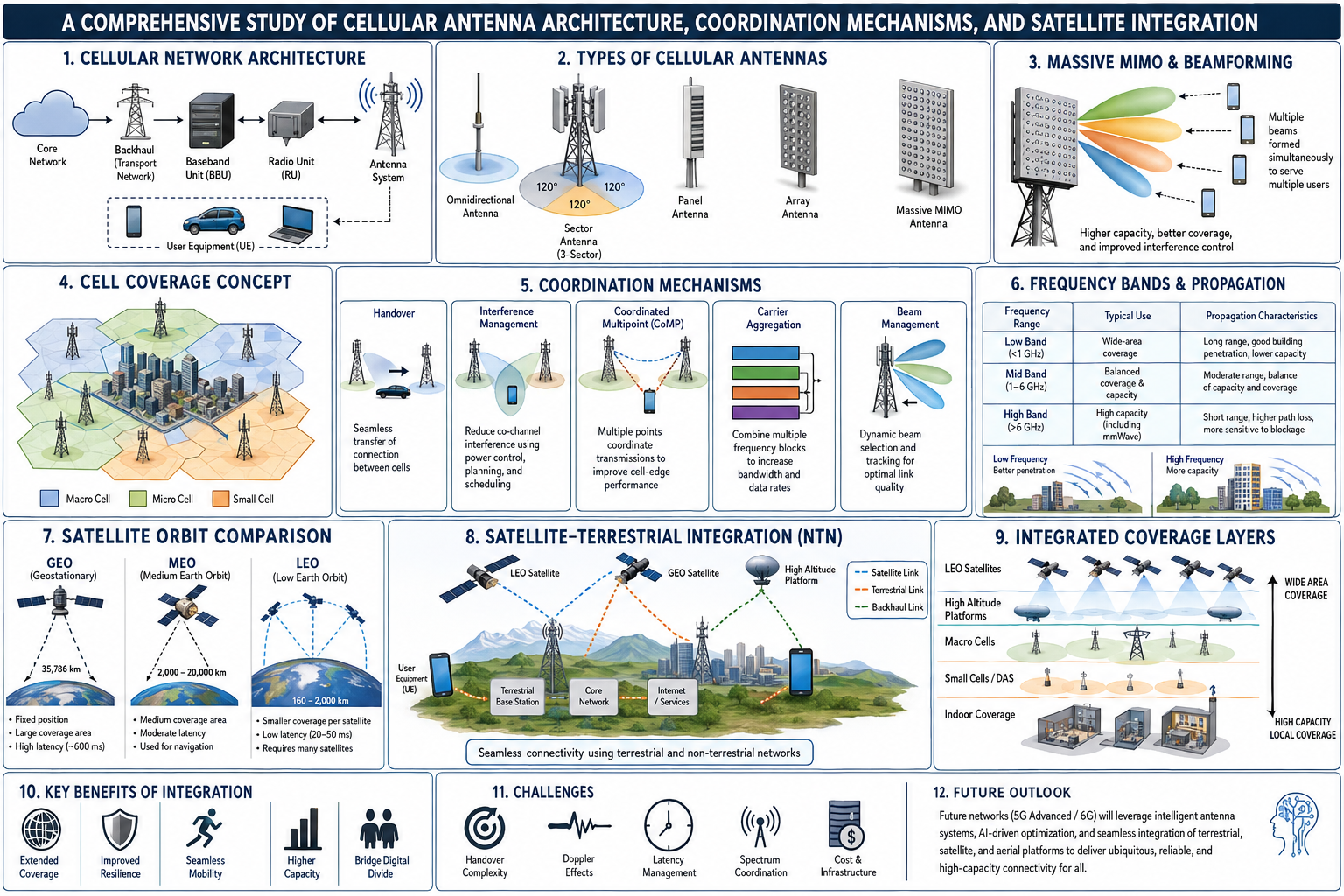
Modern wireless communication networks depend on antenna systems to transform electrical signals into electromagnetic waves and to receive transmitted signals from mobile devices, fixed terminals, vehicles, aircraft, satellites, and other connected systems. Cellular antennas form the physical radio interface between the user and the communication network. Their architecture has evolved from simple omnidirectional antennas used in early mobile networks into highly sophisticated multi-element, sectorized, adaptive, massive-MIMO, beamforming, and electronically steerable systems.
At the same time, the growth of 4G LTE, 5G New Radio, private cellular networks, Internet of Things (IoT), connected vehicles, broadband applications, and emerging 6G concepts has increased the demand for broader coverage, higher capacity, lower latency, improved energy efficiency, and seamless mobility. Satellite communication has become an increasingly important component of this ecosystem. Low Earth orbit (LEO), medium Earth orbit (MEO), and geostationary Earth orbit (GEO) satellites can complement terrestrial cellular infrastructure by providing connectivity in rural, maritime, aviation, disaster-affected, and otherwise underserved areas.
This study examines the architecture and operating principles of cellular antennas, including antenna elements, arrays, feeders, radio units, active antenna systems, remote radio units, massive MIMO, beamforming, sectorization, and small-cell deployments. It also investigates coordination mechanisms such as handover, interference management, coordinated multipoint transmission, carrier aggregation, network synchronization, beam management, and centralized or distributed radio coordination.
A major focus is the convergence between terrestrial cellular networks and satellite systems. The study explains how satellite antennas, gateway stations, user terminals, and space-based radio platforms can interact with cellular networks. It analyzes coverage characteristics associated with different orbital regimes and examines how antenna gain, frequency, bandwidth, propagation conditions, elevation angle, beam footprint, atmospheric effects, terrain, spectrum allocation, and network architecture influence service availability.
The study concludes that future communication systems are likely to become increasingly heterogeneous, combining terrestrial cellular towers, small cells, distributed antenna systems, high-altitude platforms, satellites, Wi-Fi, and other access technologies. The successful integration of these systems will depend on intelligent antenna architectures, dynamic spectrum management, advanced beamforming, artificial intelligence, network automation, accurate synchronization, and seamless mobility management.
Keywords: Cellular antennas, antenna arrays, 4G, 5G, 6G, massive MIMO, beamforming, sectorization, small cells, satellite communications, LEO, MEO, GEO, NTN, coverage, interference management, handover.
Table of Contents
- Introduction
- Historical Development of Cellular Antenna Systems
- Fundamentals of Electromagnetic Communication
- Basic Cellular Antenna Architecture
- Major Types of Cellular Antennas
- Omnidirectional Antennas
- Sectorized Antenna Systems
- Panel and Directional Antennas
- Antenna Arrays and Massive MIMO
- Beamforming and Beam Steering
- Active Antenna Systems
- Radio Units and Antenna Integration
- Small Cells and Distributed Antenna Systems
- Cellular Network Coordination Mechanisms
- Mobility and Handover Coordination
- Interference Management
- Coordinated Multipoint Communication
- Spectrum and Carrier Coordination
- Network Synchronization
- Cellular Coverage Analysis
- Factors Affecting Cellular Coverage
- Frequency Bands and Propagation
- Urban, Rural, Indoor, and Highway Coverage
- Cellular Antenna Optimization
- Satellite Communication Fundamentals
- Satellite Antenna Architecture
- GEO Satellite Systems
- MEO Satellite Systems
- LEO Satellite Systems
- Non-Terrestrial Networks and Cellular Integration
- Satellite-Terrestrial Coordination
- Coverage Analysis of Integrated Networks
- Challenges and Future Developments
- Case Study and Comparative Analysis
- Conclusion and Recommendations
- References and Suggested Further Reading
- Appendices
Chapter 1: Introduction
1.1 Background
Wireless communication has become one of the most important technological foundations of modern society. Mobile phones, computers, connected vehicles, industrial machines, smart meters, medical devices, agricultural sensors, and countless other systems rely on wireless networks.
The cellular network is called “cellular” because a large geographical area is divided into smaller service regions known as cells. Each cell is served by one or more radio access points connected to the wider telecommunications network.
The antenna is a fundamental component of every cellular radio system. It determines how electromagnetic energy is transmitted and received. The antenna’s physical design, height, orientation, gain, polarization, frequency range, and radiation pattern all influence the quality and geographical reach of wireless service.
Modern cellular antennas are no longer simply passive metal structures mounted on towers. They increasingly form part of intelligent radio systems incorporating multiple antenna elements, digital signal processing, beamforming, massive MIMO, remote radio units, and software-controlled radio resources.
At the same time, terrestrial cellular systems have limitations. Mountainous terrain, oceans, deserts, remote settlements, disaster zones, and economically challenging locations can be difficult or expensive to cover with conventional towers.
Satellite systems offer a complementary solution.
A satellite positioned hundreds or thousands of kilometers above Earth can illuminate enormous geographical regions. When combined with terrestrial networks, satellite communication can extend connectivity beyond the physical boundaries of conventional cellular infrastructure.
1.2 Research Problem
The central problem addressed by this study is how modern cellular antenna systems can provide efficient coverage and capacity while coordinating multiple users, cells, frequency resources, and increasingly integrated satellite links.
The challenges include:
- Limited radio spectrum
- Increasing mobile traffic
- Inter-cell interference
- Physical propagation limitations
- High infrastructure costs
- Uneven geographical coverage
- Network congestion
- Mobility management
- Satellite latency
- Doppler effects
- Atmospheric attenuation
- Spectrum sharing
- Synchronization
- Integration between terrestrial and non-terrestrial networks
The study therefore examines the architecture of antenna systems and the coordination technologies required to overcome these challenges.
Chapter 2: Historical Development of Cellular Antenna Systems
2.1 First-Generation Cellular Networks
Early analog cellular systems used relatively simple antenna structures. Base stations typically employed omnidirectional or sectorized antennas.
The primary objective was voice communication.
The network architecture was relatively simple compared with modern systems.
A typical early system consisted of:
Mobile phone → Radio signal → Base-station antenna → Radio equipment → Telephone network
The antenna’s primary function was to establish a radio connection over a designated geographical cell.
2.2 Second-Generation Systems
2G technologies introduced digital communication and improved spectrum efficiency.
Technologies such as GSM introduced:
- Digital voice
- SMS
- Time-division access
- Improved encryption
- Better frequency reuse
Antenna systems became more carefully engineered because networks needed to support greater numbers of users.
Sectorization became increasingly important.
A tower might use three sectors, each covering approximately 120 degrees.
2.3 Third Generation
3G systems increased data capacity and introduced mobile Internet services.
Antenna planning became more complex because network operators needed to optimize:
- Coverage
- Capacity
- Interference
- Data throughput
The importance of antenna orientation and radio-frequency planning increased.
2.4 Fourth Generation
4G LTE introduced advanced radio techniques including:
- OFDMA
- MIMO
- Carrier aggregation
- Advanced scheduling
- Improved packet networks
MIMO allowed multiple antennas to transmit and receive different signal streams.
This represented a major transformation in antenna architecture.
Instead of:
One transmitter → One antenna
the system increasingly became:
Multiple transmitters → Multiple antenna elements → Multiple spatial signal paths
2.5 Fifth Generation
5G introduced even greater reliance on:
- Massive MIMO
- Beamforming
- High-frequency spectrum
- Millimeter-wave communication
- Dense small-cell networks
- Network slicing
- Edge computing
The antenna became a highly integrated component of the radio system.
Chapter 3: Fundamentals of Electromagnetic Communication
A wireless communication system operates by converting information into an electrical signal, processing that signal, and transmitting it through an antenna.
The basic sequence is:
Information → Digital processing → Modulation → RF signal → Power amplifier → Antenna → Electromagnetic wave → Receiving antenna → RF receiver → Demodulation → Information
An antenna performs two fundamental functions:
- Converts electrical energy into electromagnetic radiation during transmission.
- Converts electromagnetic energy into electrical signals during reception.
3.1 Frequency
Frequency describes the number of oscillations occurring per second.
It is measured in hertz.
Common wireless frequencies include:
- Hundreds of megahertz
- Several gigahertz
- Tens of gigahertz
Higher frequencies generally allow larger available bandwidths but can experience greater propagation losses and poorer penetration through obstacles.
3.2 Wavelength
The relationship between frequency and wavelength is:λ=fc
where:
- λ = wavelength
- c = speed of light
- f = frequency
As frequency increases, wavelength decreases.
This has important consequences for antenna size.
Chapter 4: Basic Cellular Antenna Architecture
A modern cellular antenna system can be represented as:
Core Network
↓
Transport Network
↓
Baseband Unit
↓
Radio Unit
↓
Feeder or Fiber Connection
↓
Antenna Array
↓
Electromagnetic Radiation
A receiving system operates in the reverse direction.
4.1 Antenna Elements
An antenna element is an individual radiating structure.
Examples include:
- Dipoles
- Patches
- Monopoles
- Horns
- Slot antennas
Modern cellular arrays can contain many individual elements.
4.2 Antenna Array
An array combines multiple antenna elements.
The purpose may include:
- Increasing gain
- Controlling radiation direction
- Creating multiple beams
- Supporting spatial multiplexing
- Improving signal quality
4.3 Feed Network
The feed network distributes radio-frequency energy among antenna elements.
In passive systems, the feed network plays a major role in determining the radiation pattern.
In active systems, individual elements may have separate radio-frequency chains.
4.4 Polarization
Polarization describes the orientation of the electromagnetic field.
Cellular systems commonly use:
- Vertical polarization
- Horizontal polarization
- Slant polarization
- Dual polarization
Dual-polarized antennas are particularly important in modern MIMO systems.
Chapter 5: Major Types of Cellular Antennas
Cellular antennas can be classified according to:
- Radiation pattern
- Frequency
- Physical structure
- Polarization
- Number of elements
- Mechanical or electronic steering
- Passive or active operation
Major categories include:
- Omnidirectional antennas
- Sector antennas
- Panel antennas
- Directional antennas
- Array antennas
- Massive-MIMO antennas
- Active antenna systems
- Small-cell antennas
- Distributed antenna systems
- Indoor antennas
Chapter 6: Omnidirectional Antennas
An omnidirectional antenna radiates energy broadly around the horizontal plane.
The idealized radiation pattern resembles a doughnut.


6
Omnidirectional systems are useful where broad coverage is needed.
Advantages include:
- Simple design
- Broad horizontal coverage
- Lower installation complexity
Disadvantages include:
- Limited spatial control
- Greater potential interference
- Less capacity optimization
They are commonly associated with small cells and certain specialized deployments.
Chapter 7: Sectorized Antenna Systems
Sectorization divides a cell into multiple directional regions.
A common configuration uses:
- Three sectors
- Approximately 120 degrees per sector
Other configurations may use:
- Six sectors
- Twelve sectors
- Specialized directional arrangements
Sectorization improves frequency reuse and capacity.
A simplified tower structure is:
Sector A → 120°
Sector B → 120°
Sector C → 120°
Each sector has an independent radiation pattern.
Chapter 8: Panel and Directional Antennas
Panel antennas are common on macro-cell towers.
They generally provide:
- Controlled horizontal beamwidth
- Controlled vertical beamwidth
- High gain
- Dual polarization
Their radiation pattern can be engineered to focus energy toward the intended coverage area.
This reduces wasted radiation and can improve coverage efficiency.
Chapter 9: Antenna Arrays and Massive MIMO
Massive MIMO is one of the most important developments in cellular antenna technology.
MIMO means Multiple-Input Multiple-Output.
Instead of transmitting through one antenna, multiple antenna elements are used.
Massive MIMO expands this concept to potentially dozens or more antenna elements.
The benefits include:
- Higher capacity
- Improved spectral efficiency
- Beamforming
- Spatial multiplexing
- Improved interference control
The system can simultaneously serve multiple users by transmitting different spatial signal patterns.
Chapter 10: Beamforming and Beam Steering
Beamforming controls the phase and amplitude of signals transmitted from multiple antenna elements.
If signals are combined constructively in a desired direction, the resulting radiation becomes stronger in that direction.
Conceptually:
Antenna 1 → Signal
Antenna 2 → Phase-adjusted signal
Antenna 3 → Phase-adjusted signal
Antenna 4 → Phase-adjusted signal
↓
Combined beam
↓
Target user
Beamforming may be:
- Analog
- Digital
- Hybrid
Digital beamforming provides highly flexible control but can require greater processing power and hardware complexity.
Chapter 11: Active Antenna Systems
An Active Antenna System integrates antenna elements with radio-frequency electronics.
Traditional architecture:
Radio Unit → Cable → Passive Antenna
Modern architecture:
Digital Processing → Radio Chains → Integrated Antenna Array
Benefits include:
- Reduced feeder losses
- Dynamic beam control
- Improved MIMO capability
- More flexible coverage
- Software-defined optimization
Active antenna systems are especially important in 5G networks.
Chapter 12: Radio Units and Antenna Integration
Modern cellular architecture may separate the radio system into:
- Centralized or distributed processing
- Baseband processing
- Radio units
- Antenna arrays
In some architectures, the radio unit is mounted near the antenna to reduce cable losses.
Fiber-based transport may connect the radio unit to centralized processing.
This architecture supports flexible network deployment.
Chapter 13: Small Cells and Distributed Antenna Systems
13.1 Small Cells
Small cells are low-power cellular access points.
Examples include:
- Femtocells
- Picocells
- Microcells
They are useful for:
- Urban capacity
- Indoor coverage
- Shopping centers
- Stadiums
- Offices
- Transport hubs
13.2 Distributed Antenna Systems
A distributed antenna system uses multiple antennas connected to a shared radio source.
Conceptually:
Central Radio Source
↓
Distribution Network
↓
Antenna 1
Antenna 2
Antenna 3
Antenna 4
This architecture is valuable for large buildings and venues.
Chapter 14: Cellular Network Coordination Mechanisms
Cellular coordination ensures that multiple network elements operate together.
Important mechanisms include:
- Handover
- Interference coordination
- Resource allocation
- Synchronization
- Beam management
- Coordinated multipoint
- Carrier aggregation
Coordination is essential because neighboring cells operate in the same geographical environment.
Chapter 15: Mobility and Handover Coordination
A mobile device may move between cells.
The network must determine:
- When to hand over
- Which cell should receive the user
- Which frequency should be used
- Whether the target cell has capacity
The simplified process is:
Cell A
↓
User moves
↓
Signal from Cell B becomes stronger
↓
Network evaluates measurements
↓
Handover decision
↓
Connection transfers to Cell B
A poorly optimized handover can result in:
- Dropped calls
- Interrupted data
- Reduced quality
Modern networks use sophisticated measurement and decision mechanisms.
Chapter 16: Interference Management
Interference occurs when unwanted radio signals affect communication.
Sources include:
- Neighboring cells
- Other users
- Reflections
- External radio systems
- Poor frequency planning
Interference management techniques include:
- Frequency planning
- Power control
- Beamforming
- Sectorization
- Scheduling
- Coordinated transmission
The objective is to maximize useful signal quality while minimizing interference.
Chapter 17: Coordinated Multipoint Communication
Coordinated Multipoint, commonly abbreviated CoMP, allows multiple transmission points to coordinate their operation.
A user located near a cell boundary may receive signals from several transmission points.
Instead of treating these signals as independent interference, the network can coordinate them.
Possible benefits include:
- Improved cell-edge performance
- Better reliability
- Higher throughput
- Reduced interference
This approach requires:
- High-quality coordination
- Network synchronization
- Fast data exchange
- Advanced signal processing
Chapter 18: Spectrum and Carrier Coordination
Cellular operators use licensed spectrum bands.
Spectrum coordination involves:
- Frequency allocation
- Channel bandwidth
- Carrier aggregation
- Interference protection
- Dynamic spectrum sharing
Carrier aggregation allows multiple frequency blocks to be combined.
This increases effective bandwidth and can improve data rates.
Chapter 19: Network Synchronization
Synchronization is critical.
Networks must maintain accurate:
- Time
- Frequency
- Phase
Synchronization is especially important for:
- TDD networks
- Massive MIMO
- Coordinated transmission
- Satellite communication
- High-speed mobility
Satellite systems can also contribute precise timing references, although GNSS-based synchronization requires careful engineering because satellite signals themselves may be vulnerable to interference or obstruction.
Chapter 20: Cellular Coverage Analysis
Coverage is not simply a circle around a tower.
Real coverage depends on:
- Frequency
- Transmitter power
- Antenna gain
- Antenna height
- Terrain
- Buildings
- Vegetation
- Weather
- Receiver sensitivity
- Network loading
The basic radio link budget can be expressed conceptually as:Pr=Pt+Gt+Gr−L
where:
- Pr = received power
- Pt = transmitted power
- Gt = transmitting antenna gain
- Gr = receiving antenna gain
- L = total system losses
The total loss includes free-space path loss and additional losses.
Chapter 21: Factors Affecting Cellular Coverage
21.1 Antenna Height
Higher antennas generally improve line-of-sight conditions.
However, excessive height can cause overshooting, where the signal travels beyond the intended coverage area.
21.2 Antenna Gain
Higher gain can concentrate energy in desired directions.
However, gain is not equivalent to unlimited power.
It changes the spatial distribution of radiated energy.
21.3 Transmit Power
Higher transmit power can increase coverage but may also increase interference.
Therefore, network planning seeks an optimum balance.
21.4 Terrain
Mountains and hills can block radio signals.
Valleys can create shadow zones.
21.5 Buildings
Urban buildings create:
- Reflection
- Diffraction
- Scattering
- Shadowing
Modern cellular systems use advanced antenna techniques to manage these conditions.
Chapter 22: Frequency Bands and Propagation
Lower-frequency signals generally propagate farther and penetrate obstacles more effectively.
Higher frequencies can provide greater bandwidth but often have:
- Higher path loss
- Greater sensitivity to blockage
- Reduced penetration
Millimeter-wave systems are therefore often deployed using dense networks of access points.
A simplified comparison is:
| Frequency Range | Typical Advantage | Typical Challenge |
|---|---|---|
| Low band | Wide coverage | Limited bandwidth |
| Mid band | Balance of coverage and capacity | Moderate propagation loss |
| High band | Very high capacity | Shorter effective range |
Chapter 23: Urban, Rural, Indoor, and Highway Coverage
23.1 Urban Coverage
Urban areas require:
- Macro cells
- Small cells
- Indoor systems
- Beamforming
- Advanced interference management
High traffic density makes capacity as important as coverage.
23.2 Rural Coverage
Rural areas often require:
- Higher towers
- Lower-frequency spectrum
- Larger cells
- Strategic antenna placement
Satellite connectivity can complement terrestrial infrastructure.
23.3 Indoor Coverage
Buildings can significantly weaken outdoor signals.
Solutions include:
- Indoor small cells
- Distributed antenna systems
- Wi-Fi integration
- Repeater systems
23.4 Highway Coverage
Highways require continuous coverage along linear corridors.
Antenna systems may be oriented to provide overlapping coverage zones.
Chapter 24: Cellular Antenna Optimization
Optimization includes:
- Antenna tilt
- Azimuth adjustment
- Power control
- Frequency planning
- Beam optimization
- Cell parameter tuning
Mechanical Tilt
The physical antenna is angled downward.
Electrical Tilt
The radiation pattern is adjusted electronically.
Electrical tilt can be dynamically controlled in advanced systems.
Chapter 25: Satellite Communication Fundamentals
A satellite communication system typically consists of:
Satellite
↕
Ground Station
↕
Core Network
The satellite receives signals, processes or relays them, and transmits them toward another location.
Satellite systems are valuable because they can cover areas where terrestrial infrastructure is difficult to deploy.
Applications include:
- Broadband
- Navigation
- Broadcasting
- Disaster response
- Maritime communication
- Aviation
- Remote connectivity
- Military and government communications
Chapter 26: Satellite Antenna Architecture
Satellite antenna systems may include:
- Reflector antennas
- Horn antennas
- Phased arrays
- Electronically steered antennas
- Multi-beam antennas
Satellite antennas must operate in a challenging environment.
They must support:
- High gain
- Precise pointing
- Wide coverage
- Frequency reuse
- Beam management
Modern satellites increasingly use multiple spot beams.
Instead of one enormous beam, the satellite creates many smaller beams.
This allows frequency reuse and greater capacity.


5
Chapter 27: GEO Satellite Systems
Geostationary Earth orbit satellites operate at approximately 35,786 km above the equator.
A GEO satellite appears stationary relative to a point on Earth.
Advantages
- Large coverage footprint
- Fixed ground antennas can track the satellite without continuous movement
- Mature technology
- Long operational experience
Disadvantages
- High propagation delay
- Weaker coverage at extreme latitudes
- Large launch requirements
- Significant free-space path loss
GEO systems remain important for broadcasting and broadband applications.
Chapter 28: MEO Satellite Systems
Medium Earth orbit satellites operate between low Earth orbit and geostationary orbit.
MEO systems offer a compromise between:
- Coverage
- Latency
- Number of satellites
Navigation systems have historically made significant use of MEO orbits.
Chapter 29: LEO Satellite Systems
Low Earth orbit satellites operate much closer to Earth.
Advantages include:
- Lower latency
- Stronger received signals relative to GEO
- Smaller coverage footprints
- Potential for high-capacity broadband
Challenges include:
- Large satellite constellations
- Continuous satellite movement
- Frequent handovers
- Doppler shift
- Complex network coordination
A user terminal may transition from:
Satellite A → Satellite B → Satellite C
as satellites move across the sky.
Chapter 30: Non-Terrestrial Networks and Cellular Integration
The integration of cellular networks with satellite systems is commonly associated with Non-Terrestrial Networks, or NTN.
A conceptual integrated architecture is:
User Equipment
↓
Terrestrial Base Station OR Satellite Link
↓
Radio Access Network
↓
Transport Network
↓
5G Core / Network Core
The objective is to make connectivity increasingly seamless.
A user may communicate through:
- A terrestrial cell
- A satellite
- A high-altitude platform
depending on availability and network conditions.
Chapter 31: Satellite-Terrestrial Coordination
Coordination between terrestrial and satellite networks requires careful management.
Important areas include:
Spectrum
The systems must avoid harmful interference.
Mobility
Satellite movement creates frequent changes in connectivity.
Doppler
LEO satellites move rapidly relative to users.
Timing
Different propagation delays must be accommodated.
Beam Management
The network must select and maintain the best available beam.
Handover
Users may transition between:
- Terrestrial cell
- Satellite beam
- Another satellite beam
- Another terrestrial cell
This creates a multi-dimensional mobility problem.
Chapter 32: Coverage Analysis of Integrated Networks
An integrated network can be visualized as a layered coverage architecture.
Layer 1: Macro Cellular
Provides broad terrestrial coverage.
Layer 2: Small Cells
Provides high capacity in dense areas.
Layer 3: Indoor Systems
Provides building-level coverage.
Layer 4: LEO Satellites
Provides wide-area connectivity and remote coverage.
Layer 5: High-Altitude Platforms
Potentially provides intermediate coverage between terrestrial and satellite systems.
The result is a multi-layer connectivity environment.
32.1 Coverage Comparison
| System | Typical Coverage | Latency | Capacity Potential | Mobility Complexity |
|---|---|---|---|---|
| Macro Cell | Regional | Low | High | Moderate |
| Small Cell | Local | Very low | Very high | Moderate |
| Indoor DAS | Building | Very low | High | Low |
| GEO Satellite | Very large | High | High | Low satellite mobility |
| MEO Satellite | Large | Medium | High | Moderate |
| LEO Satellite | Regional per satellite | Low | High | High |
These values are conceptual rather than universal because actual performance depends on system design, spectrum, network loading, antenna configuration, and propagation conditions.
Chapter 33: Challenges and Future Developments
33.1 Antenna Complexity
As antenna systems become more advanced, hardware becomes more complex.
Future systems must balance:
- Cost
- Energy consumption
- Performance
- Reliability
33.2 Artificial Intelligence
AI can assist with:
- Beam optimization
- Traffic prediction
- Handover decisions
- Interference management
- Energy optimization
33.3 6G
Future 6G concepts may combine:
- Terrestrial networks
- Satellites
- High-altitude platforms
- Intelligent surfaces
- AI-native networks
The antenna may become part of an intelligent distributed communication environment.
33.4 Reconfigurable Intelligent Surfaces
Reconfigurable intelligent surfaces are being investigated as a means of controlling radio propagation.
A surface could potentially redirect or manipulate electromagnetic waves.
This may help address difficult coverage environments.
33.5 Integrated Sensing and Communication
Future networks may use radio signals for both communication and sensing.
Potential applications include:
- Object detection
- Vehicle tracking
- Environmental monitoring
- Industrial automation
This would further expand the role of antenna arrays.
Chapter 34: Case Study and Comparative Analysis
Consider a hypothetical national communication system.
The country contains:
- Major cities
- Rural communities
- Mountains
- Deserts
- Coastal areas
- Highways
A single technology cannot efficiently serve every environment.
Urban Areas
Deploy:
- 5G macro cells
- Massive MIMO
- Small cells
- Indoor systems
Rural Areas
Deploy:
- Macro cells
- Low-band spectrum
- High towers
- Satellite backhaul
Remote Areas
Deploy:
- LEO satellite systems
- Satellite user terminals
- Hybrid terrestrial-satellite systems
Disaster Areas
Deploy:
- Portable cellular systems
- Satellite backhaul
- Rapidly deployable antennas
This creates a resilient multi-layer communication architecture.
Chapter 35: Conclusion and Recommendations
Cellular antenna technology has evolved from relatively simple omnidirectional systems into sophisticated intelligent radio platforms capable of controlling multiple beams, serving many users simultaneously, and adapting to changing network conditions.
The antenna is now a central component of network intelligence.
The development of:
- MIMO
- Massive MIMO
- Beamforming
- Active antenna systems
- Small cells
- Coordinated multipoint
- Advanced interference management
has significantly improved the performance of terrestrial cellular networks.
However, terrestrial networks cannot economically cover every location on Earth.
Satellite communication provides a complementary layer.
GEO satellites provide broad regional coverage, MEO systems offer an intermediate solution, and LEO constellations provide lower-latency connectivity with increased mobility and handover complexity.
The future is therefore unlikely to be based on terrestrial or satellite networks alone.
Instead, future communication infrastructure will increasingly operate as an integrated ecosystem consisting of:
Macro Cells
Small Cells
Indoor Networks
Distributed Antenna Systems
LEO Satellites
MEO Satellites
GEO Satellites
High-Altitude Platforms
Intelligent Network Control
The major recommendation of this study is that future network planning should adopt a multi-layer, multi-access, and intelligent architecture. Antenna systems should be designed not only for maximum signal strength but also for capacity, energy efficiency, interference management, mobility, resilience, and interoperability.
The convergence of terrestrial cellular networks and satellite systems represents an important direction for global connectivity. It has the potential to reduce digital inequality, improve disaster resilience, connect remote populations, support transportation and logistics, and enable new industrial applications.
Ultimately, the future communication network can be understood as a global three-dimensional connectivity fabric. Terrestrial antennas provide dense coverage near the Earth’s surface, high-altitude platforms can provide intermediate coverage, and satellites provide large-scale connectivity from space. Intelligent coordination among these layers can create a more resilient and comprehensive communication system.
Suggested 35-Page Academic Page Distribution
| Section | Approx. Pages |
|---|---|
| Title Page | 1 |
| Abstract | 1 |
| Table of Contents | 1 |
| Introduction | 2 |
| Historical Development | 2 |
| Electromagnetic Fundamentals | 2 |
| Cellular Antenna Architecture | 2 |
| Antenna Types | 3 |
| Massive MIMO and Beamforming | 2 |
| Active Antenna Systems | 1 |
| Small Cells and DAS | 2 |
| Coordination Mechanisms | 3 |
| Coverage Analysis | 3 |
| Propagation and Frequency | 2 |
| Satellite Communication | 2 |
| GEO/MEO/LEO Analysis | 3 |
| NTN Integration | 2 |
| Satellite-Terrestrial Coordination | 1 |
| Future Technologies | 1 |
| Case Study | 1 |
| Conclusion | 1 |
| References/Appendices | 2 |
| Total | 35 pages |
Recommended Figures for the Full Thesis
- Basic cellular network architecture
- Omnidirectional antenna radiation pattern
- Three-sector cellular tower
- Panel antenna structure
- MIMO antenna array
- Massive-MIMO beamforming illustration
- Active antenna system architecture
- Small-cell deployment
- Distributed antenna system
- Cellular handover process
- Inter-cell interference illustration
- Coordinated multipoint architecture
- Cellular coverage map
- Urban propagation environment
- Rural macro-cell coverage
- GEO/MEO/LEO orbital comparison
- Satellite communication architecture
- Satellite spot-beam coverage
- LEO satellite handover
- Integrated terrestrial-satellite NTN architecture
- Future 6G multi-layer network
Final Academic Perspective
The fundamental principle connecting cellular antennas and satellite systems is controlled electromagnetic coverage. Whether the antenna is mounted on a tower, integrated into a smartphone, installed inside a building, placed on a vehicle, or mounted on a satellite, its purpose is to establish a reliable radio link.
The greatest technological transition is therefore not simply the development of faster antennas. It is the transformation of the communication network into a coordinated, adaptive, multi-layer system in which terrestrial and space-based infrastructure cooperate dynamically. This architecture is likely to become increasingly important as global demand for ubiquitous connectivity, IoT, autonomous systems, intelligent transportation, and resilient communications continues to grow.






Be First to Comment