
Abstract
- Background
- Research problem
- Research objectives
- Research methodology
- Key findings
- Recommendations
Chapter 1: Introduction
1.1 Background
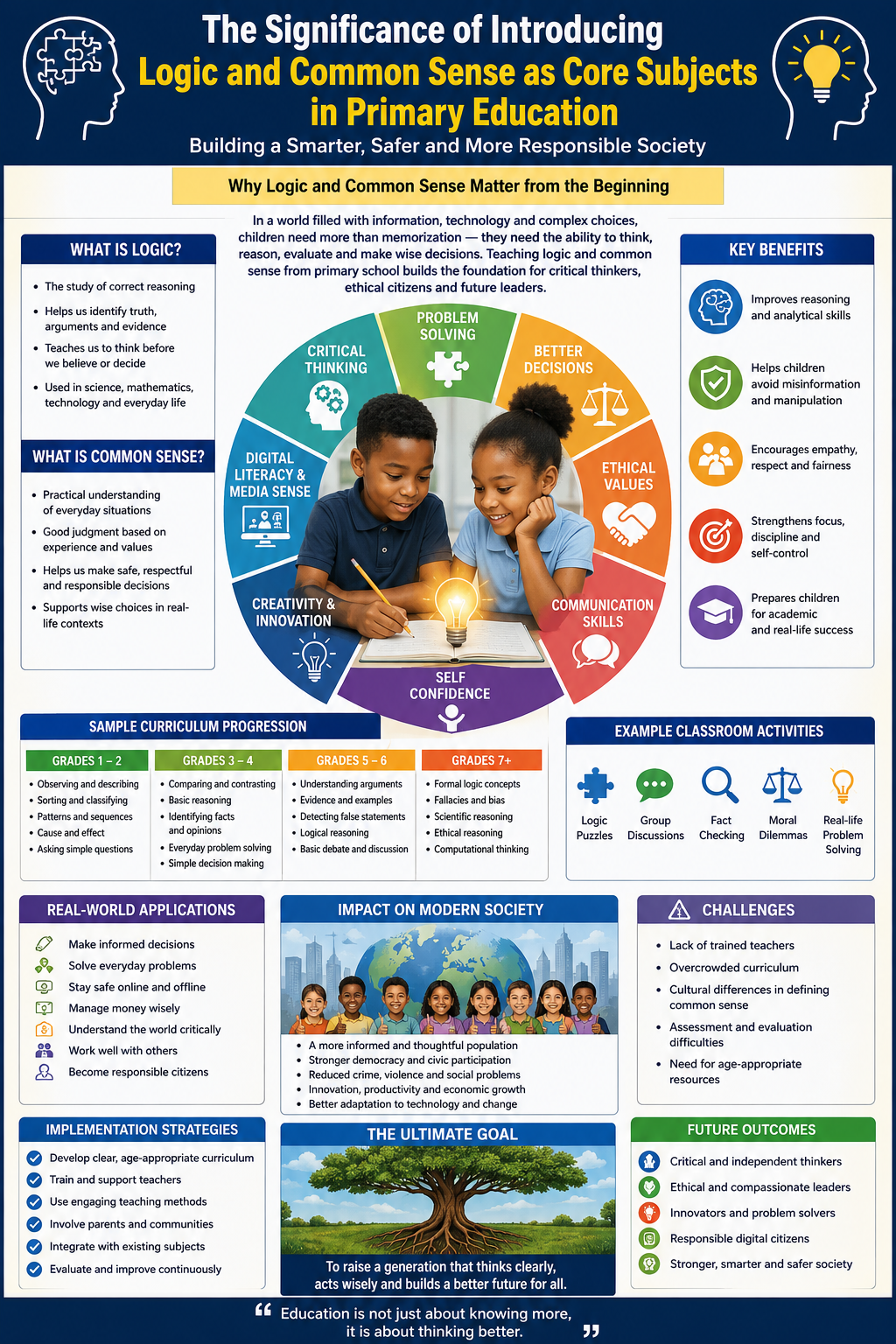
Modern societies face increasingly complex challenges, including misinformation, rapid technological change, and growing reliance on digital systems. Alongside literacy, numeracy, and science, many educators argue that reasoning skills deserve greater emphasis in education.
Logic provides methods for evaluating arguments and drawing valid conclusions. Common sense involves practical judgment developed through experience and context. Although common sense is influenced by culture and circumstances, structured education can help students improve practical reasoning and decision-making.
This thesis explores the possible educational and societal effects of introducing age-appropriate instruction in logic and practical reasoning from primary school onward.
1.2 Research Problem
Many education systems emphasize memorization while devoting comparatively less time to explicit instruction in reasoning, argument evaluation, and evidence-based decision-making. This may contribute to difficulties in evaluating information critically.
1.3 Aim
To examine the educational, social, technological, and economic significance of introducing logic and practical reasoning into primary education.
1.4 Objectives
- Examine the history of logic education.
- Define logic and practical reasoning.
- Explore child cognitive development.
- Assess potential academic benefits.
- Evaluate social implications.
- Consider ethical challenges.
- Compare international educational approaches.
- Develop implementation recommendations.
Chapter 2: Historical Development of Logic
Topics include:
- Ancient Egyptian reasoning traditions
- Ancient Greek philosophers
- Aristotle and formal logic
- Medieval logical traditions
- Renaissance developments
- Symbolic logic
- Modern computational logic
- Logic in artificial intelligence
Chapter 3: Understanding Logic
Definitions of:
- Deductive reasoning
- Inductive reasoning
- Abductive reasoning
- Mathematical logic
- Symbolic logic
- Computational logic
- Boolean logic
Chapter 4: Understanding Common Sense
Discussion includes:
- Practical reasoning
- Everyday decision-making
- Context-dependent judgment
- Human experience
- Cultural influences
- Cognitive heuristics
- Limits of common sense
Chapter 5: Child Brain Development
Topics include:
- Brain maturation
- Memory
- Attention
- Executive function
- Problem-solving
- Cognitive flexibility
- Language development
- Reasoning development
Chapter 6: Logic in Primary Education
Suggested progression:
Grades 1–3
- Observation
- Patterns
- Sorting
- Sequences
- Cause and effect
Grades 4–6
- Arguments
- Evidence
- Detecting contradictions
- Simple debate
- Everyday reasoning
Grades 7+
- Formal logic
- Fallacies
- Scientific reasoning
- Computational thinking
Chapter 7: Curriculum Design
Possible modules:
- Thinking clearly
- Asking good questions
- Evidence
- Truth and opinion
- Fact-checking
- Solving problems
- Ethical reasoning
- Decision-making
Chapter 8: Common Sense Curriculum
Topics include:
- Personal safety
- Financial awareness
- Online behavior
- Communication
- Time management
- Risk assessment
- Teamwork
- Emotional awareness
Chapter 9: Critical Thinking
Skills developed:
- Analysis
- Evaluation
- Interpretation
- Reflection
- Argument construction
- Evidence assessment
Chapter 10: Scientific Thinking
Relationship with:
- Mathematics
- Science
- Engineering
- Medicine
- Economics
- Research
Chapter 11: Artificial Intelligence
Connections between logic and:
- Machine learning
- Algorithms
- Robotics
- Expert systems
- Programming
- Data science
Chapter 12: Misinformation
Potential contributions of reasoning education to:
- Identifying false claims
- Evaluating evidence
- Recognizing manipulation
- Responsible media consumption
Chapter 13: Ethics
Discussion includes:
- Respectful disagreement
- Intellectual humility
- Fairness
- Responsibility
- Civic participation
Chapter 14: Economic Benefits
Potential long-term effects:
- Workforce readiness
- Innovation
- Entrepreneurship
- Productivity
- Better business decisions
Chapter 15: Government and Public Policy
Possible implications:
- Evidence-informed policymaking
- Public consultation
- Civic education
- Institutional trust
Chapter 16: International Perspectives
Examples of reasoning-related education in countries such as:
- Singapore
- Finland
- Japan
- Estonia
- Canada
Compare how critical thinking, philosophy for children, or reasoning skills are incorporated into curricula.
Chapter 17: Challenges
Potential issues include:
- Teacher preparation
- Curriculum time
- Assessment methods
- Cultural diversity
- Resource constraints
- Defining “common sense” consistently
Chapter 18: Implementation Framework
Recommendations:
- Teacher training
- Pilot programs
- Age-appropriate materials
- Digital learning tools
- Continuous assessment
- Parent engagement
Chapter 19: Future Society
Potential long-term outcomes:
- More informed citizens
- Improved innovation
- Better problem-solving
- Stronger democratic participation
- Responsible AI use
- Increased adaptability to technological change
Chapter 20: Conclusion
The thesis concludes that introducing structured instruction in logic and practical reasoning from primary school has the potential to strengthen analytical thinking, evidence evaluation, and problem-solving when implemented in developmentally appropriate ways. It should complement—not replace—existing subjects such as mathematics, languages, science, and social studies. Success depends on well-trained teachers, balanced curricula, and teaching methods that encourage inquiry, respectful discussion, and real-world application.
Suggested Appendices
- Sample lesson plans
- Age-based curriculum framework
- Classroom activities
- Logic puzzles
- Critical-thinking exercises
- Case studies
- Assessment rubrics
- Teacher training guidelines
- Sample examination questions
- Glossary of logical terms
This structure provides sufficient depth and breadth for a 38-page undergraduate or postgraduate thesis, with balanced discussion of educational theory, cognitive science, policy considerations, implementation strategies, and potential societal impacts.





Be First to Comment