
Emotional Intelligence: Foundations, Architecture, Application & Mastery in Modern Human Ecosystems
PAGE 1 — Executive Overview
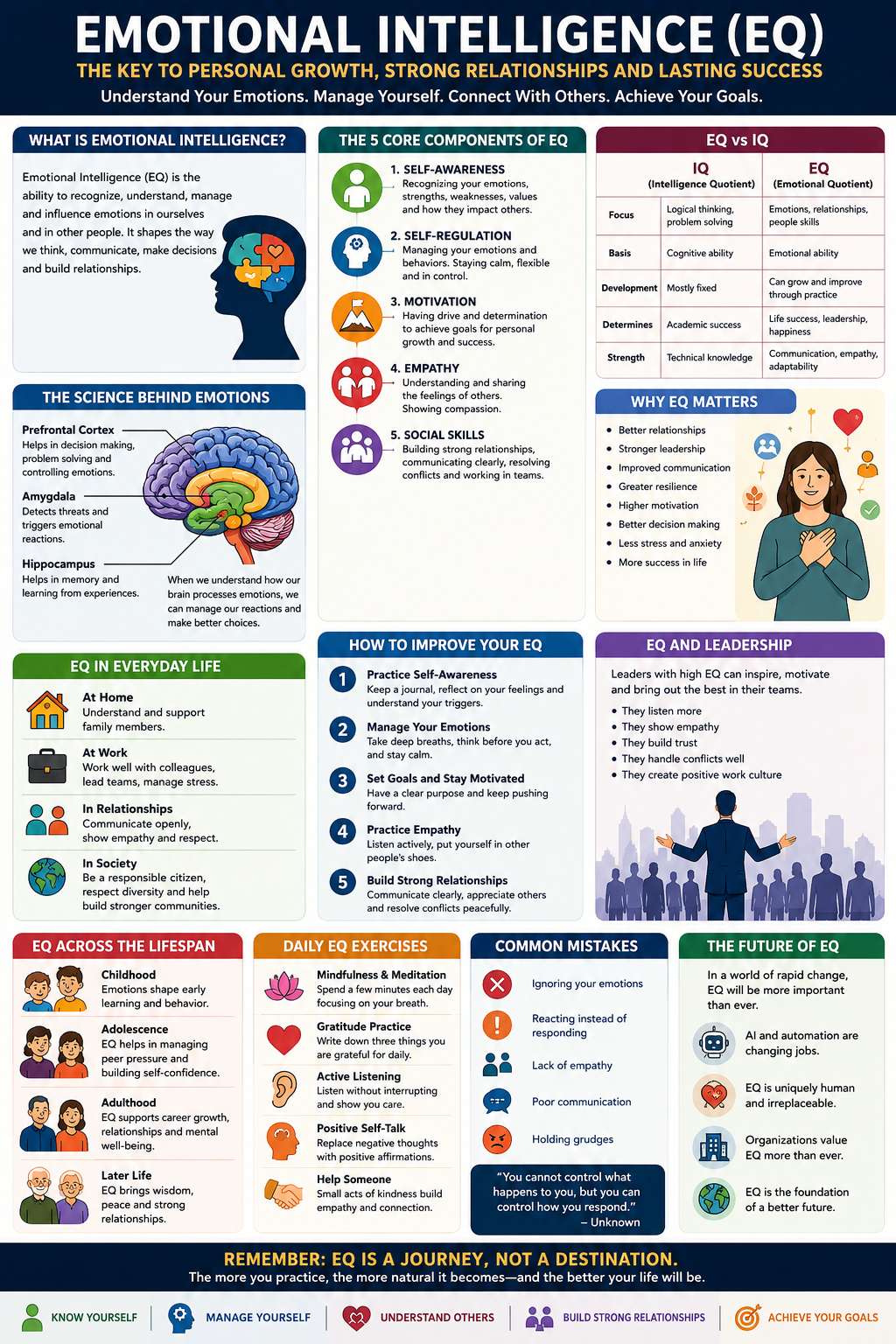
Emotional Intelligence (EQ) is the human operating system that governs how individuals perceive emotions, regulate responses, build relationships, make decisions, and navigate complex social environments. In modern society—where collaboration, leadership, and adaptability define success—EQ has become more valuable than IQ, technical skill, or academic achievement. This essay provides a complete, structured, and tutorial‑level exploration of EQ fundamentals, mechanisms, development pathways, and real‑world applications.
PAGE 2 — Definition and Core Meaning of EQ
EQ refers to the ability to recognize, understand, manage, and use emotions effectively. It integrates:
- Self-awareness
- Self-regulation
- Social awareness
- Relationship management
- Internal motivation
EQ is not “soft”; it is a measurable cognitive skill that shapes human performance.
PAGE 3 — Why EQ Matters in Modern Society
EQ determines:
- How people collaborate
- How leaders influence
- How teams resolve conflict
- How individuals adapt under pressure
- How organizations maintain culture
In a digital, automated economy, EQ is the last competitive advantage humans hold.
PAGE 4 — The Neuroscience of EQ
EQ is rooted in the interaction between:
- Amygdala (emotional response)
- Prefrontal cortex (logic, decision-making)
- Hippocampus (memory and emotional learning)
EQ mastery requires strengthening the prefrontal cortex’s ability to regulate emotional impulses.
PAGE 5 — The Five Pillars of EQ
- Self-awareness
- Self-regulation
- Motivation
- Empathy
- Social skills
These pillars form the architecture of emotional competence.
PAGE 6 — Pillar 1: Self-Awareness
Self-awareness is the ability to identify your emotions, triggers, strengths, weaknesses, and behavioral patterns. Key components:
- Emotional labeling
- Trigger recognition
- Honest self-assessment
- Confidence grounded in reality
PAGE 7 — Developing Self-Awareness
Techniques:
- Daily reflection
- Emotional journaling
- Mindfulness
- Asking for feedback
- Personality assessments
Self-awareness is the foundation of all EQ growth.
PAGE 8 — Pillar 2: Self-Regulation
Self-regulation is the ability to control emotional reactions and maintain stability under pressure. It includes:
- Impulse control
- Stress management
- Adaptability
- Emotional discipline
PAGE 9 — Techniques for Self-Regulation
- Breathing exercises
- Cognitive reframing
- Delayed response strategy
- Emotional detachment from triggers
- Building tolerance for discomfort
PAGE 10 — Pillar 3: Internal Motivation
Internal motivation is the ability to drive yourself without external rewards. Characteristics:
- Purpose-driven behavior
- Persistence
- Resilience
- Long-term focus
PAGE 11 — Building Internal Motivation
Methods:
- Goal-setting
- Vision mapping
- Habit stacking
- Reward systems
- Self-accountability
PAGE 12 — Pillar 4: Empathy
Empathy is the ability to understand and feel what others experience. Types:
- Cognitive empathy
- Emotional empathy
- Compassionate empathy
PAGE 13 — Strengthening Empathy
- Active listening
- Perspective-taking
- Reducing judgment
- Observing non-verbal cues
- Practicing compassion
PAGE 14 — Pillar 5: Social Skills
Social skills determine how effectively you interact with others. Includes:
- Communication
- Influence
- Conflict resolution
- Collaboration
- Relationship building
PAGE 15 — Communication Mastery
EQ communication requires:
- Clarity
- Tone control
- Emotional timing
- Listening more than speaking
- Reading body language
PAGE 16 — Conflict Resolution
EQ transforms conflict into growth. Steps:
- Identify root cause
- Separate emotion from issue
- Listen without interruption
- Seek mutual benefit
- Maintain respect
PAGE 17 — EQ in Leadership
High-EQ leaders:
- Inspire rather than intimidate
- Influence rather than command
- Build trust
- Create psychological safety
- Drive performance through connection
PAGE 18 — EQ in the Workplace
EQ improves:
- Team cohesion
- Productivity
- Innovation
- Customer relationships
- Organizational culture
EQ is now a top hiring criterion globally.
PAGE 19 — EQ in Decision-Making
Emotionally intelligent decisions balance:
- Logic
- Emotion
- Long-term impact
- Human factors
EQ prevents impulsive, fear-based, or ego-driven choices.
PAGE 20 — EQ in Stress Management
EQ helps individuals:
- Recognize stress signals
- Prevent emotional overload
- Maintain clarity under pressure
- Recover quickly
PAGE 21 — EQ in Relationships
EQ strengthens:
- Trust
- Communication
- Emotional intimacy
- Conflict management
- Mutual respect
Relationships fail when EQ is low, not when IQ is low.
PAGE 22 — EQ in Parenting
Emotionally intelligent parents:
- Teach emotional vocabulary
- Model emotional regulation
- Build secure attachment
- Encourage independence
PAGE 23 — EQ in Education
Schools that integrate EQ produce:
- Higher academic performance
- Lower behavioral issues
- Better social integration
EQ is the missing curriculum.
PAGE 24 — EQ in Society
High-EQ societies experience:
- Lower violence
- Higher cooperation
- Better governance
- Stronger social cohesion
EQ is a national development tool.
PAGE 25 — EQ and Technology
In an AI-driven world, EQ becomes:
- The human differentiator
- The foundation of ethical tech use
- The key to digital collaboration
PAGE 26 — EQ and Cultural Intelligence
EQ supports cultural sensitivity by:
- Reducing bias
- Improving cross-cultural communication
- Strengthening global cooperation
PAGE 27 — EQ and Mental Health
EQ protects mental health by:
- Reducing anxiety
- Improving emotional stability
- Enhancing resilience
- Supporting healthy coping mechanisms
PAGE 28 — EQ and Personal Growth
EQ accelerates:
- Self-improvement
- Self-discipline
- Emotional maturity
- Life satisfaction
PAGE 29 — EQ Measurement Tools
EQ can be measured through:
- EQ-i 2.0
- MSCEIT
- Emotional Competence Inventory
- Behavioral observation
PAGE 30 — EQ Training Framework
A complete EQ training program includes:
- Awareness modules
- Regulation exercises
- Empathy development
- Communication practice
- Real-world application
PAGE 31 — EQ Development Roadmap
Stages:
- Awareness
- Understanding
- Practice
- Integration
- Mastery
PAGE 32 — EQ Mistakes to Avoid
- Emotional suppression
- Overreacting
- Taking things personally
- Avoiding conflict
- Lack of boundaries
PAGE 33 — EQ in High-Pressure Environments
EQ is essential in:
- Leadership
- Negotiation
- Crisis management
- Public service
- Entrepreneurship
PAGE 34 — The Future of EQ
EQ will define:
- Future leadership
- Future education
- Future workplaces
- Future human-AI collaboration
EQ is becoming a global economic asset.
PAGE 35 — Final Synthesis
Emotional Intelligence is the foundation of human excellence. It shapes how individuals think, behave, connect, and succeed. In a world driven by complexity, EQ is the ultimate human advantage—an asset that strengthens leadership, relationships, mental health, and societal progress. Mastering EQ is not optional; it is essential for thriving in the modern ecosystem.





Be First to Comment