
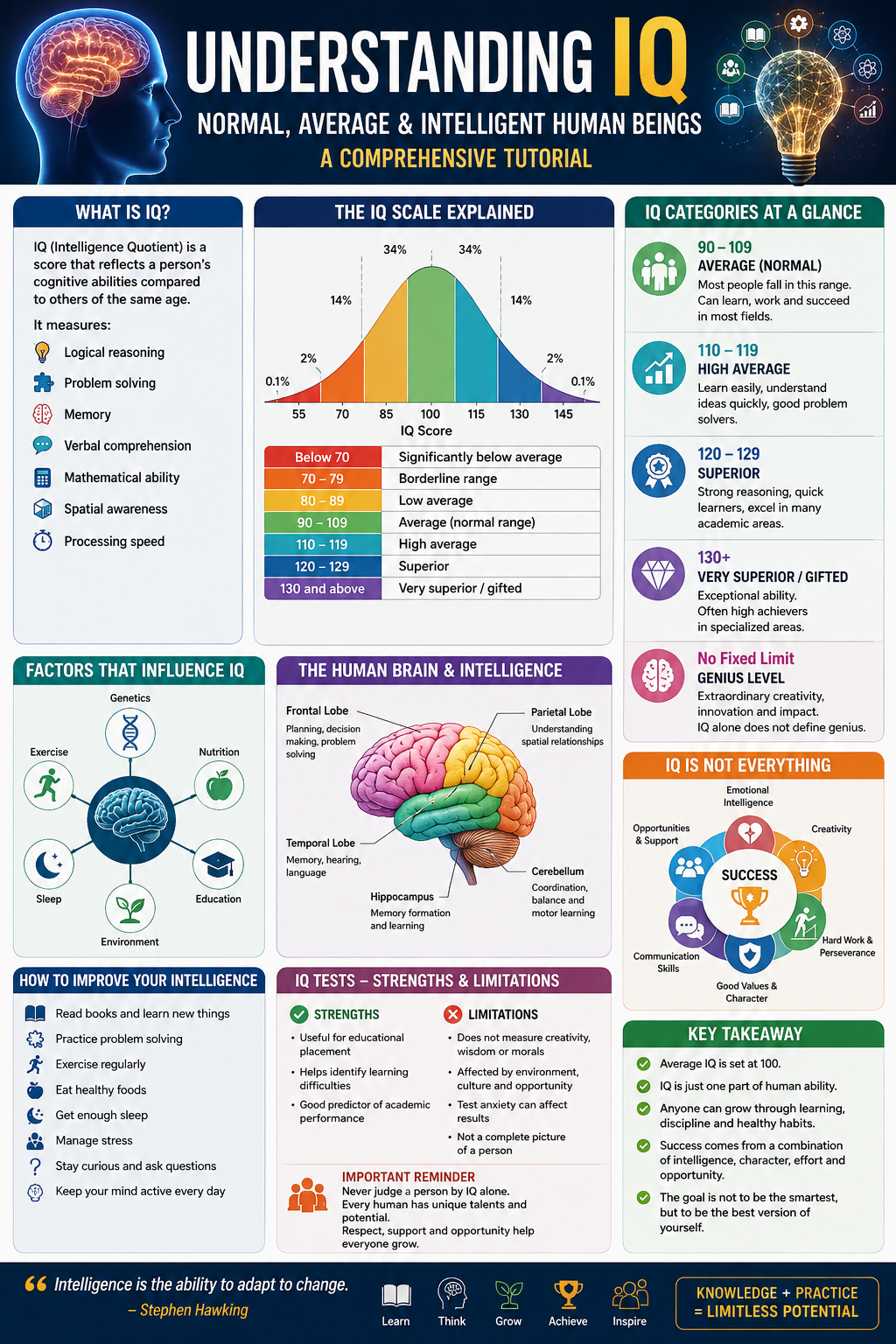
The Cognitive Architecture of Human Intelligence: A Tutorial Thesis on Normal, Average, and High IQ Levels
1. Executive Abstract (1 page)
A high‑level summary defining IQ as a deviation‑based cognitive metric with a mean of 100 and standard deviation of 15, explaining how “normal,” “average,” and “high intelligence” are classified.
2. Introduction to Human Intelligence (2 pages)
- Definition of intelligence
- Historical evolution of intelligence measurement
- Why IQ became the global standard
- The shift from ratio IQ (Stern, 1912) to deviation IQ (Wechsler, 1939)
3. Foundations of IQ Measurement (3 pages)
3.1 What IQ Measures
- Pattern recognition
- Working memory
- Verbal comprehension
- Spatial reasoning
- Numerical reasoning
3.2 What IQ Does Not Measure
- Creativity
- Emotional intelligence
- Motivation
- Social intelligence
4. The IQ Bell Curve: Statistical Architecture (3 pages)
4.1 Mean = 100
4.2 Standard Deviation = 15
4.3 Population Distribution
- 68% score between 85–115
- 95% score between 70–130
4.4 Percentile Interpretation
- 130+ = top 2%
- 120–129 = top 9%
- 110–119 = top 25%
- 90–109 = average 50%
5. Classification of Human IQ Levels (5 pages)
5.1 Normal IQ (85–115)
- Cognitive characteristics
- Learning patterns
- Problem‑solving ability
- Social functioning
- Workplace performance
5.2 Average IQ (90–109)
- Typical reasoning ability
- Educational outcomes
- Strengths and limitations
5.3 High Intelligence (115–129)
- Above‑average reasoning
- Faster information processing
- Higher academic potential
5.4 Gifted Intelligence (130+)
- Exceptional abstract reasoning
- Advanced problem‑solving
- Rarity: ~2.2% of population
6. Biological and Neurological Basis of IQ (3 pages)
- Neural efficiency theory
- Brain volume correlations
- Prefrontal cortex functioning
- Working memory neural pathways
7. Environmental Influences on IQ (3 pages)
- Nutrition
- Education quality
- Socioeconomic status
- Early childhood stimulation
- Stress and trauma
8. The Flynn Effect: Rising IQ Scores Over Time (2 pages)
- Average IQ increases ~3 points per decade
- Causes: improved education, nutrition, cognitive stimulation
9. IQ Testing Systems (3 pages)
9.1 Stanford‑Binet
9.2 WAIS (Wechsler Adult Intelligence Scale)
9.3 RIAS‑2
9.4 Modern digital IQ tests
- Why online tests are estimates, not clinical evaluations
10. Interpretation of IQ Scores (2 pages)
- Percentiles
- Cognitive strengths profile
- Educational guidance
- Occupational implications
11. IQ and Real‑World Outcomes (3 pages)
11.1 Academic Achievement
11.2 Career Performance
11.3 Income Correlations
- IQ predicts certain outcomes but not creativity or persistence
11.4 Leadership and Innovation
- Why high IQ alone does not guarantee success
12. Limitations and Criticisms of IQ (2 pages)
- Cultural bias
- Narrow measurement scope
- Overemphasis in education
- Misuse in employment screening
13. IQ vs Other Forms of Intelligence (2 pages)
- Emotional intelligence (EQ)
- Creative intelligence
- Practical intelligence
- Social intelligence
14. Enhancing Human Cognitive Ability (2 pages)
- Brain training
- Education
- Sleep
- Nutrition
- Cognitive lifestyle habits
15. Conclusion (1 page)
A synthesis explaining:
- IQ is a statistical measure, not a full definition of intelligence
- Normal and average IQ represent the majority of humanity
- High IQ is rare but not the sole determinant of success
- Human intelligence is multidimensional






Be First to Comment