
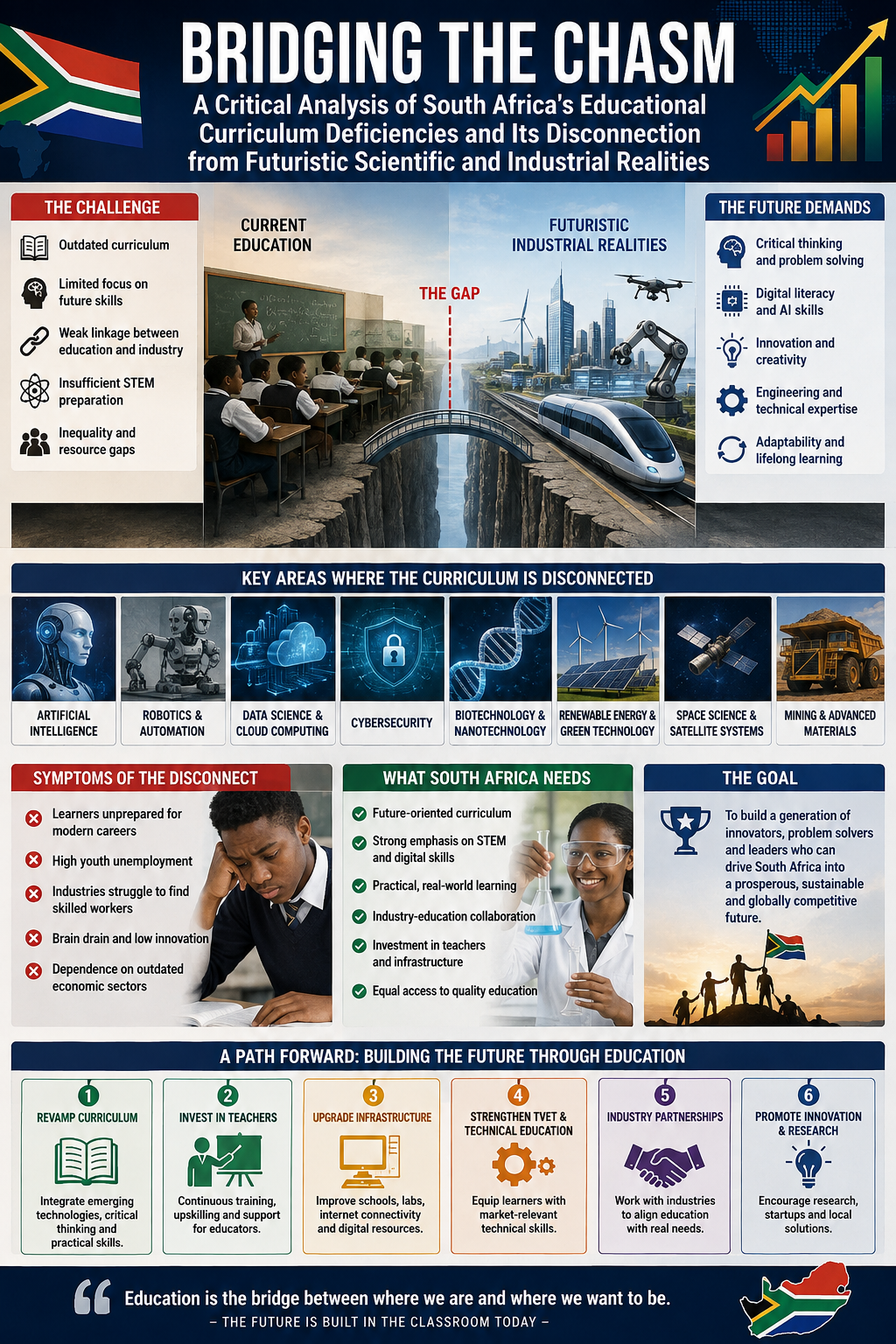
A Comprehensive 38‑Page Analytical Blueprint
PAGE 1 — Executive Summary
South Africa’s educational curriculum is trapped in a legacy framework designed for a past industrial era. It is misaligned with the demands of a rapidly evolving global scientific, technological, and industrial ecosystem. This misalignment has created a structural chasm between what learners are taught and what the future economy requires. The consequences are severe: weakened national competitiveness, chronic unemployment, low innovation output, and a widening global skills gap.
This 38‑page analysis diagnoses the curriculum’s deficiencies, explains their economic consequences, and proposes a futuristic redesign aligned with AI, automation, advanced manufacturing, biotechnology, quantum science, and global industrial transformation.
SECTION 1 — FOUNDATIONS OF THE CRISIS
(Pages 2–6)
PAGE 2 — Historical Roots of Curriculum Stagnation
- Apartheid‑era curriculum designed for labour‑intensive industries.
- Post‑1994 reforms focused on equity, not future competitiveness.
- Overemphasis on theoretical knowledge instead of applied science.
- Slow policy cycles and bureaucratic inertia.
PAGE 3 — Structural Weaknesses in Curriculum Governance
- Fragmented decision‑making between DBE, DHET, Umalusi, SETAs.
- Lack of scientific advisory councils.
- Weak integration with industry and research institutions.
- No national foresight unit for future skills mapping.
PAGE 4 — Outdated Pedagogical Models
- Teacher‑centred instruction instead of inquiry‑based learning.
- Minimal exposure to laboratories, robotics, coding, or engineering.
- Assessment systems reward memorisation, not problem‑solving.
- Weak digital literacy across most public schools.
PAGE 5 — The Global Skills Revolution
- AI, automation, robotics, biotech, quantum computing reshaping labour markets.
- Countries like Singapore, China, South Korea modernising curricula every 3–5 years.
- South Africa updates curriculum every 10–15 years—far too slow.
PAGE 6 — The Chasm Defined
The “chasm” is the widening gap between:
- What the future economy demands, and
- What South African learners are taught.
This gap is now structural, not incidental.
SECTION 2 — DIAGNOSING CURRICULUM DEFICIENCIES
(Pages 7–14)
PAGE 7 — Deficiency 1: Weak STEM Foundations
- Mathematics performance crisis.
- Limited physics, chemistry, and engineering exposure.
- No national robotics or coding mandate across all grades.
PAGE 8 — Deficiency 2: Absence of Future‑Focused Subjects
Missing subjects include:
- Artificial Intelligence
- Machine Learning
- Data Science
- Cybersecurity
- Biotechnology
- Nanotechnology
- Quantum Computing
- Renewable Energy Engineering
- Advanced Manufacturing
- Space Science
PAGE 9 — Deficiency 3: Outdated Industrial Orientation
Curriculum still prepares learners for:
- Clerical work
- Basic administration
- Low‑skill labour
- Legacy industries (mining, agriculture)
Instead of:
- Automation‑driven industries
- High‑tech manufacturing
- Digital economies
- Scientific innovation ecosystems
PAGE 10 — Deficiency 4: Weak Technical and Vocational Pathways
- TVET colleges disconnected from industry.
- Outdated equipment and training modules.
- No alignment with Industry 4.0 or 5.0.
PAGE 11 — Deficiency 5: Lack of Research and Innovation Culture
- Schools do not teach scientific inquiry.
- No national science fairs or innovation incubators.
- Universities produce low research output compared to global peers.
PAGE 12 — Deficiency 6: Teacher Skills Gap
- Teachers lack training in coding, robotics, AI, and modern science.
- Professional development is outdated and theoretical.
- No national digital competency certification for educators.
PAGE 13 — Deficiency 7: Infrastructure Inequality
- Rural schools lack labs, internet, electricity stability.
- Urban schools have uneven access to modern equipment.
- Digital divide entrenches inequality.
PAGE 14 — Deficiency 8: Weak Industry Collaboration
- Curriculum not co‑designed with private sector.
- No structured partnerships with tech companies.
- SETAs operate in isolation.
SECTION 3 — ECONOMIC CONSEQUENCES OF CURRICULUM FAILURE
(Pages 15–20)
PAGE 15 — Consequence 1: Rising Unemployment
- Youth unemployment above 50%.
- Graduates lack future‑ready skills.
- Employers prefer foreign talent for specialised roles.
PAGE 16 — Consequence 2: Weak National Competitiveness
- South Africa ranks low in global innovation indices.
- Slow adoption of automation and advanced manufacturing.
- Weak export diversification.
PAGE 17 — Consequence 3: Declining Industrial Productivity
- Outdated workforce skills reduce productivity.
- Manufacturing sector shrinking.
- Mining sector failing to modernise.
PAGE 18 — Consequence 4: Brain Drain
- Skilled professionals migrate to countries with advanced scientific ecosystems.
- Loss of engineers, doctors, researchers, data scientists.
PAGE 19 — Consequence 5: Technological Dependency
- South Africa imports most high‑tech products.
- Weak domestic R&D capacity.
- Vulnerability to global supply chain shocks.
PAGE 20 — Consequence 6: Slow Economic Growth
- Curriculum misalignment directly suppresses GDP growth.
- Innovation ecosystems remain underdeveloped.
- Limited participation in global high‑tech value chains.
SECTION 4 — THE FUTURISTIC SCIENTIFIC AND INDUSTRIAL REALITIES
(Pages 21–28)
PAGE 21 — Reality 1: AI‑Driven Economies
- AI transforming healthcare, finance, logistics, manufacturing.
- Countries investing heavily in AI education from primary school.
PAGE 22 — Reality 2: Automation and Robotics
- Factories becoming autonomous.
- Robotics integrated into agriculture, mining, logistics.
PAGE 23 — Reality 3: Biotechnology and Genomics
- Precision medicine, genetic engineering, bio‑manufacturing.
- South Africa lacks biotech curriculum pathways.
PAGE 24 — Reality 4: Quantum Technologies
- Quantum computing revolutionising cryptography, simulation, AI.
- No quantum literacy in South African schools.
PAGE 25 — Reality 5: Renewable Energy and Climate Engineering
- Solar, wind, hydrogen, battery storage.
- Curriculum does not prepare learners for green industrialisation.
PAGE 26 — Reality 6: Advanced Manufacturing
- 3D printing, nanomaterials, smart factories.
- South Africa’s manufacturing curriculum is outdated.
PAGE 27 — Reality 7: Space Science and Satellite Engineering
- Space economy growing globally.
- South Africa has SKA but no school‑level space curriculum.
PAGE 28 — Reality 8: Digital Economies
- E‑commerce, fintech, digital logistics.
- Curriculum does not teach digital entrepreneurship.
SECTION 5 — BRIDGING THE CHASM: A FUTURISTIC CURRICULUM BLUEPRINT
(Pages 29–35)
PAGE 29 — Principle 1: Future‑Skills Alignment
Curriculum must align with:
- AI
- Robotics
- Data Science
- Biotechnology
- Quantum Science
- Renewable Energy
- Advanced Manufacturing
- Space Technology
PAGE 30 — Principle 2: Scientific Literacy for All
- Mandatory coding from Grade 1.
- Robotics from Grade 4.
- AI literacy from Grade 7.
- Engineering modules in high school.
PAGE 31 — Principle 3: Industry‑Integrated Curriculum
- Co‑design with private sector.
- Apprenticeships embedded in schooling.
- Industry‑grade labs in schools.
PAGE 32 — Principle 4: Teacher Modernisation
- National digital competency certification.
- Mandatory upskilling every 3 years.
- Partnerships with universities and tech companies.
PAGE 33 — Principle 5: Infrastructure Modernisation
- High‑speed internet for all schools.
- Robotics labs, biotech labs, engineering workshops.
- Solar‑powered rural schools.
PAGE 34 — Principle 6: Research and Innovation Culture
- National science fairs.
- Innovation incubators in schools.
- Student research projects from Grade 6.
PAGE 35 — Principle 7: Policy and Governance Reform
- Establish National Future Skills Council.
- Curriculum updated every 5 years.
- Integration of DBE, DHET, SETAs under unified skills strategy.
SECTION 6 — CONCLUSION AND NATIONAL IMPERATIVE
(Pages 36–38)
PAGE 36 — The Cost of Inaction
If South Africa does not modernise its curriculum:
- Unemployment will rise.
- Innovation capacity will collapse.
- Industrial competitiveness will decline.
- The country will fall further behind global scientific progress.
PAGE 37 — The Opportunity
A futuristic curriculum can:
- Build a high‑tech workforce.
- Accelerate industrialisation.
- Position South Africa as a scientific leader in Africa.
- Unlock new economic sectors.
PAGE 38 — Final Synthesis
Bridging the chasm requires:
- Visionary leadership
- Scientific foresight
- Industry collaboration
- Curriculum modernisation
- Teacher transformation
- Infrastructure investment
South Africa’s future depends on aligning education with the realities of a rapidly evolving scientific and industrial world. The curriculum must become a launchpad for innovation, not a relic of the past.






Be First to Comment