
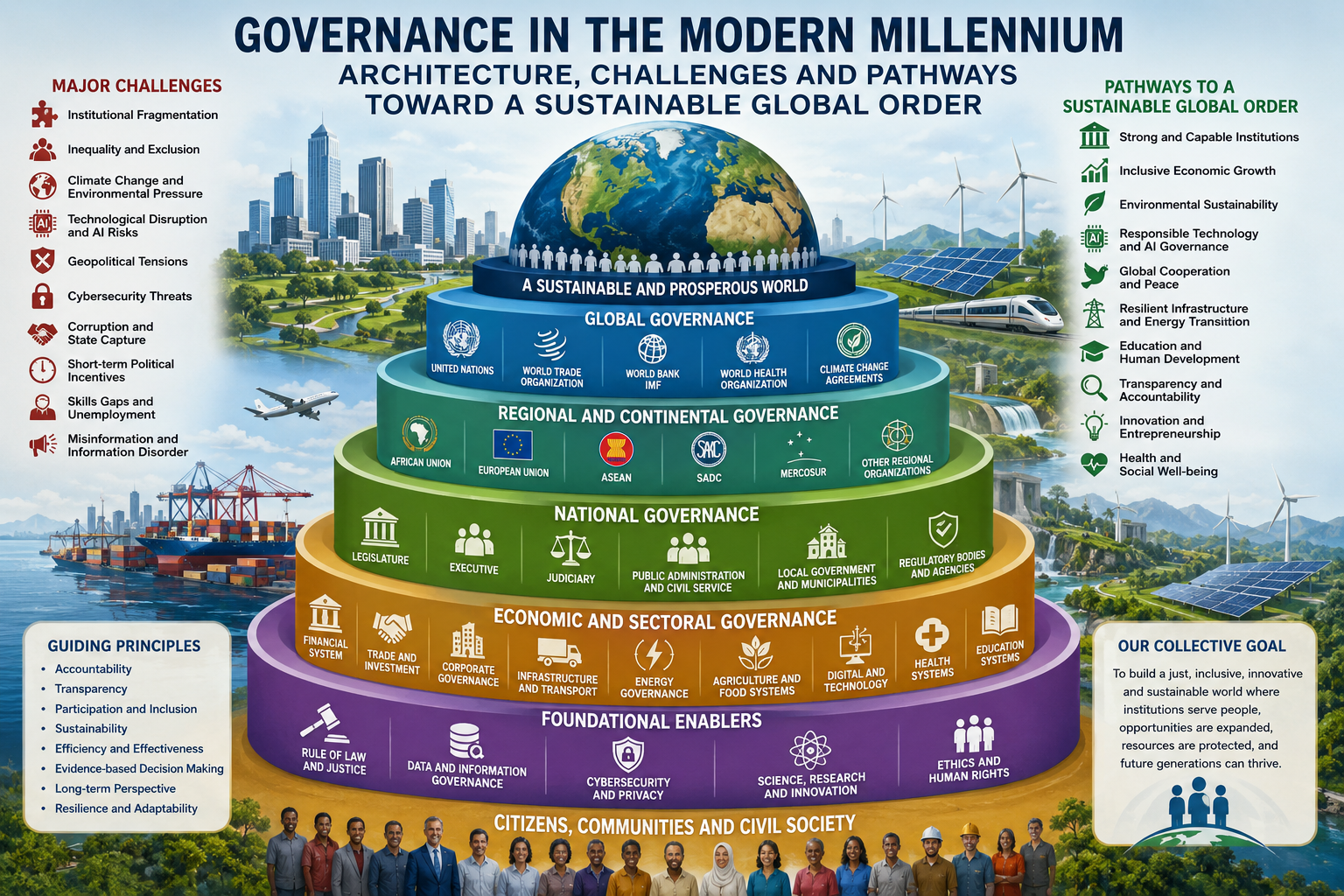
Architecture, Challenges, and Pathways Toward a Sustainable Global Order
1. INTRODUCTION: THE GOVERNANCE IMPERATIVE IN A MILLENNIUM ECONOMY
The modern millennium economy is defined by unprecedented complexity. Nations, corporations, digital platforms, and civil society operate within a deeply interconnected global system where decisions in one region ripple across continents. Governance—once a slow, bureaucratic, state‑centric function—has become a dynamic, multi‑actor, multi‑layered discipline requiring agility, foresight, and systemic coordination.
This article provides a comprehensive exploration of governance architecture, institutional challenges, and strategic pathways toward a sustainable global order. It integrates economic theory, political science, digital transformation, environmental stewardship, and global cooperation frameworks into a single coherent governance model.
2. THE MILLENNIUM ECONOMY: STRUCTURAL CHARACTERISTICS
The millennium economy differs from all previous eras due to five structural pillars:
2.1 Hyper‑Connectivity
Global markets, supply chains, and information systems are linked through digital networks, enabling instantaneous flows of capital, data, and decisions.
2.2 Digital Acceleration
AI, automation, quantum computing, and biotechnology reshape productivity cycles, competitive advantage, and national development trajectories.
2.3 Transnational Interdependence
No nation is economically isolated. Energy, food, finance, and technology systems are globally integrated, creating both opportunity and vulnerability.
2.4 Ecological Constraints
Climate change, biodiversity loss, and resource depletion impose hard limits on economic expansion, requiring governance aligned with planetary boundaries.
2.5 Demographic Transitions
Aging populations, youth bulges, migration flows, and urbanization patterns influence labor markets, consumption, and political stability.
3. GOVERNANCE ARCHITECTURE: CORE COMPONENTS
Governance in the millennium economy operates across multiple institutional pillars and layers.
3.1 Institutional Pillars
- State institutions: policy, regulation, fiscal systems, national security.
- Market institutions: corporations, financial systems, trade networks.
- Civil society: advocacy groups, NGOs, community networks.
- Multilateral bodies: UN, WTO, IMF, regional blocs.
3.2 Governance Layers
- Local governance: municipal systems, community resilience.
- National governance: policy design, institutional coherence.
- Regional governance: trade blocs, security alliances.
- Global governance: treaties, norms, global public goods.
4. ARCHITECTURE CHALLENGES IN THE MILLENNIUM SYSTEM
4.1 Fragmentation of Authority
Power is distributed across governments, corporations, digital platforms, and transnational networks, creating overlapping jurisdictions.
4.2 Asymmetric Capabilities
Technological, economic, and institutional disparities between nations create uneven governance capacity.
4.3 Governance Lag
Policy cycles are slower than innovation cycles, causing regulatory gaps in AI, fintech, biotechnology, and digital markets.
4.4 Trust Deficit
Public trust in institutions declines due to inequality, misinformation, corruption, and governance failures.
4.5 Geopolitical Polarization
Competing global powers shape governance norms, trade rules, and security architectures.
5. GLOBAL ECONOMIC GOVERNANCE: EVOLUTION AND TENSIONS
5.1 From Bretton Woods to Digital Globalization
The post‑WWII system focused on stability and reconstruction. Today’s system prioritizes digital flows, innovation, and risk management.
5.2 Key Tensions
- Sovereignty vs interdependence
- Efficiency vs equity
- Innovation vs regulation
- Competition vs cooperation
6. GOVERNANCE DOMAINS IN THE MILLENNIUM ECONOMY
6.1 Digital Governance
AI regulation, data sovereignty, cybersecurity, digital identity, platform accountability.
6.2 Financial Governance
Cross‑border capital flows, fintech regulation, systemic risk management, digital currencies.
6.3 Trade Governance
Supply chain resilience, fair competition, regional integration, trade facilitation.
6.4 Environmental Governance
Climate agreements, carbon markets, biodiversity protection, ecological accounting.
6.5 Social Governance
Education, healthcare, inequality reduction, labor protections, social cohesion.
7. INSTITUTIONAL DESIGN FOR MODERN GOVERNANCE
7.1 Adaptive Institutions
Flexible, learning‑oriented systems capable of rapid response to shocks.
7.2 Networked Governance Models
Collaborative structures linking public, private, and civil actors.
7.3 Evidence‑Driven Policy Systems
Real‑time data, predictive analytics, scenario modeling, and AI‑assisted decision‑making.
7.4 Multi‑Stakeholder Platforms
Forums for negotiation, coordination, and dispute resolution.
8. GOVERNANCE FAILURES: CASE STUDIES
- Pandemic response coordination gaps
- Supply chain disruptions
- Financial contagion risks
- Climate adaptation failures
- Digital misinformation ecosystems
9. PATHWAYS TOWARD A SUSTAINABLE GLOBAL ORDER
9.1 Strengthening Multilateralism
Reforming global institutions for legitimacy, agility, and inclusivity.
9.2 Building Resilient Economies
Diversification, innovation ecosystems, shock‑absorption capacity.
9.3 Advancing Digital Sovereignty
Balancing openness with national security and citizen rights.
9.4 Embedding Sustainability
Climate‑aligned investment, circular economy models, ecological accounting.
9.5 Enhancing Social Cohesion
Reducing inequality, strengthening democratic participation, rebuilding trust.
10. STRATEGIC GOVERNANCE FRAMEWORKS
10.1 Resilience Framework
Anticipation → Absorption → Recovery → Adaptation.
10.2 Systems Governance Framework
Holistic management of interconnected economic, social, and ecological systems.
10.3 Innovation Governance Framework
Regulating emerging technologies while enabling growth.
10.4 Global Cooperation Framework
Shared norms, coordinated action, collective problem‑solving.
11. REGIONAL GOVERNANCE MODELS
Africa
Continental integration, AfCFTA, infrastructure corridors, youth‑driven innovation.
Europe
Regulatory leadership, digital governance, social welfare models.
Asia
Innovation hubs, manufacturing powerhouses, geopolitical balancing.
Americas
Trade networks, financial centers, democratic governance challenges.
12. GOVERNANCE AND THE FUTURE OF WORK
Automation, AI labor markets, remote work governance, skills transitions, digital labor rights.
13. GOVERNANCE AND GLOBAL SECURITY
Cybersecurity, geopolitical competition, resource conflicts, hybrid warfare, digital espionage.
14. GOVERNANCE AND CLIMATE FUTURES
Mitigation, adaptation, resilience pipelines, climate finance, green industrial policy.
15. GOVERNANCE AND TECHNOLOGICAL FUTURES
AI, quantum computing, biotechnology, autonomous systems, planetary‑scale computing.
16. GOVERNANCE LEADERSHIP COMPETENCIES
Strategic foresight, systems thinking, negotiation, ethical judgment, crisis management.
17. GOVERNANCE METRICS AND EVALUATION
Institutional performance, economic resilience, social outcomes, sustainability indicators.
18. CONCLUSION: TOWARD A COHERENT GLOBAL GOVERNANCE ARCHITECTURE
A sustainable global order requires governance systems that are adaptive, inclusive, technologically aligned, and ecologically responsible. The millennium economy demands institutions capable of managing complexity, anticipating shocks, and coordinating across borders. Governance must evolve from reactive administration to proactive system stewardship.






Be First to Comment