
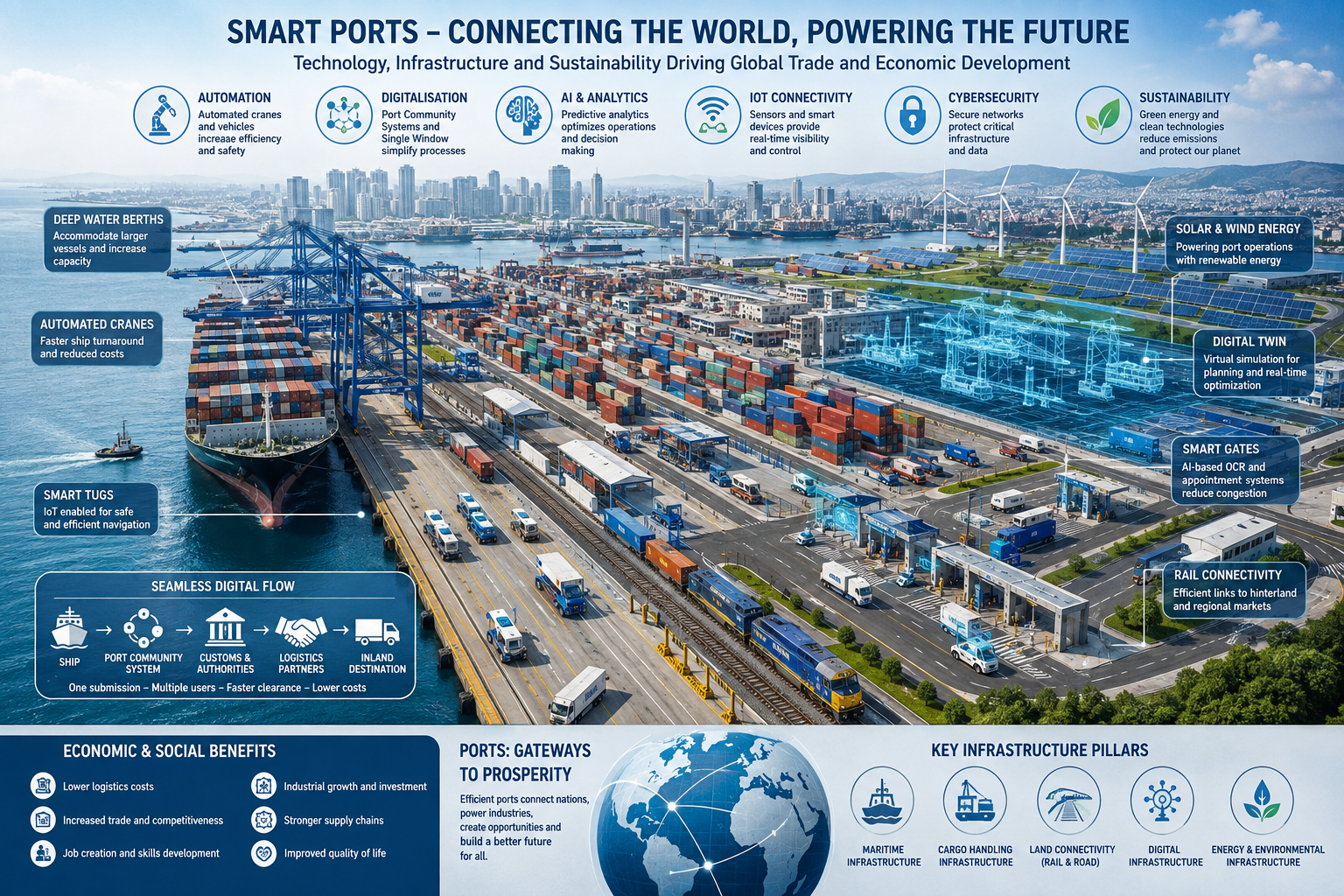
A Comprehensive 35-Page Thesis on Port Technology, Infrastructure, Modernisation, Global Connectivity and Its Effects on Civilised Economic Development
ABSTRACT
Port and harbour systems form the backbone of global trade, enabling the movement of raw materials, manufactured goods, energy commodities, and food supplies across continents. As the world economy becomes increasingly digitised, interconnected, and dependent on rapid logistics, the modernisation of port infrastructure has emerged as one of the most critical determinants of economic competitiveness. This thesis explores the technological evolution of ports, the architecture of modern maritime logistics, the digital transformation reshaping global supply chains, and the profound economic effects on the civilised world. It also examines the geopolitical implications, environmental considerations, and future pathways toward a fully automated, AI‑driven maritime ecosystem.
CHAPTER 1 — INTRODUCTION
Ports are more than physical gateways; they are complex ecosystems integrating engineering, logistics, digital systems, and global economic flows. Historically, ports were simple docking points for ships. Today, they are high‑tech industrial hubs, equipped with:
- Automated cranes
- Smart container terminals
- AI‑driven logistics platforms
- Blockchain‑secured documentation
- 5G‑enabled operational networks
- Autonomous vehicles and robotics
- Renewable‑energy microgrids
The modern port is a cyber‑physical organism, blending hardware, software, and human expertise. As globalisation accelerates, ports have become decisive in determining national competitiveness, supply chain resilience, and economic growth.
CHAPTER 2 — HISTORICAL EVOLUTION OF PORT INFRASTRUCTURE
2.1 Early Maritime Trade
Ancient ports such as Alexandria, Carthage, and Guangzhou relied on manual labour, wooden docks, and rudimentary storage facilities. Trade volumes were low, and maritime risk was high.
2.2 Industrial Revolution
Steamships, steel structures, and mechanised loading systems increased port throughput. Rail‑port integration emerged, enabling inland distribution.
2.3 Containerisation Era (1950s–2000s)
The invention of the ISO container revolutionised global logistics. Standardisation enabled:
- Faster loading/unloading
- Lower labour costs
- Reduced cargo damage
- Predictable shipping schedules
Containerisation laid the foundation for modern globalisation.
2.4 Digital & Automation Era (2000s–Present)
The 21st century introduced:
- Automated guided vehicles (AGVs)
- Remote‑controlled cranes
- Digital twins
- IoT sensors
- AI‑powered scheduling
- Blockchain documentation
Ports transitioned from industrial zones to smart logistics ecosystems.
CHAPTER 3 — CORE TECHNOLOGIES IN MODERN PORTS
3.1 Automation & Robotics
Modern ports deploy:
- Automated stacking cranes
- Autonomous trucks
- Robotic inspection systems
- Drones for surveillance and inventory
Automation reduces human error, increases speed, and enhances safety.
3.2 Internet of Things (IoT)
Sensors monitor:
- Container temperature
- Structural integrity
- Fuel consumption
- Crane performance
- Ship docking alignment
IoT enables real‑time decision‑making and predictive maintenance.
3.3 Artificial Intelligence & Machine Learning
AI optimises:
- Berth allocation
- Crane scheduling
- Cargo routing
- Demand forecasting
- Port congestion management
Machine learning models reduce delays and improve operational efficiency.
3.4 Blockchain & Digital Documentation
Blockchain eliminates fraud and accelerates customs clearance through:
- Smart contracts
- Tamper‑proof bills of lading
- Secure cargo tracking
This reduces administrative bottlenecks.
3.5 5G & High‑Speed Connectivity
5G networks support:
- Real‑time crane control
- High‑density sensor networks
- Autonomous vehicle coordination
- Digital twins and simulation models
Connectivity is the nervous system of modern ports.
3.6 Digital Twins
A digital twin is a virtual replica of the port. It allows:
- Simulation of cargo flows
- Predictive maintenance
- Emergency response planning
- Infrastructure optimisation
Digital twins reduce operational risk.
3.7 Green & Renewable Technologies
Modern ports integrate:
- Solar microgrids
- Hydrogen bunkering
- Shore‑to‑ship power
- Electrified cranes
- Carbon‑capture systems
Sustainability is now a competitive advantage.
CHAPTER 4 — ARCHITECTURE OF A MODERN SMART PORT
4.1 Physical Infrastructure
- Deep‑water berths
- High‑capacity cranes
- Container yards
- Rail and road integration
- Warehousing complexes
4.2 Digital Infrastructure
- Cloud‑based logistics platforms
- Cybersecurity frameworks
- AI‑driven control centres
- Digital documentation systems
4.3 Operational Ecosystem
- Shipping lines
- Customs authorities
- Freight forwarders
- Trucking companies
- Rail operators
- Energy suppliers
Modern ports operate as multi‑stakeholder ecosystems.
CHAPTER 5 — ECONOMIC SIGNIFICANCE OF PORT MODERNISATION
5.1 Global Trade Competitiveness
Countries with modern ports—Singapore, Rotterdam, Shanghai—dominate global trade. Efficient ports reduce:
- Shipping costs
- Delivery times
- Inventory holding costs
5.2 Supply Chain Resilience
Modern ports mitigate disruptions caused by:
- Pandemics
- Geopolitical tensions
- Natural disasters
- Market volatility
AI‑driven systems reroute cargo dynamically.
5.3 Job Creation & Skills Development
Automation shifts labour demand from manual work to:
- Robotics maintenance
- Data analytics
- Cybersecurity
- Engineering
- Maritime logistics management
5.4 National Revenue & GDP Growth
Ports contribute through:
- Customs duties
- Export earnings
- Logistics services
- Industrial zones
A modern port can increase national GDP by 2–5%.
5.5 Foreign Direct Investment (FDI)
Investors prefer countries with efficient logistics infrastructure. Modern ports attract:
- Manufacturing plants
- Distribution centres
- Energy companies
- Technology firms
CHAPTER 6 — GEOPOLITICAL IMPLICATIONS
6.1 Strategic Control of Trade Routes
Nations with advanced ports influence global trade flows. Examples:
- China’s Belt & Road Initiative
- UAE’s Jebel Ali Port dominance
- Rotterdam’s European gateway role
6.2 Maritime Security
Modern ports integrate:
- Surveillance drones
- AI threat detection
- Cybersecurity systems
Security ensures uninterrupted trade.
6.3 Global Power Shifts
Technological superiority in ports can shift economic power from traditional Western hubs to emerging Asian and African hubs.
CHAPTER 7 — ENVIRONMENTAL & SUSTAINABILITY DIMENSIONS
7.1 Decarbonisation
Ports are adopting:
- Electric cranes
- LNG and hydrogen fuels
- Shore power for ships
7.2 Waste & Water Management
Smart sensors detect:
- Oil spills
- Chemical leaks
- Water contamination
7.3 Climate Adaptation
Ports must withstand:
- Rising sea levels
- Stronger storms
- Coastal erosion
Digital modelling helps design resilient infrastructure.
CHAPTER 8 — CASE STUDIES OF WORLD‑LEADING PORTS
8.1 Port of Singapore
- Fully automated terminals
- AI‑driven scheduling
- World’s fastest container throughput
8.2 Port of Rotterdam
- Digital twin of entire port
- Autonomous shipping corridors
- Hydrogen energy hub
8.3 Shanghai Yangshan Deep‑Water Port
- Largest automated port globally
- Robotic cranes
- High‑speed 5G networks
8.4 Durban & Cape Town (South Africa)
- Modernisation underway
- Potential to become African logistics hubs
- Requires investment in automation and digital systems
CHAPTER 9 — CHALLENGES IN PORT MODERNISATION
9.1 High Capital Costs
Automation and digital systems require billions in investment.
9.2 Cybersecurity Threats
Ports are vulnerable to:
- Ransomware
- Data breaches
- Operational sabotage
9.3 Labour Resistance
Automation may cause job displacement without proper reskilling.
9.4 Regulatory Complexity
International maritime laws must adapt to digital documentation and autonomous systems.
9.5 Infrastructure Ageing
Many ports operate with outdated equipment and shallow berths.
CHAPTER 10 — FUTURE PATHWAYS TOWARD A FULLY MODERNISED GLOBAL PORT ECOSYSTEM
10.1 Autonomous Shipping
Ships will navigate, dock, and unload autonomously.
10.2 AI‑Driven Global Logistics Networks
AI will coordinate:
- Global cargo flows
- Weather routing
- Port congestion management
10.3 Hyper‑Connected Maritime Corridors
5G and satellite networks will create real‑time global visibility.
10.4 Quantum Computing in Logistics
Quantum optimisation will reduce shipping delays and fuel consumption.
10.5 Zero‑Emission Ports
Ports will operate entirely on renewable energy.
10.6 Integrated Global Digital Trade Platforms
Blockchain will unify customs, shipping lines, and governments.
CHAPTER 11 — CONCLUSION
Port and harbour modernisation is not merely an infrastructure upgrade; it is a transformation of the global economic architecture. As the world becomes more interconnected, the efficiency, intelligence, and resilience of ports will determine the stability of supply chains, national competitiveness, and global prosperity. The civilised world economy depends on ports that are:
- Digitally integrated
- Environmentally sustainable
- Geopolitically secure
- Technologically advanced
The future belongs to nations that invest boldly in maritime innovation.




Be First to Comment