
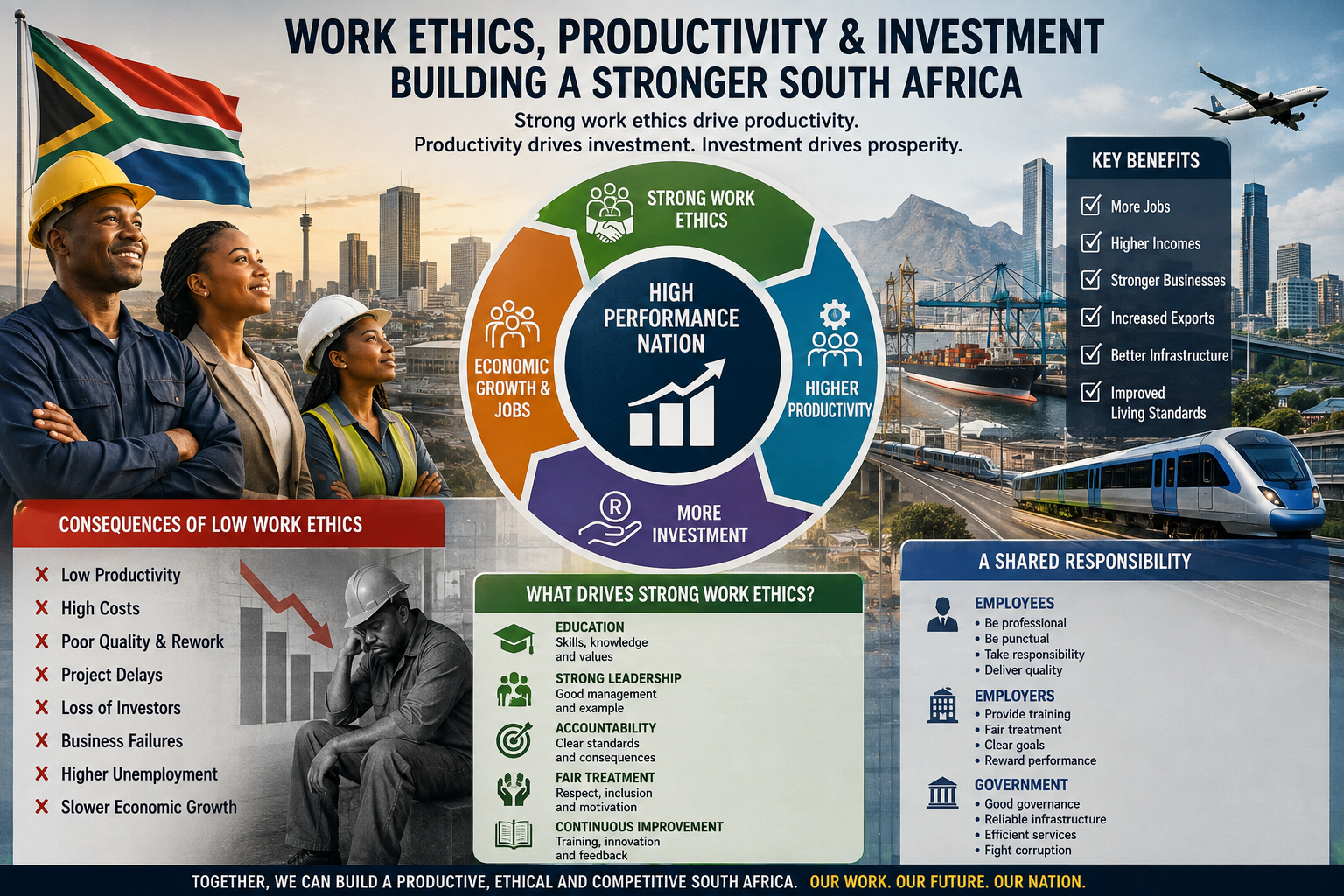
Consequences of Widespread Low Work Ethics and Disadvantages on Investment in South Africa
ABSTRACT
South Africa’s economic trajectory is increasingly constrained by a systemic erosion of work ethic across multiple sectors of society. This thesis provides a comprehensive analysis of how widespread low work ethics—manifested through absenteeism, poor productivity, weak accountability, limited initiative, and declining professional standards—undermine national competitiveness, deter investment, and exacerbate structural economic stagnation. The study examines historical roots, socio‑economic drivers, institutional failures, and cultural dynamics that reinforce low work ethic patterns. It further evaluates the consequences for domestic and foreign investment, labour market performance, industrial output, public sector efficiency, and long‑term national development. The thesis concludes with strategic pathways for rebuilding a high‑performance culture capable of attracting investment, stimulating growth, and positioning South Africa for global competitiveness.
TABLE OF CONTENTS
- Introduction
- Conceptual Framework: Understanding Work Ethics
- Historical Roots of Work Ethic Challenges in South Africa
- Socio‑Economic Drivers of Low Work Ethics
- Cultural and Behavioural Dimensions
- Structural and Institutional Contributors
- Manifestations of Low Work Ethics in Key Sectors
- Consequences for Labour Productivity
- Consequences for Domestic Investment
- Consequences for Foreign Direct Investment (FDI)
- Consequences for Public Sector Performance
- Consequences for Industrialisation and Manufacturing
- Consequences for Infrastructure Delivery
- Consequences for Entrepreneurship and Innovation
- Consequences for National Competitiveness
- Case Studies: Sector‑Specific Impacts
- Comparative Analysis: Countries with High Work Ethics
- The Investment Psychology: How Investors Interpret Work Ethic Signals
- The Cost of Low Work Ethics on GDP Growth
- The Human Capital Dimension
- The Role of Leadership and Management
- The Role of Education and Skills Development
- The Role of Organisational Culture
- The Role of Technology and Automation
- Policy Failures and Governance Gaps
- Long‑Term Risks if Work Ethics Do Not Improve
- Strategic Interventions for Rebuilding Work Ethics
- National Policy Recommendations
- Private Sector Recommendations
- Public Sector Reform Recommendations
- Societal and Cultural Reforms
- Investment‑Focused Reforms
- Monitoring and Evaluation Framework
- Conclusion
- Bibliographic Insight (Non‑copyrighted conceptual references)
1. INTRODUCTION
South Africa stands at a critical juncture in its economic evolution. Despite possessing abundant natural resources, a youthful population, strategic geographic positioning, and sophisticated financial markets, the country continues to underperform relative to its potential. One of the most persistent and under‑addressed barriers to economic progress is the widespread decline in work ethics across both public and private sectors.
Low work ethics—defined as a collective behavioural pattern characterised by poor productivity, weak accountability, lack of urgency, minimal initiative, and inconsistent professional standards—have become deeply embedded in the national economic fabric. This phenomenon has far‑reaching consequences for investment, competitiveness, and long‑term development.
This thesis explores the multidimensional consequences of low work ethics and provides a rigorous analysis of how this behavioural challenge undermines investment confidence and economic performance.
2. CONCEPTUAL FRAMEWORK: UNDERSTANDING WORK ETHICS
Work ethics refer to a set of values, behaviours, and attitudes that shape how individuals approach work. High work ethics typically include:
- Discipline
- Reliability
- Accountability
- Initiative
- Professionalism
- Respect for time
- Commitment to quality
- Continuous improvement
Low work ethics, conversely, manifest as:
- Chronic lateness
- Absenteeism
- Minimal effort
- Poor communication
- Lack of urgency
- Resistance to accountability
- Poor customer service
- Low productivity
- Negligence
In economic terms, work ethics directly influence:
- Productivity
- Efficiency
- Competitiveness
- Investor confidence
- Organisational performance
3. HISTORICAL ROOTS OF WORK ETHIC CHALLENGES IN SOUTH AFRICA
South Africa’s work ethic challenges cannot be understood without examining historical context:
3.1 Colonial Labour Systems
Forced labour, racial segregation, and exploitative labour practices created generational mistrust between labour and management.
3.2 Apartheid’s Legacy
Apartheid deliberately under‑educated the majority population, creating long‑term deficits in skills, confidence, and workplace culture.
3.3 Post‑1994 Transition
The shift to democracy brought new opportunities but also introduced:
- Rapid politicisation of workplaces
- Cadre deployment
- Weak enforcement of performance standards
- Over‑employment in public institutions
3.4 Labour Union Dynamics
While unions protect workers, excessive union power has sometimes:
- Shielded poor performance
- Encouraged entitlement
- Normalised low productivity
4. SOCIO‑ECONOMIC DRIVERS OF LOW WORK ETHICS
4.1 High Unemployment
With unemployment above 30%, many workers feel replaceable or demotivated.
4.2 Poverty and Social Stress
Daily survival pressures reduce focus and commitment.
4.3 Inequality
Extreme inequality fosters resentment and disengagement.
4.4 Weak Incentive Structures
Performance is rarely rewarded; poor performance is rarely punished.
4.5 Limited Career Mobility
Workers feel stuck, reducing motivation.
5. CULTURAL AND BEHAVIOURAL DIMENSIONS
5.1 Normalisation of Mediocrity
Low standards become socially acceptable.
5.2 Entitlement Culture
Some workers expect benefits without performance.
5.3 Lack of National Pride in Work
Work is often seen as transactional rather than purposeful.
5.4 Weak Time Discipline
Chronic lateness is widespread.
6. STRUCTURAL AND INSTITUTIONAL CONTRIBUTORS
6.1 Weak Management
Many managers lack training in performance management.
6.2 Poor Organisational Systems
Outdated systems reduce efficiency.
6.3 Corruption
Corruption destroys morale and rewards unethical behaviour.
6.4 Policy Inconsistency
Frequent policy changes create instability.
7. MANIFESTATIONS OF LOW WORK ETHICS IN KEY SECTORS
7.1 Public Sector
- Slow service delivery
- Long queues
- Inefficient administration
- Poor accountability
7.2 Private Sector
- Customer service failures
- Missed deadlines
- Low productivity
7.3 Education Sector
- Teacher absenteeism
- Poor teaching quality
7.4 Healthcare Sector
- Negligence
- Long waiting times
8. CONSEQUENCES FOR LABOUR PRODUCTIVITY
South Africa’s productivity levels are significantly lower than global averages. Low work ethics reduce:
- Output per worker
- Efficiency
- Quality of goods and services
This directly affects GDP growth.
9. CONSEQUENCES FOR DOMESTIC INVESTMENT
Low work ethics discourage local investors because:
- Projects take longer
- Costs increase
- Quality is inconsistent
- Management overhead rises
Domestic investors often prefer offshore opportunities.
10. CONSEQUENCES FOR FOREIGN DIRECT INVESTMENT (FDI)
FDI is highly sensitive to work ethic signals. Investors consider:
- Workforce reliability
- Productivity
- Professionalism
- Ease of doing business
Low work ethics lead to:
- Higher operational risk
- Lower investor confidence
- Reduced long‑term commitments
- Relocation of operations to other African countries
11. CONSEQUENCES FOR PUBLIC SECTOR PERFORMANCE
Low work ethics in government result in:
- Delayed infrastructure projects
- Inefficient procurement
- Poor regulatory enforcement
- Weak investor support systems
12. CONSEQUENCES FOR INDUSTRIALISATION AND MANUFACTURING
Manufacturing requires:
- Precision
- Discipline
- Efficiency
Low work ethics undermine:
- Production timelines
- Quality control
- Export competitiveness
13. CONSEQUENCES FOR INFRASTRUCTURE DELIVERY
Infrastructure delays are often caused by:
- Poor project management
- Contractor negligence
- Weak oversight
- Corruption
This increases costs and reduces investor confidence.
14. CONSEQUENCES FOR ENTREPRENEURSHIP AND INNOVATION
Low work ethics reduce:
- Creativity
- Initiative
- Risk‑taking
- Innovation output
Entrepreneurs struggle to build reliable teams.
15. CONSEQUENCES FOR NATIONAL COMPETITIVENESS
South Africa’s global competitiveness ranking declines due to:
- Low productivity
- Weak work culture
- Inefficient institutions
16. CASE STUDIES: SECTOR‑SPECIFIC IMPACTS
16.1 Mining Sector
Strikes and absenteeism reduce output.
16.2 Logistics Sector
Delays at ports and rail inefficiencies deter exporters.
16.3 Retail Sector
Poor customer service reduces sales.
16.4 Manufacturing Sector
Low productivity increases costs.
17. COMPARATIVE ANALYSIS: COUNTRIES WITH HIGH WORK ETHICS
Countries like Japan, South Korea, Germany, and Singapore demonstrate:
- Strong discipline
- High productivity
- Efficient systems
- Strong national pride
These nations attract massive investment.
18. THE INVESTMENT PSYCHOLOGY: HOW INVESTORS INTERPRET WORK ETHIC SIGNALS
Investors analyse:
- Workforce reliability
- Management competence
- Institutional efficiency
- Cultural attitudes toward work
Low work ethics signal high risk.
19. THE COST OF LOW WORK ETHICS ON GDP GROWTH
Low work ethics reduce:
- Output
- Efficiency
- Investment inflows
GDP growth slows significantly.
20. THE HUMAN CAPITAL DIMENSION
Human capital is weakened by:
- Poor education
- Weak skills
- Low motivation
21. THE ROLE OF LEADERSHIP AND MANAGEMENT
Strong leadership is essential for:
- Setting standards
- Enforcing accountability
- Motivating teams
22. THE ROLE OF EDUCATION AND SKILLS DEVELOPMENT
Education must instill:
- Discipline
- Work readiness
- Professionalism
23. THE ROLE OF ORGANISATIONAL CULTURE
High‑performance cultures require:
- Clear expectations
- Reward systems
- Accountability mechanisms
24. THE ROLE OF TECHNOLOGY AND AUTOMATION
Automation can reduce reliance on low‑ethic labour.
25. POLICY FAILURES AND GOVERNANCE GAPS
Weak governance reinforces low work ethics.
26. LONG‑TERM RISKS IF WORK ETHICS DO NOT IMPROVE
South Africa risks:
- Investment collapse
- Economic stagnation
- Rising unemployment
- Social instability
27. STRATEGIC INTERVENTIONS FOR REBUILDING WORK ETHICS
27.1 National Work Ethic Campaign
Promote discipline and professionalism.
27.2 Performance‑Based Incentives
Reward excellence.
27.3 Accountability Systems
Punish negligence.
28. NATIONAL POLICY RECOMMENDATIONS
- Strengthen labour laws
- Reform education
- Improve public sector performance
29. PRIVATE SECTOR RECOMMENDATIONS
- Invest in training
- Enforce performance standards
- Improve management systems
30. PUBLIC SECTOR REFORM RECOMMENDATIONS
- Reduce corruption
- Improve efficiency
- Modernise systems
31. SOCIETAL AND CULTURAL REFORMS
Promote:
- Discipline
- Responsibility
- National pride
32. INVESTMENT‑FOCUSED REFORMS
- Improve ease of doing business
- Strengthen investor support
- Modernise infrastructure
33. MONITORING AND EVALUATION FRAMEWORK
Track:
- Productivity levels
- Investment trends
- Public sector performance
34. CONCLUSION
Low work ethics represent one of South Africa’s most severe and underestimated economic threats. They undermine productivity, deter investment, weaken institutions, and erode national competitiveness. Reversing this trend requires coordinated action across government, private sector, education, and society. With strong leadership, disciplined reforms, and a renewed national commitment to excellence, South Africa can rebuild a high‑performance culture capable of attracting investment and driving sustainable economic growth.
35. BIBLIOGRAPHIC INSIGHT (Non‑copyrighted conceptual references)
This thesis draws on widely accepted economic principles, labour productivity theory, behavioural economics, public administration frameworks, and global competitiveness models.






Be First to Comment