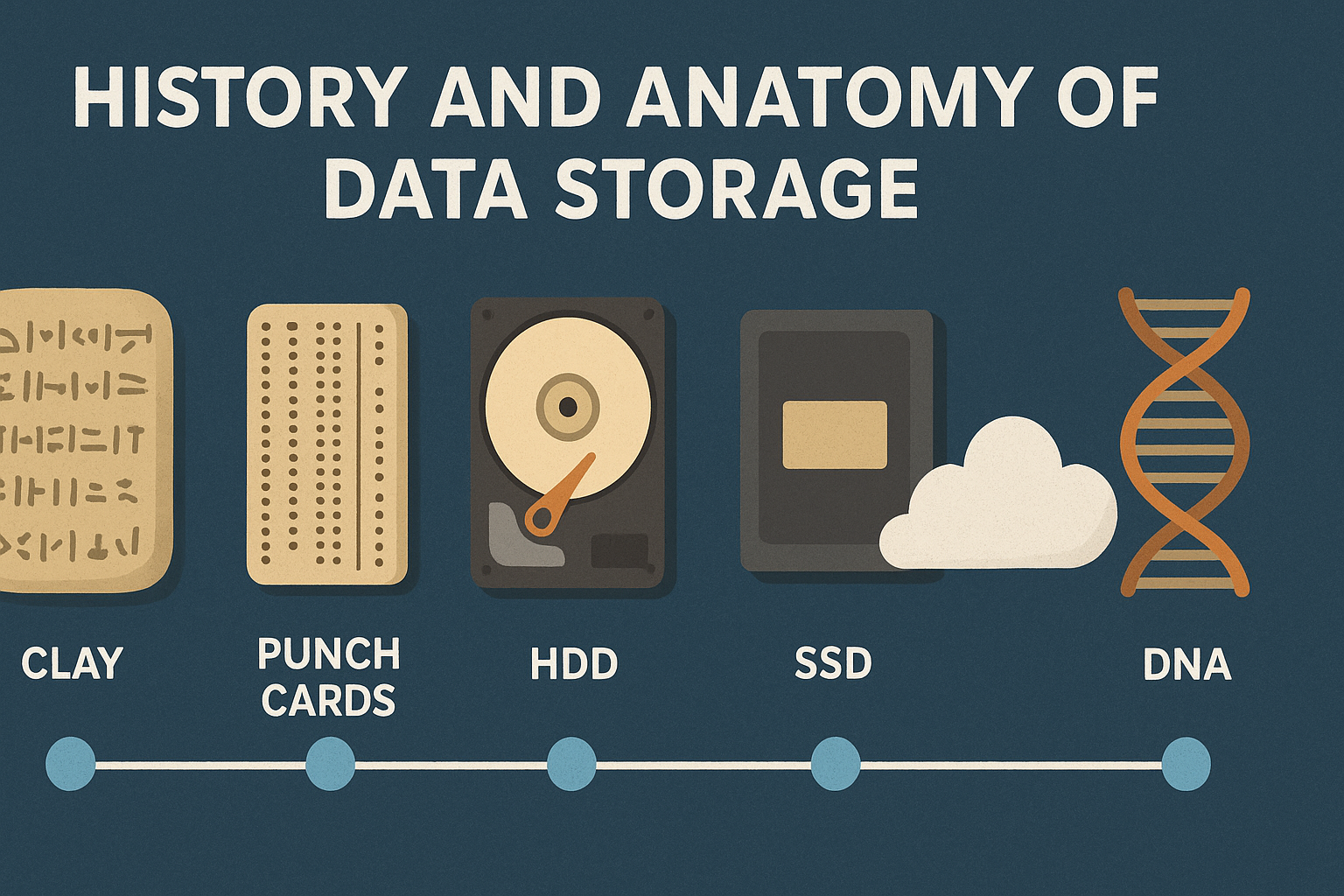
From clay tablets to cloud computing, the evolution of data storage tells the story of human progress. Every leap in how we record, save, and access information has shaped economies, societies, and technology. Understanding both the history and anatomy of data storage helps us appreciate how far we’ve come—and where we’re heading.
The History of Data Storage
1. Ancient Storage (Pre-Digital)
- Clay tablets (c. 3000 BCE): The earliest known data storage, used by Sumerians to record trade and laws.
- Papyrus & Parchment: Egyptians, Greeks, and Romans advanced storage using scrolls and manuscripts.
- Printed books (1450s): The Gutenberg press allowed mass storage and sharing of knowledge.
2. Mechanical Storage
- Punch Cards (1800s – 1900s): Used for textile looms, then for data in early IBM systems. They stored instructions and raw data using holes punched in paper.
3. Magnetic Storage
- Magnetic Tape (1950s): Allowed bulk data storage and backups, still used in archives today.
- Hard Disk Drives (HDDs – 1956): IBM introduced the first HDD, storing 5 MB on a disk the size of a fridge.
- Floppy Disks (1970s – 2000s): Portable storage for PCs, ranging from 360 KB to 1.44 MB.
4. Optical Storage
- CDs (1980s): Stored 700 MB, revolutionizing music and software distribution.
- DVDs & Blu-ray (1990s–2000s): Allowed gigabytes of storage, popular for movies and games.
5. Solid-State Storage
- Flash Drives (2000s): Portable, shock-resistant, and with rapidly growing capacities.
- Solid-State Drives (SSD): Faster, smaller, and more reliable than HDDs, now standard in laptops.
6. Modern & Future Storage
- Cloud Storage: Data stored in massive remote servers accessible via the internet.
- DNA Storage: Scientists are exploring how to encode data into synthetic DNA strands for near-infinite capacity.
- Quantum Storage (emerging): A future concept where quantum states may preserve information with unprecedented density and speed.
The Anatomy of Data Storage
Every storage medium, from ancient to modern, has three critical components:
- Recording Surface
- Clay, paper, magnetic coating, optical layers, silicon chips, or DNA strands.
- Encoding System
- Symbols, holes, magnetic polarity, laser pits, electrical charges, or nucleotide sequences.
- Access Mechanism
- Stylus (writing), readers (punch card machines), heads (HDDs/tapes), lasers (CDs/DVDs), or electronic controllers (flash/SSD).
In digital systems, storage is ultimately represented in binary (0s and 1s), no matter the medium.
Why Data Storage Matters
- Economy: Banking, e-commerce, and logistics depend on reliable data storage.
- Science: Genomics, astronomy, and AI require massive storage for research.
- Culture: Music, film, and digital art preservation depend on evolving storage.
- Personal Life: From family photos to personal documents, storage connects our daily lives to history.
Final Thoughts
Data storage is the foundation of the digital age. From clay tablets to terabyte drives, each innovation has multiplied humanity’s ability to preserve knowledge. As we enter the era of cloud, DNA, and quantum storage, we’re not just storing data—we’re archiving the future of human civilization





Be First to Comment