Introduction
The global population is projected to reach 10 billion by 2050, placing immense pressure on the agricultural sector to increase food production sustainably [1]. This demographic shift, coupled with the escalating challenges of climate change, dwindling natural resources, and a growing demand for food security, necessitates a paradigm shift in agricultural practices. Artificial Intelligence (AI) is emerging as a transformative technology, offering innovative solutions to enhance productivity, optimize resource utilization, and address these multifaceted challenges, including labor shortages and diminishing soil fertility [1]. This article delves into the pivotal role of AI in modern agriculture, meticulously examining its diverse applications in precision farming, advanced crop monitoring, and sophisticated yield prediction.
Precision Farming: Cultivating Efficiency with AI
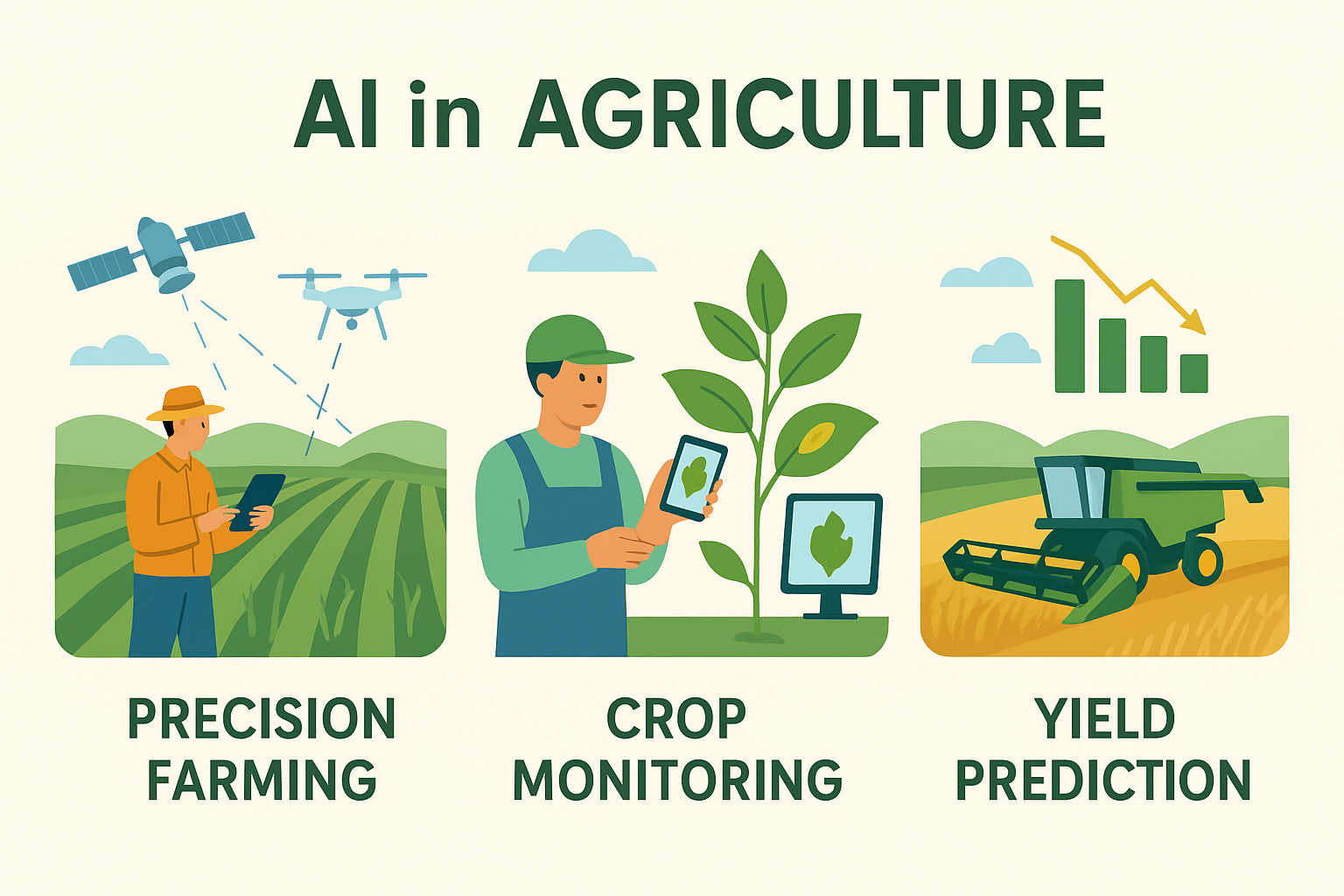
Precision farming, significantly augmented by AI, empowers farmers to manage their fields with unprecedented accuracy and efficiency. AI algorithms are capable of processing and synthesizing vast amounts of data from a myriad of sources, including sophisticated IoT sensors, high-resolution drones, and advanced satellite imagery. This comprehensive data analysis provides real-time, actionable insights into critical agricultural parameters such as crop health, soil conditions, and prevailing environmental factors [1, 2]. This data-driven approach is instrumental in optimizing resource allocation, thereby minimizing waste of precious resources like water and fertilizers, and ultimately maximizing agricultural output.
Key applications and advancements in AI-driven precision farming include:
•Optimized Irrigation Systems: AI algorithms, seamlessly integrated with IoT sensors, continuously monitor soil moisture levels and local weather conditions. This allows for the autonomous determination of the precise amount of water required for crops at any given time. This intelligent water management not only conserves water significantly but also actively promotes sustainable agricultural practices. Furthermore, in controlled environments such as smart greenhouses, AI dynamically adjusts temperature, humidity, and light levels based on real-time data to create optimal conditions for plant growth, leading to higher yields and better quality produce [1]. Case studies, such as those involving Smart Farm Agritech, vividly demonstrate AI’s crucial role in enhancing resource usage efficiency in large-scale rice and palm oil cultivation, showcasing tangible economic and environmental benefits [2].
•Targeted Fertilization and Pest Control: AI-powered systems move beyond blanket applications by recommending optimal quantities and precise locations for fertilizers and pesticides. This targeted approach dramatically reduces chemical use, mitigating environmental impact and safeguarding biodiversity. Drones, equipped with advanced computer vision AI, can conduct detailed aerial surveys to detect specific crop health issues, identify pest infestations, or pinpoint nutrient deficiencies. These drones can then apply protective pesticides or essential nutrients with surgical precision, adjusting spraying volumes based on the actual, localized needs of the crops. This level of specificity ensures maximum efficacy while minimizing chemical runoff and exposure [1, 2].
Crop Monitoring: The Vigilant Eye of AI
AI significantly enhances crop monitoring by providing accurate, timely, and comprehensive information about plant health, growth stages, and potential threats. While traditional human observation is inherently limited in its accuracy and scope, AI-driven computer vision models can continuously monitor soil conditions, detect the earliest signs of diseases, and assess overall crop health with unparalleled precision and consistency [1].
Advanced applications in AI-driven crop monitoring include:
•Early Disease and Pest Detection: AI systems are exceptionally adept at the early detection and diagnosis of crop diseases and pest infestations, often before they become visible to the human eye. Neural networks, trained on extensive datasets of plant images, can identify specific issues like apple scab with remarkable accuracy, achieving rates as high as 95% for certain conditions [1]. Similarly, machine learning algorithms analyze high-resolution images of wheat fields to identify the presence of yellow rust, enabling farmers to implement early intervention strategies that prevent widespread crop damage and significant yield losses [1]. This proactive approach is critical for maintaining crop vitality and reducing reliance on broad-spectrum treatments.
•Dynamic Soil Health Analysis: AI plays a crucial role in understanding and managing soil health. By analyzing data from soil sensors, AI helps identify nutrient imbalances, pH irregularities, and their direct effects on crop yield. This allows farmers to make timely and precise adjustments to soil amendments. Furthermore, sensors can detect subtle changes in plant growth conditions, triggering automated environmental adjustments in controlled farming systems, ensuring plants receive optimal care throughout their life cycle [1].
•Drone-Assisted Aerial Surveillance: AI-powered drones provide an invaluable tool for real-time aerial surveillance. These drones capture detailed data on moisture levels, plant health, and nutrient deficiencies across vast agricultural landscapes. This technology offers precise and granular crop health monitoring, far surpassing the capabilities of traditional ground-based methods [2]. Companies like Agrovech, for instance, leverage AI-powered drones for systematic and efficient field scanning, providing farmers with a comprehensive overview of their crops’ status [2].
Yield Prediction: Forecasting the Future Harvest
Accurate yield prediction is an indispensable component of effective farm management, strategic supply chain planning, and informed market forecasting. AI models leverage a rich tapestry of historical data, real-time weather patterns, detailed soil conditions, and high-resolution satellite imagery to forecast crop yields with remarkable accuracy [1]. The predictive power of these models is continuously improving, with some advanced AI models achieving an R² value of 0.92, indicating their ability to explain up to 92% of yield variability under specific conditions [3].
Key aspects and benefits of AI in yield prediction:
•Comprehensive Data Analysis: AI systems excel at processing and interpreting vast, complex datasets to identify intricate correlations and underlying patterns that profoundly influence crop growth and ultimate yield. This analytical capability extends to analyzing market demand, forecasting commodity prices, and precisely determining the optimal times for sowing and harvesting, thereby maximizing profitability and minimizing market risks [1].
•Advanced Predictive Modeling: Machine learning and deep learning models are rigorously trained on comprehensive agricultural data, enabling them to predict future yields with high confidence. This empowers farmers to make highly informed decisions regarding planting schedules, crop rotation, harvesting strategies, and efficient resource allocation, leading to more stable and predictable agricultural outcomes [1, 3].
Other Transformative AI Applications in Agriculture
Beyond the core areas of precision farming, crop monitoring, and yield prediction, AI is catalyzing profound transformations across numerous other facets of agriculture:
•Automated Weed Control: AI-driven robotic systems, such as the innovative BoniRob, autonomously identify and precisely remove weeds, significantly reducing the reliance on labor-intensive manual weeding and environmentally harmful chemical herbicides [1, 2]. Pioneering technologies like John Deere’s ‘See & Spray’ utilize sophisticated AI to precisely apply herbicides only where needed, achieving a remarkable reduction in usage by up to 90% compared to conventional methods [1]. This not only lowers operational costs but also promotes ecological sustainability.
•Livestock Health Monitoring: AI systems are revolutionizing animal welfare and productivity in livestock farming. By deploying a network of sensors and advanced analytical tools, AI continuously monitors critical animal health indicators, such as body temperature, activity levels, and feeding patterns. This enables the early detection of illnesses or stress, allowing for prompt interventions that significantly improve herd health and overall productivity [1, 2]. OnceCup AI stands out as a pioneering company in this specialized field, offering cutting-edge solutions for livestock management [2].
•Agricultural Supply Chain Management: AI is fundamentally reshaping the agricultural supply chain, making it more efficient, transparent, and responsive. By leveraging AI to accurately predict market demands, optimize complex delivery routes, and intelligently manage inventory, agricultural products can reach consumers in the freshest possible condition. This streamlined approach drastically reduces food waste, enhances profitability for producers, and significantly boosts market responsiveness to fluctuating consumer needs [1, 2].
Conclusion
Artificial Intelligence is not merely a technological advancement but a profound catalyst for a digital agrarian revolution. It represents a harmonious blend of age-old farming wisdom with cutting-edge technological innovation [1]. By significantly enhancing operational efficiency, fostering eco-friendly and sustainable practices, optimizing the utilization of precious resources, and strengthening monitoring and predictive mechanisms, AI is injecting unprecedented vitality into the development of a smarter, greener, and more efficient modern agricultural system [1]. As AI continues its rapid evolution and integration into agricultural ecosystems, its indispensable role in ensuring global food security, promoting environmental stewardship, and achieving long-term sustainability will become increasingly paramount. The future of farming is undeniably intelligent, interconnected, and AI-powered.

Be First to Comment