
Introduction
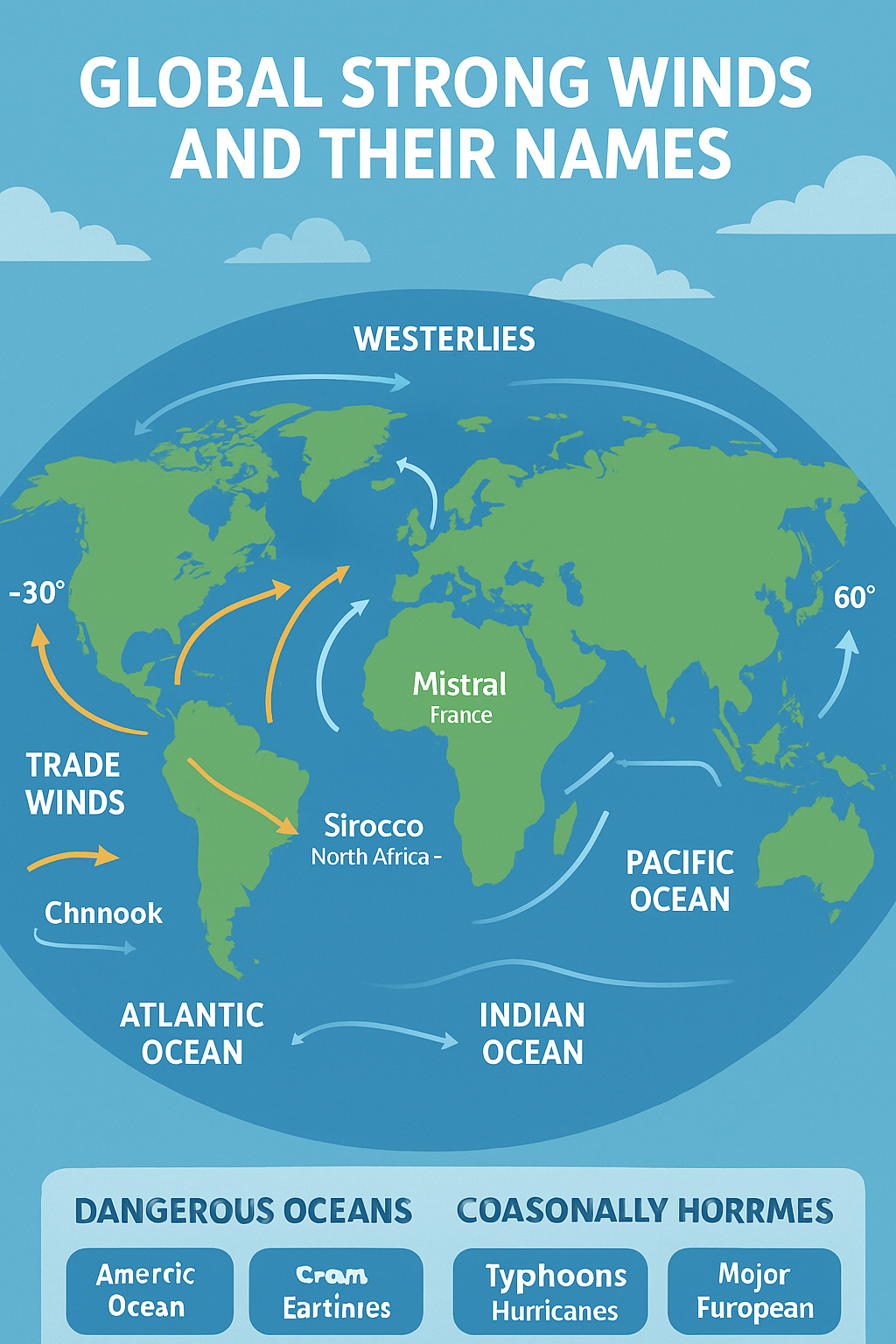
Strong winds have shaped human civilization, maritime trade, and weather patterns throughout history. From the predictable trade winds that guided ancient sailors to the ferocious storms that devastate coastlines, these atmospheric phenomena carry distinct names reflecting their regional origins and characteristics.
Major Global Wind Systems by Latitude
Trade Winds (0-30° Latitude)
Location: Between the equator and 30° North/South Characteristics: Steady, persistent winds blowing from east to west
- Northeast Trades: 0-30°N latitude
- Southeast Trades: 0-30°S latitude
- Average speed: 10-20 mph (16-32 km/h)
- Critical for historical ocean navigation and current shipping routes
Westerlies (30-60° Latitude)
Location: Between 30° and 60° North/South Characteristics: Prevailing winds flowing from west to east
- Dominant in mid-latitude regions
- Average speed: 15-30 mph (24-48 km/h)
- Drive weather systems across North America, Europe, and southern Australia
Polar Easterlies (60-90° Latitude)
Location: Between 60° and the poles Characteristics: Cold, dry winds blowing from east to west
- Originate from polar high-pressure zones
- Interact with westerlies to create storm systems
Regional Wind Names Around the World
Europe
- Mistral (France): Cold, dry northwesterly wind in the Rhône Valley, speeds up to 90 km/h
- Bora (Adriatic): Fierce northeasterly wind affecting Croatia and Slovenia, gusts exceeding 200 km/h
- Föhn (Alps): Warm, dry wind descending mountain slopes
- Sirocco (Mediterranean): Hot, humid southerly wind from the Sahara
Asia
- Monsoon Winds (South/Southeast Asia): Seasonal winds bringing heavy rainfall
- Southwest monsoon: June-September
- Northeast monsoon: December-March
- Typhoons (Western Pacific): Tropical cyclones with sustained winds over 119 km/h
- Loo (India/Pakistan): Hot, dry summer wind from the west
- Harmattan (West Africa): Dry, dusty trade wind from the Sahara
Americas
- Chinook (Rocky Mountains): Warm, dry wind causing rapid temperature changes
- Pampero (South America): Strong cold front wind in Argentina and Uruguay
- Santa Ana (California): Hot, dry wind contributing to wildfire risk
- Nor’easter (US East Coast): Powerful coastal storms with northeast winds
Africa and Middle East
- Shamal (Persian Gulf): Persistent northwesterly wind, speeds 30-50 km/h
- Haboob (Sudan/Arabian Peninsula): Intense dust storm with winds over 60 km/h
- Khamsin (Egypt): Hot, sandy spring wind lasting about 50 days
Oceania
- Willy-Willy (Australia): Term for tropical cyclones in the northwest
- Southerly Buster (Australia): Rapid cold front bringing sudden wind changes
- Roaring Forties (40-50°S): Powerful westerly winds in the Southern Ocean
Dangerous Ocean Regions and Their Winds
1. Drake Passage (Southern Ocean)
- Location: Between South America and Antarctica (55-65°S)
- Winds: Roaring Forties, Furious Fifties, Screaming Sixties
- Danger level: Extreme – waves can exceed 15 meters
- Unpredictable cyclonic storms and icebergs
2. Cape of Good Hope (South Africa)
- Location: Southern tip of Africa (34°S)
- Winds: Southeasterly gales
- Historical significance: Known as “Cape of Storms” by early sailors
- Convergence of Atlantic and Indian Ocean currents
3. North Sea
- Location: Between Britain and Northern Europe (51-62°N)
- Winds: North Atlantic westerlies and Arctic outbreaks
- Danger level: High – frequent storms, fog, and strong tides
- Shallow waters amplify wave heights
4. Bay of Bengal
- Location: Northeastern Indian Ocean (5-22°N)
- Winds: Monsoon winds and tropical cyclones
- Danger level: Extreme during cyclone season (April-May, October-November)
- Funnel shape amplifies storm surges
5. Gulf of Alaska
- Location: Pacific Ocean, south of Alaska (54-60°N)
- Winds: Aleutian Low systems
- Danger level: High – notorious for “weather bombs” (rapid cyclogenesis)
- Icy conditions and rogue waves
6. South China Sea
- Location: Western Pacific Ocean (5-23°N)
- Winds: Typhoons and winter monsoons
- Danger level: Very high during typhoon season (May-November)
- High shipping traffic increases risk
7. Tasman Sea
- Location: Between Australia and New Zealand (30-50°S)
- Winds: Roaring Forties
- Danger level: High – unpredictable storms and large swells
Global Warming and Wind Patterns: Potential Mitigation Strategies
Current Climate Change Impacts on Winds
Global warming is already affecting wind patterns worldwide:
- Intensification of tropical cyclones: Warmer ocean temperatures fuel stronger hurricanes and typhoons
- Shifting wind belts: Westerlies and jet streams are moving poleward
- Weakening trade winds: In some regions, reducing oceanic mixing
- Increased wind variability: More extreme wind events alternating with calm periods
How Climate Action Can Help Moderate Wind Extremes
1. Reducing Greenhouse Gas Emissions
Primary Goal: Limit global temperature rise to 1.5-2°C
- Slows the intensification of tropical storm systems
- Reduces energy available for extreme wind events
- Stabilizes atmospheric circulation patterns
- Action items: Transition to renewable energy, improve energy efficiency, protect carbon sinks
2. Ocean Temperature Management
Objective: Reduce sea surface temperature anomalies
- Cooler oceans produce less fuel for cyclones and hurricanes
- More stable temperature gradients reduce wind shear extremes
- Approaches:
- Reduce thermal pollution from coastal industries
- Protect and restore ocean ecosystems (kelp forests, seagrass beds)
- Support ocean current stability through reduced ice melt
3. Atmospheric Aerosol Reduction (Paradox)
Complex relationship: While pollution is harmful, some aerosols have a cooling effect
- Cleaner air may initially increase surface temperatures
- Long-term benefits outweigh short-term risks
- Balance needed: Clean air policies with aggressive CO2 reduction
4. Land Use and Vegetation Management
Impact on surface winds:
- Reforestation: Trees reduce surface wind speeds by 20-40%
- Urban planning: Green corridors and strategic building placement
- Coastal vegetation: Mangroves and coastal forests buffer storm winds
- Agricultural practices: Windbreaks and conservation tillage reduce wind erosion
5. Preserving Polar Ice Caps
Critical for global wind patterns:
- Ice reflects sunlight, maintaining temperature gradients
- Strong temperature contrasts between equator and poles drive predictable wind patterns
- Arctic warming weakens the polar vortex, causing erratic jet stream behavior
- Actions: Rapid emissions cuts to slow ice melt
6. Enhanced Climate Monitoring and Prediction
Better preparation rather than prevention:
- Improved early warning systems save lives
- Advanced modeling helps communities prepare
- Real-time wind forecasting aids aviation and maritime safety
- Investment areas: Satellite systems, AI-powered prediction, global data sharing
7. Infrastructure Resilience
Adapting to inevitable changes:
- Building codes for higher wind loads
- Offshore wind farms positioned to avoid extreme cyclone paths
- Resilient power grids that withstand storms
- Strategic location of critical infrastructure away from high-risk wind zones
The Path Forward
While global warming is altering wind patterns and intensifying extreme events, comprehensive climate action offers our best strategy for moderating these changes. The key lies not in eliminating these natural phenomena—which are essential to Earth’s climate system—but in:
- Stabilizing the climate system through emissions reduction
- Reducing the energy available for extreme wind events
- Maintaining natural wind regulators like forests and ice caps
- Building adaptive capacity in vulnerable regions
- Supporting global cooperation on climate science and disaster preparedness
The winds that once guided explorers and traders are now sending us urgent signals about our changing planet. By acting decisively on climate change, we can help ensure that future generations inherit predictable, manageable wind patterns rather than increasingly chaotic and dangerous atmospheric conditions.
Conclusion
Global winds are magnificent forces of nature, each with distinct characteristics shaped by geography, temperature, and planetary rotation. From the gentle trade winds at 15° latitude to the screaming gales of the Roaring Forties at 45°S, these winds define our climate, shape our oceans, and challenge our resilience.
As climate change intensifies, our response will determine whether these winds remain within historical norms or spiral into more dangerous extremes. The solution lies not in controlling the wind itself, but in stabilizing the climate system that governs it—a challenge that requires immediate, sustained global action.



Be First to Comment