
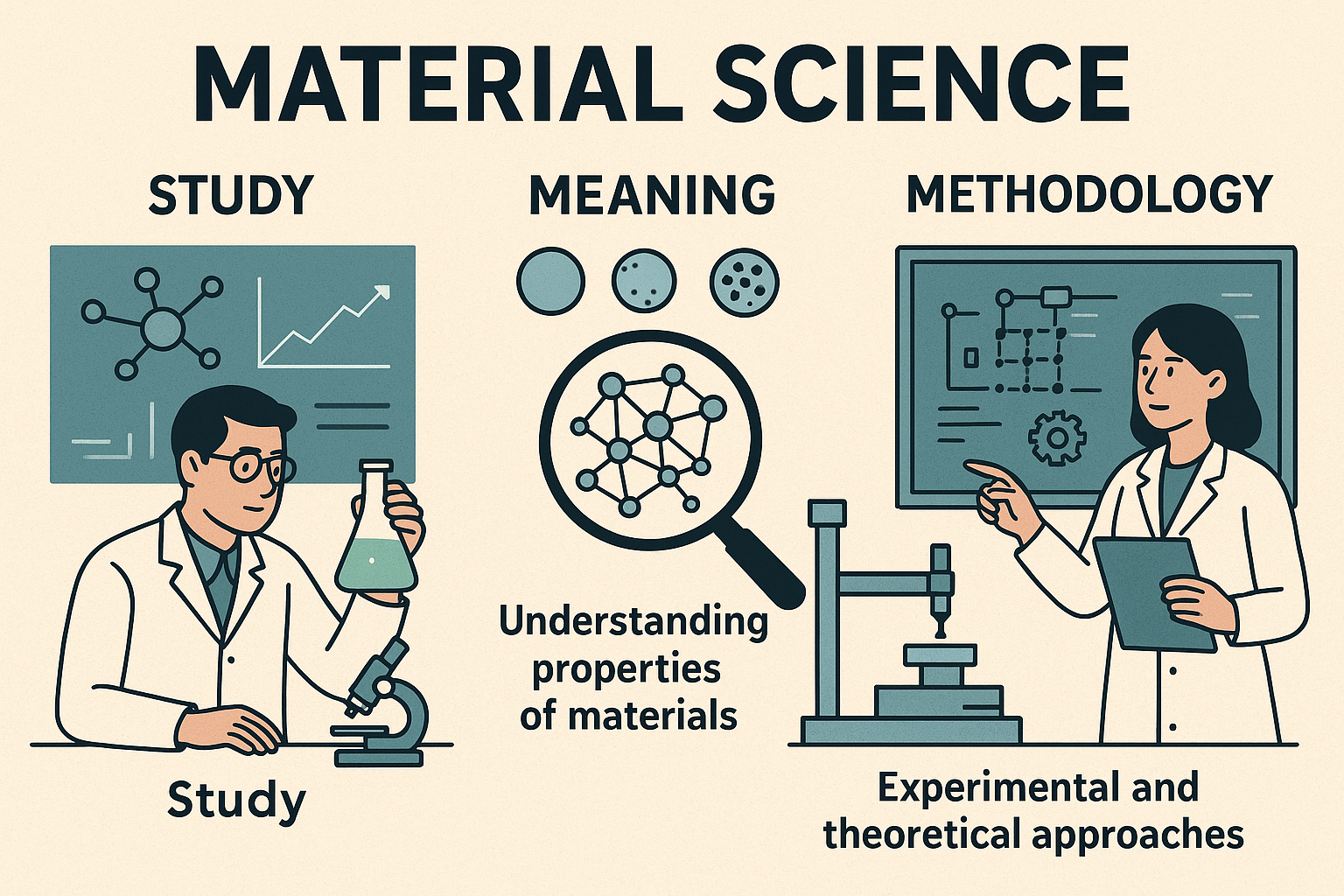
1. Meaning of Materials Science
Materials Science is an interdisciplinary field that studies the relationship between the structure, properties, processing, and performance of materials.
It combines physics, chemistry, engineering, and nanotechnology to understand and design materials for practical applications.
In simple terms:
- What it studies: The “stuff” the world is made of — metals, ceramics, polymers, semiconductors, composites, biomaterials.
- Why it matters: Every technology (from airplanes to smartphones to medical implants) depends on choosing and designing the right material.
2. Scope of Study
Materials Science covers the entire life cycle of materials:
- Discovery → Finding new materials (e.g., graphene, shape-memory alloys).
- Characterization → Understanding their internal structure at atomic and microscopic levels.
- Processing → Manufacturing and shaping materials into useful forms.
- Performance → Evaluating how materials behave in real-world applications.
- Sustainability → Recycling, reducing energy use, and creating eco-friendly materials.
3. Core Principles
Materials Science is often described by the “Materials Tetrahedron”:
- Structure – Atomic arrangement, crystal structure, microstructure.
- Properties – Mechanical (strength, hardness), thermal, electrical, optical, magnetic.
- Processing – How the material is made or treated (casting, forging, heat treatment, 3D printing).
- Performance – How the material performs in an application (durability, efficiency, failure modes).
4. Methodology of Study in Materials Science
The methodology is systematic and combines theory, experiments, and modeling:
(A) Theoretical & Conceptual Study
- Solid-state physics (atomic bonding, crystal lattices).
- Thermodynamics (phase diagrams, phase transformations).
- Quantum mechanics (electronic structure, band theory).
- Materials chemistry (diffusion, corrosion, reactivity).
(B) Experimental Approach
- Synthesis and Processing: Casting, sintering, thin-film deposition, additive manufacturing.
- Characterization Tools:
- Microscopy: SEM, TEM, AFM for surface and atomic-scale imaging.
- Spectroscopy: X-ray diffraction (XRD), Raman, NMR for atomic/molecular analysis.
- Mechanical Testing: Tensile, fatigue, hardness tests.
- Electrical/Optical Testing: Conductivity, refractive index, dielectric constant.
(C) Computational & Modeling Methods
- Density Functional Theory (DFT) for electronic structure.
- Molecular Dynamics (MD) for atomic interactions.
- Finite Element Modeling (FEM) for stress and strain.
- Machine Learning & AI for discovering new materials (Materials Informatics).
(D) Applied & Practical Studies
- Failure analysis (why materials break or degrade).
- Materials selection for engineering design (using tools like Ashby charts).
- Sustainability studies (life cycle assessment, recycling).
5. Branches of Materials Science
- Metallurgy – Metals and alloys (steel, aluminum, titanium).
- Ceramics – Glass, clay, oxides, refractories.
- Polymers – Plastics, rubber, biopolymers.
- Semiconductors – Silicon, gallium arsenide, quantum materials.
- Composites – Carbon fiber, reinforced concrete.
- Biomaterials – Implants, drug delivery systems.
- Nanomaterials – Graphene, carbon nanotubes, quantum dots.
6. Applications of Materials Science
- Electronics: Microchips, batteries, displays.
- Aerospace: Lightweight alloys, heat-resistant ceramics.
- Energy: Solar panels, nuclear reactor materials, fuel cells.
- Medical: Artificial joints, dental implants, drug delivery polymers.
- Civil Engineering: High-strength concrete, smart materials.
7. Methodological Flow of a Materials Science Study
- Identify a Problem/Need → e.g., need lighter materials for aircraft.
- Select Material Candidates → consider metals, polymers, composites.
- Theoretical Prediction → simulate properties using models.
- Synthesis & Processing → create samples in lab.
- Characterization → analyze using microscopy, spectroscopy, mechanical tests.
- Performance Testing → test in simulated or real environments.
- Optimization → refine processing to improve properties.
- Application & Scaling → move from lab to industry.
- Sustainability Check → recycling, environmental impact.





Be First to Comment