
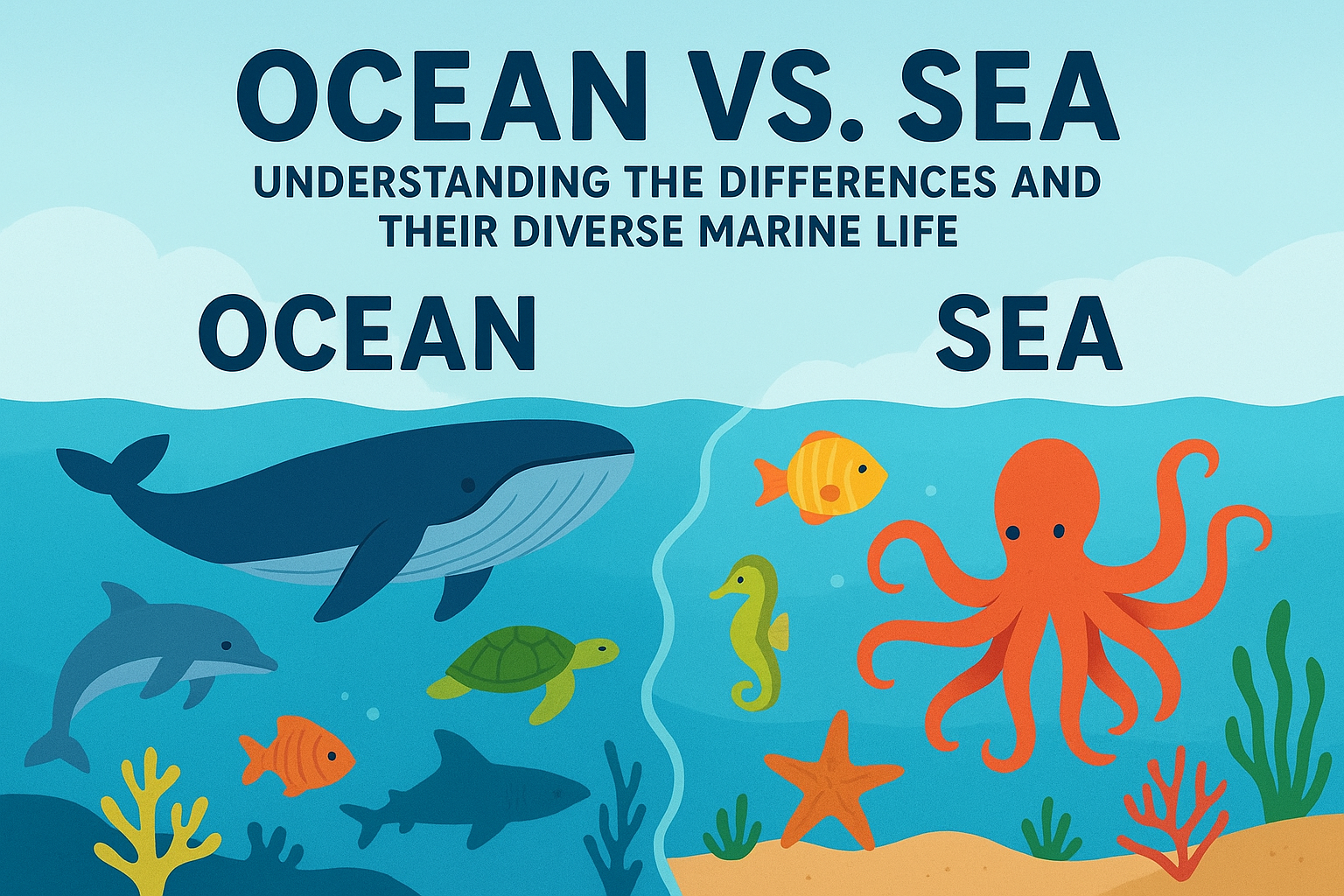
The terms “ocean” and “sea” are often used interchangeably in everyday conversation, but they actually refer to distinct types of water bodies with important geographical, physical, and biological differences. Understanding these differences helps us better appreciate the complexity and diversity of our planet’s marine environments.
What is an Ocean?
An ocean is a vast body of saltwater that covers large portions of Earth’s surface. Oceans are the largest water bodies on our planet and are interconnected, forming a continuous global water system. They are characterized by their immense size, great depth, and direct connection to the open waters of the world.
Key Characteristics of Oceans:
- Size: Extremely large, covering millions of square kilometers
- Depth: Very deep, with average depths of 3,000-4,000 meters
- Boundaries: Defined by continents and major underwater ridges
- Salinity: Relatively consistent salinity levels (about 3.5%)
- Currents: Major global circulation patterns
The Five Major Oceans:
- Pacific Ocean – The largest and deepest ocean, covering about one-third of Earth’s surface
- Atlantic Ocean – The second-largest ocean, known for its distinctive S-shape
- Indian Ocean – The third-largest ocean, bounded by Africa, Asia, and Australia
- Southern Ocean – Surrounds Antarctica and connects the Pacific, Atlantic, and Indian Oceans
- Arctic Ocean – The smallest and shallowest ocean, located around the North Pole
What is a Sea?
A sea is a smaller body of saltwater that is partially enclosed by land or connected to an ocean through narrow passages. Seas are generally smaller, shallower, and more enclosed than oceans, though they can still be quite large.
Key Characteristics of Seas:
- Size: Smaller than oceans, though still substantial
- Depth: Generally shallower than oceans
- Boundaries: Partially or completely enclosed by land
- Salinity: Can vary more than oceans due to freshwater input and evaporation
- Connection: Usually connected to oceans through straits or channels
Examples of Major Seas:
- Mediterranean Sea – Nearly enclosed sea between Europe, Africa, and Asia
- Caribbean Sea – Tropical sea in the Western Hemisphere
- Red Sea – Narrow sea between Africa and the Arabian Peninsula
- Baltic Sea – Brackish sea in Northern Europe
- Caspian Sea – Actually the world’s largest lake, despite its name
- Dead Sea – A hypersaline lake between Jordan and Israel
- North Sea – Shallow sea between Great Britain and continental Europe
Main Differences Between Oceans and Seas
AspectOceanSeaSizeMassive (millions of km²)Smaller (thousands to hundreds of thousands km²)DepthVery deep (avg. 3,000-4,000m)Generally shallowerEnclosureOpen water bodiesPartially or fully enclosed by landSalinityConsistent (~3.5%)Variable (can be higher or lower)ConnectionInterconnected globallyConnected to oceans via straitsMarine LifeDiverse oceanic speciesAdapted to local conditions
Marine Life in Oceans
Oceans support an incredible diversity of marine life, from microscopic plankton to massive whales. The vast open waters and varying depths create numerous ecological niches.
Common Ocean Animals:
Surface and Mid-Water Species:
- Blue whales, humpback whales, and sperm whales
- Dolphins and porpoises
- Sea turtles (leatherback, loggerhead, green turtles)
- Tuna, marlin, and swordfish
- Flying fish and mahi-mahi
- Jellyfish and Portuguese man-of-war
Deep Ocean Species:
- Giant squid and colossal squid
- Deep-sea anglerfish
- Gulper eels
- Vampire squid
- Deep-sea sharks (goblin shark, frilled shark)
Ocean Floor Dwellers:
- Sea cucumbers and sea stars
- Deep-sea corals
- Tube worms around hydrothermal vents
- Flatfish and rays
Marine Life in Seas
Seas often have more specialized ecosystems due to their unique conditions, such as varying salinity, temperature, and depth. Many sea creatures are adapted to these specific environments.
Examples by Sea:
Mediterranean Sea:
- Bluefin tuna
- Mediterranean monk seals
- Loggerhead sea turtles
- Dolphins and pilot whales
- Sea bass and bream
- Octopus and cuttlefish
Caribbean Sea:
- Caribbean reef sharks
- Manatees
- Sea turtles (hawksbill, green, leatherback)
- Colorful reef fish (parrotfish, angelfish, wrasse)
- Coral species
- Spiny lobsters
Red Sea:
- Red Sea coral reefs (among the most diverse)
- Dugongs
- Whale sharks
- Manta rays
- Clownfish and butterflyfish
- Red Sea banner fish
Baltic Sea:
- Harbor seals and gray seals
- Porpoises
- Cod and herring
- Pike and perch (in less salty areas)
- Various waterfowl
Dead Sea:
- Very limited life due to extreme salinity
- Some bacteria and algae
- Brine shrimp in adjacent areas
Environmental Factors Affecting Marine Life
The distribution of marine life in oceans and seas is influenced by several factors:
Temperature: Tropical waters support coral reefs and warm-water species, while polar waters host cold-adapted species like polar bears and Arctic seals.
Salinity: Species in seas with unusual salinity levels (like the Baltic or Dead Sea) have special adaptations.
Depth: Different species occupy various depth zones, from surface swimmers to deep-sea bottom dwellers.
Nutrients: Upwelling areas in oceans and nutrient-rich seas support abundant plankton and fish populations.
Geography: Enclosed or semi-enclosed seas often develop endemic species found nowhere else.
Conservation Importance
Both oceans and seas face significant environmental challenges, including:
- Climate change and ocean acidification
- Overfishing and habitat destruction
- Pollution (plastic, chemicals, oil spills)
- Coastal development
Understanding the differences between oceans and seas helps in developing appropriate conservation strategies. Seas, being more enclosed, may be more vulnerable to local pollution sources, while oceans face global-scale challenges like climate change and large-scale fishing operations.
Conclusion
While oceans and seas are both saltwater bodies teeming with life, their distinct characteristics create unique environments that support different types of marine ecosystems. Oceans, with their vast expanses and great depths, serve as the planet’s primary marine habitat and climate regulator. Seas, though smaller and more enclosed, often harbor specialized species and serve as crucial breeding and feeding grounds for many marine animals.
Recognizing these differe


Be First to Comment