
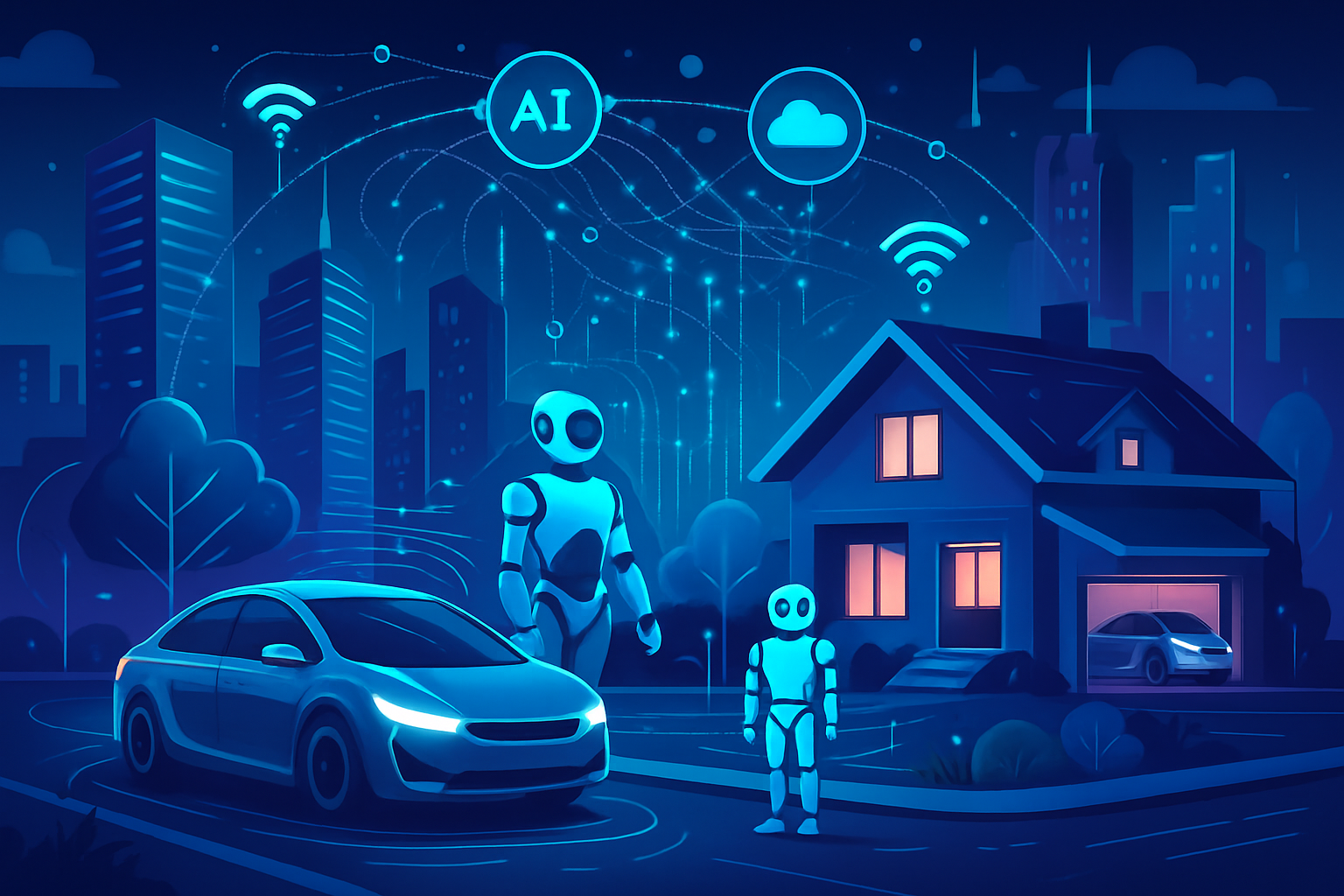
The automotive industry is experiencing a technological revolution, and at its heart lie two transformative forces: the Internet of Things (IoT) and Artificial Intelligence (AI). Together, they are shaping the future of driving, turning conventional vehicles into fully connected, intelligent machines capable of providing a safer, more efficient, and even personalized experience.
The Rise of the Connected Car
A connected car refers to a vehicle equipped with internet access and a network of sensors, allowing it to communicate with external devices, cloud platforms, other vehicles, and even infrastructure like traffic lights. This connectivity opens the door to a range of smart features, from real-time navigation updates and predictive maintenance alerts to sophisticated driver assistance systems.
IoT: The Backbone of Connectivity
IoT enables vehicles to gather, exchange, and act upon data. Sensors embedded throughout the car continuously monitor everything from engine health and tire pressure to environmental conditions and driver behavior. This data is transmitted over secure networks, allowing vehicles to interact with:
- Other vehicles (V2V): Exchange information about speed, location, and potential hazards.
- Infrastructure (V2I): Communicate with traffic signals, parking systems, and road sensors.
- Cloud systems: Access real-time updates, traffic data, and predictive analytics.
By harnessing IoT, connected cars can reduce accidents, optimize traffic flow, and enhance the overall driving experience.
AI: The Brain Behind Autonomy
While IoT provides the eyes and ears of the connected car, AI serves as its brain. Advanced machine learning algorithms process the massive volumes of data collected by sensors, enabling vehicles to:
- Recognize objects, pedestrians, and obstacles.
- Predict traffic patterns and potential hazards.
- Make real-time driving decisions with minimal human input.
- Personalize in-car experiences by learning driver preferences for routes, climate, and entertainment.
AI-driven autonomous vehicles rely on this intelligence to navigate complex urban environments, adapt to changing conditions, and even communicate with other autonomous systems on the road.
Creating the Autonomous Experience
The fusion of IoT and AI is accelerating the move toward fully autonomous vehicles. Current levels of autonomy, from advanced driver-assistance systems (ADAS) to near-complete self-driving capabilities, are already enhancing safety and convenience:
- Level 2-3 Autonomy: Features like adaptive cruise control, lane-keeping assist, and automated parking.
- Level 4-5 Autonomy: Vehicles capable of operating without human intervention in specific environments, ultimately leading to fully autonomous transport solutions.
Beyond driving, connected autonomous vehicles promise a new era of mobility services, such as autonomous ride-sharing, logistics, and on-demand delivery, all managed efficiently through IoT networks and AI optimization.
Challenges and the Road Ahead
Despite the remarkable progress, several challenges remain:
- Data Security: Protecting vehicles and networks from cyber threats is critical.
- Regulatory Frameworks: Autonomous vehicles must comply with safety standards and legal requirements across regions.
- Infrastructure Readiness: Widespread adoption requires smart roads and consistent connectivity.
Nevertheless, as IoT networks expand and AI algorithms continue to evolve, the vision of fully connected, autonomous vehicles is becoming increasingly tangible.
Conclusion
The connected car is no longer a futuristic concept—it’s a reality. By combining IoT’s connectivity with AI’s intelligence, vehicles are evolving into autonomous systems capable of transforming mobility. The result is a safer, more efficient, and personalized driving experience that is redefining how we move, commute, and interact with our environment.
The autonomous experience isn’t just coming—it’s already on the road.




Be First to Comment