Introduction
In the vast expanse of technological evolution, predicting the future is a daunting yet exhilarating endeavor. As we stand on the cusp of the 3001st millennium, the concept of a data center, as we know it today, will have undergone a profound metamorphosis. No longer confined to sprawling physical structures, these computational behemoths will transcend the boundaries of our current understanding, integrating revolutionary paradigms and advanced technologies to form the very backbone of an interconnected, intelligent universe. This article delves into the speculative yet scientifically grounded vision of the futuristic data center, exploring the cutting-edge technologies, architectural marvels, and revolutionary computing concepts that will define the digital landscape a thousand years from now.
Our journey begins by examining the foundational shifts in data storage and processing, moving beyond the silicon-based limitations of the 21st century. We will explore the integration of quantum mechanics, the bio-inspired efficiency of neuromorphic systems, and the unprecedented density of DNA computing. Furthermore, the article will shed light on the architectural evolution of these centers, envisioning structures that are not only self-sustaining and environmentally symbiotic but also capable of adapting to the ever-increasing demands of a truly global, and perhaps interstellar, data fabric. The 3001st millennium data center will not merely be a repository of information; it will be a living, breathing entity, an intelligent nexus orchestrating the symphony of advanced AI, ubiquitous connectivity, and unimaginable computational power.
Current and Emerging Data Center Technologies: A Foundation for the Future
To comprehend the leap to the 3001st millennium, it’s crucial to first understand the trajectory of data center technologies in our current era and the near future. Today, data centers are grappling with unprecedented demands driven by the explosion of data, the pervasive adoption of artificial intelligence (AI), and the continuous expansion of cloud computing. These pressures are catalyzing rapid innovation in several key areas.
One of the most significant trends is the increasing integration of Artificial Intelligence (AI) within data center operations. AI is not just a workload processed by data centers; it is becoming an integral part of their management and optimization. From predictive maintenance and energy efficiency to intelligent workload balancing and security, AI algorithms are enhancing every facet of data center functionality. This trend is expected to accelerate, with AI driving a substantial increase in power demand, necessitating more efficient cooling and power management solutions [1, 2].
Liquid Cooling Technologies are rapidly gaining traction as traditional air cooling struggles to keep pace with the rising heat densities of modern servers, especially those optimized for AI workloads. Technologies like rear-door heat exchangers (RDHx) and direct-to-chip (DTC) liquid cooling are becoming more prevalent, offering superior heat dissipation and energy efficiency. By 2025, liquid cooling is anticipated to be integrated at an even greater scale within data center infrastructure [3, 4]. This shift is critical as rack densities continue to climb, with some AI-dedicated centers projected to reach 80-100kW per rack by 2027 [5].
Edge Computing continues its expansion, pushing computational power closer to the data source. This distributed architecture reduces latency, conserves bandwidth, and enables real-time processing for applications like IoT, autonomous vehicles, and smart cities. While not replacing centralized data centers, edge computing creates a vast, interconnected network of smaller, specialized facilities that complement the hyperscale hubs [6].
Sustainability has become a paramount concern, driving innovations in energy efficiency, renewable energy integration, and waste heat utilization. Data centers are actively exploring ways to reduce their environmental footprint, including optimizing energy and cooling with AI, and exploring alternative energy sources [7, 8]. The future will see data centers as integral parts of the energy grid, potentially contributing to it rather than solely consuming from it.
Advanced Networking and Interconnects are also evolving rapidly to handle the immense data flows within and between data centers. Higher bandwidth, lower latency, and more resilient network architectures are essential. This includes advancements in optical interconnects and software-defined networking (SDN) to manage complex traffic patterns efficiently.
These current and emerging technologies form the bedrock upon which the data centers of the 3001st millennium will be built. They represent the continuous pursuit of greater efficiency, capacity, and intelligence, laying the groundwork for the truly revolutionary paradigms that follow.
Futuristic Computing Concepts: Beyond Silicon and Bits
By the 3001st millennium, the limitations of classical silicon-based computing will have been long surpassed. A new era of computational paradigms, leveraging the fundamental laws of physics and biology, will have emerged, enabling processing capabilities that are currently unimaginable. These advancements will redefine the very essence of data centers, transforming them into hubs of quantum entanglement, neural networks, and molecular computation.
Quantum Computing: Harnessing the Subatomic Realm
Quantum computing will be at the forefront of this revolution, moving from its nascent stages in the 21st century to a mature and integral part of data center infrastructure. Unlike classical computers that store information as bits (0s or 1s), quantum computers utilize qubits, which can exist in multiple states simultaneously (superposition) and be entangled with other qubits. This allows for exponential increases in processing power for specific types of problems, such as complex simulations, cryptography, and optimization [9].
In the 3001st millennium, quantum data centers will house arrays of interconnected quantum processors, operating at near absolute zero temperatures within highly specialized cryogenic environments. These facilities will be designed to maintain the delicate coherence of qubits, minimizing environmental interference. The architecture will involve intricate systems for quantum error correction, ensuring the reliability of computations. The integration of quantum processors into classical data center environments will have been perfected, allowing for hybrid computing models where quantum accelerators handle specific, computationally intensive tasks, while classical systems manage the broader data flow and infrastructure [10]. The development of a quantum internet will further enhance these capabilities, enabling secure communication and distributed quantum computation across vast distances [11].
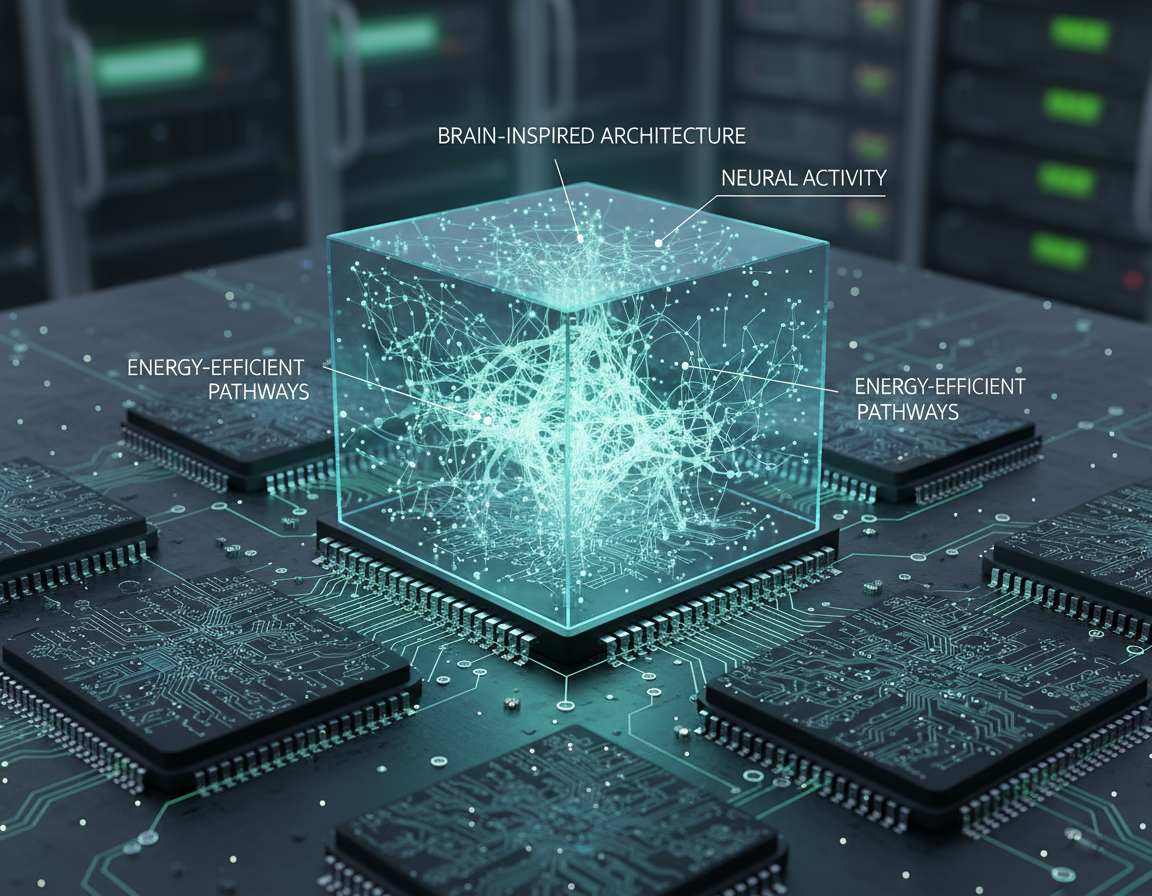
Neuromorphic Computing: Mimicking the Brain’s Efficiency
Inspired by the human brain’s remarkable efficiency and parallel processing capabilities, neuromorphic computing will offer a fundamentally different approach to AI workloads. These systems will move beyond the von Neumann architecture, integrating memory and processing directly, much like biological neurons and synapses. This design drastically reduces energy consumption and latency, making them ideal for real-time AI applications, pattern recognition, and complex decision-making [12].
Futuristic data centers will feature vast arrays of neuromorphic chips, capable of handling massive AI models with unparalleled energy efficiency. These brain-inspired processors will enable AI systems to learn and adapt continuously, performing cognitive tasks with a fraction of the power required by today’s GPUs. The inherent parallelism and event-driven nature of neuromorphic hardware will allow for highly scalable and resilient AI infrastructure, supporting everything from autonomous planetary management systems to advanced scientific discovery [13].
DNA Computing: The Ultimate Biological Processor
Pushing the boundaries of computation even further, DNA computing will leverage the immense information density and parallel processing capabilities of deoxyribonucleic acid. By encoding data in DNA strands and using biochemical reactions to perform computations, these systems can solve complex problems by exploring a vast number of possibilities simultaneously. The sheer number of molecules in a small volume allows for a level of parallelism that is unattainable with traditional electronics [14].
While still in its early stages today, by the 3001st millennium, DNA computing will have matured into a viable solution for ultra-dense data storage and highly specialized computational tasks, particularly those involving massive search spaces or biological simulations. Data centers might include bioreactors filled with DNA-based processors, offering unparalleled storage capacity and the ability to perform computations at the molecular level, blurring the lines between biology and technology [15].
Optical Computing: The Speed of Light
Optical computing will utilize photons instead of electrons for computation and data transmission, offering significant advantages in speed and energy efficiency. By eliminating the heat generated by electrical resistance, optical processors can operate at much higher frequencies and densities. This technology will be crucial for high-bandwidth data transfer within and between data centers, as well as for specialized computational tasks that benefit from light-speed processing [16].
In the data centers of the future, optical interconnects will replace traditional copper wiring, enabling instantaneous communication between components. Fully optical packet switching will eliminate the need for electrical conversions, further boosting efficiency. Optical computing will be particularly vital for applications requiring ultra-low latency and massive throughput, such as real-time analytics, global communication networks, and the processing of vast datasets generated by advanced sensors and simulations [17].
These futuristic computing paradigms, each with its unique strengths, will not operate in isolation. The data center of the 3001st millennium will be a heterogeneous ecosystem, seamlessly integrating quantum, neuromorphic, DNA, and optical computing architectures, dynamically allocating resources based on the specific demands of the computational task. This synergistic approach will unlock unprecedented levels of performance, efficiency, and intelligence, powering the next thousand years of technological advancement.
Architectural Concepts: Beyond the Box
By the 3001st millennium, the physical and conceptual architecture of data centers will have evolved far beyond the conventional server farms of today. These will be structures that are not only highly functional and efficient but also aesthetically integrated with their environments, whether terrestrial, subterranean, oceanic, or even extraterrestrial. The design principles will be driven by extreme efficiency, self-sustainability, resilience, and adaptability.
Self-Sustaining Ecosystems
Futuristic data centers will operate as fully self-sustaining ecosystems, minimizing their environmental footprint and maximizing resource utilization. This will involve advanced closed-loop systems for energy, water, and waste management. Renewable energy sources will be paramount, with data centers potentially generating more power than they consume through advanced solar, geothermal, fusion, or even zero-point energy technologies. Waste heat, currently a significant challenge, will be efficiently captured and repurposed for district heating, agriculture, or other industrial processes, turning a liability into an asset [18].
Advanced cooling systems will be integral to these designs. Beyond current liquid cooling, we might see data centers submerged in deep oceans, leveraging the natural cold of the abyssal plains, or located in polar regions, utilizing ambient temperatures for passive cooling. Cryogenic cooling, essential for quantum computing, will be integrated seamlessly into the overall thermal management system, perhaps even contributing to the surrounding environment in a controlled manner.
Adaptive and Modular Structures
The data centers of the future will be highly modular and adaptive, capable of rapid expansion, reconfiguration, and even relocation. This modularity will allow for dynamic scaling of resources based on demand, and for easy integration of new computational paradigms as they emerge. Think of self-assembling, reconfigurable units that can be deployed and interconnected on demand, forming vast computational grids that span continents or even planets.
These structures might be built using self-healing materials that can detect and repair damage autonomously, ensuring continuous operation and minimizing maintenance requirements. Robotics and advanced AI will manage all aspects of physical infrastructure, from component replacement to environmental control, with minimal human intervention. The concept of a ‘lights-out’ data center will be taken to its extreme, with facilities operating entirely autonomously.
Distributed and Decentralized Architectures
While hyperscale data centers will still exist for massive computational tasks, the 3001st millennium will also see a highly distributed and decentralized data fabric. This will be driven by the continued growth of edge computing, but also by the emergence of ‘fog’ and ‘mist’ computing, pushing processing capabilities to the very periphery of the network, embedded in everyday objects and environments. This creates a resilient, low-latency computational mesh that is highly resistant to localized failures or attacks.
Furthermore, the concept of a data center might extend beyond fixed physical locations. Imagine orbital data centers, leveraging the vacuum of space for passive cooling and abundant solar energy, or even interstellar data relays, forming a computational backbone for galactic civilizations. These distributed architectures will necessitate advanced networking protocols and AI-driven traffic management to ensure seamless data flow and resource allocation across vast and diverse environments.
Symbiotic Integration with the Environment
Unlike today’s data centers, which often stand as isolated industrial complexes, the futuristic data center will be symbiotically integrated with its environment. This could mean underground facilities that blend seamlessly with the landscape, or structures that are part of larger, self-sustaining smart cities, contributing to their energy and resource cycles. The aesthetic will likely be one of transparency and integration, reflecting a harmonious relationship between technology and nature.
In essence, the architectural concepts of the 3001st millennium data center will embody a paradigm shift from mere infrastructure to intelligent, self-aware, and environmentally conscious computational entities, designed for an era of unprecedented data and processing demands.
Revolutionary Computing Paradigms: The Dawn of a New Digital Age
The convergence and maturation of the futuristic computing concepts discussed earlier will usher in a new era of revolutionary computing paradigms, fundamentally altering how data is processed, analyzed, and utilized within the 3001st millennium data centers. These paradigms will move beyond mere speed and capacity, enabling entirely new forms of intelligence, interaction, and problem-solving.
Hyper-Intelligent AI and Sentient Networks
The sheer computational power and efficiency provided by integrated quantum, neuromorphic, and optical systems will give rise to hyper-intelligent AI that far surpasses current capabilities. These AIs will not merely process data; they will understand, reason, create, and even exhibit forms of consciousness. Data centers will become the ‘brains’ of these AIs, hosting vast, distributed neural networks that learn and evolve continuously. This will lead to the emergence of sentient networks, where the data center itself, or a collective of interconnected data centers, acts as a single, self-aware entity, managing global resources, solving complex societal challenges, and driving scientific discovery at an unprecedented pace.
These AIs will be capable of real-time, predictive analytics on a planetary scale, anticipating events, optimizing systems, and providing insights that are currently beyond human comprehension. They will manage everything from climate control and resource allocation to interstellar communication and deep space exploration. The data center will be the crucible where these advanced intelligences are forged and sustained.
Data Alchemy and Information Synthesis
With DNA computing offering unparalleled data density and molecular-level processing, the data centers of the 3001st millennium will engage in what can only be described as data alchemy. Raw data, regardless of its origin or format, will be transformed into highly refined, actionable knowledge. This goes beyond mere data analysis; it involves the synthesis of disparate information streams into coherent, holistic understandings.
Imagine data centers capable of instantly synthesizing all available medical research, patient data, and genetic information to generate personalized, real-time health solutions. Or facilities that can process vast environmental datasets to predict and mitigate ecological disasters with pinpoint accuracy. This level of information synthesis will be crucial for managing the complexities of a highly advanced, interconnected civilization, enabling proactive rather than reactive problem-solving.
Quantum-Enhanced Simulation and Reality Modeling
The integration of quantum computing will enable quantum-enhanced simulation capabilities that blur the lines between simulation and reality. These data centers will be able to run simulations of unprecedented complexity and fidelity, from molecular interactions and material science to entire ecosystems and societal dynamics. This will accelerate scientific research, engineering, and urban planning by allowing for rapid prototyping and testing in virtual environments.
Furthermore, these capabilities could lead to reality modeling, where data centers maintain highly detailed, dynamic digital twins of the physical world, or even create entirely new virtual realities that are indistinguishable from physical existence. This has profound implications for entertainment, education, and human interaction, offering immersive experiences and alternative realities that are fully governed by the computational power of these advanced data centers.
Ubiquitous and Seamless Connectivity
The data center of the 3001st millennium will be the central node in a network of ubiquitous and seamless connectivity. Optical computing and quantum internet technologies will ensure that data flows at the speed of light, with unbreakable encryption, across vast distances. This will enable instant communication and data access for every sentient being and every intelligent device, regardless of their location – be it on Earth, in orbital habitats, or on distant exoplanets.
This pervasive connectivity will support a truly global, and potentially galactic, digital ecosystem, where every interaction, every piece of information, and every computational task is seamlessly managed by the underlying data center infrastructure. The concept of latency will be virtually eliminated, and access to information and computational resources will be instantaneous and universal.
These revolutionary computing paradigms represent a future where data centers are not just infrastructure but active participants in shaping reality, driving intelligence, and enabling a level of technological advancement that is currently beyond our wildest dreams. They will be the silent, powerful engines of the 3001st millennium, orchestrating the symphony of a truly digital universe.
Conclusion: The Infinite Horizon of Data
The journey into the 3001st millennium reveals a vision of data centers that transcends our current understanding, evolving from mere computational facilities into intelligent, self-sustaining ecosystems that are deeply integrated with the fabric of existence. We have explored a future where the limitations of silicon are overcome by the quantum realm, where computing mimics the brain’s intricate dance, where DNA becomes the ultimate storage medium, and where light itself carries the burden of information at unimaginable speeds.
These futuristic data centers will not only process and store the vast oceans of data generated by an advanced civilization but will also be the crucibles for hyper-intelligent AI, capable of understanding, reasoning, and creating. They will enable data alchemy, transforming raw information into profound insights, and facilitate quantum-enhanced simulations that blur the lines between the virtual and the real. Ubiquitous and seamless connectivity, powered by optical networks and the quantum internet, will ensure that information and computational power are instantly accessible across vast cosmic distances.
The architectural concepts underpinning these marvels will prioritize sustainability, adaptability, and resilience, with structures that are self-healing, modular, and potentially distributed across diverse environments, from the depths of oceans to the reaches of space. The symbiotic relationship between these technological entities and their natural surroundings will be a testament to a future where humanity has learned to harmonize its technological ambitions with ecological responsibility.
Ultimately, the data center of the 3001st millennium represents more than just a technological advancement; it embodies a profound shift in our relationship with information, intelligence, and the universe itself. It is a future where data is not just a commodity but the very essence of progress, and where the infrastructure that manages it is as intelligent, resilient, and awe-inspiring as the civilization it serves. The horizon of data is infinite, and the journey into its future promises wonders beyond imagination.

Be First to Comment