
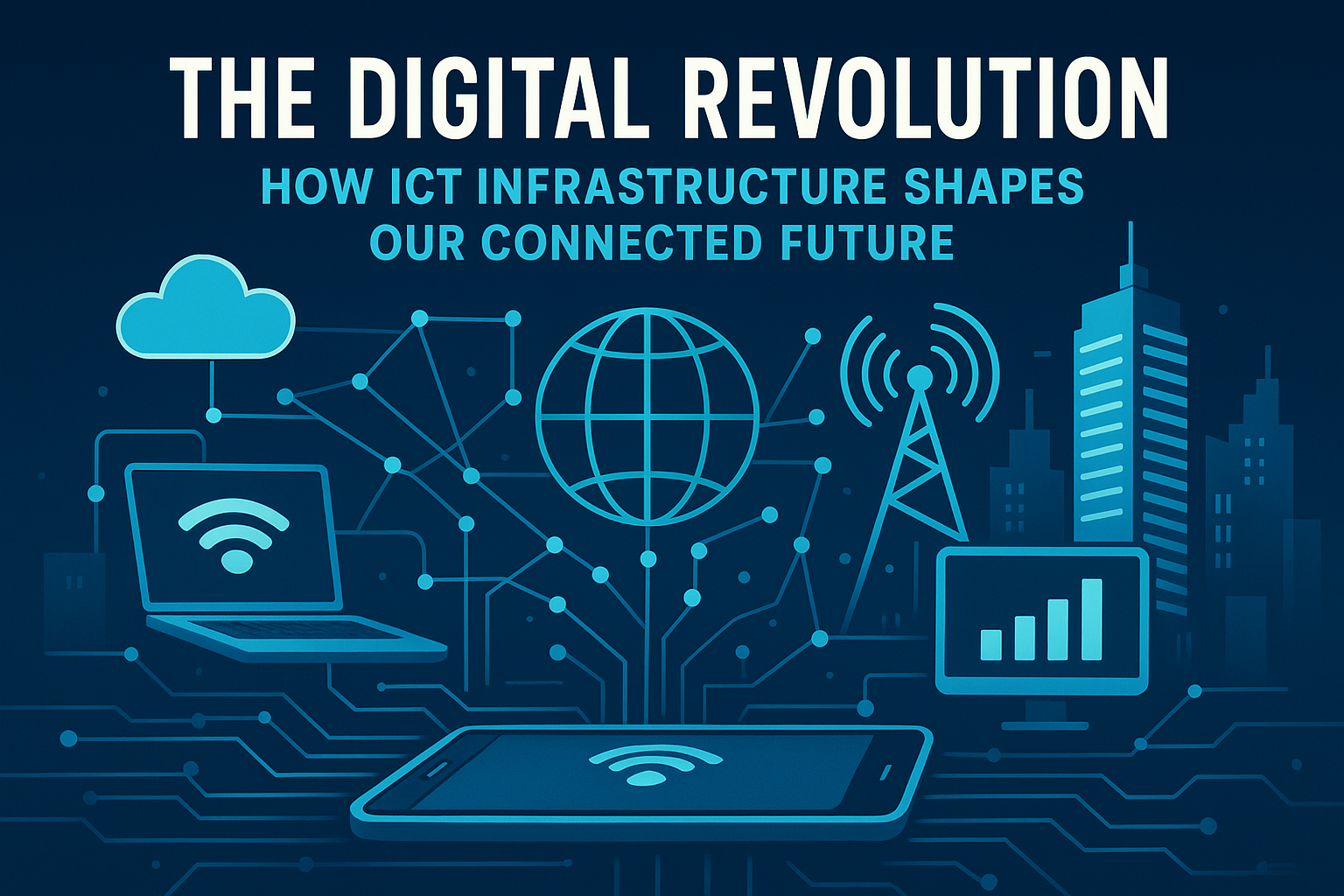
In our rapidly evolving digital landscape, Information and Communication Technology (ICT) has become the backbone of modern civilization. As we stand at the precipice of unprecedented technological advancement, it’s crucial to understand the intricate web of infrastructure that makes our hyperconnected world possible.
The foundation of our digital society rests upon the electromagnetic spectrum—that invisible highway carrying billions of conversations, data packets, and digital dreams across the globe every second. This spectrum, carefully managed and allocated by regulatory bodies worldwide, operates across various frequency bands that determine how our devices communicate with each other.
Consider the frequencies that surround us daily. Our mobile phones operate on frequencies ranging from 850 MHz to 2.6 GHz, with newer 5G networks pushing into even higher frequency ranges above 24 GHz. These megahertz (MHz) and gigahertz (GHz) measurements aren’t just technical jargon—they represent the speed and capacity of our digital lives. The higher the frequency, the more data we can transmit, but paradoxically, the shorter the range of transmission becomes.
This is where the physical manifestation of our digital infrastructure becomes visible. Drive through any urban area, and you’ll witness the towering sentinels of connectivity—cellular towers and base stations that form the neural network of our information age. These structures, often overlooked by the average citizen, are the unsung heroes of our always-on society.
Each base station serves as a critical node in the vast network that enables everything from emergency calls to streaming entertainment. The antennas mounted on these towers are sophisticated pieces of engineering, precisely calibrated to transmit and receive signals across specific frequency bands. Modern antenna arrays can handle multiple frequency ranges simultaneously, supporting everything from legacy 2G networks operating at 900 MHz to cutting-edge 5G systems utilizing millimeter-wave frequencies above 28 GHz.
The speed at which our data travels through these networks is truly remarkable. While we often think of internet speed in terms of megabits per second (Mbps) or gigabits per second (Gbps), the underlying radio frequencies that carry this data operate at frequencies measured in MHz and GHz. A 2.4 GHz Wi-Fi network, for instance, uses electromagnetic waves oscillating at 2.4 billion cycles per second to carry our digital communications.
However, this technological marvel comes with its challenges. The increasing demand for bandwidth has created what experts call “spectrum scarcity.” As more devices compete for space on the electromagnetic spectrum, regulators and engineers must find innovative ways to maximize efficiency. This has led to the development of more sophisticated base station technologies and smarter antenna systems that can dynamically adjust their coverage patterns based on demand.
The proliferation of towers and base stations has also sparked important conversations about urban planning and environmental considerations. While these structures are essential for maintaining our connected lifestyle, communities must balance the need for coverage with aesthetic and health concerns. Modern tower designs increasingly incorporate stealth technology, disguising antennas as architectural elements or natural features.
Looking toward the future, the next generation of ICT infrastructure promises even greater capabilities. The rollout of 5G networks requires a denser network of base stations due to the higher frequencies involved. These millimeter-wave signals, operating in the 24-71 GHz range, offer unprecedented speed but require more towers positioned closer together to maintain coverage.
As we embrace this digital transformation, we must remember that behind every video call, social media update, and streaming session lies a complex ecosystem of frequencies, towers, base stations, and antennas working in perfect harmony. The spectrum that enables our connectivity is a finite resource that must be managed wisely for future generations.
The true measure of our technological progress isn’t just in the GHz speeds we achieve or the number of towers we erect, but in how we use this powerful infrastructure to solve real-world problems, bridge digital divides, and create opportunities for all members of society.
In conclusion, as we continue to push the boundaries of what’s possible in our interconnected world, let us not forget the fundamental building blocks that make it all possible. The electromagnetic spectrum, measured in MHz and GHz, transmitted through carefully positioned antennas on towers and base stations, represents more than just technology—it represents human ingenuity and our endless quest to stay connected.
The future of ICT lies not just in faster speeds or more frequencies, but in our ability to harness this infrastructure responsibly and inclusively, ensuring that the benefits of our digital revolution reach every corner of society.

Be First to Comment