Introduction
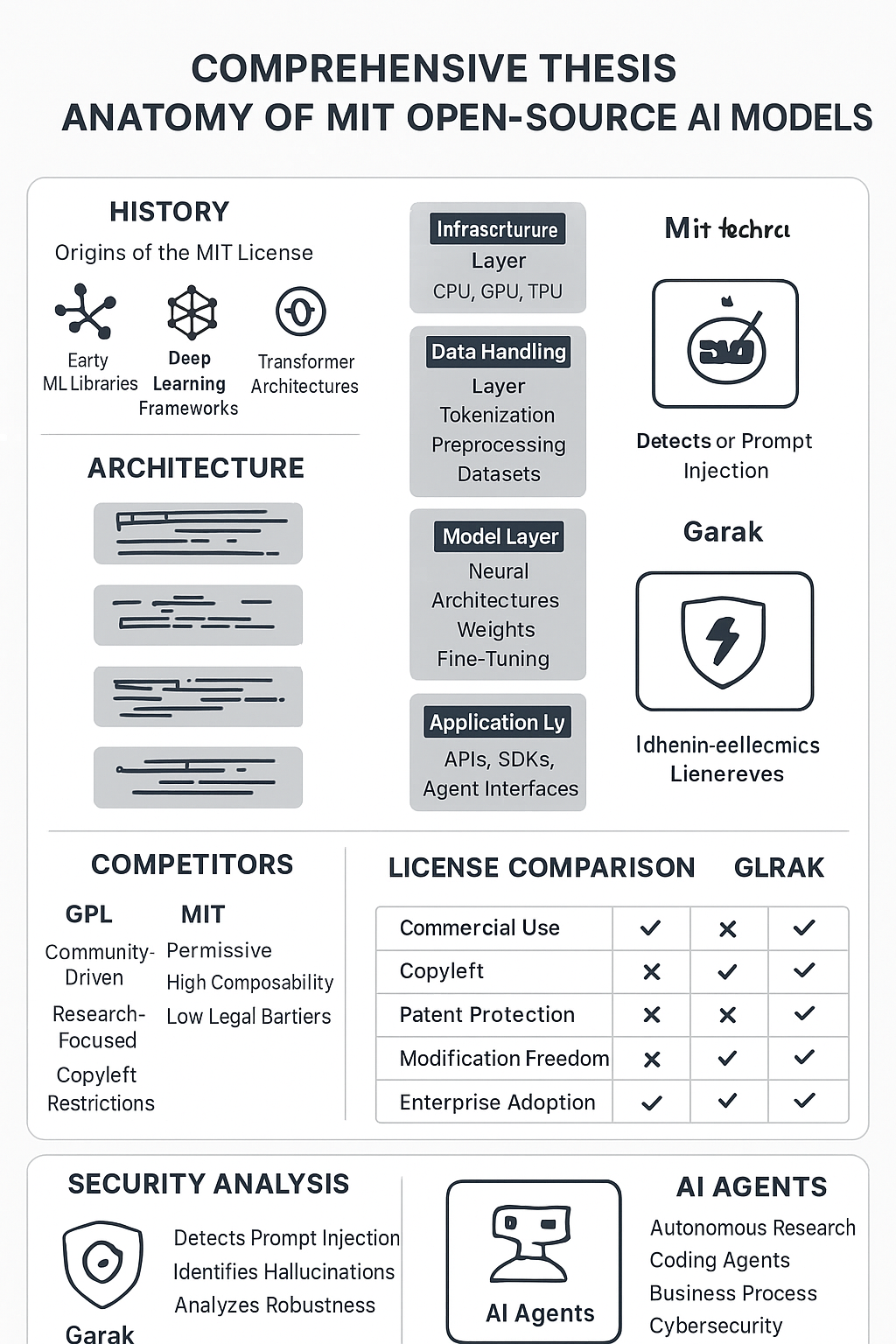
The MIT License stands as one of the most permissive and widely adopted open source licenses in software development history. Its simplicity, legal clarity, and minimal restrictions have made it the license of choice for countless projects, from small utilities to massive frameworks powering modern artificial intelligence systems. This article explores the MIT License’s origins, its technical and legal architecture, how it compares to alternatives like the GPL and Apache licenses, and examines its crucial role in the AI agent ecosystem.
Historical Background of the MIT License
Origins at the Massachusetts Institute of Technology
The MIT License emerged from the Massachusetts Institute of Technology in the late 1980s, though its exact origins are somewhat nebulous. The license was originally used for software distributed with the X Window System, a foundational graphics system for Unix-like operating systems developed at MIT. The X Consortium, which managed the X Window System, popularized what would become known as the MIT License.
The license represented a philosophical shift in how academic institutions approached software distribution. Rather than keeping software proprietary or imposing strict conditions on its use, MIT chose to release code with minimal restrictions, believing that widespread adoption and improvement of software served the greater good of the computing community.
Evolution and Standardization
Over the decades, the MIT License has undergone minimal changes, which is part of its enduring appeal. The Open Source Initiative (OSI) officially recognized it as an open source license, and it became one of the most popular licenses approved by the OSI. The license’s stability and legal precedent have made it a safe choice for both individual developers and large corporations.
By the 2000s, the MIT License had become synonymous with permissive open source licensing. Its adoption by major projects like jQuery, Rails, and Node.js cemented its position as the go-to license for developers who wanted to maximize the usability and adoption of their code.
Architecture and Legal Framework of the MIT License
Core Components
The MIT License is remarkably brief, typically consisting of fewer than 200 words. Its architecture can be broken down into several key components:
1. Copyright Notice Requirement
The license requires that the copyright notice and permission notice be included in all copies or substantial portions of the software. This ensures attribution to the original authors while allowing unlimited modification and distribution.
2. Permission Grant
The license grants extraordinarily broad permissions, explicitly allowing anyone to:
- Use the software for any purpose
- Copy the software without restriction
- Modify the software in any way
- Merge the software with other projects
- Publish the software or modifications
- Distribute the software freely
- Sublicense the software under different terms
- Sell copies of the software
3. Warranty Disclaimer
The license includes a comprehensive disclaimer that the software is provided “as is” without warranty of any kind. This protects authors from liability for defects, security vulnerabilities, or any damages arising from the software’s use.
4. Liability Limitation
Authors and copyright holders are explicitly protected from liability claims, whether arising from contract, tort, or other legal theories. This clause is typically written in all capitals for legal emphasis.
Legal Characteristics
Permissiveness
The MIT License is classified as a “permissive” license, meaning it imposes minimal restrictions on how the software can be used. Unlike “copyleft” licenses, it does not require derivative works to be distributed under the same license terms.
Compatibility
One of the MIT License’s greatest strengths is its compatibility with virtually all other licenses, both open source and proprietary. MIT-licensed code can be incorporated into GPL projects, Apache projects, or closed-source commercial software without legal complications.
Simplicity
The license’s brevity and plain language make it accessible to developers without legal expertise. This simplicity reduces the barrier to adoption and minimizes ambiguity in interpretation.
Commercial Friendliness
The MIT License explicitly allows commercial use, making it attractive to businesses that want to build proprietary products on open source foundations. Companies can take MIT-licensed code, modify it, and sell it without releasing their modifications.
Competitors to the MIT License
The GNU General Public License (GPL)
The GPL, created by Richard Stallman and the Free Software Foundation, represents the philosophical opposite of the MIT License in many ways.
GPL Version 2 (1991)
GPL v2 introduced the concept of “copyleft,” requiring that any derivative works be distributed under the same license terms. This ensures that software freedom is preserved throughout the distribution chain. Major projects like the Linux kernel use GPL v2.
GPL Version 3 (2007)
GPL v3 addressed modern concerns like digital rights management (DRM), patent grants, and “tivoization” (hardware restrictions on modified software). Projects like GCC and many GNU utilities use GPL v3.
Key Differences from MIT:
- GPL requires source code disclosure for distributed derivatives
- GPL enforces license inheritance (copyleft)
- GPL provides explicit patent grants
- GPL is significantly longer and more complex legally
- GPL restricts commercial use cases where source code disclosure is undesirable
Philosophy:
The GPL prioritizes software freedom over permissiveness, ensuring that code remains free for all users in perpetuity. The MIT License prioritizes flexibility and maximum adoption.
The Apache License
The Apache License, maintained by the Apache Software Foundation, occupies a middle ground between the MIT and GPL licenses.
Apache License 2.0 (2004)
The current version provides several enhancements over simpler permissive licenses:
Key Features:
- Explicit patent grant from contributors
- Clear contribution terms
- Trademark protection clauses
- More detailed legal language than MIT
- Explicit disclaimer of warranty and limitation of liability
Differences from MIT:
- Apache provides explicit patent protection
- Apache includes contribution provisions
- Apache protects project trademarks
- Apache is approximately 5 times longer than MIT
- Apache requires notices of modifications in NOTICE files
Use Cases:
Major Apache projects include Hadoop, Kafka, Spark, and Cassandra. The license is popular for enterprise software where patent protection is valuable.
The BSD License Family
BSD (Berkeley Software Distribution) licenses are close cousins to the MIT License.
Original BSD License (4-Clause)
Included an advertising clause requiring acknowledgment in all advertising materials. This clause created compatibility issues and is now rarely used.
Modified BSD License (3-Clause)
Removed the advertising clause but retained a non-endorsement clause prohibiting use of the copyright holder’s name for promotion without permission.
Simplified BSD License (2-Clause)
Functionally nearly identical to the MIT License, differing mainly in wording. Also known as the “FreeBSD License.”
Comparison with MIT:
The 2-clause BSD and MIT licenses are so similar that choosing between them often comes down to personal preference or institutional tradition. Both are equally permissive and commercially friendly.
Mozilla Public License (MPL)
The MPL represents a “weak copyleft” approach, requiring modifications to MPL-licensed files to remain open source while allowing combination with proprietary code.
MPL 2.0 Key Features:
- File-level copyleft (not project-level like GPL)
- Compatible with GPL and Apache licenses
- Allows mixing with proprietary code
- Explicit patent grant
Comparison with MIT:
MPL is more restrictive than MIT, requiring disclosure of modifications to MPL-covered files, but more permissive than GPL, allowing integration into proprietary projects.
Comparing MIT with GPL and Apache: A Detailed Analysis
Licensing Philosophy Spectrum
MIT License: Maximum Freedom
The MIT License embodies the philosophy that code should be free to use in any context. It prioritizes:
- Developer convenience
- Commercial adoption
- Minimal legal overhead
- Maximum compatibility
- Rapid project growth
Apache License: Balanced Protection
The Apache License adds pragmatic protections while remaining permissive:
- Patent defense
- Contributor clarity
- Corporate confidence
- Professional legal framework
- Enterprise adoption
GPL License: Perpetual Freedom
The GPL ensures that freedom propagates through the entire software ecosystem:
- User rights protection
- Source code availability
- Community benefit
- Corporate accountability
- Ideological consistency
Patent Considerations
MIT License:
- No explicit patent grant
- Relies on implied license theory
- Potential patent ambiguity
- Simpler but less protected
Apache License:
- Explicit patent grant from contributors
- Patent retaliation clause (defensive termination)
- Clear patent position
- Preferred by patent-aware organizations
GPL License:
- Implicit patent grant through distribution
- GPL v3 includes explicit patent provisions
- Strongest patent protection for users
- May deter some corporate contributors
Commercial Use Scenarios
Scenario 1: Building a Proprietary Product
- MIT: Full freedom to incorporate without disclosure
- Apache: Same freedom with patent protection
- GPL: Requires entire product to be GPL-licensed or separate linking arrangements
Scenario 2: SaaS/Cloud Services
- MIT: No obligations even for modified code
- Apache: No obligations even for modified code
- GPL v2: No obligations (ASP loophole)
- AGPL: Must provide source to all users
Scenario 3: Embedded Systems
- MIT: Ideal for firmware and embedded use
- Apache: Good for embedded with patent concerns
- GPL: Requires providing source to device owners
Community and Ecosystem Effects
MIT License Effects:
- Rapid adoption across diverse users
- Potential for “free-riding” by large corporations
- Less guaranteed contribution back to original projects
- Maximum ecosystem diversity
- Potential for fragmentation
Apache License Effects:
- Strong corporate confidence
- Clear contribution pathways
- Enterprise-friendly governance
- Balanced community growth
- Professional project image
GPL License Effects:
- Strong community cohesion
- Guaranteed source availability
- Corporate hesitation in some sectors
- Vibrant volunteer ecosystems
- Ideologically aligned communities
Legal Complexity and Risk
MIT License:
- Minimal legal review needed
- Widely understood and tested
- Low compliance burden
- Some patent uncertainty
- Simple to implement
Apache License:
- Moderate legal complexity
- Comprehensive legal coverage
- Explicit patent safety
- Clear compliance requirements
- Professional legal framework
GPL License:
- High legal complexity
- Extensive legal review often needed
- Strict compliance requirements
- Complex compatibility issues
- Significant corporate legal costs
Garak: AI LLM Vulnerability Scanner
It’s important to note that Garak is not a “security system” in the traditional sense, nor is it comparable to licenses like MIT, GPL, or Apache. Instead, Garak is an AI security tool specifically designed to probe and test Large Language Models (LLMs) for vulnerabilities.
What is Garak?
Garak (named after the character from Star Trek: Deep Space Nine) is an open-source LLM vulnerability scanner developed to identify security weaknesses, biases, and harmful behaviors in language models. It’s maintained by NVIDIA and the broader AI security community.
Primary Functions:
- Tests LLMs for various vulnerability categories
- Identifies potential prompt injection weaknesses
- Detects bias and fairness issues
- Checks for data leakage vulnerabilities
- Tests toxicity and harmful content generation
- Evaluates model robustness
Key Features:
- Modular probe architecture
- Extensive vulnerability database
- Automated testing frameworks
- Configurable scanning profiles
- Detailed reporting capabilities
How Garak Differs from Licensing
While MIT, GPL, and Apache are legal frameworks for software distribution, Garak is a security testing tool. The comparison would be:
Licenses (MIT/GPL/Apache):
- Define usage rights
- Govern distribution
- Specify attribution requirements
- Address liability
Garak:
- Tests AI model security
- Identifies vulnerabilities
- Improves AI safety
- Provides security assessment
Garak’s License
Interestingly, Garak itself is released under the Apache License 2.0, making it freely usable for testing and securing AI systems while providing patent protection to users.
Integration with AI Development
Garak has become an essential tool in the AI development pipeline for organizations building LLM-based applications. It integrates with:
- Model development workflows
- CI/CD pipelines
- Security audit processes
- Red team operations
- Compliance verification
AI Agents and Platforms Using MIT-Licensed Technology
The AI revolution has been built significantly on MIT-licensed foundations. Here’s an in-depth look at major AI agents and platforms leveraging MIT-licensed code:
1. PyTorch (Modified BSD, similar to MIT)
Overview: PyTorch, developed by Meta AI (formerly Facebook AI Research), uses a BSD-style license that’s functionally equivalent to MIT in its permissiveness.
Architecture:
- Tensor computation with GPU acceleration
- Dynamic computational graphs
- Automatic differentiation (autograd)
- Extensive neural network libraries
- Production deployment tools (TorchScript, TorchServe)
AI Agents Using PyTorch:
Hugging Face Transformers Agents:
- Built on PyTorch backend
- Pre-trained model architectures
- Task-specific fine-tuning capabilities
- Used by thousands of AI applications
LangChain with PyTorch Models:
- Integrates PyTorch-based LLMs
- RAG (Retrieval-Augmented Generation) pipelines
- Agent reasoning frameworks
- Tool-using AI systems
Stability AI Models:
- Stable Diffusion (image generation)
- StableLM (language models)
- PyTorch-powered inference
Why MIT-style Licensing Matters: PyTorch’s permissive license has enabled rapid commercial adoption, with companies like OpenAI, Tesla, and Uber building proprietary AI systems on its foundation.
2. FastAPI (MIT License)
Overview: FastAPI is a modern Python web framework extensively used for building AI agent APIs and microservices.
Key Features:
- High performance (comparable to Node.js and Go)
- Automatic API documentation
- Data validation with Pydantic
- Async support for concurrent requests
- Type hints for IDE support
AI Agents Built with FastAPI:
LangServe:
- Deploys LangChain agents as APIs
- Production-ready AI agent endpoints
- Streaming support for long responses
- MIT-licensed deployment infrastructure
Custom ChatGPT-style Interfaces:
- Companies build proprietary chatbots
- FastAPI serves model inference
- Handles authentication and rate limiting
- Enables commercial AI products
Multi-Modal AI Services:
- Vision + language agent APIs
- Audio processing pipelines
- Document understanding systems
Impact: FastAPI’s MIT license allows companies to build commercial AI services without open-sourcing their proprietary prompts, training data, or business logic.
3. React (MIT License)
Overview: React, developed by Meta, is the foundation for countless AI agent user interfaces.
AI Agent UIs Built with React:
ChatGPT-style Interfaces:
- Open-source alternatives like LibreChat
- Custom enterprise chatbot UIs
- Multi-agent conversation interfaces
- Streaming response rendering
AI Code Editors:
- Cursor (AI-powered IDE)
- GitHub Copilot interface components
- AI pair programming tools
AI Dashboard Applications:
- Vector database UIs (Pinecone, Weaviate)
- ML experiment tracking (Weights & Biases uses React)
- Model monitoring dashboards
Significance: React’s MIT license enables companies to build sophisticated AI agent interfaces without licensing concerns, accelerating AI product development.
4. LangChain (MIT License)
Overview: LangChain is one of the most important frameworks for building AI agents and applications with LLMs.
Core Architecture:
- Chain composition for complex workflows
- Agent frameworks with tool use
- Memory systems for context retention
- Vector store integrations
- Prompt management and optimization
AI Agents Powered by LangChain:
Autonomous Research Agents:
- Web browsing and information gathering
- Multi-step reasoning chains
- Fact verification and citation
- Report generation
Customer Service Agents:
- Context-aware conversation management
- Database query integration
- Ticket routing and classification
- Sentiment analysis integration
Code Generation Agents:
- Repository analysis
- Code modification suggestions
- Bug detection and fixing
- Documentation generation
Personal Assistant Agents:
- Calendar integration
- Email management
- Task prioritization
- Information retrieval from personal documents
Enterprise Adoption:
Thousands of companies build on LangChain’s MIT-licensed foundation:
- Financial institutions for document analysis
- Healthcare providers for medical record processing
- Legal firms for contract review
- E-commerce for personalized recommendations
Why MIT License Matters: LangChain’s permissive license allows enterprises to build proprietary AI systems while benefiting from community improvements to the core framework.
5. AutoGPT (MIT License)
Overview: AutoGPT represents one of the first attempts at fully autonomous AI agents capable of self-directed task completion.
Capabilities:
- Goal decomposition
- Autonomous web browsing
- File operations
- Code execution
- Memory management
- Self-correction
Derivatives and Inspired Projects:
AgentGPT:
- Web-based autonomous agent platform
- Browser-accessible AI agents
- Community-contributed agent templates
BabyAGI:
- Task-driven autonomous agent
- Simpler architecture than AutoGPT
- Focus on task generation and prioritization
Impact on AI Agent Development: AutoGPT’s MIT license enabled rapid experimentation, with dozens of forks and variations exploring different approaches to AI autonomy.
6. Semantic Kernel (MIT License)
Overview: Microsoft’s Semantic Kernel is an SDK for integrating LLMs into applications with native support for C#, Python, and Java.
Architecture:
- Plugin system for extending capabilities
- Planner for multi-step task execution
- Memory and context management
- Native function calling
AI Agents Using Semantic Kernel:
Enterprise Automation Agents:
- Document processing pipelines
- Data extraction and transformation
- Workflow automation
Conversational AI:
- Customer support bots
- Internal knowledge assistants
- Meeting summarization agents
Microsoft Ecosystem Integration:
- Azure OpenAI Service integration
- Office 365 connectivity
- Teams bot frameworks
Commercial Significance: The MIT license allows companies to build proprietary AI solutions while leveraging Microsoft’s robust framework, accelerating enterprise AI adoption.
7. Transformers.js (Apache 2.0, similar permissiveness)
Overview: Transformers.js brings Hugging Face’s transformer models to JavaScript environments, enabling client-side AI agents.
Use Cases:
Browser-Based AI Agents:
- Privacy-preserving text analysis
- Real-time translation interfaces
- Sentiment analysis without server calls
- Client-side content moderation
Edge AI Applications:
- Mobile AI assistants
- Offline-capable AI tools
- Low-latency inference
Commercial Applications: Companies build proprietary browser extensions and web apps with embedded AI capabilities, enabled by the permissive license.
8. Vercel AI SDK (Apache 2.0)
Overview: The Vercel AI SDK simplifies building AI-powered applications with streaming support and framework integration.
Features:
- Streaming responses from LLMs
- React hooks for AI integration
- Edge runtime support
- Multi-provider support (OpenAI, Anthropic, etc.)
AI Agent Applications:
Chatbot Interfaces:
- Real-time streaming chat
- Multi-turn conversation management
- Function calling interfaces
Content Generation Tools:
- Blog post writers
- Marketing copy generators
- Code explanation tools
License Impact: Apache 2.0 licensing allows startups and enterprises to build commercial AI products with minimal legal overhead while benefiting from Vercel’s infrastructure expertise.
9. OpenAI Python Library (Apache 2.0)
Overview: OpenAI’s official Python library provides the foundation for countless AI agents accessing GPT models.
AI Agent Implementations:
Custom GPT Wrappers:
- Industry-specific AI assistants
- Internal knowledge base agents
- Automated workflow tools
Function Calling Agents:
- Database query agents
- API integration bots
- Multi-tool reasoning systems
RAG Systems:
- Document Q&A agents
- Codebase understanding tools
- Research assistance agents
Licensing Advantage: Apache 2.0 licensing means companies can modify the library for proprietary use cases, adding custom retry logic, caching, or usage tracking without open-sourcing changes.
10. CrewAI (MIT License)
Overview: CrewAI is a framework for orchestrating role-playing, autonomous AI agents that collaborate to accomplish complex tasks.
Architecture:
- Multi-agent collaboration
- Role-based agent design
- Task delegation and coordination
- Sequential and hierarchical workflows
Example AI Agent Crews:
Research Teams:
- Researcher agent: Gathers information
- Analyst agent: Processes findings
- Writer agent: Creates reports
- Reviewer agent: Quality checks output
Software Development Crews:
- Product manager agent: Defines requirements
- Developer agent: Writes code
- QA agent: Tests functionality
- DevOps agent: Handles deployment
Marketing Crews:
- Content strategist agent
- Copywriter agent
- SEO optimizer agent
- Social media manager agent
Commercial Impact: CrewAI’s MIT license enables consulting firms and SaaS companies to build sophisticated multi-agent systems as proprietary products.
11. Haystack (Apache 2.0)
Overview: Haystack is an end-to-end framework for building search systems and AI agents that work with large document collections.
Core Components:
- Document stores and retrieval
- Reader models for question answering
- Pipeline orchestration
- Evaluation frameworks
AI Agents Built with Haystack:
Enterprise Search Agents:
- Internal document Q&A
- Contract analysis systems
- Research paper exploration
- Regulatory compliance checking
Customer Support Automation:
- FAQ answering from knowledge bases
- Ticket classification and routing
- Solution recommendation
License Benefit: Apache 2.0 allows enterprises to build proprietary search and Q&A systems while benefiting from Haystack’s robust architecture and active development.
12. LlamaIndex (MIT License)
Overview: LlamaIndex (formerly GPT Index) specializes in connecting LLMs to external data sources, enabling context-aware AI agents.
Key Features:
- Data connectors for various sources
- Index structures for efficient retrieval
- Query engines for natural language interaction
- Integration with vector databases
AI Agent Applications:
Personal Knowledge Assistants:
- Email archive Q&A
- Personal document search
- Note-taking integration
- Meeting transcript analysis
Enterprise Data Agents:
- SQL database natural language interface
- Multi-source data synthesis
- Real-time data analysis
- Report generation from structured data
Developer Tools:
- Codebase understanding agents
- API documentation exploration
- Debugging assistants
Startup Ecosystem: LlamaIndex’s MIT license has spawned numerous startups building vertical-specific AI agents for legal, healthcare, finance, and education sectors.
13. Rasa (Apache 2.0)
Overview: Rasa is an open-source framework for building contextual AI assistants and chatbots with on-premise deployment capabilities.
Architecture:
- Natural language understanding (NLU)
- Dialogue management
- Custom action server
- Interactive learning
AI Agents Using Rasa:
Enterprise Assistants:
- HR benefits chatbots
- IT helpdesk automation
- Employee onboarding guides
Customer Service Bots:
- E-commerce support
- Banking virtual assistants
- Telecom troubleshooting bots
Healthcare Agents:
- Symptom checkers
- Appointment schedulers
- Patient education assistants
Privacy Advantage: Apache 2.0 licensing combined with on-premise deployment allows healthcare and financial institutions to build compliant AI agents without data leaving their infrastructure.
14. Guidance (MIT License)
Overview: Guidance, developed by Microsoft, is a library for controlling and constraining LLM outputs programmatically.
Capabilities:
- Structured output generation
- Constrained sampling
- Template-based prompting
- Control flow in prompts
AI Agent Enhancement:
Reliable Agent Outputs:
- JSON-formatted responses
- XML-structured data
- Constrained choice selection
- Multi-step reasoning with verification
Use Cases:
- Form filling agents
- Data extraction systems
- API response generation
- Structured report creation
Commercial Value: MIT licensing allows companies to integrate Guidance into proprietary AI products where output reliability is critical, such as healthcare diagnostics or financial analysis.
15. Botpress (MIT License)
Overview: Botpress is a platform for building, deploying, and managing conversational AI agents with a visual flow editor.
Features:
- Visual conversation design
- Multi-channel deployment (web, Slack, Teams)
- Analytics and monitoring
- Custom integrations
AI Agents Built on Botpress:
Customer Engagement Bots:
- Lead qualification
- Product recommendations
- Order tracking
- Feedback collection
Internal Business Agents:
- HR policy guides
- IT support ticketing
- Procurement assistants
- Compliance training bots
License Impact: MIT licensing enables agencies and consultancies to white-label Botpress for client deployments without royalties or restrictions.
The Impact of MIT Licensing on AI Innovation
Accelerating Development
MIT-licensed AI tools have dramatically accelerated the pace of AI innovation:
Rapid Prototyping: Developers can quickly experiment with multiple frameworks without legal review, enabling faster iteration and innovation cycles.
Ecosystem Integration: Permissive licensing allows seamless integration between different tools. A startup might combine LangChain (MIT), FastAPI (MIT), React (MIT), and PyTorch (BSD) without any licensing conflicts.
Educational Access: Students and researchers can freely use and learn from production-grade code, democratizing AI education.
Commercial AI Products
The MIT license has enabled the current AI startup boom:
Lower Barriers to Entry: Startups can build on robust open-source foundations without expensive licensing fees or complex legal negotiations.
Proprietary Differentiation: Companies can build proprietary features on open-source bases, focusing innovation on unique value propositions rather than infrastructure.
Faster Time to Market: By leveraging MIT-licensed tools, companies can launch AI products in months rather than years.
Corporate Adoption
Large enterprises favor MIT-licensed AI tools for several reasons:
Legal Clarity: Simple, well-understood licensing reduces legal review time and costs.
Flexibility: Companies can modify tools for internal use without disclosure obligations.
Patent Safety: While MIT doesn’t explicitly grant patents, its permissiveness and lack of patent retaliation clauses make it attractive for patent-conscious organizations (though Apache 2.0 is often preferred where explicit patent grants are desired).
Vendor Independence: MIT licensing prevents vendor lock-in, allowing companies to fork and maintain tools if the original project is abandoned or takes an undesirable direction.
Challenges and Criticisms
The Free-Riding Problem
Issue: Large corporations can use MIT-licensed code without contributing back, potentially draining community resources.
Examples:
- Tech giants building proprietary AI systems on open frameworks
- Cloud providers offering managed services without supporting upstream projects
- Companies extracting value without contributing improvements
Counterarguments:
- Community benefits from widespread adoption
- Indirect contributions through ecosystem growth
- Some companies do contribute despite no obligation
Maintenance Burden
Issue: Popular MIT-licensed projects may struggle with maintenance as usage grows without proportional contributor growth.
Manifestations:
- Overwhelmed maintainers
- Slow response to security vulnerabilities
- Feature requests exceeding development capacity
- Burnout in open-source communities
Solutions:
- Corporate sponsorship programs
- Dual licensing models (open core)
- Foundation governance (e.g., Linux Foundation)
- Paid support services
Patent Ambiguity
Issue: MIT’s lack of explicit patent grants creates uncertainty in patent-heavy industries.
Concerns:
- Submarine patent attacks
- Unclear patent licensing
- Risk aversion in healthcare and biotech AI
Why Apache 2.0 Often Preferred: Apache’s explicit patent grant and retaliation clause provide clearer protection, leading many AI projects to choose Apache 2.0 over MIT.
Competition with Restrictive AI Models
Issue: MIT-licensed open-source AI competes with proprietary models from OpenAI, Anthropic, and Google.
Dynamics:
- Open models typically lag in capability
- Closed models have funding advantages
- Open models enable privacy and customization
- Debate over AI safety and access
Trend: Despite challenges, MIT and Apache-licensed AI models (Llama, Mistral, Falcon) are rapidly improving and gaining enterprise adoption for specialized use cases.
Future Outlook
The Evolution of AI Licensing
Emerging Trends:
Responsible AI Licenses: New licenses attempting to balance openness with safety requirements, though facing adoption challenges.
Use-Based Restrictions: Some projects adding ethical use clauses (e.g., no military use), though this compromises pure open-source status.
Hybrid Models: Combining MIT/Apache licensing for code with proprietary licenses for models and datasets.
MIT’s Continued Relevance
Despite challenges, the MIT License remains highly relevant for AI development:
Simplicity Wins: As AI licensing becomes more complex, MIT’s simplicity remains attractive.
Ecosystem Effects: The vast MIT-licensed ecosystem creates network effects encouraging continued use.
Startup Preference: New AI startups overwhelmingly choose MIT or Apache 2.0 for maximum adoption.
The Role of Foundations
Trend: Critical MIT-licensed AI projects increasingly moving under foundation governance (Linux Foundation, OpenSSF) to ensure sustainability while maintaining permissive licensing.
Benefits:
- Legal protection for maintainers
- Sustainable funding models
- Corporate participation frameworks
- Brand protection
Conclusion
The MIT License has played a foundational role in the current AI revolution. Its permissive nature has enabled rapid experimentation, commercial adoption, and ecosystem development in ways that more restrictive licenses might have hindered. From PyTorch and React to LangChain and CrewAI, MIT-licensed tools form the backbone of modern AI agent development.
While the GPL provides stronger guarantees of software freedom and Apache offers explicit patent protection, the MIT License’s simplicity, flexibility, and legal clarity continue to make it the license of choice for many AI developers and organizations. Its impact on AI innovation cannot be overstated—by removing legal barriers to adoption and modification, MIT licensing has accelerated the pace of AI development and democratized access to cutting-edge AI tools.
As AI technology continues to evolve, the balance between openness and sustainability will remain a central challenge. However, the MIT License’s track record suggests it will continue to play a crucial role in fostering innovation, enabling commercial applications, and building the open ecosystems that power the next generation of AI agents and applications.
The choice between MIT, Apache, GPL, or other licenses ultimately depends on a project’s goals, community philosophy, and intended use cases. For AI agent development, where rapid iteration, commercial adoption, and ecosystem integration are paramount, MIT and Apache licenses have proven to be powerful enablers of innovation—democratizing AI technology while allowing diverse business models to flourish.
Understanding these licensing dynamics is essential for anyone building, using, or investing in AI technologies. As we move forward into an increasingly AI-driven world, the legal frameworks governing these technologies will play as important a role as the technologies themselves in shaping our



Be First to Comment