

Artificial Intelligence (AI) refers to the simulation of human intelligence processes by machines, particularly computer systems. These processes include learning from experience, reasoning to solve problems, understanding natural language, and perceiving the environment. As of 2025, AI has evolved from theoretical concepts to pervasive technologies powering everything from virtual assistants to autonomous systems. This article dissects the “anatomy” of AI—its core components and structure—provides an in-depth analysis of its mechanisms, challenges, and implications, and illustrates with real-world examples.
A Brief History of AI
AI’s roots trace back to the mid-20th century. In 1956, the Dartmouth Conference coined the term “artificial intelligence” and marked the field’s formal beginning. Early milestones included rule-based systems in the 1960s and 1970s, followed by “AI winters” due to overhyped expectations and funding cuts. The resurgence in the 2010s was fueled by advances in machine learning, big data, and computational power, leading to breakthroughs like deep learning. Today, with models like large language models (LLMs) and multimodal AI, the field is accelerating toward more general intelligence.
The Anatomy of AI: Breaking Down the Components
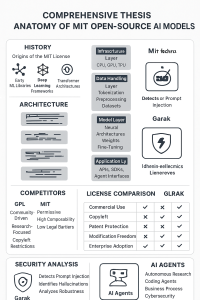
At its core, AI isn’t a monolithic entity but a complex system composed of interconnected parts, much like the human body. The “anatomy” of AI can be visualized as layers spanning from raw resources to high-level decision-making. Here’s a breakdown:
1. Data: The Foundation
Data is the lifeblood of AI. It includes structured (e.g., databases) and unstructured (e.g., images, text) inputs. AI systems require vast datasets for training, often sourced from the internet, sensors, or user interactions. Preparation involves cleaning, labeling, and augmentation to ensure quality. Issues like bias in data can propagate errors throughout the system.
2. Algorithms and Models: The Brain
Algorithms define how AI processes data. Key subsets include:
- Machine Learning (ML): Algorithms that learn patterns from data without explicit programming.
- Deep Learning: A subset of ML using neural networks with multiple layers to handle complex tasks like image recognition.
Neural networks mimic the human brain’s structure: input layers receive data, hidden layers process it through weighted connections and activation functions, and output layers produce results. For instance, in a feedforward neural network, data flows unidirectionally, while recurrent networks handle sequences like time-series data.
3. Hardware and Infrastructure: The Skeleton
AI demands immense computational resources. Graphics Processing Units (GPUs) and Tensor Processing Units (TPUs) accelerate training. Cloud platforms like AWS provide scalable infrastructure. This layer also encompasses energy consumption—training a single large model can emit as much CO2 as five cars over their lifetimes—and planetary resources like rare earth minerals for chips.
4. Interfaces and Applications: The Skin and Senses
This includes user-facing elements like APIs, chat interfaces, or sensors (e.g., cameras in self-driving cars). Privacy concerns arise here, as systems often collect user data for refinement.
5. Ethical and Governance Layers: The Nervous System
Overarching controls for bias mitigation, transparency, and accountability. This “anatomy” isn’t static; it evolves with feedback loops where models are retrained on new data.
The following table summarizes AI’s anatomical components:
| Component | Description | Key Technologies/Examples |
|---|---|---|
| Data | Raw inputs for learning | Big data pipelines, datasets like ImageNet |
| Algorithms/Models | Processing logic | Neural networks, reinforcement learning |
| Hardware | Computational backbone | GPUs, data centers |
| Interfaces | Interaction points | APIs, voice recognition |
| Ethics/Governance | Oversight for responsible use | Bias audits, regulatory frameworks |
In-Depth Analysis: How AI Works, Its Strengths, and Challenges
Mechanisms of AI Operation
AI operates in two phases: training and inference. During training, models adjust parameters to minimize errors on labeled data using techniques like backpropagation in neural networks. Inference applies the trained model to new data for predictions.
Types of AI include:
- Narrow AI (ANI): Task-specific, like voice assistants. Most current AI falls here.
- General AI (AGI): Human-like versatility, still theoretical.
- Super AI: Surpassing human intelligence, a speculative future stage.
Strengths: AI excels in pattern recognition, automation, and scalability. For example, in healthcare, AI analyzes medical images faster than humans with comparable accuracy.
Challenges:
- Bias and Fairness: If training data reflects societal biases, AI can perpetuate them (e.g., facial recognition errors on diverse ethnicities).
- Energy and Environmental Impact: Massive models require enormous electricity, contributing to climate change.
- Ethics and Job Displacement: AI raises questions about privacy, autonomy, and employment shifts.
- Explainability: “Black box” models make decisions opaque, hindering trust in critical applications like medicine.
Future Trends: By 2025, hybrid AI-human systems and edge computing (AI on devices) are rising. Quantum computing could revolutionize training speeds, but regulatory frameworks like the EU AI Act aim to mitigate risks.
Real-World Examples of AI in Action
AI’s applications span industries, demonstrating its transformative potential.
1. Self-Driving Cars
Companies like Tesla and Waymo use AI for autonomous vehicles. Sensors (LiDAR, cameras) feed data to neural networks that detect objects, predict trajectories, and make driving decisions. For instance, Tesla’s Autopilot processes real-time video to navigate roads, reducing accidents through predictive analytics.
2. Chatbots and Virtual Assistants
AI-powered chatbots like Grok (built by xAI) or ChatGPT handle natural language queries. They use LLMs trained on vast text corpora to generate responses, assist in customer service, or even code. In e-commerce, bots recommend products; in healthcare, they triage symptoms.
3. Medical Diagnostics
AI tools like those from Google DeepMind analyze X-rays for diseases like cancer with high precision. In anatomy education, AI simulates 3D models for interactive learning, enhancing student outcomes.
4. Recommendation Systems
Netflix and Amazon employ AI to suggest content or products based on user behavior, using collaborative filtering algorithms to boost engagement.
These examples highlight AI’s efficiency but also underscore the need for robust safety measures.
Conclusion
AI is a multifaceted technology with a intricate anatomy that blends data, computation, and human ingenuity. While its analysis reveals immense potential for innovation, it also exposes vulnerabilities that society must address. As AI integrates deeper into daily life, understanding its structure and implications empowers responsible development. For the latest advancements, exploring resources like xAI’s initiatives can provide insights into cutting-edge applications.


Be First to Comment