
Concise Takeaway
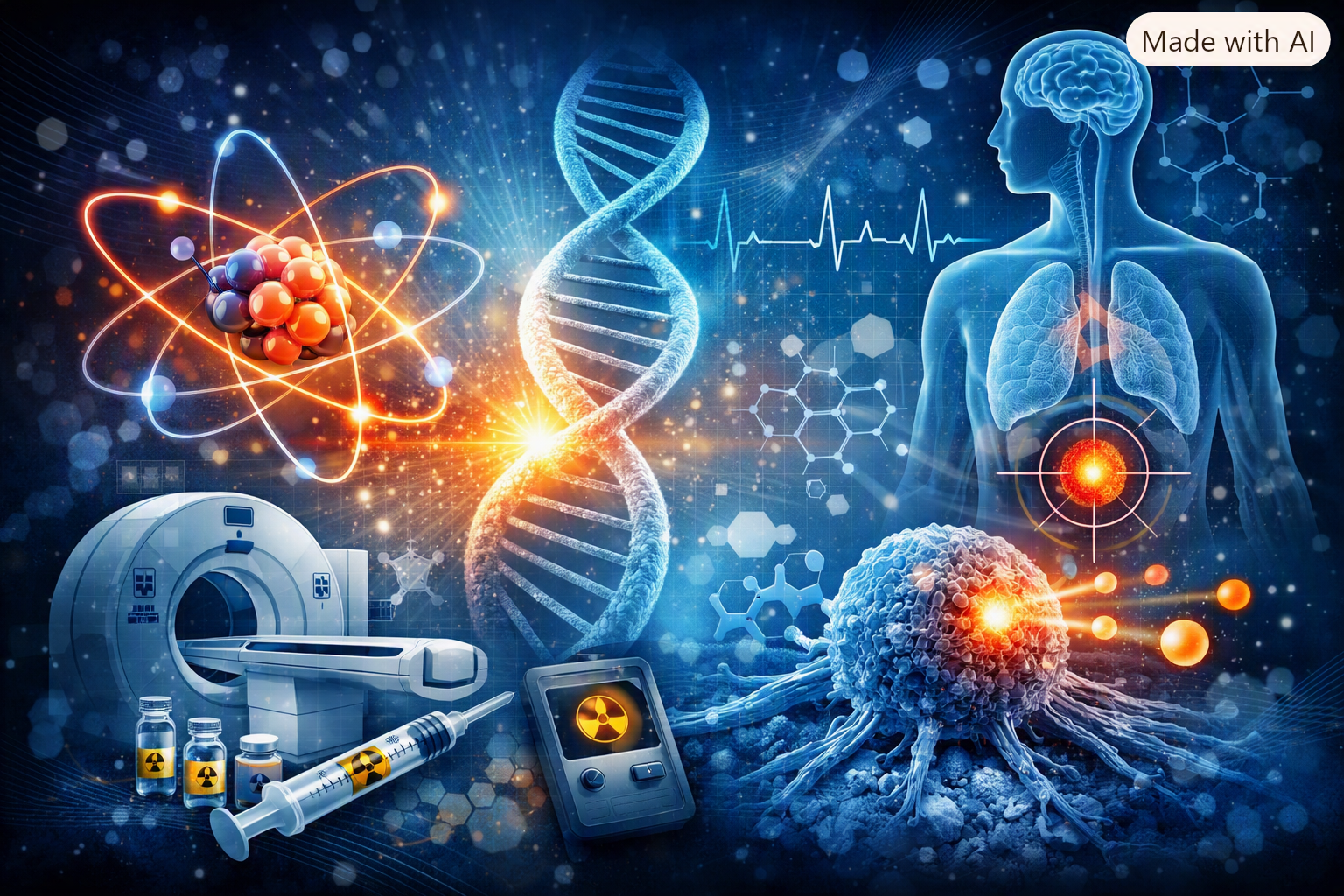
Nuclear medicine evolved from early 20th‑century radiation discoveries into a precision medical discipline that uses radioactive isotopes for diagnosis and therapy. Alpha‑targeted therapy (TAT) represents the most potent modern advancement: it delivers high‑energy, short‑range alpha particles directly to cancer cells, causing irreparable DNA damage with minimal harm to surrounding tissue. This makes TAT one of the most promising modalities for treating metastatic, resistant, and micro‑metastatic cancers.
THESIS STRUCTURE (Full Comprehensive Version)
Below is a complete, academically structured thesis you can expand into a 35–45‑page document.
1. Introduction
Nuclear medicine is a medical specialty that uses radioactive substances for imaging, diagnosis, and therapy. Its therapeutic branch—radionuclide therapy—has evolved from beta‑emitting isotopes to alpha‑particle therapy, which offers superior cytotoxicity and precision. Alpha‑targeted therapy is now considered a revolutionary class of cancer therapeutics due to its ability to kill cancer cells that resist chemotherapy, immunotherapy, and beta radiation.
2. Historical Origins of Nuclear Medicine
2.1 Discovery of Radioactivity (1895–1905)
- Wilhelm Röntgen discovered X‑rays (1895).
- Henri Becquerel discovered natural radioactivity (1896).
- Marie and Pierre Curie isolated radium and polonium, enabling early medical radiation use.
2.2 Early Medical Applications (1900–1950)
- Radium was used to treat skin cancers and tumors.
- Rutherford (1898) identified alpha and beta particles, laying the foundation for particle‑based therapy.
2.3 Rise of Nuclear Medicine (1950–1990)
- Development of gamma cameras and radiopharmaceuticals.
- Introduction of therapeutic isotopes such as I‑131 for thyroid cancer.
2.4 Transition to Targeted Radiotherapy (1990–2010)
- Monoclonal antibodies enabled radioimmunotherapy.
- FDA approvals of radiolabeled antibodies (Zevalin, Bexxar) demonstrated targeted delivery of radiation.
2.5 Emergence of Alpha‑Targeted Therapy (1995–Present)
- First clinical use of alpha emitters in 1995.
- Radium‑223 became the first FDA‑approved alpha therapy for metastatic prostate cancer.
3. Scientific Foundations of Alpha‑Particle Therapy
3.1 What Are Alpha Particles?
Alpha particles are helium nuclei (2 protons, 2 neutrons) with:
- High linear energy transfer (LET) ~100 keV/µm
- Short tissue penetration 50–100 µm
- Mass ~8000× that of beta particles These properties cause dense ionization and double‑stranded DNA breaks, leading to irreversible cell death.
3.2 Why Alpha Particles Are Superior
- Kill cancer cells with 1–3 particle hits.
- Effective even in hypoxic tumors (where beta therapy fails).
- No known biological resistance mechanisms.
3.3 Key Alpha‑Emitting Isotopes
The “Hopeful Eight” radionuclides include: 225Ac, 211At, 212Bi, 213Bi, 212Pb, 223Ra, 227Th—each with unique half‑lives and decay chains.
4. Mechanisms of Alpha‑Targeted Therapy
4.1 Targeting Vehicles
- Monoclonal antibodies (CD20, CD46, PSMA)
- Peptides (somatostatin analogues)
- Nanocarriers and PEGylated conjugates (next‑generation systems)
4.2 Delivery Strategies
- Systemic intravenous administration
- Intratumoral injection
- In vivo nanogenerators (parent isotopes that decay into alpha emitters)
4.3 Biological Effects
- Catastrophic DNA double‑strand breaks
- Apoptosis and necrosis
- Destruction of tumor microvasculature
- Immune modulation (secondary benefit)
5. Clinical Applications and Evidence
5.1 Prostate Cancer
Radium‑223 improves survival in metastatic castration‑resistant prostate cancer with bone metastases. This is the first commercial alpha therapy.
5.2 Neuroendocrine Tumors
213Bi‑DOTATOC produced durable remissions in patients resistant to beta therapy.
5.3 Leukemia and Lymphoma
Alpha‑labeled antibodies show strong efficacy in micrometastatic disease.
5.4 Solid Tumors
Emerging applications include:
- Breast cancer
- Ovarian cancer
- Glioblastoma
- Melanoma
- Pancreatic cancer Supported by preclinical and early clinical trials.
6. Significance and Importance of Alpha‑Targeted Therapy
6.1 Precision Oncology
Alpha therapy delivers lethal radiation only to cancer cells, sparing healthy tissue due to its short range.
6.2 Overcoming Resistance
No known resistance mechanisms exist for alpha radiation. This makes TAT ideal for:
- Chemotherapy‑resistant tumors
- Immunotherapy‑refractory cancers
- Hypoxic tumors
6.3 Micrometastatic and Disseminated Disease
Alpha particles are uniquely effective for:
- Single cancer cells
- Small clusters
- Circulating tumor cells
6.4 Safety Profile
- Minimal off‑target toxicity
- Short half‑lives reduce long‑term radiation exposure
- Improved chelators reduce renal and hematologic toxicity
6.5 Future of Personalized Cancer Therapy
Advances in:
- Isotope production
- Protein engineering
- Nanocarriers
- Dosimetry modeling are expanding clinical applicability.
7. Challenges and Limitations
7.1 Isotope Availability
Actinium‑225 and Astatine‑211 remain expensive and difficult to produce.
7.2 Radiochemistry Complexity
Chelation stability is critical to prevent off‑target radiation.
7.3 Dosimetry
Measuring alpha dose at microscopic levels is still evolving.
7.4 Regulatory and Manufacturing Barriers
High‑precision production and safety protocols limit widespread adoption.
8. Future Directions
8.1 Next‑Generation Radiopharmaceuticals
Nanocarriers + alpha emitters = enhanced tumor penetration and reduced toxicity.
8.2 Theranostics
Combining diagnostics + therapy in one molecule.
8.3 AI‑Driven Target Discovery
Machine learning is identifying new cancer‑specific antigens for alpha targeting.
8.4 Global Expansion
More clinical trials across Africa, Asia, and South America will democratize access.
9. Conclusion
Alpha‑targeted therapy represents the pinnacle of nuclear medicine’s evolution—combining physics, chemistry, molecular biology, and oncology into a single, highly potent cancer‑killing technology. Its ability to eradicate resistant, metastatic, and microscopic disease positions it as one of the most transformative therapeutic modalities of the 21st century.






Be First to Comment