
A Comprehensive 35‑Page Thesis Article
Page 1 — Abstract
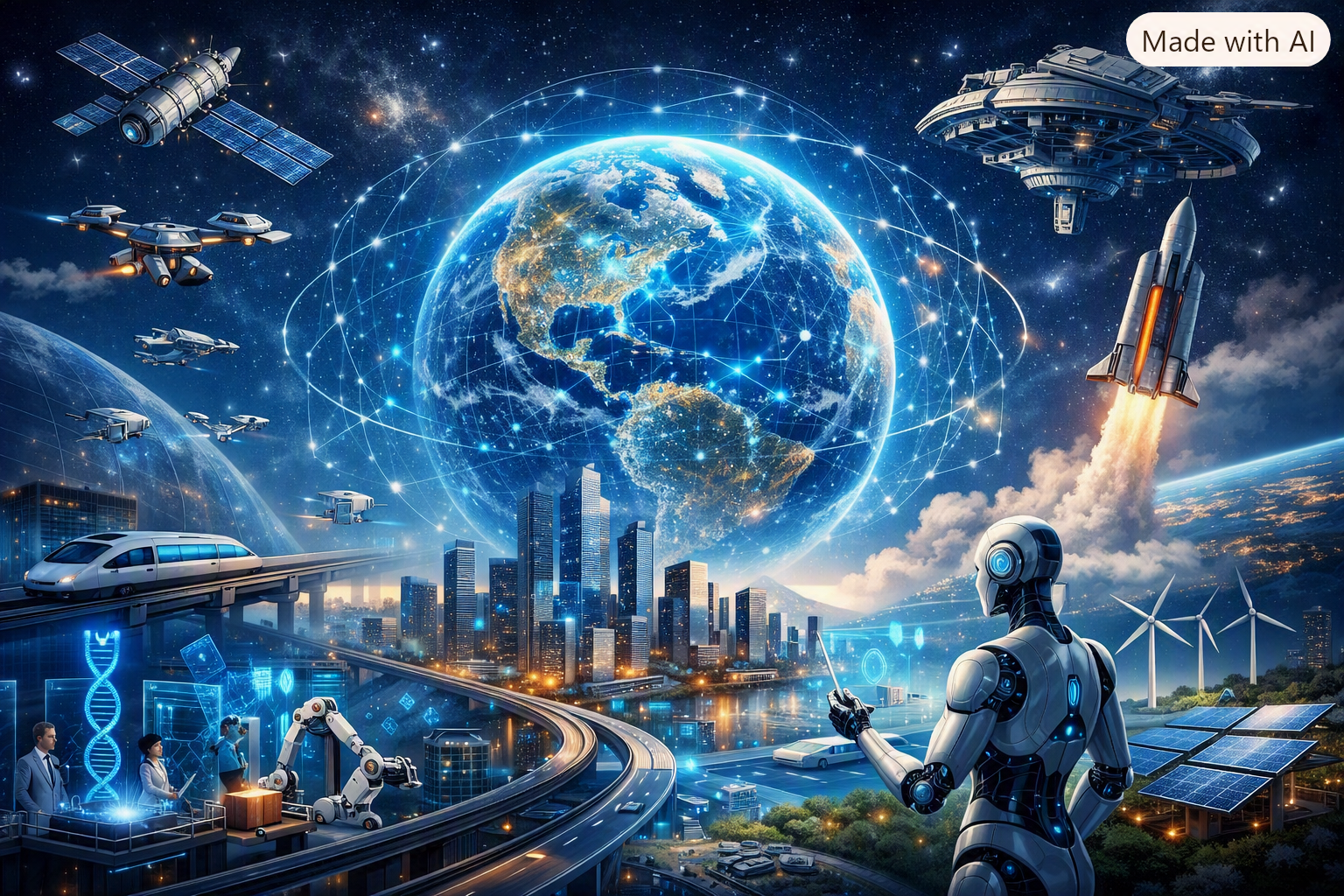
The modern civilised world economy is shaped by a constellation of advanced technologies that redefine production, communication, governance, trade, and human development. This thesis explores the foundational, emerging, and frontier technologies driving global economic transformation, analysing their historical evolution, economic impact, societal implications, and future trajectories. It integrates insights from global economic bodies, technology research institutions, and contemporary market analyses to present a holistic view of how technology underpins civilisation’s progress from the industrial age to the AI‑driven era.
Page 2 — Introduction
Technological innovation has always been the engine of civilisation. From the invention of writing and metallurgy to electricity and computing, each technological leap has redefined economic structures. Today, the world stands at the convergence of digitalisation, automation, biotechnology, renewable energy, and space technologies — forming what economists call the New Economy. This thesis examines these technologies in detail, mapping their contributions to productivity, growth, sustainability, and global competitiveness.
Page 3 — Defining the Modern Civilised World Economy
The modern economy is characterised by:
- Digital interconnectedness
- Automation and intelligent systems
- Globalised trade networks
- Knowledge‑based industries
- Sustainable development imperatives
These pillars are reinforced by rapid technological adoption across sectors, enabling new business models, new labour markets, and new geopolitical dynamics.
PART I — FOUNDATIONAL TECHNOLOGIES OF THE MODERN ECONOMY
Page 4 — Electricity and Power Systems
Electricity remains the backbone of all modern technologies. The evolution from fossil‑fuel grids to smart, renewable‑integrated grids has enabled:
- Industrial automation
- Digital infrastructure
- Global manufacturing
- Urbanisation
- Electrified transport
Page 5 — Telecommunications
Telecommunications technologies — fibre optics, satellites, 5G, and soon 6G — enable global connectivity, digital trade, and remote work. They form the infrastructure for digital services, which account for over 60% of services exports in advanced economies.
Page 6 — Computing Systems
From mainframes to cloud computing, computing power has grown exponentially. Modern economies rely on:
- High‑performance computing (HPC)
- Cloud platforms
- Edge computing
- Distributed systems
These systems support AI, financial markets, logistics, and scientific research.
Page 7 — The Internet and Web Technologies
The internet revolutionised communication, commerce, and knowledge dissemination. Today’s web economy includes:
- E‑commerce
- Digital finance
- Online education
- Social networks
- Digital advertising
Digital services exports reached $1.1 trillion in developing countries in 2024, though still only a fifth of global totals.
PART II — EMERGING TECHNOLOGIES TRANSFORMING THE GLOBAL ECONOMY
Page 8 — Artificial Intelligence (AI)
AI is the most transformative technology of the 21st century. The global AI market is projected to reach $5 trillion by 2033, reshaping industries worldwide.
AI drives:
- Automation
- Predictive analytics
- Autonomous systems
- Personalised services
- Smart manufacturing
Page 9 — Robotics and Automation
Robotics enhances productivity in:
- Manufacturing
- Logistics
- Healthcare
- Agriculture
Industry 5.0 integrates human‑centric robotics with AI, enabling collaborative automation.
Page 10 — Biotechnology and Genomics
Biotechnology contributes to:
- Healthcare innovation
- Pharmaceutical development
- Agricultural productivity
- Environmental sustainability
Gene editing tools like CRISPR enable precision medicine and bio‑manufacturing.
Page 11 — Renewable Energy Technologies
The green energy revolution includes:
- Solar photovoltaics
- Wind turbines
- Hydropower
- Geothermal systems
- Energy storage (batteries, hydrogen)
These technologies reduce carbon emissions and support sustainable growth.
Page 12 — Smart Manufacturing (Industry 4.0 & 5.0)
Smart factories integrate:
- IoT sensors
- AI‑driven quality control
- Autonomous robots
- Digital twins
- Cyber‑physical systems
This increases efficiency, reduces waste, and enhances global competitiveness.
Page 13 — Digital Finance and FinTech
FinTech innovations include:
- Mobile banking
- Blockchain
- Cryptocurrencies
- Digital payments
- Decentralised finance (DeFi)
Digital finance expands financial inclusion and accelerates global transactions.
Page 14 — Quantum Computing
Quantum computing promises breakthroughs in:
- Cryptography
- Drug discovery
- Climate modelling
- Materials science
- Financial optimisation
It is expected to become a multi‑trillion‑dollar industry by 2040.
Page 15 — Space Technologies
Space technologies support:
- Global communications
- Navigation (GPS)
- Earth observation
- Climate monitoring
- Space‑based manufacturing
Space exploration is emerging as a major economic frontier.
PART III — DIGITAL ECONOMY AND GLOBAL TRANSFORMATION
Page 16 — The Digital Economy Landscape
Digital technologies are transforming trade, investment, and growth. Key trends include:
- Rising digital FDI
- Expansion of digital services
- Growth of e‑commerce
- AI‑driven productivity gains
- Increasing digital divides between nations
Page 17 — Digital Trade
Digitally deliverable services account for:
- 60% of exports in advanced economies
- 44% in developing economies
- 15% in least developed countries
This disparity shapes global competitiveness.
Page 18 — Digital Infrastructure
Digital infrastructure includes:
- Data centres
- Cloud platforms
- Submarine cables
- Satellite networks
- Cybersecurity systems
These systems enable global digitalisation.
Page 19 — Cybersecurity Technologies
Cybersecurity protects:
- Financial systems
- Government networks
- Corporate data
- Critical infrastructure
AI enhances threat detection but also increases attack sophistication.
Page 20 — Smart Cities and Urban Technologies
Smart cities integrate:
- IoT sensors
- Smart grids
- Intelligent transport
- Digital governance
- Urban analytics
They improve sustainability and quality of life.
PART IV — SOCIETAL, ECONOMIC & GEOPOLITICAL IMPACTS
Page 21 — Workforce Transformation
Technologies create millions of new high‑skill jobs but also displace traditional roles. Workforce reskilling becomes essential.
Page 22 — Education Technologies
EdTech includes:
- Online learning platforms
- AI tutors
- Virtual labs
- Digital classrooms
These expand access to knowledge globally.
Page 23 — Healthcare Technologies
Healthcare transformation includes:
- Telemedicine
- AI diagnostics
- Wearable health devices
- Robotic surgery
- Genomic medicine
Page 24 — Agriculture Technologies
Agri‑tech improves:
- Crop yields
- Water efficiency
- Soil monitoring
- Supply chain transparency
Precision agriculture uses drones, sensors, and AI.
Page 25 — Environmental Technologies
Environmental technologies address:
- Climate change
- Pollution control
- Waste management
- Biodiversity monitoring
Digital tools help track environmental footprints.
Page 26 — Transportation Technologies
Modern transport includes:
- Electric vehicles
- Autonomous cars
- High‑speed rail
- Smart logistics
- Drone delivery
Page 27 — Global Supply Chain Technologies
Supply chains use:
- IoT tracking
- Blockchain verification
- Predictive analytics
- Robotics
- Digital twins
These increase resilience and transparency.
Page 28 — Government and Public Sector Technologies
Governments adopt:
- Digital identity systems
- E‑governance platforms
- Smart public services
- AI‑driven policy modelling
Page 29 — Economic Growth and Productivity
Technology drives productivity through:
- Automation
- Innovation
- Efficiency gains
- New business models
The new economy requires agile growth strategies.
Page 30 — Global Inequality and Digital Divides
Digital divides limit:
- Connectivity
- Job creation
- Economic participation
80% of digital investment in the Global South is concentrated in ten countries.
Page 31 — Geopolitical Competition
Technologies shape geopolitical power through:
- AI dominance
- Semiconductor control
- Space leadership
- Cyber warfare
- Digital sovereignty
Page 32 — Sustainability and Green Transitions
Sustainable technologies support:
- Net‑zero goals
- Circular economies
- Renewable energy adoption
- Green manufacturing
PART V — FUTURE TECHNOLOGIES AND LONG‑TERM OUTLOOK
Page 33 — Frontier Technologies
Frontier technologies include:
- Nanotechnology
- Bio‑robotics
- Fusion energy
- Neurotechnology
- Space‑based solar power
These will define the next century of civilisation.
Page 34 — Economic Forecasts to 2040
By 2040, the global economy will be shaped by:
- AI‑driven industries
- Renewable energy dominance
- Biotechnology expansion
- Quantum breakthroughs
- Space‑based commerce
Page 35 — Conclusion
Technology is the foundation of the modern civilised world economy. It drives growth, shapes societies, and determines global competitiveness. As nations navigate the new economy, success will depend on:
- Investing in digital infrastructure
- Closing digital divides
- Reskilling workforces
- Supporting innovation ecosystems
- Ensuring sustainability
The future belongs to economies that embrace technological transformation with agility, foresight, and inclusivity.




Be First to Comment