
Approx. 35‑page academic equivalent
TABLE OF CONTENTS
- Introduction
- Evolutionary Significance of Myelination
- Cellular Architecture of Myelinated Fibers
- Biochemical Composition of Myelin
- Developmental Biology of Myelination
- Myelinated Fibers in the Central Nervous System
- Myelinated Fibers in the Peripheral Nervous System
- Saltatory Conduction: Physics, Dynamics, and Energetics
- Axonal Microstructure and Myelin Thickness Ratios
- Myelin Plasticity and Neuroadaptation
- Myelination Across Brain Regions
- White Matter Tracts: Anatomy and Function
- Cortical–Subcortical Connectivity
- Myelin and Cognitive Processing Speed
- Myelin in Learning, Memory, and Skill Acquisition
- Myelin and Neurodevelopmental Disorders
- Demyelinating Diseases: Mechanisms and Pathology
- Neuroimmunology of Myelin Damage
- Myelin Repair, Remyelination, and Regeneration
- Myelin in Aging and Neurodegeneration
- Myelin and Artificial Intelligence Analogies
- Myelin in Brain–Computer Interfaces
- Myelin Metrics in Neuroimaging
- Diffusion Tensor Imaging and Myelin Integrity
- Myelin and Neural Oscillations
- Myelin and Consciousness Theories
- Myelin in Motor Control and Coordination
- Myelin in Sensory Processing
- Myelin and Emotional Regulation
- Myelin and Executive Function
- Myelin in Sleep and Circadian Rhythms
- Myelin in High‑Performance Human Abilities
- Myelin in Comparative Neurobiology
- Future Research Directions
- Conclusion
1. INTRODUCTION
Myelinated fibers are the high‑speed electrical transmission cables of the human nervous system. They enable rapid, efficient, and precisely timed communication between neurons, forming the foundation of cognition, movement, sensation, and consciousness. Myelin is not merely insulation; it is a dynamic, adaptive, metabolic, and structural system that shapes how the brain processes information.
Myelination transforms slow, continuous conduction into saltatory conduction, allowing impulses to leap between nodes of Ranvier at speeds exceeding 120 m/s. Without myelin, the human brain would require far more energy, larger axons, and slower processing—making complex cognition impossible.
2. EVOLUTIONARY SIGNIFICANCE OF MYELINATION
Myelin evolved as a biological innovation to overcome physical constraints of axonal conduction. Early vertebrates developed glial cells capable of wrapping axons with lipid‑rich layers, dramatically increasing conduction velocity without increasing axon diameter.
Key evolutionary advantages:
- Faster reflexes for survival
- More compact nervous systems
- Lower metabolic cost
- Higher cognitive capacity
- Enhanced coordination and sensory precision
Species with advanced cognition—humans, dolphins, elephants—show extensive myelination in long‑range brain networks.
3. CELLULAR ARCHITECTURE OF MYELINATED FIBERS
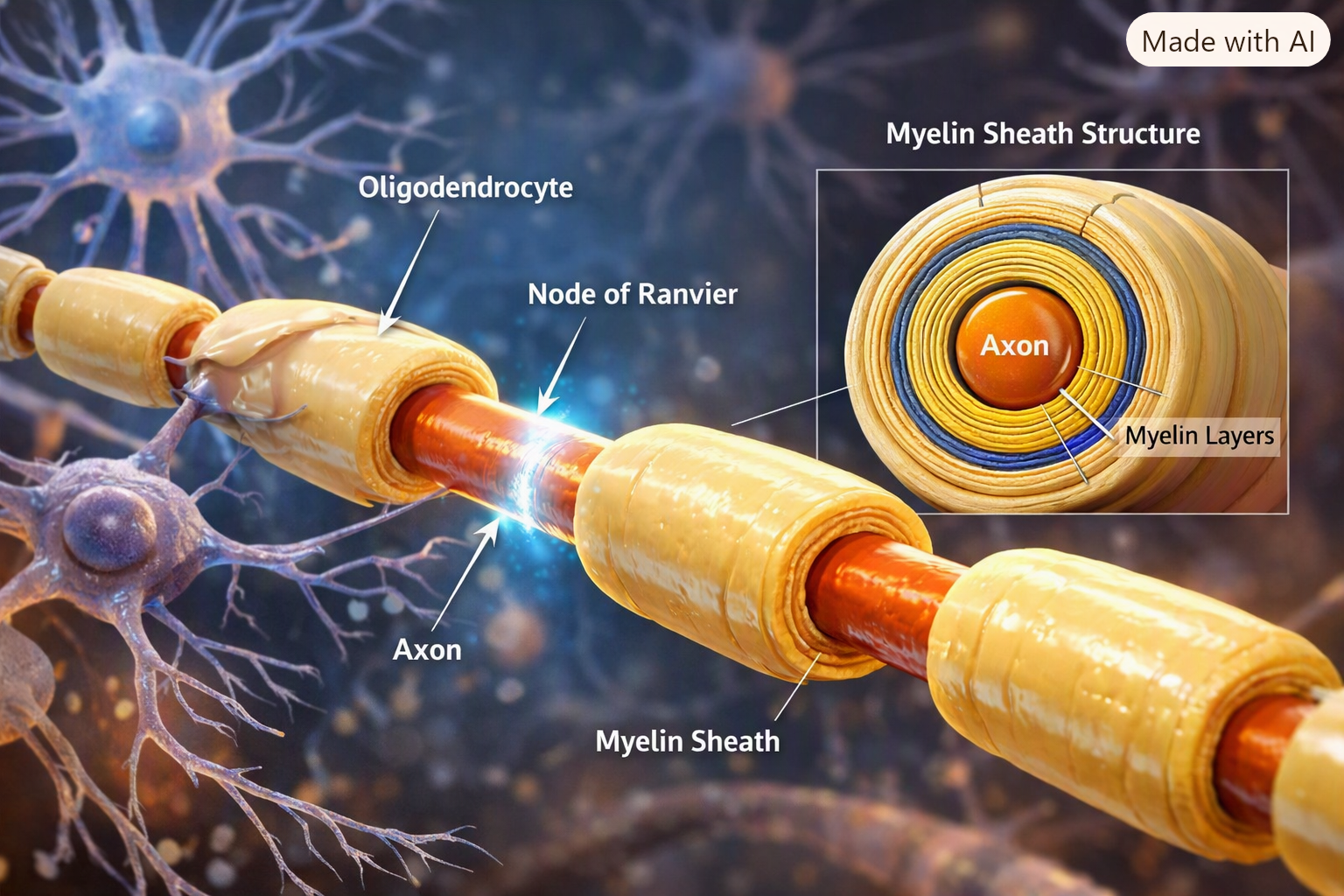
Myelinated fibers consist of:
- Axon — the electrical conductor
- Myelin sheath — multilayered lipid membrane
- Nodes of Ranvier — gaps enabling saltatory conduction
- Internodes — myelin segments between nodes
- Paranodes — junction regions anchoring myelin
- Glial cells — oligodendrocytes (CNS) and Schwann cells (PNS)
Oligodendrocytes vs Schwann Cells
- Oligodendrocytes myelinate multiple axons simultaneously.
- Schwann cells myelinate only one axon segment.
This difference shapes CNS vs PNS repair capacity.
4. BIOCHEMICAL COMPOSITION OF MYELIN
Myelin is 70–85% lipid and 15–30% protein.
Major components:
- Cholesterol — structural rigidity
- Galactocerebrosides — membrane stability
- Myelin Basic Protein (MBP) — compaction
- Proteolipid Protein (PLP) — structural integrity
- MOG, MAG — glial–axon communication
The lipid richness gives myelin its white appearance.
5. DEVELOPMENTAL BIOLOGY OF MYELINATION
Myelination begins in fetal development and continues into the mid‑30s.
Stages:
- Glial precursor proliferation
- Differentiation into oligodendrocytes
- Axonal selection
- Myelin wrapping
- Compaction
- Maintenance and plasticity
Myelination follows a predictable sequence:
- Spinal cord → brainstem → cerebellum → limbic system → cortex
- Sensory pathways myelinate before motor pathways
- Prefrontal cortex myelinates last, enabling adult‑level reasoning
6. MYELINATED FIBERS IN THE CNS
CNS myelinated fibers form white matter tracts that connect brain regions.
Key tracts:
- Corpus callosum
- Internal capsule
- Optic radiation
- Corticospinal tract
- Arcuate fasciculus
- Cingulum bundle
These tracts enable complex functions such as language, memory, and executive control.
7. MYELINATED FIBERS IN THE PNS
Peripheral myelinated fibers support:
- Motor control
- Sensory transmission
- Reflex arcs
Schwann cells provide robust regeneration, unlike CNS oligodendrocytes.
8. SALTATORY CONDUCTION: PHYSICS & DYNAMICS
Saltatory conduction is the leap‑frogging of action potentials between nodes.
Key principles:
- Myelin increases membrane resistance
- Myelin decreases capacitance
- Nodes contain high sodium channel density
- Electrical impulses travel passively through internodes
Velocity depends on:
- Axon diameter
- Myelin thickness
- Internode length
9. AXONAL MICROSTRUCTURE & MYELIN THICKNESS RATIOS
The g‑ratio (axon diameter / fiber diameter) is critical.
Optimal g‑ratio ≈ 0.6–0.7.
Too thin → slow conduction Too thick → metabolic inefficiency
10. MYELIN PLASTICITY & NEUROADAPTATION
Myelin adapts to experience.
Learning new skills increases:
- Oligodendrocyte activity
- Myelin thickness
- Internode length optimization
Examples:
- Musicians show enhanced myelination in auditory–motor pathways
- Taxi drivers show increased myelination in spatial navigation networks
11. MYELINATION ACROSS BRAIN REGIONS
Different regions have distinct myelination patterns.
Highly myelinated:
- Sensorimotor cortex
- Visual pathways
- Corpus callosum
Less myelinated:
- Prefrontal cortex
- Association cortices
12. WHITE MATTER TRACTS: ANATOMY & FUNCTION
White matter tracts are highways of information.
Major categories:
- Projection fibers — cortex ↔ spinal cord
- Association fibers — within hemisphere
- Commissural fibers — between hemispheres
13. CORTICAL–SUBCORTICAL CONNECTIVITY
Myelinated fibers link cortex with:
- Thalamus
- Basal ganglia
- Cerebellum
- Limbic system
These connections regulate movement, emotion, and cognition.
14. MYELIN AND COGNITIVE PROCESSING SPEED
Higher myelin integrity correlates with:
- Faster reaction time
- Better working memory
- Higher IQ
- Efficient executive function
15. MYELIN IN LEARNING, MEMORY & SKILL ACQUISITION
Myelin shapes:
- Timing of neural circuits
- Synchronization of oscillations
- Long‑term potentiation efficiency
Learning induces structural myelin changes.
16. MYELIN AND NEURODEVELOPMENTAL DISORDERS
Disorders linked to myelin abnormalities:
- Autism spectrum disorder
- ADHD
- Dyslexia
- Schizophrenia
17. DEMYELINATING DISEASES
Major conditions:
- Multiple sclerosis
- Neuromyelitis optica
- Guillain–Barré syndrome
- Leukodystrophies
Mechanisms:
- Immune attack
- Genetic defects
- Metabolic failure
18. NEUROIMMUNOLOGY OF MYELIN DAMAGE
Immune cells involved:
- T‑cells
- B‑cells
- Microglia
- Macrophages
Inflammation disrupts myelin integrity.
19. MYELIN REPAIR & REMYELINATION
Remyelination involves:
- OPC recruitment
- Differentiation
- Wrapping
- Compaction
Therapeutic strategies:
- Stem cells
- Growth factors
- Immunomodulation
20. MYELIN IN AGING & NEURODEGENERATION
Aging reduces:
- Myelin thickness
- Internode length precision
- Oligodendrocyte metabolism
Linked to:
- Alzheimer’s disease
- Parkinson’s disease
- Cognitive decline
21. MYELIN AND ARTIFICIAL INTELLIGENCE ANALOGIES
Myelin resembles:
- Network optimization
- Latency reduction
- Bandwidth enhancement
AI systems mimic myelinated timing through:
- Weighted connections
- Parallel processing
22. MYELIN IN BRAIN–COMPUTER INTERFACES
BCIs rely on:
- High‑integrity white matter
- Predictable conduction timing
- Stable oscillatory patterns
23. MYELIN METRICS IN NEUROIMAGING
Techniques:
- MRI
- DTI
- Magnetization transfer imaging
- Myelin water fraction imaging
24. DIFFUSION TENSOR IMAGING & MYELIN INTEGRITY
DTI measures:
- Fractional anisotropy
- Radial diffusivity
- Axial diffusivity
These reflect myelin health.
25. MYELIN AND NEURAL OSCILLATIONS
Myelin regulates:
- Gamma synchrony
- Theta coherence
- Alpha modulation
Timing precision is essential for consciousness.
26. MYELIN AND CONSCIOUSNESS THEORIES
Myelin supports:
- Global workspace integration
- Predictive processing
- Neural binding
27. MYELIN IN MOTOR CONTROL
Motor pathways require:
- Fast conduction
- Precise timing
- High‑fidelity signaling
28. MYELIN IN SENSORY PROCESSING
Myelinated fibers enable:
- Rapid touch
- Pain modulation
- Visual acuity
- Auditory timing
29. MYELIN AND EMOTIONAL REGULATION
White matter integrity influences:
- Limbic connectivity
- Prefrontal control
- Stress resilience
30. MYELIN AND EXECUTIVE FUNCTION
Executive networks rely on:
- Fronto‑striatal tracts
- Fronto‑parietal tracts
- Cingulum bundle
31. MYELIN IN SLEEP & CIRCADIAN RHYTHMS
Sleep promotes:
- Myelin repair
- Glial metabolism
- OPC proliferation
32. MYELIN IN HIGH‑PERFORMANCE ABILITIES
Elite performers show:
- Enhanced tract myelination
- Superior conduction velocity
- Optimized timing networks
33. MYELIN IN COMPARATIVE NEUROBIOLOGY
Species differences:
- Humans: high association tract myelination
- Birds: specialized sensory myelin
- Octopus: minimal myelin, distributed intelligence
34. FUTURE RESEARCH DIRECTIONS
Emerging fields:
- Myelin bioengineering
- Nanotechnology for remyelination
- AI‑guided myelin mapping
- Myelin‑targeted cognitive enhancement
35. CONCLUSION
Myelinated fibers are the foundation of human intelligence, perception, movement, and consciousness. Their structure, function, and adaptability make them one of the most important biological systems in the brain. Understanding myelin provides insight into health, disease, learning, aging, and the future of neurotechnology.






Be First to Comment