
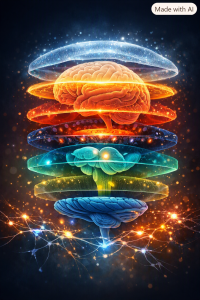
Generative AI is not just one tool—it’s an ecosystem of interacting parts that mirror the human body in a way:
- Brain (Models & Algorithms):
Large language models (LLMs), diffusion models, transformers, and multimodal architectures act as the cognitive core—processing data, learning, reasoning, and generating content. - Nervous System (Data Pipelines):
Data collection, preprocessing, labeling, and integration serve as the lifeblood that keeps models alive and learning. Without high-quality, diverse data, generative AI can’t function effectively. - Muscles (Applications & Outputs):
The tangible outputs—text, images, music, code, designs, simulations—are the “movements” powered by AI. These are what businesses and individuals interact with directly. - Skeleton (Infrastructure):
Cloud computing, GPUs/TPUs, edge devices, and APIs provide the structure on which AI stands. They determine scalability, speed, and accessibility. - Heart (Ethics & Trust):
Value alignment, transparency, fairness, and bias management pump trust into the system. Without this, adoption stalls. - Immune System (Regulation & Security):
Cybersecurity, privacy protection, compliance with laws (e.g., GDPR, AI Act), and safeguards against misuse protect the economy and society from systemic risks.
2. How This Anatomy Operates in the Modern Economy
Generative AI permeates multiple economic layers:
- Production & Efficiency:
Automates creative, analytical, and operational tasks (marketing copy, product design, financial modeling, logistics optimization). - Labor Market Transformation:
Shifts demand from routine and repetitive jobs toward higher-value creative, strategic, and supervisory roles. Raises reskilling needs. - New Value Chains:
Creates entirely new industries—AI-as-a-service, synthetic media, personalized medicine, digital twins, and education platforms. - Capital Flows:
Attracts venture capital, shapes stock markets, and drives tech sector growth, while pressuring traditional industries to adapt. - Consumer Economy:
Personalizes shopping, entertainment, healthcare, and education—reshaping how people consume products and services.
3. Holistic View
To see generative AI holistically in the economy:
- It is a general-purpose technology like electricity or the internet—embedded everywhere, reshaping every sector.
- Its anatomy is dynamic and interconnected: improvements in data, infrastructure, or ethics ripple across applications.
- It acts as a multiplier of human creativity and productivity, but also a disruptor of labor and traditional business models.
- The challenge is to build balance—innovation with governance, automation with employment, personalization with privacy.
✅ In short: Generative AI in our modern economy is a living system. Its brain (models), skeleton (infrastructure), heart (ethics), and immune system (regulation) must work together so that its muscles (applications) can move the economy forward without breaking trust or stability.



Be First to Comment