
A Comprehensive History, Anatomy, and Simple Understanding of the Invisible Waves That Connect the Modern World
Introduction
Every day, invisible to the naked eye, the space around us is filled with a dense, overlapping traffic of electromagnetic ripples — radio waves — carrying music into cars, voices into phones, data into laptops, and navigation signals down from satellites twenty thousand kilometers overhead. This companion sets out to make that invisible traffic legible: where radio waves came from, what they physically are, and how to build a genuine, working intuition for how they behave.
The material is organized in four parts: a total history from Ørsted’s compass needle to satellite internet; an anatomical tour of frequency, wavelength, propagation, and modulation; a look at the materials science — conductors, semiconductors, and metamaterials — that makes it all physically possible; and finally, plain-language intuition for everyday life, including a South African spectrum-regulation perspective.
Part I — The Total History of Radio Waves
1.1 Before Radio: Electricity and Magnetism Learn to Dance
In 1820, Hans Christian Ørsted noticed a compass needle deflecting near a current-carrying wire — the first solid evidence electricity and magnetism were related. Ampère formalized it mathematically that same year. A decade later, Michael Faraday discovered electromagnetic induction: a changing magnetic field could induce current in a nearby conductor. Faraday described this using “lines of force” filling space — a picture later generations of physicists would take far more literally.
Why This MatteredFaraday’s lines of force were originally just a convenient mental picture. It took a mathematician to show these invisible lines were physically real fields capable of carrying energy through empty space — as a wave.
1.2 Maxwell’s Theoretical Prediction (1861–1873)
James Clerk Maxwell translated Faraday’s field pictures into precise mathematics. Maxwell’s Equations (1861–1865) predicted that oscillating electric and magnetic fields could sustain each other and propagate through empty space as a wave — travelling at the speed of light. Maxwell concluded light itself was electromagnetic, and that invisible electromagnetic waves must exist at other frequencies. He published the synthesis in 1873. He died in 1879, never seeing his prediction proven.
1.3 Hertz Proves It Real (1886–1889)
Heinrich Hertz built a spark-gap transmitter and a separate receiving loop with no wire connecting them. Triggering a spark at the transmitter produced a faint answering spark at the receiver — direct proof of Maxwell’s invisible travelling wave. Hertz measured its wavelength and speed, and showed it reflected, refracted, and polarized like light. Asked about practical applications, he reportedly saw none. The hertz (Hz), the unit of frequency, honors him.
1.4 Marconi and the Race to Wireless Telegraphy (1894–1901)
Guglielmo Marconi combined Hertz’s principles with improvements from Tesla, Popov, and Lodge, iterating relentlessly on antennas, grounding, and receivers. By 1899 he’d crossed the English Channel; on 12 December 1901 he claimed reception of the Morse letter “S” transmitted across the Atlantic — roughly 3,500 km. The feat defied the era’s physics until later explained by ionospheric reflection (the Kennelly–Heaviside layer).
A Contested PriorityTesla had filed relevant patents earlier; the US Supreme Court invalidated several Marconi patents in 1943, citing prior work. Russia’s Alexander Popov demonstrated similar principles in 1895. The fairest summary: parallel, overlapping discovery — Marconi’s real genius was commercialization and engineering iteration, not a unique scientific insight.
1.5 Ships, Disasters, and the Beginning of Regulation
Wireless telegraphy proved its worth at sea — most famously in April 1912, when Titanic’s distress calls reached the Carpathia, which rescued over 700 survivors. The disaster also exposed chaotic, unregulated spectrum use, prompting the US Radio Act of 1912 and the beginning of formal spectrum regulation — a tradition continued today by the ITU internationally and ICASA in South Africa.
1.6 The Birth of Broadcasting (1906–1930s)
Reginald Fessenden’s 1906 Christmas Eve voice/music broadcast, Lee de Forest’s triode vacuum tube (amplification), and the 1920s explosion of stations — KDKA Pittsburgh (1920), the BBC (1922), and eventually the SABC (1936) in South Africa — moved radio from military/hobbyist novelty to the dominant mass medium of the interwar era within a single decade.
| Year | Milestone |
|---|---|
| 1820 | Ørsted observes current deflecting a compass needle |
| 1831 | Faraday discovers electromagnetic induction |
| 1861–65 | Maxwell formulates the equations of electromagnetism |
| 1886–89 | Hertz generates and detects radio waves experimentally |
| 1901 | Marconi transmits across the Atlantic Ocean |
| 1912 | Titanic disaster prompts first wireless regulation |
| 1920s | Mass-market broadcasting begins (KDKA, BBC, SABC precursors) |
| 1936 | SABC formally established in South Africa |
1.7 Radar and the Second World War
Britain’s Chain Home radar network, under Robert Watson-Watt, proved decisive in the 1940 Battle of Britain. The 1940 cavity magnetron enabled higher-frequency, more powerful radar — and, adapted after the war, became the heart of the microwave oven.
1.8 Television Rides on Radio Waves
Television is fundamentally a radio technology — a video signal on a radio-frequency carrier. Electronic TV matured through the 1930s–40s; South Africa’s own analogue-to-digital migration, coordinated by ICASA, has freed up valuable UHF spectrum (the “digital dividend”) for mobile broadband.
1.9 The Space Age: Radio Waves Leave the Atmosphere
Sputnik 1 (1957) was itself a radio transmitter; its beep provided the first data on upper-atmosphere density. Telstar 1 (1962) relayed transatlantic TV and telephone. GPS, opened to full civilian use in the 1990s–2000s, uses precisely timed satellite radio signals to fix position on Earth to within meters.
1.10 The Digital and Wireless Age (1980s–Present)
Cellular telephony progressed from analogue 1G through digital 2G (GSM), mobile-data 3G, and broadband 4G LTE — South Africa’s Vodacom, MTN, Cell C, and Telkom following this same arc, with commercial 5G from 2020. Wi-Fi (802.11), Bluetooth, and RFID/NFC turned radio into the backbone of everyday short-range connectivity.
1.11–1.14 Transistors, the Cold War, Ham Radio, and Radio Astronomy
The 1947 transistor replaced fragile vacuum tubes, birthing the portable transistor radio (1954) — for decades, the primary information source for many households across Africa. Cold War shortwave broadcasters (Voice of America, BBC World Service, Radio Moscow) exploited radio’s indifference to borders; governments responded with jamming. South Africa’s own apartheid-era history included Radio Freedom, the exiled ANC broadcast service, reaching listeners via the same borderless sky-wave propagation despite state efforts to jam it. Licensed amateur radio and CB radio built an enduring hobbyist and emergency-communication tradition. In 1932, Karl Jansky’s accidental discovery of cosmic radio noise founded radio astronomy — a field in which South Africa’s MeerKAT array and the international Square Kilometre Array (SKA), both hosted in the Northern Cape, are now global leaders.
1.15 Low-Earth-Orbit Constellations and the Newest Chapter
Thousands-strong low-Earth-orbit satellite constellations (e.g., Starlink) are extending broadband to areas fiber cannot economically reach. Across Africa, mobile radio networks — rather than fixed-line infrastructure — have driven the continent’s “leapfrogging” expansion of internet access and digital financial services, with South Africa’s high mobile penetration underpinning its own digital and e-commerce ambitions.
From Spark Gap to Smartphone15 years separated Hertz’s first spark (1887) from Marconi’s transatlantic signal (1901). It then took over a century of engineering — tubes, transistors, integrated circuits, digital signal processing — to compress that same physics into a chip inside a wristwatch, carrying gigabits per second.
Part II — The Anatomy of a Radio Wave
2.1 What Is a Radio Wave?
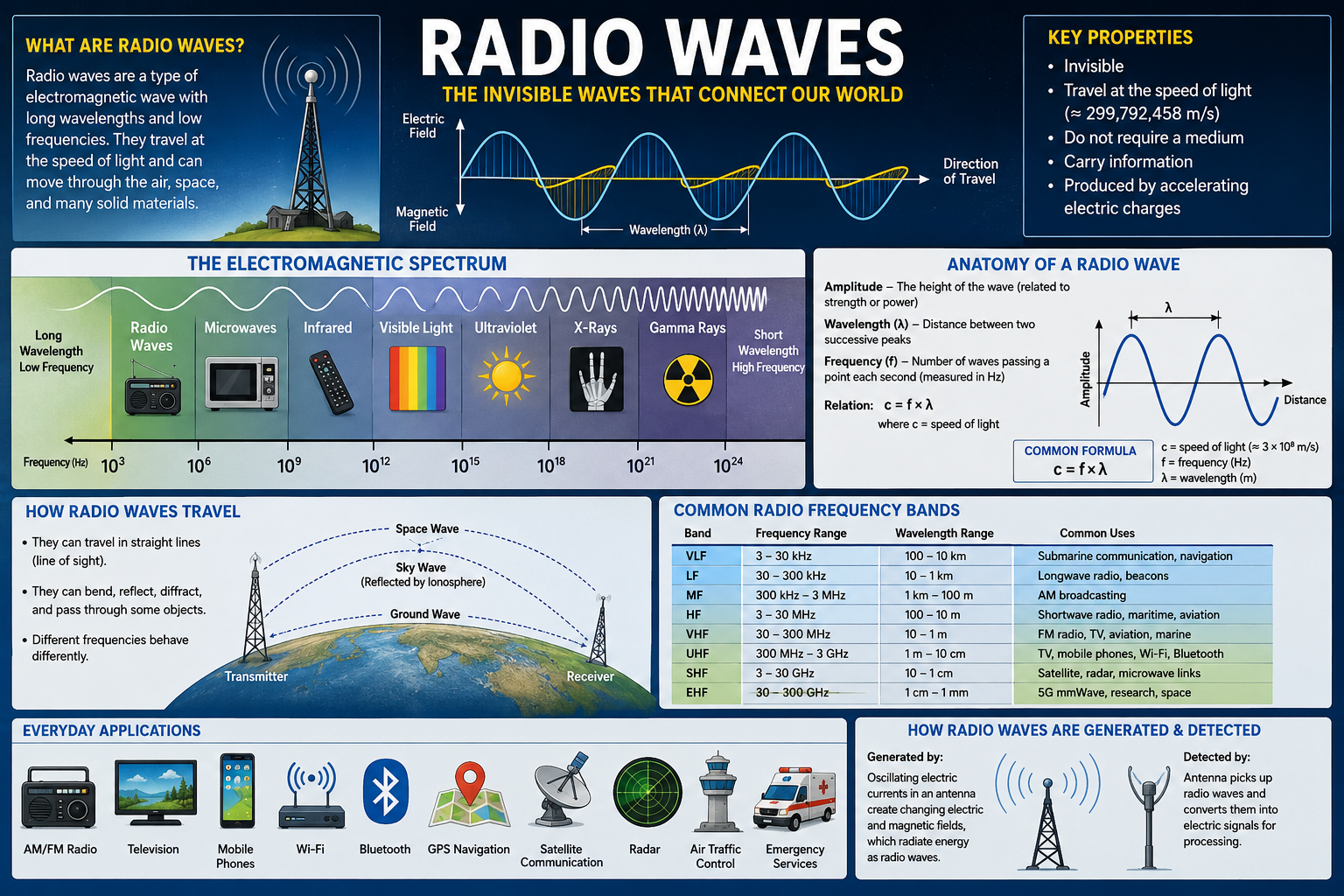
A radio wave is electromagnetic radiation — the same phenomenon as visible light, X-rays, and gamma rays, differing only in frequency and wavelength. Oscillating electric and magnetic fields, perpendicular to each other and to the direction of travel, propagate through space with no medium required. Radio waves occupy the lowest-frequency, longest-wavelength end of the spectrum: roughly 3 kHz to 300 GHz.
| Region | Approx. Frequency | Approx. Wavelength | Everyday Example |
|---|---|---|---|
| Radio waves | 3 kHz – 300 GHz | 1 mm – 100 km | FM radio, Wi-Fi, mobile networks |
| Microwaves | 300 MHz – 300 GHz | 1 mm – 1 m | Microwave ovens, satellite links, radar |
| Infrared | 300 GHz – 400 THz | 700 nm – 1 mm | TV remotes, thermal cameras |
| Visible light | 400 – 790 THz | 380 – 700 nm | Human vision |
| Ultraviolet | 790 THz – 30 PHz | 10 – 380 nm | Sunburn, sterilization lamps |
| X-rays | 30 PHz – 30 EHz | 0.01 – 10 nm | Medical imaging |
| Gamma rays | > 30 EHz | < 0.01 nm | Nuclear decay, cosmic events |
2.2 Anatomy of a Wave: The Four Vital Signs
Frequency
Cycles per second, in hertz. South African FM spans 88–108 MHz.
Wavelength
Distance between equivalent wave points. Speed = frequency × wavelength, so higher frequency means shorter wavelength.
Amplitude
The wave’s strength/height — corresponds to signal power, which is why phone signal bars fade with distance.
Phase
Position within the oscillation cycle — critical in modern digital modulation schemes.
The Core Formulac = f × λ — speed of light equals frequency times wavelength. Know any two, calculate the third.
2.3 How Radio Waves Are Born
Accelerating electric charge — electrons pushed back and forth in an antenna — radiates a self-sustaining electromagnetic wave. The recipe: an oscillator (sets frequency), an amplifier (boosts power), and an antenna (radiates the wave). Reception runs this in reverse.
2.4 The Radio Spectrum in Detail
| Band | Frequency Range | Typical Uses |
|---|---|---|
| ELF | 3 – 30 Hz | Submarine communication |
| VLF | 3 – 30 kHz | Navigation, time signals |
| LF | 30 – 300 kHz | AM longwave broadcasting |
| MF | 300 kHz – 3 MHz | AM broadcast radio |
| HF | 3 – 30 MHz | Shortwave, amateur radio |
| VHF | 30 – 300 MHz | FM radio, analogue TV, air traffic control |
| UHF | 300 MHz – 3 GHz | Digital TV, mobile, Wi-Fi, GPS |
| SHF | 3 – 30 GHz | Satellite links, 5G, radar |
| EHF | 30 – 300 GHz | Advanced 5G/6G, imaging radar |
2.5 How Radio Waves Travel: Propagation Modes
Ground wave — lower frequencies follow the Earth’s curvature (AM’s large coverage). Sky wave — HF signals bounce off the ionosphere for long-distance shortwave (the mechanism behind Marconi’s 1901 feat). Line-of-sight — VHF/UHF and above travel in straight lines, requiring towers or direct sight (FM, TV, mobile, Wi-Fi). Tropospheric/satellite — microwave signals refract slightly through the atmosphere, or relay via satellites to bypass the horizon entirely.
2.6 Modulation: Carrying Information
AM varies amplitude — simple but noise-prone. FM varies frequency — largely immune to amplitude-based static, hence music radio’s move to FM. Digital modulation (PSK, QAM) encodes binary data via phase and amplitude shifts — the basis of Wi-Fi, mobile, and digital TV, packing vastly more data per hertz than analogue schemes.
Why Your Phone Slows Down, Not Just Gets QuieterA weakening digital link automatically falls back to a simpler modulation scheme (fewer bits per symbol) to stay reliable — showing up as slower speeds rather than static.
2.7–2.8 Antennas and Receivers
Antenna size relates to wavelength (a half-wave dipole is half a wavelength long) — hence enormous AM towers versus tiny Wi-Fi antennas. Omnidirectional antennas (phones, Wi-Fi) radiate broadly; directional antennas (satellite dishes) focus narrowly. MIMO arrays electronically steer combined radiation patterns. Receivers filter, amplify, and demodulate a signal captured amid noise — Edwin Armstrong’s 1918 superheterodyne design remains the dominant receiver architecture today.
2.9–2.17 Noise, Polarization, Multiplexing, Attenuation, and the Link Budget
Signal-to-noise ratio (SNR), measured in decibels (dB, a logarithmic scale), determines usability more than raw signal strength. Waves have polarization — orientation of the electric field — which must roughly match between transmitter and receiver antennas. Multiplexing schemes (FDMA, TDMA, CDMA, and OFDM — the basis of Wi-Fi, LTE, and 5G) let many users share spectrum without conflict. Attenuation follows an inverse-square law with distance, and higher frequencies are blocked more readily by walls and rain. The Doppler effect lets radar measure speed, not just distance. Engineers sum all of this into a single link budget — transmit power, antenna gains, path loss, and receiver noise floor — to predict whether any given radio link will actually work.
Part III — The Materials Science Behind Radio Technology
Every radio wave is generated, guided, and captured by physical materials. Copper and aluminum dominate antennas for their conductivity; the skin effect confines high-frequency current to a thin outer layer, which is why silver-plating (not solid silver) captures most of silver’s benefit at a fraction of the cost.
Silicon transistors replaced vacuum tubes in the 1950s and remain dominant for cost and manufacturing maturity. For demanding RF work, gallium arsenide (GaAs) offers higher electron mobility; gallium nitride (GaN) handles higher power, voltage, and temperature, and is now central to 5G base-station amplifiers and radar; silicon carbide (SiC) supports high-power supporting electronics.
| Material | Key Property | Typical Radio Application |
|---|---|---|
| Silicon (Si) | Mature, low-cost manufacturing | General RF and digital baseband electronics |
| Gallium arsenide (GaAs) | High electron mobility | Satellite links, early mobile amplifiers |
| Gallium nitride (GaN) | High power density & frequency | 5G base stations, radar, high-power amplifiers |
| Silicon carbide (SiC) | High voltage/thermal tolerance | Power electronics supporting RF systems |
Dielectric substrates (fiberglass epoxy, ceramics, PTFE composites) carry RF signals along circuit traces with minimal loss, chosen for permittivity and loss-tangent properties. Metamaterials — artificially structured materials patterned below the wavelength scale — allow antenna miniaturization beyond traditional half-wavelength designs, and reconfigurable intelligent surfaces are being researched to actively steer 5G/6G signals around buildings and streets.
A Closing ThreadFrom Faraday’s iron filings in the 1830s to gallium nitride transistors switching billions of times per second in a 5G tower, radio’s history has always been inseparable from the materials used to generate, guide, and receive it. Sub-terahertz 6G research is pushing this further still, into ultra-wide-bandgap semiconductors and low-loss substrates.
Part IV — Simple Understanding: Radio Waves in Everyday Life
The Pond Ripple Analogy
A transmitter is a pebble dropped in a pond; ripples (waves) spread outward, weakening with distance. Fast taps make closely-spaced ripples (high frequency, short wavelength); slow taps make widely-spaced ones. A receiver is a floating cork, moved by passing ripples rather than reaching out to grab them. Unlike water ripples, radio waves need no medium — they cross the vacuum of space with ease.
A Single Day, Told Through Radio Waves
- Waking up: a phone quietly syncs time via GPS or mobile signals overnight.
- Breakfast: FM radio in the kitchen; a smart speaker standing by on Wi-Fi and Bluetooth.
- The commute: mobile data, GPS satellites 20,000+ km up, and Bluetooth to the car stereo — all on separate frequencies, none interfering.
- At work: NFC contactless payment, office Wi-Fi, RFID door badges powered by the reader’s own radio signal.
- Evening: the microwave oven’s contained 2.45 GHz burst, Wi-Fi streaming, a smartwatch checking in over Bluetooth.
Spectrum regulators (the ITU internationally, ICASA domestically) keep all of this from colliding by allocating specific, licensed, non-overlapping frequency bands to each use.
Common Misconceptions, Cleared Up
“Radio waves are sound” — no; sound needs a medium and cannot cross a vacuum, radio waves need neither. “More bars = faster connection” — signal strength ≠ speed; tower congestion and modulation fallback matter more. “Wi-Fi and mobile are the same” — different licensing, architecture, and standards, even when frequencies overlap. “5G is dangerous due to higher frequency” — all commercial radio bands are non-ionizing, far below the energy needed to damage DNA directly; exposure limits (WHO, ICASA) carry substantial safety margins.
Radio Waves in Emergencies
Mobile networks depend on cell towers, backhaul, and power — all of which can fail in a disaster even though the underlying radio physics doesn’t. This is why battery/hand-crank AM/FM radios, amateur radio networks, and satellite phones remain standard emergency-preparedness tools worldwide.
The South African Radio Landscape
The SABC (est. 1936) remains the primary public broadcaster; ICASA licenses spectrum and sets technical standards. The digital TV migration freed UHF “digital dividend” spectrum for mobile broadband; the 2022 high-demand spectrum auction allocated capacity to Vodacom, MTN, Cell C, Telkom, and Rain for 4G/5G expansion, alongside 5G rollout across major metros since 2020. South Africa also co-hosts the MeerKAT and Square Kilometre Array radio astronomy infrastructure in the Northern Cape.
Where Radio Waves Go From Here
More devices, more shared spectrum, higher frequencies, more data — low-Earth-orbit constellations extending broadband to underserved areas, reconfigurable metamaterial surfaces turning buildings into deliberate signal reflectors, and radio astronomy continuing to push the same physics outward to observe the universe’s most distant events. The underlying phenomenon — Maxwell’s oscillating fields, Hertz’s spark, Marconi’s signal — remains unchanged beneath all of it.
Conclusion
Radio waves are, in the end, a remarkably simple physical phenomenon carrying an extraordinarily large share of modern civilization’s information — oscillating electric and magnetic fields moving at the speed of light, first predicted by a mathematician who never saw them, first produced by a physicist who saw no use for them, and first commercialized by an engineer who saw almost nothing but their use. Understanding their history, anatomy, and everyday intuition means understanding one of the invisible load-bearing pillars of the modern information age.
Glossary of Key Terms
| Term | Definition |
|---|---|
| Amplitude | The strength or height of a wave’s oscillation; relates to signal power. |
| Antenna | A conductor that converts electrical current into radio waves, or radio waves back into current. |
| Attenuation | The weakening of a signal as it travels through distance or obstacles. |
| Carrier wave | A steady base radio wave onto which information is loaded via modulation. |
| Decibel (dB) | A logarithmic unit expressing power ratios such as SNR or antenna gain. |
| Frequency | Wave cycles per second, measured in hertz (Hz). |
| Ionosphere | A charged upper-atmosphere layer that reflects certain radio frequencies. |
| Metamaterial | An engineered structure designed to manipulate waves beyond natural material capability. |
| Modulation | Varying a carrier wave’s properties to encode information. |
| Non-ionizing radiation | Radiation, including radio waves, lacking energy to strip electrons from atoms. |
| Polarization | The orientation of a wave’s electric field. |
| Propagation | How a wave travels from transmitter to receiver. |
| Semiconductor | A material like silicon or GaN whose conductivity can be precisely controlled. |
| Wavelength | Distance between two equivalent points on consecutive wave cycles. |
Further Reading
This companion draws on the well-established historical and technical record of classical electromagnetism and radio engineering — Ørsted, Ampère, Faraday, Maxwell, Hertz, and Marconi — plus SABC/ICASA’s public regulatory record and standard RF engineering references. For the materials science threads in Part III, standard semiconductor device physics texts and the growing literature on metamaterials and reconfigurable intelligent surfaces offer further depth. Makoti Millennium Services · Educational Series ·






Be First to Comment