
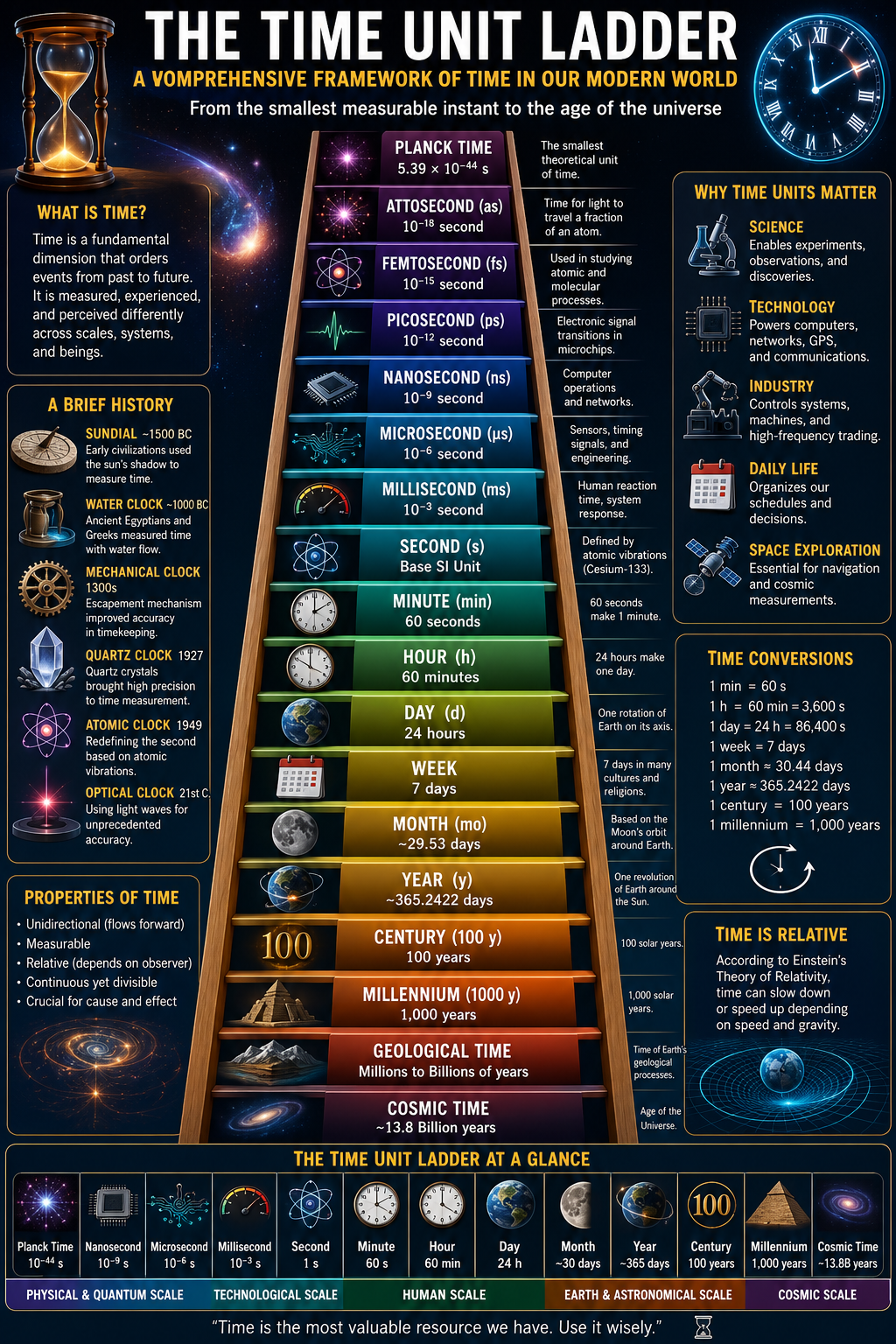
THE TIME UNIT LADDER
A comprehensive framework for understanding how humanity measures, standardises, and reasons about time — from Planck time to deep cosmic and geological scales.
EXECUTIVE SUMMARY
Every measurement of duration that humans use — from the flicker of a computer clock cycle to the age of the universe — belongs to a single continuous ladder of units. Each rung is defined with reference to the rungs around it: a minute is sixty seconds, a day is approximately 86,400 seconds, a year is roughly 365.25 days. But the ladder is not as uniform as this arithmetic suggests. It is built from at least five distinct measurement traditions stitched together by convention: physical constants at the smallest scales, atomic resonance at the human scale, astronomical motion at the calendrical scale, radiometric decay at the geological scale, and cosmological modelling at the largest scale.
Three findings run through this report. First, only one everyday unit of time has a fixed, non-negotiable physical definition: the second, defined by a fixed number of caesium-133 microwave oscillations, and now approaching redefinition using optical atomic transitions roughly one hundred times more precise. Second, the ladder is presently mid-transition: the leap second is being retired by 2035, and the SI second itself may be redefined before the end of the decade. Third, the higher rungs — geological and cosmological time — are actively revised too, as the 2024 rejection of a proposed Anthropocene epoch shows. Precision decreases as scale increases, but the discipline of definition never disappears.
Report ScopeThis report treats the ladder end-to-end: quantum-scale durations, the SI second and its sub-multiples, civil and calendrical time, computing time, geological time, and cosmological time, closing with one comparative table and a set of cross-domain applications.
1. INTRODUCTION — WHAT IS A TIME UNIT LADDER?
A “time unit ladder” is the ordered set of units — from the smallest physically meaningful interval to the largest cosmologically meaningful span — that humans use to describe how long things last. Laid end to end it runs from the Planck time (roughly 5.4 × 10⁻⁴⁴ seconds) to the age of the observable universe (roughly 13.8 billion years). Between those extremes sit more than thirty named units, each solving a different measurement problem for a different community: physicists need femtoseconds to watch a chemical bond form; civil authorities need days and years to run a calendar; software engineers need nanoseconds and epoch timestamps to order events; geologists need millions of years to read rock strata; cosmologists need billions of years to model the universe’s expansion.
What makes the ladder interesting — and occasionally confusing — is that it is not one system but several, bolted together. The metric (SI) system provides a strict decimal ladder of sub-second units built on a single fixed constant. Civil and calendrical time is built on astronomical cycles that do not divide evenly into each other or into SI seconds. Geological and cosmological time abandon human-scale counting altogether, anchored instead to physical processes that only make sense over durations no human will ever directly observe.
1.1 WHY A SINGLE FRAMEWORK MATTERS
Every one of these systems, no matter how large or small, is ultimately calibrated back to the same fixed point — the SI second, defined by a caesium-133 atom’s hyperfine transition frequency. A geologist’s radiometric date, a cosmologist’s redshift-derived age, and a stock exchange’s microsecond trade timestamp are all, in the end, statements measured against that single atomic tick.
1.2 HOW THIS REPORT IS ORGANISED
Sections 2–4 build the ladder upward from the physics floor to the SI second and its sub-multiples. Sections 5–10 cover civil and calendrical time. Sections 11–12 cover the standards infrastructure keeping clocks, satellites, and computers synchronised. Sections 13–14 extend the ladder into geological and cosmological time. Section 15 assembles everything into one table, and Section 16 surveys cross-industry use.
Key IdeaOnly one unit in the entire ladder is defined by an unchanging physical constant with no reference to any other unit: the second. Every other unit is either a multiple of the second, or is defined independently and reconciled back to it by measurement.
2. THE PHYSICS FLOOR: PLANCK TIME AND QUANTUM-SCALE DURATION
At the bottom of the ladder sits the Planck time, tₚ, approximately 5.391 × 10⁻⁴⁴ seconds — derived mathematically from the speed of light, the gravitational constant, and the reduced Planck constant, as the time light would take to cross one Planck length. Below this scale, the equations of general relativity and quantum mechanics are believed to break down or require an unknown theory of quantum gravity. The Planck time is a theoretical floor, not a working unit of measurement.
2.1 FROM PLANCK TIME TO LABORATORY REALITY
Nothing built today can measure anything close to a Planck time. The shortest durations ever directly resolved are in the realm of zeptoseconds (10⁻²¹ s) and, in the most extreme attosecond-physics experiments, tens of yoctoseconds (10⁻²⁴ s) — used to time light crossing a hydrogen molecule or an electron leaving an atom. Attosecond science (10⁻¹⁸ s), which earned the 2023 Nobel Prize in Physics for its founding experimental techniques, is now a mature field used to film electron motion inside atoms in real time.
Unit | Symbol | Approx. duration (s) | Representative phenomenon
Planck time | tₚ | 5.39 × 10⁻⁴⁴ | Theoretical floor of physical duration
Yoctosecond | ys | 10⁻²⁴ | Light crossing a proton
Zeptosecond | zs | 10⁻²¹ | Photon transit across a hydrogen molecule
Attosecond | as | 10⁻¹⁸ | Electron motion within an atom
Femtosecond | fs | 10⁻¹⁵ | A chemical bond forming or breaking
Picosecond | ps | 10⁻¹² | One oscillation cycle of visible light
2.2 WHY THESE SCALES MATTER OUTSIDE PHYSICS
Quantum-scale units matter to the rest of the ladder because they are the resolution at which atomic clocks operate. A caesium fountain clock counts roughly 9.19 billion oscillations to mark one second — the precision achievable at the bottom of the ladder is what allows the entire upper structure, from GPS timing to financial trade sequencing, to be as exact as it is.
Precision NoteThe shortest interval ever directly measured is on the order of 247 zeptoseconds — light crossing a hydrogen molecule — achieved with attosecond X-ray pulse techniques. Still many orders of magnitude above the Planck time.
2.3 ATTOSECOND AND ZEPTOSECOND SCIENCE IN PRACTICE
Attosecond pulses are typically generated by firing an intense femtosecond laser into a noble gas, producing a burst of extreme ultraviolet or soft X-ray light lasting a few hundred attoseconds through high-harmonic generation. Researchers use these pulses stroboscopically to build a frame-by-frame picture of electron motion otherwise far too fast to observe.
In PracticeThe 2023 Nobel Prize in Physics was awarded for experimental methods generating attosecond pulses of light, used to study electron dynamics in matter.
3. THE SI SECOND: DEFINITION, HISTORY, AND THE ROAD TO REDEFINITION
The second is the only base time unit in the International System of Units, and every other SI time-related unit is derived from it. Its modern definition, adopted in 1967, fixes the second as the duration of exactly 9,192,631,770 periods of the radiation corresponding to the transition between two hyperfine levels of the ground state of the caesium-133 atom. This replaced earlier definitions based on the Earth’s rotation and, briefly, the Earth’s orbit — both abandoned because astronomical motion is not perfectly regular.
3.1 WHY CAESIUM
Caesium-133 was chosen because its hyperfine transition frequency is extraordinarily stable and reproducible anywhere on Earth. A caesium fountain clock counts oscillations with a relative uncertainty of a few parts in 10¹⁶ — equivalent to losing or gaining roughly one second every hundred million years.
3.2 THE OPTICAL CLOCK CHALLENGE
Since the early 2000s, optical atomic clocks — built on transitions in strontium, ytterbium, or aluminium ions — have surpassed caesium fountains in stability and accuracy by one to two orders of magnitude. This has created an unusual situation: the technology available is now more precise than the legal definition of the unit it measures. The CCTF, under the CIPM, is developing a roadmap toward redefining the second on an optical transition. As of 2026, no single reference transition has been finalised; formal options are expected this year, with final adoption realistically expected toward the end of the decade or into the early 2030s.
In PracticeA redefinition will not change how long a second feels — it will simply swap the reference transition for a far more precise one, exactly as the 1967 caesium definition replaced the earlier astronomical one.
3.3 FROM SECOND TO MINUTE AND HOUR
Above the second, the ladder briefly becomes purely conventional. A minute is 60 seconds and an hour is 60 minutes by base-60 (sexagesimal) convention inherited from Babylonian astronomy — not from any physical constant. Base-60 persists because it divides evenly by 2, 3, 4, 5, 6, 10, 12, 15, 20, and 30.
4. THE SUB-SECOND CASCADE: DECI- TO QUECTO-
Below the second, the SI system is perfectly regular: each unit is a fixed decimal fraction of the one above it. This is the only fully decimal, fully consistent segment of the entire ladder — every segment above the second must accommodate an astronomical cycle that is not a round number of seconds.
Prefix | Symbol | Factor | Typical use
milli- | ms | 10⁻³ s | Network latency, video frame timing, human reflexes
micro- | µs | 10⁻⁶ s | CPU instruction timing, audio sample intervals
nano- | ns | 10⁻⁹ s | Light travels ~30 cm; processor clock cycles
pico- | ps | 10⁻¹² s | Fibre-optic signal timing; laser pulse widths
femto- | fs | 10⁻¹⁵ s | Molecular and chemical bond dynamics
atto- | as | 10⁻¹⁸ s | Electron dynamics within atoms
zepto- | zs | 10⁻²¹ s | Nuclear and sub-atomic process timing
yocto- | ys | 10⁻²⁴ s | Shortest intervals resolved experimentally
ronto- / quecto- | rs / qs | 10⁻²⁷ / 10⁻³⁰ s | Adopted 2022; not yet in laboratory use
Ronto- and quecto- — with their large-number counterparts ronna- and quetta- — were formally adopted by the General Conference on Weights and Measures in November 2022, to keep pace with growing instrument precision and data volumes.
Key IdeaEverything below the second is arithmetic; everything above it is negotiation. That single dividing line explains almost every irregularity in the rest of this report.
5. CIVIL TIME: MINUTES, HOURS, AND THE DAY
The day is where the ladder first collides with astronomy. A solar day averages 24 hours but varies through the year by up to about 16 minutes relative to clock time (the equation of time), and Earth’s rotation is gradually slowing, lengthening the day by roughly 1.7 milliseconds per century. A sidereal day is about 4 minutes shorter than a solar day.
5.1 WHY 24 HOURS
The 24-hour day descends from ancient Egyptian practice of dividing daylight and night each into 12 parts, later formalised by Hellenistic astronomers. Several historical systems — including a short-lived French Revolutionary 10-hour day — attempted decimal alternatives without lasting adoption.
5.2 THE CIVIL SECOND IN PRACTICE
For civil purposes, a day is treated as exactly 86,400 SI seconds. In reality the mean solar day is very slightly longer, which is what makes leap seconds necessary (Section 11).
Watch Out”A day has 86,400 seconds” is a civil convention, not a physical law. On a leap-second day the true count is 86,401 seconds.
5.3 TIME ZONES: DIVIDING THE DAY BY LONGITUDE
Time zones keep clock time loosely aligned with the Sun’s position across a rotating Earth. The world is nominally divided into 24 one-hour zones from Greenwich, though the real map includes half-hour and 45-minute offsets (India, Nepal), single-zone countries spanning multiple natural zones (China), and seasonal daylight saving adjustments in roughly 70 countries.
5.4 HOUR, MINUTE, AND SECOND IN PROFESSIONAL PRACTICE
The hour, minute, and second reappear as rate units across industries: interest accrues daily or continuously in finance, billable time is tracked in six-minute increments in law, and a “five nines” 99.999% service-level target permits only about 5 minutes 15 seconds of downtime a year.
6. THE WEEK: A UNIT WITH NO ASTRONOMICAL BASIS
Unlike every other traditional civil unit, the seven-day week corresponds to no astronomical cycle at all. The most widely accepted origin is Babylonian, tied to the seven visible “wandering” bodies — the Sun, Moon, and five planets — each given a day. The week survived independently through Judaic, Roman, Christian, and Islamic adoption, becoming a near-global default via European colonial and commercial influence, and is standardised internationally by ISO 8601 (Monday as day one).
Precision NoteRevolutionary France’s ten-day décade and the Soviet Union’s five- and six-day weeks (late 1920s–early 1930s) both tried replacing the seven-day week and were abandoned within a few years — largely because the change disrupted religious rest days and social coordination.
7. MONTHS AND THE MOON
A synodic month averages 29.53059 days — the astronomical basis for the “month” in most calendar traditions, but it doesn’t divide evenly into a 365.24-day year (roughly 12.37 synodic months per solar year) or into whole days.
7.1 THREE WAYS CALENDARS HAVE SOLVED THIS
- Purely lunar calendars (e.g. Islamic Hijri) ignore the solar mismatch, using alternating 29/30-day months (354–355 days/year), causing months to drift through the seasons over ~33 years.
- Lunisolar calendars (e.g. Hebrew, Chinese) keep months tied to the Moon but periodically insert a thirteenth intercalary month to stay roughly aligned with the solar year.
- Purely solar calendars (e.g. Gregorian) abandon the lunar link, dividing the year into twelve fixed months of arbitrary length that no longer track the Moon at all.
The Gregorian month is really a bookkeeping division of the year, sized unevenly purely so twelve of them add up to a full solar year.
8. THE YEAR: TROPICAL, SIDEREAL, AND CALENDAR YEARS
“A year” is actually at least three different, slightly mismatched durations.
Type of year | Definition | Length
Sidereal year | Return to same position vs. distant stars | 365.25636 days
Tropical (solar) year | Between successive spring equinoxes; basis for seasons | 365.24219 days
Julian calendar year | Fixed civil approximation, 46 BCE–1582 CE | 365.25 days
Gregorian calendar year | Refined civil approximation used today | 365.2425 days (avg.)
Anomalistic year | Return to perihelion | 365.25964 days
8.1 WHY LEAP YEARS EXIST
The Gregorian calendar approximates the 365.24219-day tropical year with a 365-day common year plus a leap day roughly every fourth year, excluding century years not divisible by 400. This gives a 365.2425-day average — a residual error of about 26 seconds/year, accumulating to a full day of drift only after roughly 3,300 years.
In PracticeThe tropical year is itself slowly shortening due to Earth’s gradual rotational slowdown, meaning even a perfectly tuned calendar rule would eventually need re-tuning on multi-millennial timescales.
9. CALENDARS IN ACTIVE USE TODAY
The Gregorian calendar, introduced in 1582 to correct Julian drift, is the near-universal civil standard, coexisting with several living calendar systems used for religious, cultural, or national purposes.
Calendar | Type | Primary use today
Gregorian | Solar | Global civil standard
Hijri (Islamic) | Lunar | Religious observance across the Muslim world
Hebrew | Lunisolar | Jewish religious and some Israeli civil use
Chinese | Lunisolar | Cultural and festival dating, East Asia
Ethiopian | Solar (Coptic-derived) | Civil calendar of Ethiopia
Fiscal / financial year | Administrative | Corporate and government accounting
9.1 CONVERTING BETWEEN CALENDAR SYSTEMS
Because each living calendar system uses a different epoch and intercalation rule, conversion is never a simple linear offset. The Hijri calendar, for instance, is traditionally fixed by moon sighting, meaning a month’s start can vary by a day between regions — some countries address this with a calculated civil Hijri calendar.
9.2 ISO 8601: THE INTEROPERABILITY LAYER
ISO 8601 (YYYY-MM-DD, with optional UTC-offset time) removes the day/month ordering ambiguity between conventions like US MM/DD/YYYY and most other countries’ DD/MM/YYYY, and underlies most modern software date handling.
10. DECADES, CENTURIES, AND MILLENNIA
Above the year, the ladder becomes purely a matter of counting — decades, centuries, and millennia are simple decimal multiples of the year with no independent astronomical basis. Because the Gregorian calendar has no year zero, the 21st century and third millennium technically began on 1 January 2001, not 2000, even though popular culture celebrated the turn a year early.
Watch OutThis off-by-one issue is a labelling convention, not a calculation error — both the popular and technically correct dates are internally consistent once the rule is known.
11. GLOBAL TIME STANDARDS: UTC, TAI, GPS TIME, AND LEAP SECONDS
Above civil time sits a layer of technical standards keeping every clock, satellite, and computer synchronised, while respecting that Earth’s rotation is not perfectly uniform.
11.1 INTERNATIONAL ATOMIC TIME (TAI)
TAI is a continuous time scale with no leap seconds, computed by the BIPM as a weighted average of more than 450 atomic clocks across over 80 national laboratories. TAI is the principal realisation of Terrestrial Time and underlies UTC.
11.2 COORDINATED UNIVERSAL TIME (UTC)
UTC normally runs in 24-hour days of 60-second minutes, but occasionally 61, when a leap second is inserted. As of early 2026, UTC sits exactly 37 seconds behind TAI. The gap is corrected periodically by inserting a second at the end of June or December, decided by the IERS.
11.3 THE END OF THE LEAP SECOND
In November 2022, the General Conference on Weights and Measures resolved to increase the maximum permitted UT1–UTC difference by, or before, 2035, keeping the civil second fixed while letting clock time drift slowly out of step with the Sun’s apparent position. Proposed replacements include a rare “leap minute” every 50–100 years, or a gradual, invisible time “smear.” No leap second has been needed in recent years, and Earth’s rotation has recently sped up in places — raising the unprecedented possibility of a negative leap second for the first time since 1972.
11.4 GPS TIME AND OTHER SATELLITE TIME SCALES
GPS Time is a separate continuous scale fixed since January 1980 that never applies leap seconds, sitting 18 seconds ahead of UTC since the 2016 leap second. Receivers store the current offset and apply it in software.
Time scale | Leap seconds? | Primary purpose
TAI | No — continuous | Underlying atomic reference
UTC | Yes, historically (phased out by 2035) | Global civil time
UT1 | N/A — astronomical | Earth’s actual rotational orientation
GPS Time | No — fixed offset from TAI | Satellite navigation and positioning
TT (Terrestrial Time) | No | High-precision astronomical ephemerides
Precision NoteThe redefinition of the second (Section 3) and the retirement of the leap second are related but separate reforms on separate timelines.
12. COMPUTATIONAL TIME: CLOCKS, TICKS, AND THE UNIX EPOCH
Computers count discrete events rather than experiencing time continuously. A CPU clock cycle is timed by an oscillator running at gigahertz frequencies — a 3 GHz processor completes roughly 3 billion cycles per second, each lasting about 333 picoseconds.
12.1 THE UNIX EPOCH
Most systems track time as a running count of seconds since a fixed epoch. The Unix epoch (1 January 1970, 00:00:00 UTC) underlies Unix, Linux, macOS, and most databases and networking protocols. Standard 32-bit storage overflows on 19 January 2038 (the “Year 2038 problem”); most modern systems have migrated to 64-bit representations.
12.2 LATENCY AND HUMAN-PERCEPTIBLE TIME
Operation | Typical duration
CPU clock cycle (3 GHz) | ~0.33 ns
RAM access | ~50–100 ns
SSD read | ~10–100 µs
Same-datacentre round trip | ~0.5 ms
Intercontinental round trip | ~100–250 ms
Human reaction to visual stimulus | ~150–300 ms
Perceived as “instant” | < 100 ms
12.3 KEEPING DISTRIBUTED SYSTEMS SYNCHRONISED
An uncorrected clock can drift by seconds to minutes per month. The Network Time Protocol (NTP) typically synchronises machines to within a few milliseconds of UTC; the Precision Time Protocol (IEEE 1588) or GPS-disciplined oscillators achieve sub-microsecond synchronisation where required — telecoms, power grids, and high-frequency trading.
Precision NoteFinancial regulators in major markets now mandate clock-sync accuracy for trading systems measured in single-digit microseconds relative to UTC.
13. GEOLOGICAL TIME: EONS, ERAS, PERIODS, EPOCHS, AND AGES
Geologists read time from rock strata, radiometric decay, and fossil succession, formalised by the International Commission on Stratigraphy (ICS) and ratified by the International Union of Geological Sciences (IUGS).
13.1 THE FIVE-RANK HIERARCHY
Rank | Current unit | Approx. start
Eon | Phanerozoic | ~539 million years ago
Era | Cenozoic | ~66 million years ago
Period | Quaternary | ~2.58 million years ago
Epoch | Holocene | ~11,700 years ago
Age | Meghalayan | ~4,200 years ago
13.2 THE ANTHROPOCENE: A LIVE CASE STUDY IN DEFINING A UNIT
The Anthropocene was proposed as a new epoch following the Holocene, but was formally rejected in 2024 by both the ICS and IUGS after roughly fifteen years of deliberation, largely owing to its shallow sedimentary record and unusually recent proposed start date. Some working-group members have since challenged the vote on procedural grounds, and the debate continues in parts of the literature even though the formal timescale does not include it.
Watch Out”Anthropocene” is in wide informal and scientific use but is not, as of 2026, a formally ratified rank. Officially the current epoch remains the Holocene, and the current age remains the Meghalayan.
13.3 HOW A GEOLOGICAL TIME BOUNDARY IS ACTUALLY FIXED
Formal boundaries are set not by round numbers but by a Global Boundary Stratotype Section and Point (GSSP) — a “golden spike” in an actual rock sequence marked by a globally traceable signal. The Anthropocene working group’s candidate GSSP (Crawford Lake, Canada) was itself part of what the 2024 vote assessed.
13.4 RADIOMETRIC DATING: THE MEASUREMENT BACKBONE
Most absolute ages are established through radiometric dating — measuring the ratio of a radioactive parent isotope to its stable decay product against a known, constant half-life. Carbon-14 (half-life ~5,730 years) suits organic material up to ~50,000 years old; uranium-lead dating (billions-of-years half-life) suits the oldest rocks and meteorites. A half-life is itself a duration calibrated against atomic timekeeping — linking geological time back to the SI second.
14. COSMOLOGICAL TIME: THE AGE AND FUTURE OF THE UNIVERSE
At the top rung, time is measured by modelling the universe’s expansion. The current best estimate, drawn primarily from cosmic microwave background measurements (e.g. ESA’s Planck satellite), places the universe’s age at approximately 13.8 billion years, uncertain by only tens of millions of years.
14.1 THE COSMIC CALENDAR ANALOGY
Popularised by Carl Sagan, compressing 13.8 billion years into one calendar year: the Big Bang occurs at the first instant of 1 January, the Milky Way forms in March, the Sun and Earth form in early September, multicellular life appears mid-December, dinosaurs go extinct on 30 December, and all of recorded human history occupies the last few seconds before midnight on 31 December.
14.2 WHERE COSMOLOGICAL AND GEOLOGICAL TIME MEET
Cosmological and geological timescales use entirely different physical methods — cosmic expansion versus radiometric decay — yet agree closely: the oldest Earth zircons date to ~4.4–4.5 billion years, consistent with a ~4.6-billion-year Solar System, comfortably within the 13.8-billion-year age of the universe.
Key IdeaEvery rung below the second grows more certain as scale shrinks; every rung above the year grows less certain as scale grows. The second remains the most precisely known unit on the entire ladder.
15. THE FULL LADDER: AN END-TO-END COMPARATIVE VIEW
Rung | Approx. duration | Defining discipline
Planck time | 5.4 × 10⁻⁴⁴ s | Theoretical physics
Yoctosecond – attosecond | 10⁻²⁴ – 10⁻¹⁸ s | Particle & attosecond physics
Femtosecond – picosecond | 10⁻¹⁵ – 10⁻¹² s | Chemistry & photonics
Nanosecond – microsecond | 10⁻⁹ – 10⁻⁶ s | Computing & electronics
Millisecond | 10⁻³ s | Human perception & networking
SI second | 1 s | Metrology (caesium / optical clocks)
Minute, hour, day | 60 s – 86,400 s | Civil convention
Week | ~604,800 s | Cultural / religious convention
Month | ~2.4–2.7 × 10⁶ s | Lunar cycle / civil convention
Year | ~3.156 × 10⁷ s | Earth’s solar orbit
Decade – millennium | 10¹ – 10³ years | Simple decimal counting
Age – epoch – period – era – eon | 10³ – 10⁸ years | Geology / stratigraphy
Age of the universe | 1.38 × 10¹⁰ years | Observational cosmology
16. CROSS-DOMAIN APPLICATIONS
16.1 FINANCE AND MARKETS
High-frequency trading competes on microsecond and nanosecond execution differences and order books are timestamped to microsecond precision under regulations like MiFID II, while portfolio and fiscal reporting run on monthly, quarterly, and annual civil cycles.
16.2 COMPLIANCE AND GOVERNANCE
Multi-entity organisations tracking statutory obligations operate almost entirely on civil and calendrical rungs, where the main risk is calendar and jurisdiction mismatch rather than physical imprecision.
16.3 MEDICINE AND BIOLOGY
Nerve impulses propagate in milliseconds, cardiac cycles repeat roughly once per second, cell division runs in hours to days, and evolutionary change is measured in thousands to millions of years — nine or more orders of magnitude within one field.
16.4 ASTRONOMY AND NAVIGATION
GPS requires nanosecond-level timing precision, since a one-microsecond error translates to roughly 300 metres of positioning error.
16.5 ENGINEERING AND MANUFACTURING
Industrial control and telecom networks depend on microsecond-to-nanosecond synchronisation (e.g. IEEE 1588), while asset lifecycle planning reasons in years to decades.
16.6 RESEARCH AND DEVELOPMENT STRATEGY
Long-horizon research programmes operate on at least three simultaneous timescales: laboratory processes (microseconds to hours), project planning (months to years), and strategic positioning (years to decades). Recognising which rung a given decision belongs to — rather than defaulting to the most familiar one — is itself a useful discipline.
17. CONCLUSION
The time unit ladder is best understood not as one measurement system but as a single physical anchor — the SI second — surrounded by independent measurement traditions that each solve a different problem at a different scale, then reconcile back to that anchor whenever precision demands it. Sub-second units are purely decimal and physical. Civil and calendrical units are conventions layered over astronomical cycles that never divide evenly. Computational time counts discrete events against a fixed epoch. Geological and cosmological time abandon human-scale counting altogether, yet still calibrate back to the same second.
The ladder is also actively under revision: the leap second is being retired by 2035; the SI second may be redefined before decade’s end; and the geological timescale continues to be debated, as the rejected Anthropocene epoch shows. None of this threatens the ladder’s coherence — it demonstrates the opposite: every rung remains open to correction against better evidence.
Key IdeaFrom 5.4 × 10⁻⁴⁴ seconds to 13.8 billion years is roughly 61 orders of magnitude — and every rung along that span ultimately answers to the same caesium (soon to be optical) atomic tick.
GLOSSARY OF KEY TERMS
Planck time — The smallest theoretically meaningful duration, ~5.39 × 10⁻⁴⁴ seconds.
SI second — Base unit of time, defined by 9,192,631,770 periods of caesium-133 hyperfine radiation.
TAI — International Atomic Time; continuous, no leap seconds.
UTC — Coordinated Universal Time; global civil standard, historically adjusted by leap seconds.
UT1 — Astronomical time based on Earth’s actual rotation.
Leap second — One-second UTC adjustment; being phased out by 2035.
Tropical year — Between successive spring equinoxes, ~365.24219 days.
Sidereal year — Return to same position vs. distant stars, ~365.25636 days.
Synodic month — New moon to new moon, ~29.53 days.
Unix epoch — Reference point (1 Jan 1970 00:00:00 UTC) for computer time counts.
Eon / Era / Period / Epoch / Age — The five formal ranks of the Geologic Time Scale.
Anthropocene — Proposed but formally rejected (2024) epoch describing the human-dominated present.
Cosmic Calendar — Device compressing the 13.8-billion-year universe into one calendar year.





Be First to Comment