
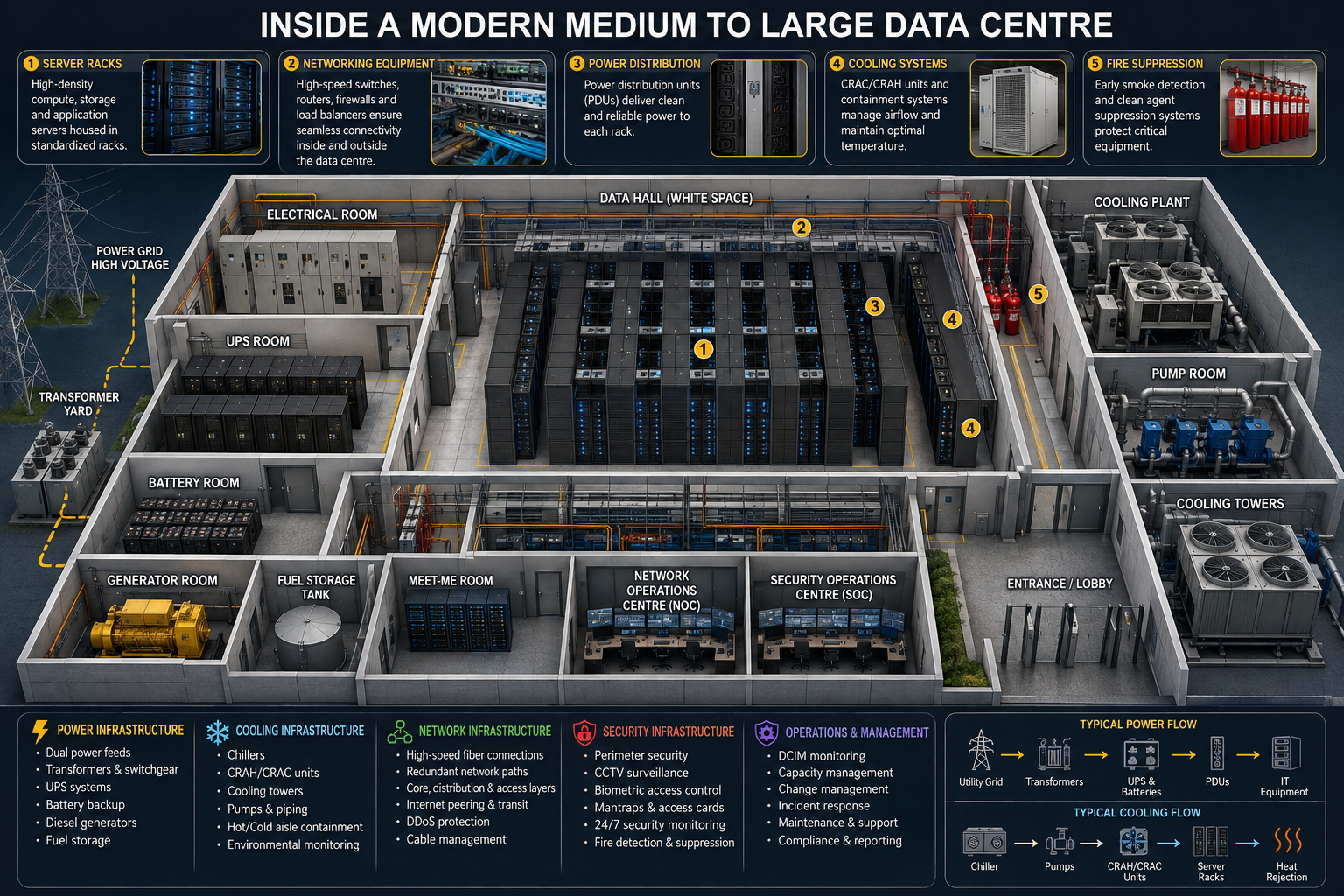
A Comprehensive 15-Page Technical Essay on the Architecture, Infrastructure, Technology, Security, Energy Systems and Operations of Modern Data Centres
1. Introduction: The Purpose and Philosophy of Modern Data Centres
A modern medium‑to‑large data centre is the physical heart of the digital world. Every online transaction, cloud service, AI model, streaming platform, banking system, government database, and enterprise application ultimately relies on the infrastructure inside these facilities. They are engineered environments where computing, storage, networking, power, cooling, security, and automation converge into a single, highly‑controlled ecosystem.
Data centres today are no longer simple server rooms. They are industrial‑scale digital factories, designed with precision engineering, redundancy, and resilience. Their internal architecture reflects global standards such as Tier III and Tier IV classifications, ensuring continuous uptime even during failures. Inside them, thousands of interconnected systems operate in harmony to deliver reliability, speed, and scalability.
This essay explores, in detail, what exists inside a modern medium‑large data centre—its physical components, digital architecture, operational workflows, environmental controls, security systems, and emerging technologies.
2. Physical Layout and Structural Architecture
2.1 Building Design and Zoning
A medium‑large data centre is divided into zones, each with a specific function:
- Entrance & Security Lobby – biometric access, mantraps, visitor logs.
- Network Operations Centre (NOC) – monitoring screens, dashboards, incident response teams.
- Server Halls / White Space – rows of racks, hot/cold aisle containment.
- Mechanical & Electrical Rooms – UPS systems, switchgear, transformers.
- Cooling Infrastructure Rooms – chillers, pumps, CRAC/CRAH units.
- Storage Rooms – spare parts, cables, replacement drives.
- Staging Areas – where new servers are assembled and tested.
- Loading Bays – secure delivery of equipment.
The building is constructed with reinforced walls, raised floors or slab floors, fire‑rated materials, and seismic bracing depending on location.
2.2 Raised Floor or Slab Floor
Many data centres use raised floors for cable routing and cooling airflow. Others use slab floors with overhead cable trays and ducted cooling. The choice depends on density, cooling strategy, and cost.
3. Server Infrastructure: The Compute Layer
3.1 Rack Systems
Racks are the fundamental physical units. A typical rack is:
- 42U to 52U in height
- Equipped with PDUs (Power Distribution Units)
- Connected to structured cabling (fiber + copper)
- Labelled for asset management
3.2 Types of Servers
Inside the racks, you find:
- General-purpose servers – for web hosting, enterprise apps.
- High-density blade servers – compact, modular compute.
- GPU servers – for AI, machine learning, rendering.
- Hyperconverged infrastructure (HCI) nodes – combining compute + storage.
- Bare-metal servers – used by cloud providers for high-performance workloads.
3.3 Virtualization and Cloud Layers
Most physical servers run:
- VMware ESXi
- Microsoft Hyper‑V
- KVM
- OpenStack
- Container orchestration (Kubernetes)
This abstraction allows thousands of virtual machines and containers to run on fewer physical servers.
4. Storage Infrastructure: The Data Layer
4.1 Storage Types
A modern data centre uses multiple storage technologies:
- SAN (Storage Area Network) – high‑speed block storage.
- NAS (Network Attached Storage) – file storage.
- Object Storage – scalable cloud storage (e.g., S3‑compatible).
- NVMe Flash Arrays – ultra‑fast storage for databases and AI workloads.
- Tape Libraries – long-term archival storage.
4.2 Redundancy and Replication
Storage systems use:
- RAID arrays
- Erasure coding
- Snapshots
- Replication across data centres
This ensures data durability and availability.
5. Networking Infrastructure: The Connectivity Layer
5.1 Core Network
At the centre of the data centre network are:
- Core switches (40/100/400Gbps)
- Aggregation switches
- Top-of-Rack (ToR) switches
These form a leaf-spine architecture, ensuring low latency and high throughput.
5.2 Fiber Optic Cabling
Fiber is the backbone:
- Single-mode fiber for long distances
- Multi-mode fiber for short distances
- MPO/MTP connectors for high-density links
5.3 Routers and Edge Devices
The data centre connects to the outside world through:
- Border routers
- Firewalls
- Load balancers
- DDoS protection appliances
5.4 Software-Defined Networking (SDN)
Modern centres use SDN platforms such as:
- Cisco ACI
- VMware NSX
- Juniper Contrail
These allow automated network provisioning and segmentation.
6. Power Infrastructure: The Electrical Backbone
6.1 Utility Power
Data centres receive high-voltage power from the grid, often:
- 11kV or 33kV feeds
- Dual utility feeds for redundancy
6.2 UPS Systems
Uninterruptible Power Supplies ensure continuity:
- Battery-based UPS (lithium-ion or VRLA)
- Flywheel UPS (for short bridging)
- Modular UPS units for scalability
6.3 Generators
Diesel generators provide backup power:
- Multiple generators in N+1 or N+2 configuration
- Automatic Transfer Switches (ATS)
- Fuel storage for 24–72 hours
6.4 Power Distribution
Power flows through:
- Switchgear
- PDUs
- Busways
- Rack PDUs
All monitored for load balancing and efficiency.
7. Cooling Infrastructure: The Thermal Management Layer
7.1 Cooling Methods
Data centres use:
- CRAC/CRAH units – air cooling
- Chillers – water cooling
- Cooling towers
- Direct-to-chip liquid cooling
- Immersion cooling for high-density AI servers
7.2 Hot/Cold Aisle Containment
Servers are arranged so cold air enters the front and hot air exits the back. Containment systems prevent mixing, improving efficiency.
7.3 Environmental Monitoring
Sensors track:
- Temperature
- Humidity
- Airflow
- Pressure
These feed into automated control systems.
8. Security Systems: Physical and Cyber
8.1 Physical Security
Data centres enforce strict access control:
- Biometric scanners
- RFID badges
- Mantraps
- CCTV with AI analytics
- Security guards
- Anti-tailgating systems
8.2 Cybersecurity
Cyber layers include:
- Firewalls
- Intrusion detection systems
- Zero-trust architecture
- SIEM platforms
- Endpoint protection
- Encryption at rest and in transit
9. Monitoring and Management Systems
9.1 DCIM (Data Centre Infrastructure Management)
DCIM platforms monitor:
- Power usage
- Cooling performance
- Rack density
- Asset tracking
- Environmental conditions
9.2 NOC Operations
The Network Operations Centre handles:
- Incident response
- Performance monitoring
- Capacity planning
- Change management
Large screens display real-time dashboards.
10. Automation and Orchestration
Modern data centres rely heavily on automation:
- Infrastructure as Code (IaC)
- Automated provisioning
- AI-driven predictive maintenance
- Robotic cable management (emerging)
Automation reduces human error and speeds up deployment.
11. Fire Suppression and Safety Systems
11.1 Fire Detection
Systems include:
- VESDA (air sampling)
- Smoke detectors
- Heat sensors
11.2 Suppression
Instead of water, data centres use:
- FM200
- Novec 1230
- Inert gas systems
These extinguish fire without damaging electronics.
12. Redundancy, Resilience, and Tier Classification
Data centres are designed for uptime:
- N+1 redundancy
- 2N redundancy
- Concurrent maintainability
- Fault tolerance
Tier III and IV facilities guarantee high availability.
13. Cloud Architecture Inside the Data Centre
Medium‑large data centres often host:
- Private cloud
- Hybrid cloud
- Multi-cloud interconnects
- Edge computing nodes
They support platforms like:
- Azure Stack
- AWS Outposts
- Google Anthos
14. Emerging Technologies Inside Modern Data Centres
14.1 AI Accelerators
AI workloads require:
- GPU clusters
- TPU pods
- FPGA arrays
14.2 Liquid Immersion Cooling
Used for high-density compute.
14.3 Renewable Energy Integration
Solar, wind, and battery storage reduce carbon footprint.
14.4 Autonomous Data Centres
AI-driven operations reduce human intervention.
15. Conclusion: The Data Centre as the Engine of the Digital World
A modern medium‑large data centre is a complex ecosystem combining engineering, computing, networking, security, and automation. It is the unseen backbone of global digital infrastructure. Inside it, thousands of systems work together to deliver reliability, speed, and scalability for billions of users worldwide.
Understanding what lies inside these facilities reveals the sophistication behind everyday digital experiences—from banking to streaming, from AI to cloud computing. As technology evolves, data centres will continue to grow more efficient, more automated, and more critical to the functioning of modern civilization.





Be First to Comment