
Between the Outside Parts of the Human Body and the Inside Parts: Which Ones Do More Work to Keep Us Alive?
Abstract
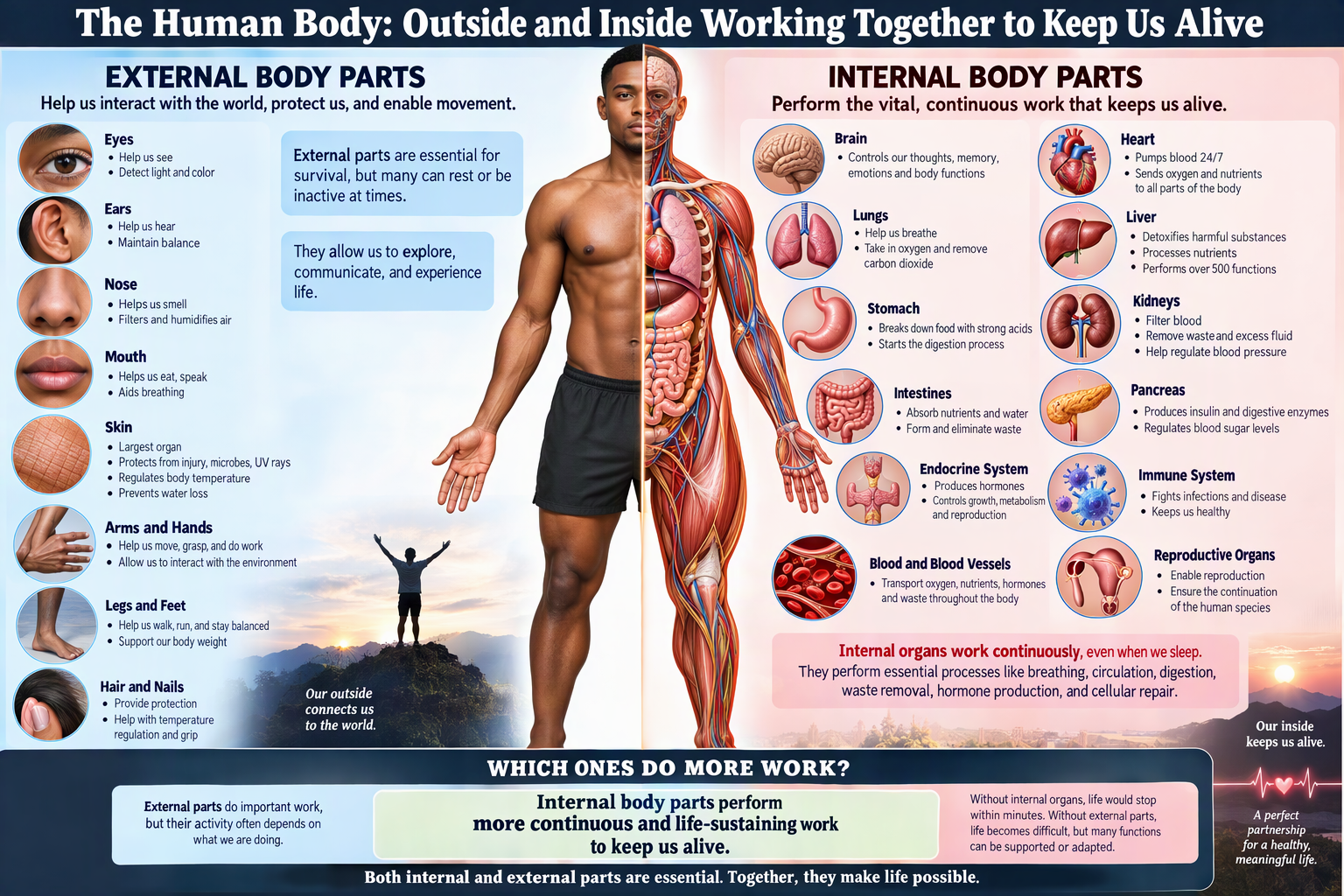
The human body is an extraordinarily complex biological system composed of external and internal structures that function together to maintain life. A common question in anatomy and physiology is whether the outside parts of the body or the inside parts perform more work in sustaining human life. This thesis explores the anatomy, physiology, interdependence, and significance of both external and internal body structures. Through detailed examination of the skin, sensory organs, limbs, muscles, organs, glands, blood vessels, and cellular systems, this study demonstrates that while external body parts are crucial for environmental interaction and protection, the internal systems perform the majority of life-sustaining functions required for survival. Nevertheless, neither system can function independently, making their cooperation essential for human existence.
Table of Contents
- Introduction
- Understanding Human Body Organization
- External Body Parts
- Functions of the Skin
- Importance of Hair and Nails
- The Human Face and Sensory Reception
- The Eyes and Vision
- The Ears and Hearing
- The Nose and Smell
- The Mouth and Communication
- Upper Limbs and Movement
- Lower Limbs and Locomotion
- Skeletal Support Functions
- Muscular Contributions
- Internal Body Parts Overview
- The Brain
- The Spinal Cord
- The Nervous System
- The Heart
- Blood and Blood Vessels
- The Respiratory System
- The Lungs
- The Digestive System
- The Stomach
- The Liver
- The Pancreas
- The Small Intestine
- The Large Intestine
- The Kidneys
- The Urinary System
- The Endocrine System
- The Immune System
- Reproductive Organs
- Cellular Functions
- Energy Production
- Oxygen Transport
- Waste Removal
- Protection Against Disease
- Comparison Between External and Internal Parts
- Which Performs More Work?
- System Interdependence
- Evolutionary Perspective
- Clinical Significance
- Future Biomedical Understanding
- Conclusion
Chapter 1: Introduction
The human body consists of visible external structures and hidden internal systems. Every moment, numerous processes occur simultaneously to sustain life. Breathing, circulation, digestion, thinking, movement, temperature regulation, immunity, and cellular repair operate continuously.
Many people assume that visible body parts perform the most work because they are constantly used for movement and interaction. However, invisible internal organs carry out life-critical processes twenty-four hours a day without conscious effort.
This thesis investigates the relative contributions of external and internal body structures and determines which performs the greater workload in maintaining life.
Chapter 2: Understanding Human Body Organization
The body is organized into several levels:
- Cells
- Tissues
- Organs
- Organ systems
- Organism
More than 30 trillion cells cooperate to create human life. Every organ system contributes to survival.
Examples include:
- Nervous system
- Circulatory system
- Respiratory system
- Digestive system
- Skeletal system
- Muscular system
- Endocrine system
- Immune system
Each system functions continuously to maintain homeostasis.
Chapter 3: External Body Parts
External structures include:
- Skin
- Hair
- Nails
- Eyes
- Ears
- Nose
- Mouth
- Arms
- Hands
- Legs
- Feet
These structures form the body’s interface with the environment.
Chapter 4: Functions of the Skin
The skin is the largest organ of the human body.
Its functions include:
- Protection
- Temperature regulation
- Sensation
- Vitamin D production
- Water retention
Without skin, humans would quickly die from infection, dehydration, and temperature imbalance.
Chapter 5: Importance of Hair and Nails
Hair provides:
- Temperature insulation
- Protection from sunlight
- Sensory input
Nails provide:
- Enhanced grip
- Finger protection
- Precision handling
Though important, their contribution to survival is less critical than major internal organs.
Chapter 6: The Human Face and Sensory Reception
The face contains multiple sensory structures.
Functions include:
- Recognition
- Communication
- Emotional expression
- Environmental awareness
The face serves as a biological information center.
Chapter 7: The Eyes and Vision
The eyes convert light into neural signals.
Functions:
- Object recognition
- Navigation
- Reading
- Learning
Visual information accounts for a large proportion of sensory input received by the brain.
Chapter 8: The Ears and Hearing
The ears detect sound waves and maintain balance through the vestibular system.
Functions:
- Hearing
- Spatial orientation
- Equilibrium
Balance disorders illustrate the importance of ear function.
Chapter 9: The Nose and Smell
The nose:
- Filters air
- Detects odors
- Humidifies inhaled air
Smell also contributes to taste and hazard detection.
Chapter 10: The Mouth and Communication
The mouth aids:
- Speech
- Eating
- Breathing
- Expression
Human civilization largely depends upon oral communication.
Chapters 11–14: Limbs, Skeleton, and Muscles
The external musculoskeletal apparatus enables:
- Walking
- Running
- Climbing
- Tool use
- Social interaction
Bones provide support while muscles generate force.
Humans possess over 600 muscles working continuously.
Yet movement can cease temporarily during sleep, whereas internal organs continue functioning.
Chapter 15: Internal Body Parts Overview
Internal organs perform automatic life-support operations.
These include:
- Brain
- Heart
- Lungs
- Liver
- Kidneys
- Intestines
- Endocrine glands
Most operate without conscious control.
Chapter 16: The Brain
The brain is the body’s control center.
The human brain contains approximately 86 billion neurons.
Functions include:
- Memory
- Intelligence
- Emotion
- Learning
- Decision making
- Motor control
The brain consumes approximately 20% of the body’s energy despite being only about 2% of body weight.
Chapter 17: The Spinal Cord
The spinal cord acts as a communication highway.
It transfers information between:
- Brain
- Limbs
- Organs
Damage often causes severe paralysis.
Chapter 18: The Nervous System
The nervous system controls:
- Movement
- Sensation
- Organ function
- Hormonal regulation
Millions of signals move through nerves each second.
Chapter 19: The Heart
The heart works continuously from before birth until death.
Functions:
- Blood circulation
- Oxygen distribution
- Nutrient delivery
A healthy heart beats more than 100,000 times daily.
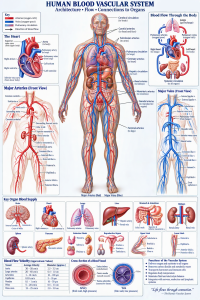
Chapter 20: Blood and Blood Vessels
Blood transports:
- Oxygen
- Nutrients
- Hormones
- Immune cells
The circulatory network stretches approximately 100,000 kilometers throughout the body
Chapter 21: The Respiratory System
Breathing supplies oxygen for cellular metabolism.
Respiration enables:
- Energy generation
- Carbon dioxide removal
Without oxygen, irreversible brain damage occurs within minutes.
Chapter 22: The Lungs
The lungs contain hundreds of millions of microscopic air sacs.
Functions include:
- Oxygen absorption
- Carbon dioxide removal
- Blood oxygenation
They work every second of life.
Chapter 23: The Digestive System
Digestion converts food into usable nutrients.
Functions:
- Nutrient extraction
- Energy supply
- Waste formation
Without digestion, cellular life cannot continue.
Chapter 24: The Stomach
The stomach:
- Stores food
- Mixes digestive enzymes
- Initiates protein digestion
Strong acids break down consumed materials.
Chapter 25: The Liver
The liver is one of the hardest-working organs.
Functions include:
- Detoxification
- Glucose storage
- Protein synthesis
- Bile production
Over 500 known physiological functions occur within the liver.
Chapter 26: The Pancreas
The pancreas regulates blood sugar levels.
It produces:
- Insulin
- Glucagon
- Digestive enzymes
Its role is critical for metabolic stability.
Chapter 27: The Small Intestine
The small intestine absorbs nutrients.
Its villi and microvilli dramatically increase surface area.
Most nutrient absorption occurs here.
Chapter 28: The Large Intestine
Functions include:
- Water absorption
- Electrolyte regulation
- Waste storage
Gut bacteria support digestion and immunity.
Chapter 29: The Kidneys
The kidneys filter blood continuously.
Functions:
- Waste removal
- Fluid balance
- Blood pressure regulation
Each day, kidneys process approximately 180 liters of fluid.
Chapter 30: The Urinary System
The urinary system removes toxins and maintains internal balance.
Without kidney function, toxic substances rapidly accumulate.
Chapter 31: The Endocrine System
Hormones coordinate body activity.
Major glands include:
- Pituitary gland
- Thyroid gland
- Adrenal glands
- Pancreas
Hormones regulate growth, metabolism, and reproduction.
Chapter 32: The Immune System
The immune system protects against disease.
Components include:
- White blood cells
- Lymph nodes
- Antibodies
- Spleen
Millions of immune responses occur daily.
Chapter 33: Reproductive Organs
The reproductive system ensures species survival.
Functions include:
- Gamete production
- Hormonal regulation
- Reproduction
Though not immediately required for individual survival, reproduction ensures continuation of humanity.
Chapter 34: Cellular Functions
Cells represent the true workers of life.
They perform:
- Energy generation
- Protein production
- Repair
- Communication
Every second, billions of biochemical reactions occur.
Chapter 35: Energy Production
Mitochondria act as cellular power stations.
ATP production fuels:
- Muscle activity
- Brain function
- Organ operation
Without ATP, life ceases instantly.
Chapter 36: Oxygen Transport
Hemoglobin carries oxygen to tissues.
This enables:
- Cellular respiration
- ATP production
- Organ performance
Oxygen delivery is among the body’s most vital activities.
Chapter 37: Waste Removal
Internal systems eliminate:
- Carbon dioxide
- Urea
- Toxins
- Metabolic wastes
Efficient waste removal prevents poisoning.
Chapter 38: Protection Against Disease
Protection occurs through:
External Defenses
- Skin
- Tears
- Saliva
Internal Defenses
- Immune cells
- Antibodies
- Inflammation mechanisms
The body employs layered defensive strategies.
Chapter 39: Comparison Between External and Internal Parts
| External Parts | Internal Parts |
|---|---|
| Interaction with environment | Maintenance of life |
| Movement | Blood circulation |
| Sensory detection | Respiration |
| Protection | Digestion |
| Communication | Hormonal control |
| Limited automatic activity | Continuous automatic activity |
Internal organs continue functioning even during deep sleep.
External parts often rest.
Chapter 40: Which Performs More Work?
From a physiological perspective, internal organs perform substantially more continuous work.
Reasons include:
Continuous Activity
The heart never rests.
The lungs continuously breathe.
The kidneys continuously filter blood.
The liver continuously processes chemicals.
Simultaneous Functions
Multiple internal organs work at the same time.
Cellular Workload
Trillions of cellular reactions occur internally every second.
Thus, the majority of biological work sustaining life occurs inside the body.
Chapter 41: System Interdependence
Despite internal organs performing more workload, external structures remain essential.
Without skin:
- Infection risk rises
- Fluid loss increases
- Temperature regulation fails
Without eyes:
- Environmental awareness decreases
Without limbs:
- Survival becomes difficult
Both internal and external systems depend on one another.
Chapter 42: Evolutionary Perspective
Evolution shaped external and internal structures together.
External adaptations improved:
- Mobility
- Predator avoidance
- Resource acquisition
Internal adaptations improved:
- Energy efficiency
- Brain development
- Organ specialization
Human survival emerged from cooperation between these systems.
Chapter 43: Clinical Significance
Medicine recognizes the importance of both systems.
Examples:
External Disorders
- Burns
- Fractures
- Vision impairment
Internal Disorders
- Heart disease
- Lung disease
- Kidney failure
- Liver dysfunction
Internal organ failure usually presents a more immediate threat to life.
Chapter 44: Future Biomedical Understanding
Advances in:
- Artificial intelligence
- Biomedical engineering
- Regenerative medicine
- Organ transplantation
continue revealing the extraordinary complexity of internal and external body functions.
Future technologies may replace some body structures, but reproducing the complete integration of all systems remains a tremendous challenge.
Chapter 45: Conclusion
The human body is an integrated biological masterpiece in which external and internal structures cooperate to sustain life. External body parts provide protection, communication, movement, environmental awareness, and interaction with the world. Internal organs perform the hidden processes that maintain life, including circulation, respiration, digestion, waste removal, immunity, hormonal regulation, and cellular metabolism.
When comparing overall workload, internal body parts perform significantly more continuous and life-sustaining work than external body parts. The heart beats continuously, the lungs exchange gases every moment, the kidneys filter blood around the clock, and the liver conducts hundreds of metabolic activities simultaneously. These processes occur automatically and persist throughout life.
However, survival depends on the cooperation of both systems. External structures gather information, protect the body, and enable interaction with the environment, while internal structures maintain the biological conditions necessary for existence. Neither system is superior in importance, but the evidence clearly shows that the majority of the physiological workload responsible for keeping humans alive occurs inside the body.
Final Conclusion: Internal body parts perform more continuous work to keep us alive, while external body parts serve as essential protective, sensory, and interactive systems that enable survival and quality of life. Together they form one integrated system that makes human life possible.



Be First to Comment