
Artificial Intelligence Architecture Design and Its Transformational Impact on Automation and Innovation Technology in the Modern World
Abstract
Artificial Intelligence (AI) architecture design has become one of the most influential technological developments of the 21st century. It represents the structural framework through which intelligent systems collect, process, analyze, learn, and make decisions from data. Modern AI architecture integrates computational intelligence, machine learning algorithms, neural networks, cloud computing, edge computing, robotics, and advanced automation systems to create intelligent environments capable of performing complex tasks with minimal human intervention.
The rapid advancement of AI architecture has significantly transformed automation and innovation technologies across industries such as manufacturing, healthcare, agriculture, transportation, finance, education, defense, and smart cities. Through intelligent decision-making, predictive analytics, autonomous operations, and adaptive learning capabilities, AI-driven solutions have enhanced productivity, reduced operational costs, increased efficiency, and fostered unprecedented innovation.
This thesis explores the foundations, components, principles, applications, challenges, and future prospects of AI architecture design, highlighting its crucial role in shaping modern automation and innovation technologies.
Chapter 1: Introduction
1.1 Background
The digital revolution has created an environment where vast amounts of data are generated every second. Traditional computing systems struggle to process and derive meaningful insights from this data efficiently. Artificial Intelligence emerged as a solution capable of mimicking human intelligence and learning from experience.
AI architecture serves as the blueprint that enables intelligent systems to function effectively. Similar to how an architect designs a building, AI architects design computational frameworks that define how data moves, how decisions are made, and how systems learn and adapt.
Automation and innovation technologies increasingly rely on AI architectures to improve performance and sustainability.
1.2 Purpose of the Study
This study aims to:
- Examine AI architecture design principles.
- Analyze AI’s contribution to automation technologies.
- Evaluate innovation opportunities enabled by AI.
- Identify future trends and challenges.
- Provide strategic recommendations for implementation.
Chapter 2: Fundamentals of AI Architecture
2.1 Definition of AI Architecture
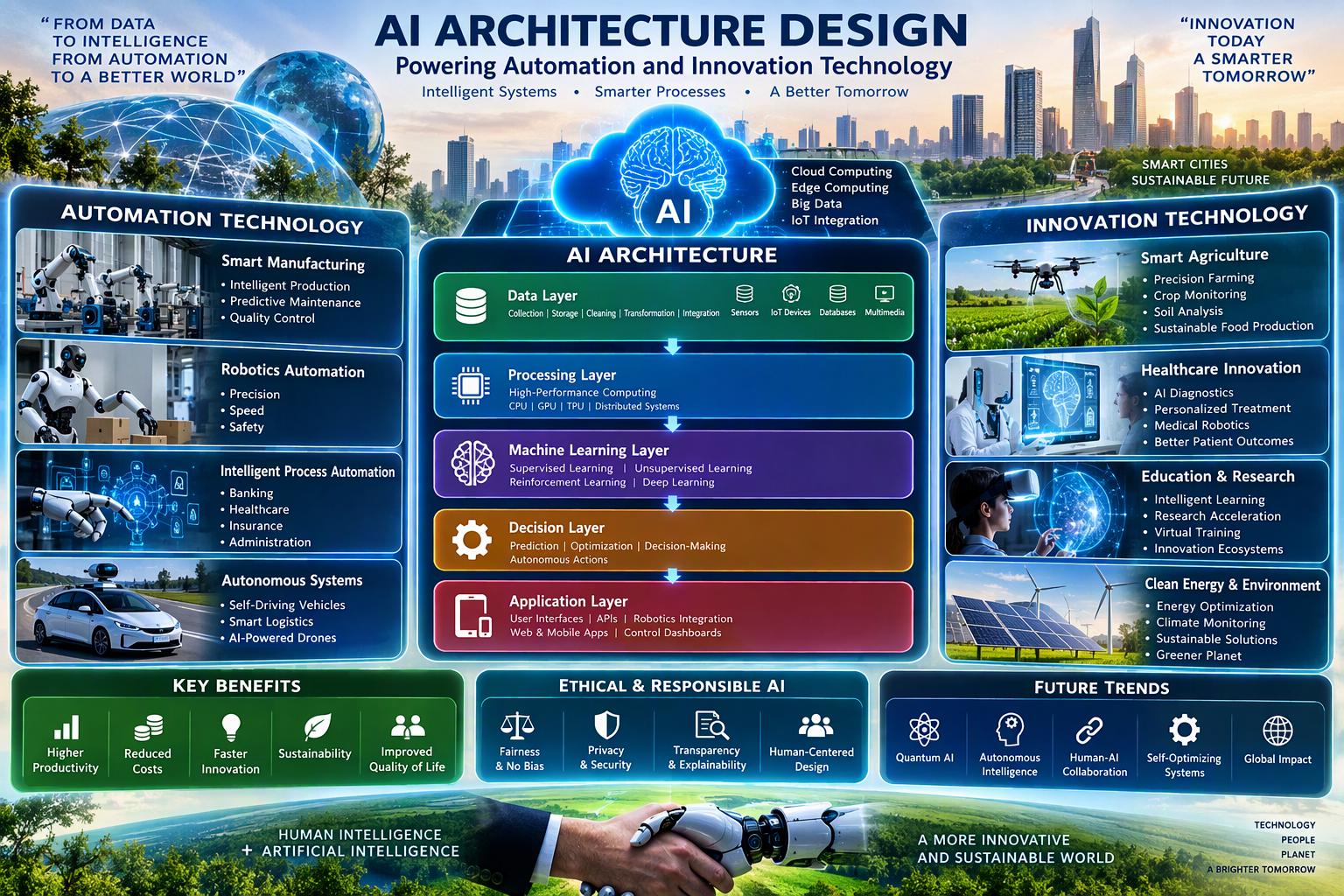
AI architecture refers to the systematic arrangement of software, hardware, algorithms, databases, and communication networks that collectively support artificial intelligence operations.
It encompasses:
- Data acquisition
- Data processing
- Machine learning
- Decision-making mechanisms
- User interfaces
- System integration
2.2 Objectives of AI Architecture
The primary objectives include:
Intelligence
Enable systems to perform human-like reasoning.
Learning
Allow systems to improve through experience.
Adaptability
Adjust behavior according to environmental changes.
Automation
Reduce manual interventions.
Scalability
Handle increasing workloads efficiently.
Chapter 3: Core Components of AI Architecture
3.1 Data Layer
Data is the foundation of AI systems.
Functions include:
- Collection
- Storage
- Cleaning
- Transformation
- Integration
Sources include:
- Sensors
- Cameras
- IoT devices
- Databases
- Mobile applications
3.2 Processing Layer
Responsible for transforming raw data into usable information.
Technologies include:
- CPUs
- GPUs
- TPUs
- Distributed computing systems
3.3 Machine Learning Layer
The learning engine of AI.
Methods include:
Supervised Learning
Uses labeled datasets.
Unsupervised Learning
Finds hidden patterns.
Reinforcement Learning
Learns through trial and reward.
3.4 Decision Layer
Generates actions and predictions.
Examples:
- Medical diagnosis
- Financial forecasting
- Autonomous driving decisions
3.5 Application Layer
Provides interaction between users and AI systems through:
- Mobile Apps
- Web Platforms
- Robotics Interfaces
- Control Dashboards
Chapter 4: Neural Network Architecture
4.1 Artificial Neural Networks
Inspired by the human brain.
Components:
- Input layer
- Hidden layers
- Output layer
Applications:
- Image recognition
- Voice processing
- Medical diagnostics
4.2 Deep Learning Architecture
Multiple hidden layers allow complex pattern recognition.
Benefits:
- High accuracy
- Autonomous feature extraction
- Self-learning capabilities
4.3 Convolutional Neural Networks (CNN)
Designed for image processing.
Applications:
- Medical imaging
- Facial recognition
- Agricultural crop monitoring
4.4 Recurrent Neural Networks (RNN)
Designed for sequence-based information.
Applications:
- Language translation
- Speech recognition
- Weather forecasting
Chapter 5: Automation Technology Powered by AI
5.1 Industrial Automation
Modern factories employ AI to:
- Optimize production
- Predict equipment failures
- Improve quality control
Benefits:
- Reduced downtime
- Increased productivity
- Lower operating costs
5.2 Robotic Automation
AI-powered robots perform:
- Welding
- Packaging
- Inspection
- Assembly
Advantages:
- Precision
- Speed
- Safety
5.3 Intelligent Process Automation
Combines AI with process automation.
Applications:
- Banking
- Insurance
- Healthcare administration
Chapter 6: AI-Driven Innovation Technology
6.1 Innovation Acceleration
AI reduces research and development cycles.
Organizations use AI for:
- Product design
- Market prediction
- Consumer analysis
6.2 Smart Product Development
Examples:
- Smart phones
- Autonomous vehicles
- Intelligent medical devices
6.3 Innovation Ecosystems
AI supports:
- Universities
- Research centers
- Technology incubators
- Startups
Through rapid prototyping and experimentation.
Chapter 7: AI Architecture in Smart Manufacturing
7.1 Industry 4.0
Industry 4.0 integrates:
- AI
- IoT
- Robotics
- Cloud Computing
Resulting in intelligent factories.
7.2 Predictive Maintenance
AI analyzes equipment behavior.
Benefits:
- Reduced repairs
- Better asset utilization
- Increased lifespan
7.3 Digital Twins
Virtual models represent physical systems.
Applications:
- Factory optimization
- Design testing
- Process simulation
Chapter 8: AI Architecture in Smart Agriculture
8.1 Precision Farming
AI assists farmers through:
- Soil analysis
- Crop monitoring
- Weather forecasting
8.2 Autonomous Farming Systems
Technologies include:
- Smart tractors
- Agricultural drones
- Robotic harvesters
Benefits:
- Increased yields
- Reduced waste
- Sustainable farming
8.3 Ginger Farming Applications
AI can improve ginger farming by:
- Monitoring soil nutrients
- Detecting diseases
- Managing irrigation
- Predicting harvest periods
Chapter 9: Cloud-Based AI Architecture
9.1 Cloud Computing Integration
Cloud platforms provide:
- Storage
- Computing power
- AI services
Examples:
- Microsoft Azure AI
- Google Cloud AI
- AWS AI Services
9.2 Benefits
- Scalability
- Cost-effectiveness
- Global accessibility
9.3 Challenges
- Privacy concerns
- Connectivity dependency
- Cybersecurity risks
Chapter 10: Edge AI Architecture
10.1 Concept
Edge AI processes data close to its source.
Examples:
- Smart cameras
- Industrial sensors
- Autonomous vehicles
10.2 Advantages
- Low latency
- Faster decisions
- Reduced bandwidth use
10.3 Future Importance
Essential for:
- Smart cities
- Autonomous systems
- Next-generation robotics
Chapter 11: AI Architecture and Cybersecurity
11.1 Security Enhancement
AI strengthens cybersecurity through:
- Threat detection
- Intrusion prevention
- Fraud identification
11.2 Intelligent Monitoring
AI systems monitor networks continuously.
Benefits:
- Real-time protection
- Faster response
- Improved resilience
Chapter 12: Ethical Considerations
12.1 Algorithmic Bias
Poor datasets may lead to unfair decisions.
Solutions:
- Diverse training data
- Continuous evaluation
12.2 Transparency
AI decisions should be explainable.
12.3 Privacy Protection
Organizations must:
- Secure personal data
- Comply with regulations
- Maintain user trust
Chapter 13: Economic Impact
13.1 Productivity Growth
AI architecture improves:
- Output quality
- Operational efficiency
- Resource utilization
13.2 Job Transformation
AI changes job roles by:
- Automating repetitive tasks
- Creating new technology careers
13.3 Global Competitiveness
Countries investing in AI gain advantages in:
- Manufacturing
- Healthcare
- Defense
- Innovation
Chapter 14: Future Trends
14.1 Autonomous Intelligence
Future systems will make increasingly independent decisions.
14.2 Human-AI Collaboration
Humans and AI will work together as integrated teams.
14.3 Quantum AI
Quantum computing may dramatically accelerate AI capabilities.
14.4 Self-Optimizing Systems
AI architectures will autonomously improve performance.
Chapter 15: Strategic Framework for AI Architecture Design
Phase 1: Planning
- Define objectives
- Assess resources
- Establish governance
Phase 2: Data Infrastructure
- Build databases
- Create pipelines
- Ensure quality
Phase 3: Model Development
- Choose algorithms
- Train models
- Validate performance
Phase 4: Deployment
- Integrate systems
- Monitor operations
- Optimize continuously
Phase 5: Innovation Expansion
- Scale applications
- Introduce automation
- Foster research initiatives
Conclusion
Artificial Intelligence architecture design represents the foundation of modern automation and innovation technology. Through advanced computational frameworks, machine learning systems, neural networks, cloud infrastructure, and intelligent decision-making models, AI has transformed the way industries operate and innovate.
From automated manufacturing and smart agriculture to healthcare, transportation, cybersecurity, and digital economies, AI architecture enables organizations to achieve higher efficiency, sustainability, productivity, and competitiveness. As emerging technologies such as quantum computing, autonomous robotics, digital twins, and edge intelligence continue to evolve, AI architecture will remain at the center of technological advancement and economic transformation.
The future belongs to intelligent architectures capable of learning, adapting, innovating, and collaborating with humans to solve complex global challenges, creating a smarter, more efficient, and more sustainable world.



Be First to Comment