Abstract
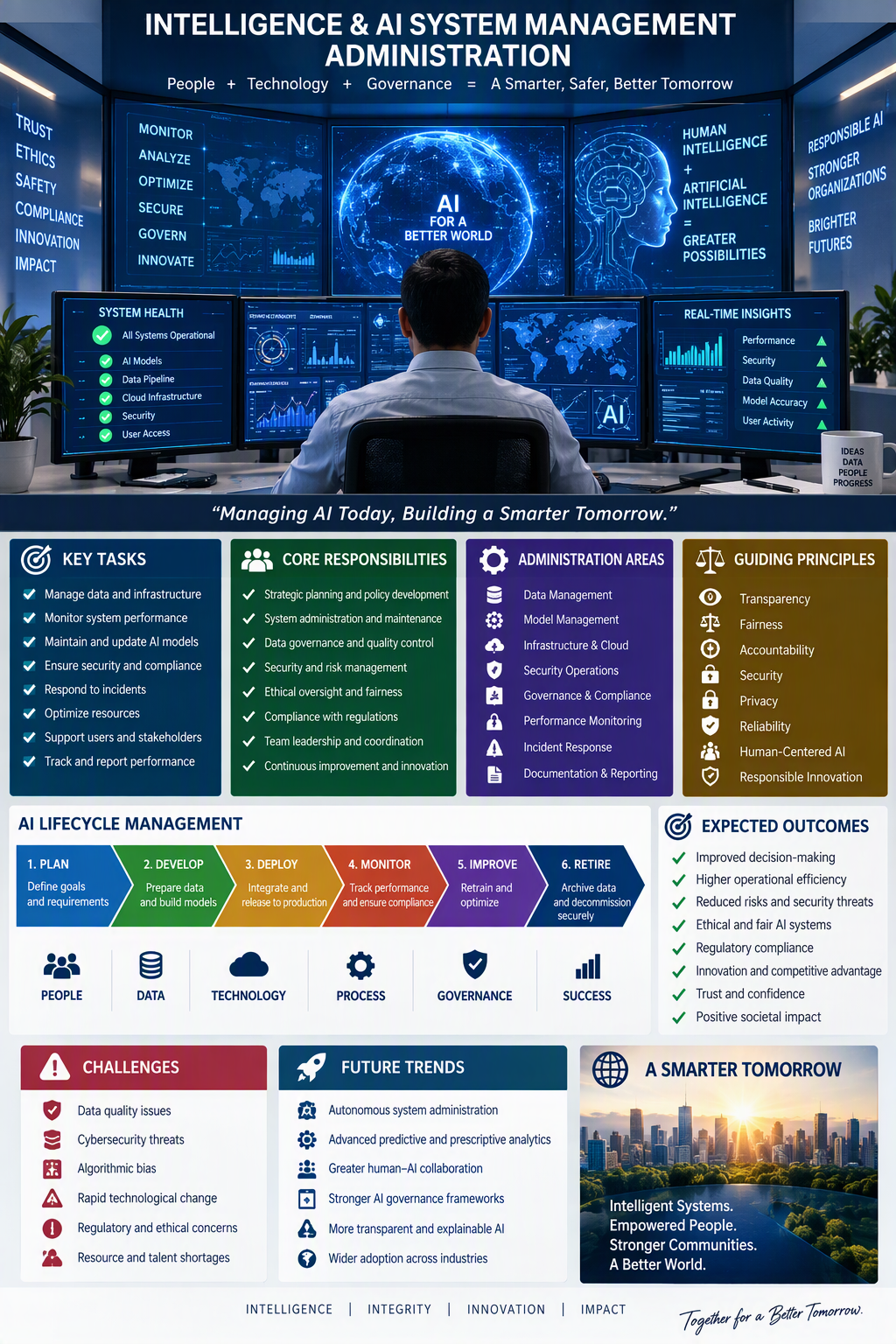
Artificial Intelligence (AI) has emerged as one of the most transformative technologies of the 21st century. Organizations across government, business, healthcare, education, transportation, finance, and security sectors increasingly rely on intelligent systems to automate processes, enhance decision-making, and improve operational efficiency. As AI adoption expands, the importance of Intelligence and AI System Management Administration grows significantly. This discipline encompasses the planning, governance, maintenance, security, optimization, ethical oversight, and continuous improvement of AI-driven systems.
This thesis examines the role of intelligence and AI system management administration, outlining its key responsibilities, operational tasks, strategic functions, governance frameworks, technological requirements, ethical considerations, and future developments. The study further explores the competencies required of AI administrators and demonstrates how effective management contributes to organizational success.
Chapter 1: Introduction
1.1 Background
The digital revolution has transformed the way organizations operate. Traditional information systems have evolved into intelligent platforms capable of learning, reasoning, and adapting through machine learning, deep learning, natural language processing, computer vision, and predictive analytics.
Modern AI systems generate vast quantities of data and intelligence. Managing these systems requires specialized administration practices that ensure:
- Reliability
- Accuracy
- Security
- Compliance
- Scalability
- Ethical operation
Intelligence management administration bridges the gap between technological infrastructure and organizational objectives.
1.2 Purpose of Study
The purpose of this thesis is to:
- Examine the functions of intelligence and AI system management.
- Analyze administrative responsibilities.
- Identify operational tasks.
- Explore governance frameworks.
- Investigate future trends and challenges.
1.3 Research Objectives
The primary objectives include:
- Defining AI intelligence administration.
- Examining system management functions.
- Identifying administrator responsibilities.
- Evaluating governance requirements.
- Investigating ethical considerations.
- Exploring future opportunities.
Chapter 2: Understanding Intelligence and AI Systems
2.1 Definition of Artificial Intelligence
Artificial Intelligence refers to computational systems designed to perform tasks traditionally requiring human intelligence.
These tasks include:
- Learning
- Reasoning
- Problem-solving
- Decision-making
- Pattern recognition
- Prediction
2.2 Categories of AI
Narrow AI
Designed for specific tasks such as:
- Chatbots
- Recommendation engines
- Fraud detection systems
General AI
A theoretical AI capable of performing intellectual tasks equal to human intelligence.
Superintelligent AI
An advanced hypothetical AI surpassing human cognitive capabilities.
2.3 Components of AI Systems
Key AI system components include:
Data Infrastructure
Provides training and operational datasets.
Machine Learning Models
Generate predictions and classifications.
Processing Systems
Execute computational workloads.
Knowledge Bases
Store structured intelligence and information.
User Interfaces
Enable interaction between users and AI systems.
Chapter 3: Intelligence Management Administration
3.1 Definition
Intelligence Management Administration refers to the systematic oversight of information, analytics, and AI-driven decision-support systems.
Its purpose is to maximize the value of organizational intelligence while minimizing operational risks.
3.2 Strategic Importance
Effective intelligence administration supports:
- Improved decisions
- Increased efficiency
- Enhanced innovation
- Competitive advantage
- Business growth
3.3 Administrative Functions
Planning
Developing AI strategies and implementation roadmaps.
Organizing
Allocating resources and responsibilities.
Directing
Managing teams and technologies.
Monitoring
Tracking performance and compliance.
Evaluating
Assessing outcomes and effectiveness.
Chapter 4: AI System Management
4.1 Overview
AI System Management involves overseeing the entire lifecycle of AI technologies.
This includes:
- Design
- Implementation
- Deployment
- Monitoring
- Maintenance
- Improvement
4.2 Operational Framework
Infrastructure Management
Maintaining:
- Servers
- Cloud platforms
- Databases
- Storage systems
Model Management
Monitoring AI models for:
- Accuracy
- Bias
- Drift
- Performance
Security Management
Protecting against:
- Cyberattacks
- Data breaches
- Unauthorized access
Chapter 5: Tasks of Intelligence and AI System Administrators
5.1 Data Management
Key responsibilities include:
- Collecting data
- Cleaning datasets
- Data validation
- Storage administration
- Quality control
5.2 System Monitoring
Administrators continuously monitor:
- Performance metrics
- Resource utilization
- Processing speeds
- Error rates
5.3 AI Model Maintenance
Tasks include:
- Retraining models
- Fine-tuning parameters
- Updating algorithms
- Correcting biases
5.4 Security Operations
Responsibilities include:
- User authentication
- Encryption management
- Threat detection
- Vulnerability assessment
5.5 Incident Response
Administrators respond to:
- System failures
- Security breaches
- Data corruption
- Service interruptions
Chapter 6: Core Responsibilities
6.1 Strategic Responsibilities
Vision Development
Align AI initiatives with organizational goals.
Policy Development
Create management and governance policies.
Innovation Leadership
Identify emerging opportunities.
6.2 Technical Responsibilities
System Configuration
Configure AI environments and infrastructure.
Performance Optimization
Improve processing speed and resource allocation.
Model Governance
Establish controls for AI systems.
6.3 Administrative Responsibilities
Documentation
Maintain records of:
- Models
- Processes
- Updates
- Risks
Reporting
Produce regular performance reports.
Auditing
Conduct operational audits.
Chapter 7: AI Governance and Compliance
7.1 Governance Framework
AI governance ensures responsible AI operation.
Key elements include:
- Accountability
- Transparency
- Fairness
- Reliability
- Security
7.2 Regulatory Compliance
Organizations must comply with:
- Privacy regulations
- Data protection laws
- Industry standards
- Cybersecurity requirements
7.3 Risk Management
Risk categories include:
Technical Risks
- System failures
- Data inaccuracies
Security Risks
- Cyber threats
- Unauthorized access
Ethical Risks
- Algorithmic bias
- Lack of transparency
Chapter 8: Ethical Responsibilities of AI Administrators
8.1 Fairness
AI should make unbiased decisions.
Administrators must monitor:
- Dataset quality
- Model fairness
- Output consistency
8.2 Transparency
Users must understand:
- System decisions
- Data usage
- Model limitations
8.3 Accountability
Administrators remain accountable for:
- System performance
- Compliance violations
- Ethical conduct
Chapter 9: Human Resource Management in AI Administration
9.1 Team Structure
An AI administration team may include:
- AI Engineers
- Data Scientists
- Cloud Specialists
- Security Analysts
- Compliance Officers
- Business Analysts
9.2 Leadership Responsibilities
Leaders ensure:
- Project coordination
- Resource allocation
- Team development
- Strategic execution
9.3 Training Responsibilities
Continuous learning is essential because AI technologies evolve rapidly.
Chapter 10: Technology Infrastructure Management
10.1 Cloud Computing
AI administrators manage platforms such as:
- Microsoft Azure
- AWS
- Google Cloud
10.2 Storage Management
Data storage responsibilities include:
- Capacity planning
- Backup strategies
- Disaster recovery
10.3 Network Administration
Administrators maintain:
- Connectivity
- Performance
- Reliability
- Security
Chapter 11: Performance Measurement
11.1 Key Performance Indicators
KPIs include:
Accuracy
Prediction reliability.
Availability
System uptime percentage.
Efficiency
Resource utilization rates.
Security
Incident reduction statistics.
11.2 Monitoring Dashboards
Administrators use dashboards to visualize:
- AI performance
- Resource consumption
- User activities
- Security events
Chapter 12: AI Lifecycle Management
12.1 Development Phase
Activities include:
- Requirement gathering
- Data preparation
- Model development
12.2 Deployment Phase
Tasks include:
- System integration
- Testing
- Production release
12.3 Maintenance Phase
Activities include:
- Monitoring
- Updates
- Optimization
12.4 Retirement Phase
Responsibilities include:
- Data archiving
- Knowledge preservation
- Secure decommissioning
Chapter 13: Intelligence Analysis Responsibilities
13.1 Data Analysis
Administrators interpret:
- Trends
- Patterns
- Anomalies
13.2 Decision Support
Provide insights for:
- Strategic planning
- Risk assessment
- Operational improvements
13.3 Predictive Intelligence
Develop forecasts regarding:
- Market changes
- Customer behavior
- System performance
Chapter 14: Challenges Facing AI Administrators
14.1 Data Quality Issues
Problems include:
- Missing data
- Inconsistent records
- Data duplication
14.2 Cybersecurity Threats
Challenges include:
- Malware
- Ransomware
- Insider threats
14.3 Rapid Technological Change
Administrators must adapt continuously.
14.4 Ethical Concerns
Addressing:
- Bias
- Privacy
- Explainability
Chapter 15: Future of Intelligence and AI System Management
15.1 Autonomous Administration
Future systems may self-manage through:
- Self-healing networks
- Automated optimization
- Autonomous monitoring
15.2 Advanced Analytics
Organizations will increasingly use:
- Predictive analytics
- Prescriptive analytics
- Cognitive intelligence
15.3 Human-AI Collaboration
Future workplaces will combine:
- Human judgment
- Machine intelligence
15.4 Responsible AI
Greater focus will be placed on:
- Ethics
- Transparency
- Governance
- Trust
Recommendations
Organizations should:
- Establish comprehensive AI governance frameworks.
- Invest in administrator training programs.
- Implement robust cybersecurity measures.
- Develop ethical AI policies.
- Continuously monitor AI performance.
- Maintain data quality standards.
- Adopt transparent decision-making processes.
- Create disaster recovery plans.
- Promote responsible AI innovation.
- Foster human-AI collaboration.
Conclusion
Intelligence and AI System Management Administration has become a critical organizational function in the modern digital era. AI administrators serve as the architects, guardians, and optimizers of intelligent systems that drive business value and innovation. Their responsibilities extend beyond technical maintenance to include governance, security, compliance, ethics, strategy, and organizational leadership.
As artificial intelligence continues its rapid advancement, effective AI system management will determine whether organizations can harness the full benefits of intelligent technologies while maintaining trust, accountability, and operational excellence. The future belongs to organizations that successfully integrate human expertise with artificial intelligence under strong administrative leadership, sound governance, and responsible innovation practices.




Be First to Comment