Abstract
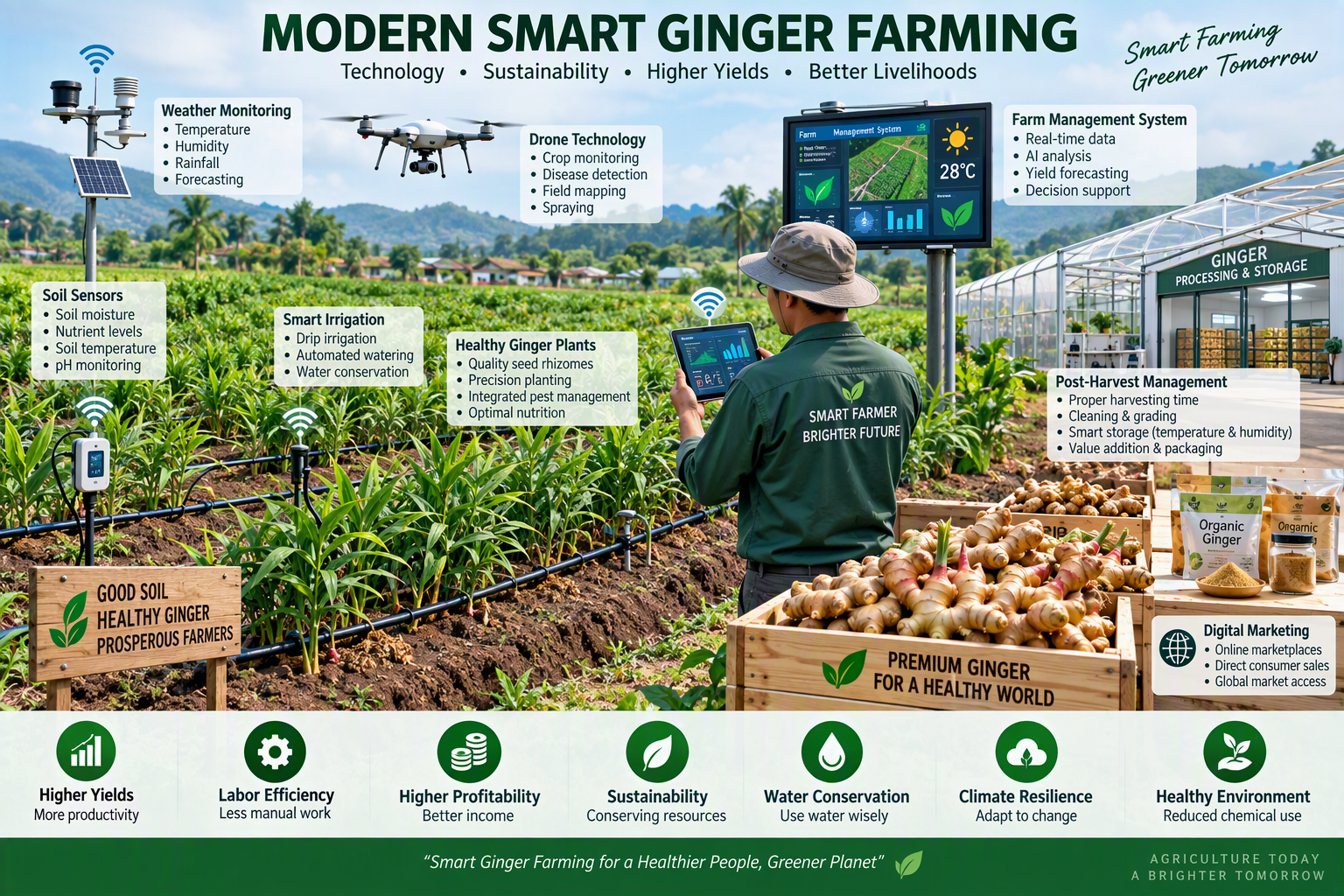
Modern smart ginger farming represents the integration of advanced agricultural technologies, scientific crop management practices, data-driven decision-making, and sustainable farming techniques to maximize ginger productivity, profitability, and environmental conservation. Ginger (Zingiber officinale) is one of the world’s most valuable spice and medicinal crops, widely cultivated for food, pharmaceutical, cosmetic, and industrial uses. The increasing global demand for ginger requires innovative farming systems that can produce higher yields while preserving natural resources. This thesis explores the characteristics, principles, technologies, benefits, challenges, and future prospects of modern smart ginger farming. It highlights how digital agriculture, precision farming, artificial intelligence, Internet of Things (IoT), mechanization, and climate-smart practices are transforming traditional ginger cultivation into a sophisticated agricultural enterprise.
Chapter 1: Introduction
1.1 Background of Ginger Farming
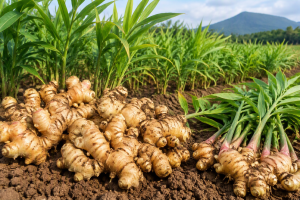
Ginger is a flowering plant belonging to the Zingiberaceae family. The underground rhizome serves as both the planting material and the harvested product. For centuries, ginger has been cultivated in Africa, Asia, South America, and other tropical regions.
Modern agriculture is experiencing significant technological advancements aimed at improving food security, increasing productivity, and adapting to climate change. Smart ginger farming emerges from the need to overcome traditional farming challenges such as:
- Low yields
- Poor soil management
- Pest infestations
- Water scarcity
- Climate variability
- High labor costs
- Post-harvest losses
Smart farming offers solutions through automation, precision agriculture, and intelligent resource management.
1.2 Purpose of the Study
The primary purpose of this thesis is to examine the characteristics and importance of modern smart ginger farming systems that improve productivity, sustainability, and profitability.
1.3 Objectives
The objectives include:
- Understanding smart farming concepts
- Identifying key characteristics of smart ginger farming
- Exploring technological innovations
- Examining sustainability practices
- Evaluating economic benefits
Chapter 2: Understanding Smart Agriculture
2.1 Definition of Smart Farming
Smart farming refers to the application of modern technologies to monitor, analyze, and manage agricultural operations efficiently.
Key technologies include:
- Artificial Intelligence (AI)
- Internet of Things (IoT)
- Sensors
- Drones
- Robotics
- Geographic Information Systems (GIS)
- Cloud Computing
- Machine Learning
2.2 Evolution of Agriculture
Agricultural development can be categorized into:
Agriculture 1.0
Traditional manual farming.
Agriculture 2.0
Mechanization through tractors and machines.
Agriculture 3.0
Precision agriculture using GPS technologies.
Agriculture 4.0
Digital agriculture incorporating AI and IoT.
Agriculture 5.0
Fully integrated intelligent farming ecosystems.
Modern smart ginger farming belongs primarily to Agriculture 4.0 and Agriculture 5.0.
Chapter 3: Characteristics of Modern Smart Ginger Farming
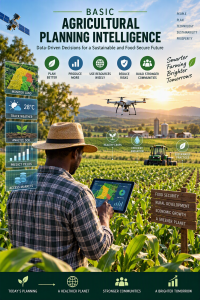
3.1 Data-Driven Decision Making
Data collection is the backbone of smart ginger farming.
Farmers use:
- Soil sensors
- Weather stations
- GPS devices
- Satellite imagery
Benefits include:
- Better crop planning
- Precise irrigation scheduling
- Improved fertilizer management
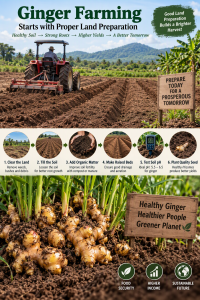
3.2 Precision Land Preparation
Modern smart ginger farming begins with scientific land preparation.
Characteristics include:
- Soil mapping
- GPS-guided cultivation
- Raised bed construction
- Soil fertility analysis
Proper land preparation promotes:
- Better root development
- Improved drainage
- Reduced disease incidence
3.3 Smart Soil Management
Healthy soils produce healthy ginger crops.
Smart soil management involves:
Soil Testing
Analyzing:
- Soil pH
- Nutrient levels
- Organic matter content
Digital Soil Monitoring
Sensors continuously measure:
- Moisture levels
- Temperature
- Nutrient availability
3.4 Intelligent Irrigation Systems
Water management is critical.
Characteristics include:
Automated Irrigation
Systems automatically deliver water when needed.
Drip Irrigation
Benefits include:
- Water conservation
- Reduced disease
- Increased efficiency
Sensor-Based Irrigation
Real-time monitoring prevents overwatering.
3.5 Climate Monitoring Technologies
Weather significantly impacts ginger production.
Smart farms use:
- Weather stations
- Mobile forecasting applications
- Climate prediction software
Data helps farmers make informed decisions regarding:
- Irrigation
- Fertilization
- Harvesting
Chapter 4: Technology Applications in Smart Ginger Farming
4.1 Internet of Things (IoT)
IoT devices connect agricultural equipment and sensors.
Applications include:
- Soil moisture monitoring
- Temperature measurement
- Water management
Benefits include:
- Increased efficiency
- Lower operational costs
- Better crop monitoring
4.2 Artificial Intelligence
AI systems analyze vast agricultural data.
AI applications include:
- Disease detection
- Yield forecasting
- Pest prediction
- Decision support systems
AI helps farmers respond faster to crop challenges.
4.3 Drone Technology
Drones perform:
- Crop inspections
- Field mapping
- Spraying operations
Advantages include:
- Time savings
- Accurate monitoring
- Reduced labor requirements
4.4 Geographic Information Systems (GIS)
GIS assists farmers by:
- Mapping farm locations
- Monitoring field conditions
- Identifying productivity zones
GIS improves planning accuracy.
Chapter 5: Smart Planting Practices
5.1 Selection of Quality Seed Rhizomes
Characteristics of quality seed ginger include:
- Disease-free
- High vigor
- Uniform size
- High germination potential
5.2 Precision Planting
Precision planting ensures:
- Uniform spacing
- Optimal population density
- Efficient resource utilization
Modern machinery improves planting consistency.
5.3 Digital Crop Scheduling
Digital platforms assist with:
- Planting dates
- Fertilizer applications
- Irrigation schedules
- Harvest planning
Chapter 6: Smart Nutrient Management
6.1 Precision Fertilization
Nutrients are applied according to crop requirements.
Methods include:
- Fertigation
- Variable-rate technology
- Sensor-guided fertilization
Benefits include:
- Reduced waste
- Increased yields
- Improved soil health
6.2 Organic Nutrient Integration
Modern smart systems encourage:
- Compost use
- Green manure
- Biofertilizers
Organic approaches improve sustainability.
Chapter 7: Smart Pest and Disease Management
7.1 Early Detection Systems
Technology assists in detecting:
- Rhizome rot
- Bacterial wilt
- Fungal diseases
Early intervention reduces losses.
7.2 AI-Based Disease Recognition
Machine learning algorithms identify symptoms through:
- Smartphone images
- Drone imagery
- Sensor data
7.3 Integrated Pest Management
IPM combines:
- Biological control
- Cultural control
- Mechanical control
- Chemical control
Resulting in environmentally friendly production.
Chapter 8: Sustainability Characteristics
8.1 Water Conservation
Smart farming minimizes water wastage through:
- Precision irrigation
- Rainwater harvesting
- Moisture sensors
8.2 Soil Conservation
Techniques include:
- Mulching
- Cover cropping
- Raised beds
- Conservation tillage
8.3 Environmental Protection
Modern systems reduce:
- Chemical pollution
- Greenhouse gas emissions
- Resource wastage
Chapter 9: Economic Characteristics
9.1 Increased Productivity
Smart farming significantly increases yields through:
- Better management
- Improved monitoring
- Scientific decision-making
9.2 Labor Efficiency
Automation reduces manual labor requirements.
Examples include:
- Mechanical planting
- Automated irrigation
- Smart monitoring
9.3 Higher Profitability
Benefits include:
- Lower input costs
- Higher marketable yields
- Improved product quality
Chapter 10: Post-Harvest Smart Management
10.1 Smart Harvesting
Data analytics identify the best harvesting time.
Benefits include:
- Maximum quality
- Improved storage life
10.2 Smart Storage Systems
Advanced storage facilities monitor:
- Temperature
- Humidity
- Ventilation
Reducing post-harvest losses.
10.3 Digital Marketing
Technology enables:
- Online marketplaces
- Direct consumer sales
- Export market access
Chapter 11: Challenges of Smart Ginger Farming
Major challenges include:
High Initial Investment
Technology acquisition costs.
Technical Skills Gap
Farmers require specialized training.
Internet Connectivity
Rural areas may experience limited access.
Data Management
Large datasets require efficient analysis.
Chapter 12: Future of Smart Ginger Farming
Future developments may include:
Autonomous Farming
Robotics performing farming operations independently.
AI Predictive Systems
Advanced forecasting models.
Blockchain Technology
Enhanced traceability and food safety.
Smart Greenhouses
Controlled production environments.
Agricultural Digital Twins
Virtual farm simulations supporting management decisions.
Chapter 13: The Seven Core Characteristics of Modern Smart Ginger Farming
- Precision Agriculture
- Automation and Mechanization
- Data-Driven Decision Making
- Sustainability Focus
- Climate Resilience
- Resource Optimization
- Digital Connectivity
These characteristics define successful smart ginger farming operations.
Conclusion
Modern smart ginger farming is transforming ginger production through technological innovation, precision agriculture, sustainability, and intelligent management systems. Its core characteristics include automation, digital monitoring, artificial intelligence integration, efficient resource utilization, climate-resilient practices, and data-driven decision-making. As global food demand continues to rise, smart ginger farming provides a sustainable pathway for improving productivity, profitability, and environmental stewardship. Farmers who embrace modern technologies will be better positioned to meet future market demands, reduce production risks, and contribute to agricultural development in the twenty-first century.
Key Recommendations
- Invest in farmer digital literacy programs.
- Promote adoption of smart irrigation technologies.
- Encourage AI-based disease monitoring systems.
- Support sustainable soil management practices.
- Expand rural internet infrastructure.
- Develop affordable smart farming technologies.
- Strengthen agricultural research and innovation.
- Promote climate-smart ginger production systems.
- Establish digital agricultural advisory services.
- Encourage public-private partnerships in smart agriculture.
This comprehensive framework provides a foundation for building highly productive, sustainable, and technologically advanced modern smart ginger farming systems.


Be First to Comment