
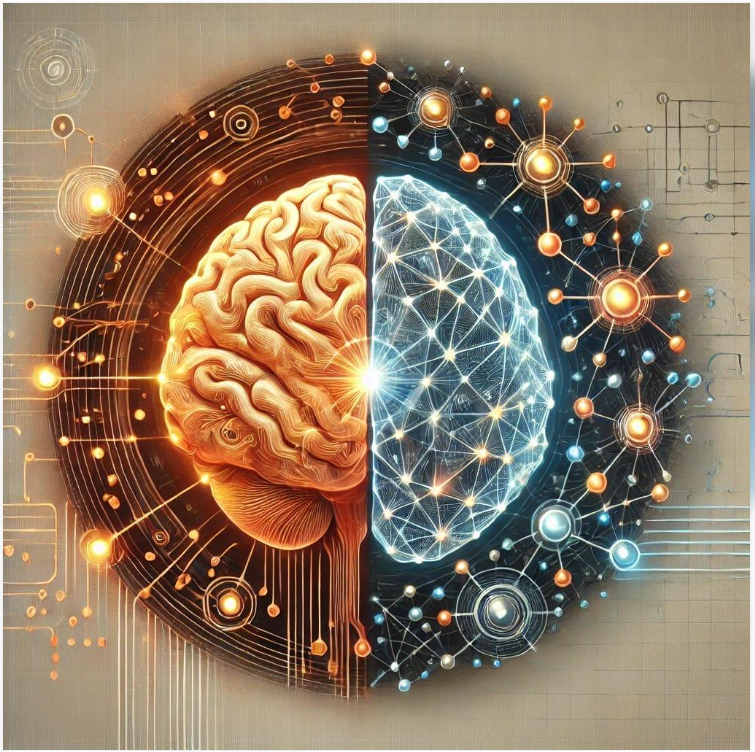
A Comprehensive 38-Page Learning Framework
Executive Overview
This document provides a structured framework for using Artificial Intelligence as a cognitive training partner to develop advanced innovation, critical thinking, creative problem-solving, and strategic decision-making skills. Rather than allowing AI to think for you, the objective is to use AI to expand your mental capacity, accelerate learning, challenge assumptions, and strengthen your innovation intelligence.
Page 1: Introduction to AI-Augmented Thinking
The future belongs to individuals who know how to think with AI rather than compete against it.
Innovation is no longer driven solely by expertise. Modern innovators combine human creativity, emotional intelligence, systems thinking, and AI-powered analysis to solve increasingly complex challenges.
AI acts as:
- A thinking partner
- A research assistant
- A creativity catalyst
- A strategic advisor
- A pattern recognition engine
- A learning accelerator
Your goal should be developing:
Human Intelligence + Artificial Intelligence = Augmented Intelligence
Page 2: Understanding Innovation Thinking
Innovation thinking involves:
Divergent Thinking
Generating many possible solutions.
Convergent Thinking
Selecting the best solution.
Systems Thinking
Understanding relationships between factors.
Critical Thinking
Evaluating assumptions.
Strategic Thinking
Planning future outcomes.
Design Thinking
Focusing on human needs.
AI can strengthen all six thinking dimensions.
Page 3: Tip #1 – Use AI as a Socratic Questioning Coach
Great innovators ask better questions.
Train AI to challenge every assumption.
Prompt:
Act as a world-class innovation coach. Challenge every assumption in my idea through Socratic questioning.
Benefits:
- Deeper thinking
- Stronger logic
- Reduced blind spots
- Better decisions
Daily Practice:
Spend 20 minutes challenging one idea.
Page 4: Tip #2 – Learn First-Principles Thinking
Elon Musk’s success is largely based on first-principles reasoning.
Prompt:
Break this problem into its most fundamental truths. Remove assumptions and rebuild a solution from scratch.
Example:
Problem: Transportation congestion
Traditional Solution: Build more roads
First Principles:
- People need movement
- Not necessarily roads
- Not necessarily private cars
Possible Innovations:
- Autonomous shuttles
- Drone transport
- AI traffic systems
Page 5: Developing Mental Models
Mental models help simplify complexity.
Ask AI:
What mental models can help solve this problem?
Examples:
- Pareto Principle
- Network Effects
- Inversion
- Opportunity Cost
- Compounding
- Feedback Loops
- Game Theory
Using multiple mental models improves innovative thinking.
Page 6: Tip #3 – Conduct Daily Brain Expansion Sessions
Innovation is a cognitive muscle.
Create a daily AI learning schedule.
30-Minute Structure:
10 min: Learn something new.
10 min: Challenge assumptions.
10 min: Apply knowledge to real problems.
Consistency rewires the brain for innovation.
Page 7: Tip #4 – Practice Future Scenario Thinking
Innovators see possibilities others miss.
Prompt:
Generate five future scenarios for this industry over the next 20 years.
Benefits:
- Strategic foresight
- Trend recognition
- Opportunity discovery
Industries:
- Transport
- Healthcare
- Education
- Manufacturing
- Agriculture
Page 8: Future Thinking Framework
Analyze:
Technology Drivers
Economic Drivers
Social Drivers
Environmental Drivers
Political Drivers
Together these produce innovation opportunities.
Page 9: Tip #5 – Master Problem Reframing
Many people solve the wrong problem.
Prompt:
Give me ten alternative ways to define this problem.
Example:
Original Problem:
Customers are not buying.
Reframed Problems:
- Poor communication
- Wrong market
- Pricing mismatch
- Trust issues
- Distribution gap
Reframing creates innovation pathways.
Page 10: Innovation Through Curiosity
Curiosity drives breakthroughs.
Ask AI daily:
- What am I missing?
- What assumptions exist?
- What emerging technologies affect this issue?
Curiosity enhances neuroplasticity.
Page 11: Tip #6 – Build Cross-Industry Knowledge
Innovation happens at intersections.
Study:
- Biology
- Physics
- Economics
- Psychology
- Engineering
- AI
Prompt:
How would experts from five different industries solve this problem?
Page 12: Multi-Disciplinary Thinking
Innovation often combines:
Biology + Technology
Psychology + Marketing
AI + Transport
Energy + Materials Science
Cross-domain thinking creates breakthrough ideas.
Page 13: Tip #7 – Develop Systems Thinking Using AI
Complex problems are interconnected.
Prompt:
Map all cause-and-effect relationships affecting this challenge.
Analyze:
- Inputs
- Outputs
- Feedback loops
- Delays
- Constraints
This strengthens strategic thinking capabilities.
Page 14: Systems Mapping Exercise
Use AI to create:
- Influence diagrams
- Causal loops
- Stakeholder maps
Understand entire ecosystems before proposing solutions.
Page 15: Tip #8 – Train Pattern Recognition
Innovation requires seeing patterns.
Ask AI:
What hidden patterns exist within this data or situation?
Patterns often reveal:
- Opportunities
- Risks
- Market shifts
- Future trends
Page 16: Improving Analytical Intelligence
Daily exercises:
- Trend analysis
- Data interpretation
- Signal detection
- Comparative analysis
Over time, your brain becomes better at recognizing innovation opportunities.
Page 17: Tip #9 – Learn Creative Combination
Most innovations combine existing ideas.
Prompt:
Combine these unrelated concepts to generate innovation opportunities.
Examples:
- AI + Bus Transport
- Robotics + Agriculture
- Blockchain + Healthcare
Creative combination fuels innovation.
Page 18: The Innovation Matrix
Innovation Formula:
New Value = Existing Idea A + Existing Idea B + New Context
Practice generating 20 combinations daily.
Page 19: Tip #10 – Use AI for Reverse Thinking
Prompt:
How would I deliberately cause this system to fail?
This technique uncovers:
- Risks
- Weaknesses
- Vulnerabilities
Known as inversion thinking.
Page 20: Risk-Based Innovation
Innovators anticipate failure.
Questions:
- What can go wrong?
- Why might customers reject this?
- What hidden risks exist?
AI helps identify blind spots.
Page 21: Tip #11 – Build Strategic Intelligence
Prompt:
Analyze this problem from short-term, medium-term, and long-term perspectives.
Strategic leaders think across multiple time horizons.
Page 22: Three-Horizon Model
Horizon 1
Current operations
Horizon 2
Emerging opportunities
Horizon 3
Future breakthroughs
AI helps evaluate all three simultaneously.
Page 23: Tip #12 – Train Decision-Making Skills
Prompt:
Generate five possible decisions and compare their risks and benefits.
Benefits:
- Better judgment
- Faster decisions
- More confidence
Page 24: Decision Intelligence Framework
Evaluate:
- Cost
- Impact
- Risk
- Feasibility
- Sustainability
Use AI to score alternatives objectively.
Page 25: Tip #13 – Conduct Innovation Simulations
Prompt:
Simulate five different outcomes if we implement this innovation.
Benefits:
- Scenario analysis
- Risk reduction
- Improved planning
Page 26: Cognitive Flexibility Development
Innovation requires adaptive thinking.
Practice:
- Multiple viewpoints
- Alternative explanations
- Contradictory ideas
AI enables rapid perspective shifting.
Page 27: Tip #14 – Build an Innovation Journal with AI
Document:
- Ideas
- Lessons
- Patterns
- Failures
- Insights
Prompt:
Summarize key lessons from today’s learning session.
Knowledge compounds over time.
Page 28: Continuous Learning Loop
Learn
↓
Apply
↓
Observe
↓
Reflect
↓
Improve
↓
Repeat
This cycle continuously strengthens innovation capabilities.
Page 29: Tip #15 – Create Personal AI Innovation Challenges
Weekly Challenge:
Choose one major problem.
Examples:
- Public transportation
- Energy efficiency
- Education
- Healthcare
Use AI to generate potential solutions.
Evaluate each solution critically.
Page 30: Advanced Brain Training Exercises
Exercise 1:
Generate 50 ideas.
Exercise 2:
Select Top 10.
Exercise 3:
Combine into 3 innovations.
Exercise 4:
Build implementation plans.
This strengthens innovation muscles rapidly.
Page 31: Developing Expert-Level Innovation Thinking
Experts think differently because they:
- See patterns faster
- Understand systems
- Challenge assumptions
- Learn continuously
AI accelerates each competency.
Page 32: The Neuroscience of Innovation
Innovation activates:
- Prefrontal Cortex
- Associative Networks
- Executive Function
- Working Memory
AI-supported learning strengthens these neural pathways through repeated mental engagement.
Page 33: Building an Innovation Mindset
Core beliefs:
- Every problem has multiple solutions.
- Failure is feedback.
- Learning never stops.
- Curiosity creates opportunities.
- Innovation is trainable.
Page 34: Avoiding AI Dependency
Never ask AI to think instead of you.
Use this sequence:
- Think independently.
- Generate your solution.
- Ask AI for alternatives.
- Compare solutions.
- Improve your thinking.
This develops intelligence rather than dependence.
Page 35: Daily 60-Minute Innovation Training Program
10 min: Trend scanning
10 min: Problem reframing
10 min: Systems analysis
10 min: Creative idea generation
10 min: Strategic scenario planning
10 min: Reflection and journaling
Page 36: Weekly Innovation Development Program
Monday: Critical Thinking
Tuesday: Systems Thinking
Wednesday: Creative Thinking
Thursday: Strategic Thinking
Friday: Decision Intelligence
Saturday: Innovation Projects
Sunday: Reflection
Page 37: Measuring Innovation Growth
Track:
- Number of ideas generated
- Quality of ideas
- Problems solved
- Speed of learning
- Strategic insights gained
Measure progress monthly.
Page 38: Conclusion and Action Plan
The most powerful use of AI is not automation but cognitive enhancement.
Your objective is to transform AI into a permanent innovation partner that helps strengthen:
✅ Critical Thinking
✅ Strategic Thinking
✅ Systems Thinking
✅ Creativity
✅ Decision Intelligence
✅ Future Readiness
✅ Problem-Solving Capability
✅ Innovation Leadership
Final 30-Day Challenge
For the next 30 days:
- Spend 60 minutes daily with AI.
- Solve one real-world problem each day.
- Generate at least 20 new ideas daily.
- Keep an innovation journal.
- Review lessons weekly.



Be First to Comment