
Abstract
The universe is a dynamic and evolving system characterized by continuous motion at every observable scale. From the rotation of planets and stars to the movement of galaxies and the expansion of spacetime itself, motion is one of the most fundamental properties of cosmic existence. This thesis examines the basic motion and speed of the universe, exploring astronomical observations, Einstein’s theories of relativity, cosmic expansion, dark matter, dark energy, and the large-scale structure of the cosmos. The study investigates various interpretations of universal motion, analyzes current measurements of cosmic expansion, and discusses the implications for the ultimate fate of the universe. Modern cosmology reveals that the universe is not static but expanding at an accelerating rate, driven by forces that remain only partially understood. Through theoretical analysis and observational evidence, this thesis presents a comprehensive understanding of motion within the universe and humanity’s ongoing efforts to measure and explain it.
Keywords: Universe, motion, cosmic expansion, Hubble constant, relativity, dark energy, galaxies, cosmology.
Chapter 1: Introduction
1.1 Background
Since ancient times, humanity has looked toward the sky and wondered whether the universe was fixed or in motion. Early civilizations believed the Earth occupied the center of creation while celestial objects moved around it. Modern scientific discoveries have overturned this view, revealing a universe characterized by continuous movement and change.
The motion of the universe encompasses multiple scales. The Earth rotates around its axis and orbits the Sun. The Sun moves around the center of the Milky Way galaxy. The Milky Way itself travels through space while being influenced by neighboring galaxies. Beyond these local motions, the universe as a whole is expanding.
Understanding cosmic motion provides insights into the origin, structure, and destiny of the universe.
1.2 Problem Statement
Although significant advances have been made in understanding cosmic motion, fundamental questions remain unanswered:
- What is the speed of the universe?
- Is there a center of expansion?
- How fast are galaxies moving?
- Why is cosmic expansion accelerating?
- What role do dark matter and dark energy play?
1.3 Research Objectives
The objectives of this thesis are:
- To examine the concept of motion in the universe.
- To investigate measured velocities of cosmic structures.
- To analyze cosmic expansion.
- To evaluate theories explaining universal motion.
- To discuss future implications for cosmology.
Chapter 2: Historical Development of Cosmic Motion
2.1 Ancient Cosmological Models
Ancient civilizations developed geocentric models placing Earth at the center of the universe. Greek philosopher Aristotle proposed a stationary Earth surrounded by concentric celestial spheres.
Ptolemy’s model dominated scientific thought for nearly 1,500 years.
2.2 Copernican Revolution
Nicolaus Copernicus proposed that the Earth revolves around the Sun. This heliocentric understanding transformed astronomy and laid foundations for modern cosmology.
2.3 Contributions of Galileo
Galileo’s telescopic observations demonstrated that celestial objects were not perfect and immutable. His findings supported heliocentrism and challenged prevailing beliefs.
2.4 Newtonian Mechanics
Isaac Newton introduced universal gravitation and laws of motion, providing mathematical explanations for planetary movements.
Chapter 3: Motion in the Solar System
3.1 Earth’s Rotation
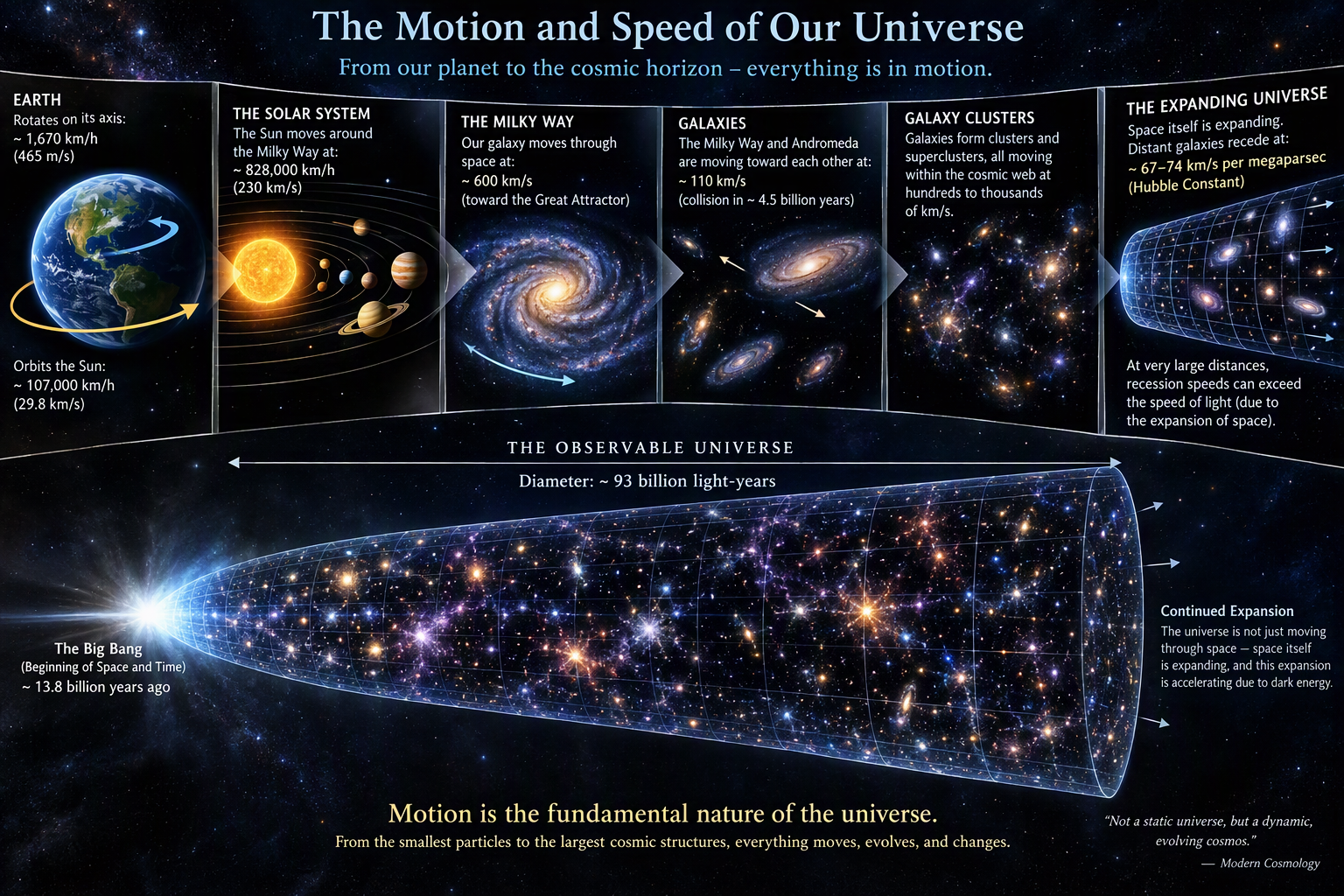
Earth rotates once every 24 hours.
At the equator:
- Speed ≈ 1,670 km/h
- Speed ≈ 465 m/s
This rotation causes day and night cycles.
3.2 Earth’s Revolution Around the Sun
Earth travels around the Sun at:
- 107,000 km/h
- 29.8 km/s
This orbital motion produces seasonal variations.
3.3 Solar Motion
The Sun itself travels through the Milky Way.
Average speed:
- 828,000 km/h
- 230 km/s
One complete galactic orbit requires approximately:
- 225–250 million years
Chapter 4: Motion within the Milky Way
4.1 Structure of the Milky Way
The Milky Way is a barred spiral galaxy containing:
- Hundreds of billions of stars
- Interstellar gas
- Dust
- Dark matter
4.2 Galactic Rotation
Stars orbit the galactic center at different speeds.
Unexpected observations revealed that stars farther from the center move faster than predicted.
This discrepancy led to the dark matter hypothesis.
4.3 Dark Matter Influence
Dark matter constitutes approximately:
- 27% of the universe
It is invisible but exerts gravitational effects.
Chapter 5: Motion of Galaxies
5.1 Galaxy Clusters
Galaxies form clusters and superclusters.
Examples include:
- Virgo Cluster
- Coma Cluster
5.2 Local Group Motion
The Milky Way belongs to the Local Group containing over 80 galaxies.
The Milky Way and Andromeda Galaxy approach one another at approximately:
- 110 km/s
Predicted collision:
- About 4.5 billion years from now
Chapter 6: Discovery of Cosmic Expansion
6.1 Edwin Hubble’s Observations
In 1929, Edwin Hubble demonstrated that galaxies are moving away from Earth.
He discovered:
v = H₀d
Where:
v = recessional velocity
H₀ = Hubble Constant
d = distance
6.2 Redshift
When galaxies move away, light wavelengths stretch.
This phenomenon is called redshift.
Redshift provided evidence that the universe is expanding.
Chapter 7: The Expanding Universe
7.1 Understanding Expansion
Expansion does not imply galaxies moving through space like objects through air.
Rather:
Space itself is expanding.
7.2 Balloon Analogy
Imagine dots on an inflating balloon.
As the balloon expands:
- Every dot moves away from every other dot.
- No center exists on the balloon’s surface.
Similarly, the universe expands everywhere simultaneously.
Chapter 8: The Speed of Universal Expansion
8.1 Hubble Constant
Current measurements estimate:
67–74 km/s/Mpc
This means:
A galaxy one megaparsec away appears to recede at approximately 67–74 km/s.
8.2 Large Distance Effects
At immense distances:
Galaxies appear to recede faster than light because spacetime expands.
This does not violate relativity.
Chapter 9: Einstein and Relativity
9.1 Special Relativity
Einstein established:
- Speed of light = universal limit
- c = 299,792,458 m/s
9.2 General Relativity
Gravity arises from spacetime curvature.
This theory remains the foundation of modern cosmology.
Chapter 10: Cosmic Microwave Background
10.1 Discovery
Discovered in 1965 by:
- Arno Penzias
- Robert Wilson
10.2 Significance
The CMB is relic radiation from the early universe.
Age:
13.8 billion years
It provides evidence supporting the Big Bang.
Chapter 11: Large Scale Structure
The universe contains:
- Filaments
- Walls
- Superclusters
- Voids
These structures emerge through gravitational interactions over billions of years.
Chapter 12: Dark Energy
12.1 Discovery
In 1998 astronomers discovered that universal expansion is accelerating.
12.2 Characteristics
Dark energy constitutes approximately:
68% of the universe
It remains one of science’s greatest mysteries.
Chapter 13: Measuring Universal Motion
Methods include:
Redshift Analysis
Determines galaxy velocities.
Standard Candles
Uses:
- Cepheid variables
- Type Ia supernovae
Cosmic Background Measurements
Provides large-scale velocity information.
Chapter 14: Cosmic Velocity Fields
Galaxies exhibit both:
- Expansion velocities
- Peculiar velocities
These combine to produce observed motions.
Chapter 15: The Great Attractor
Astronomers discovered a massive gravitational region influencing galaxy motion.
Estimated speed of Local Group:
≈ 600 km/s toward this region.
Chapter 16: Cosmic Inflation
Inflation proposes an extremely rapid expansion shortly after the Big Bang.
Time:
Less than one trillionth of a second.
Expansion exceeded light-speed separation rates due to spacetime growth.
Chapter 17: Is There a Center?
Modern cosmology suggests:
No observable center exists.
Expansion occurs uniformly throughout spacetime.
Chapter 18: Is the Universe Rotating?
Some theories propose global rotation.
Current evidence supports:
No significant universal rotation detected.
Chapter 19: The Observable Universe
Diameter:
Approximately 93 billion light-years.
Motion beyond observable boundaries remains unknown.
Chapter 20: Relativistic Limits
Objects moving through space cannot exceed light speed.
However:
Spacetime expansion itself has no such restriction.
Chapter 21: Galaxy Collisions
Collisions contribute to cosmic evolution.
Examples:
- Milky Way-Andromeda merger
- Antennae galaxies
Chapter 22: Black Holes and Motion
Black holes influence stellar and galactic dynamics through extreme gravitational fields.
Chapter 23: Quantum Effects
Quantum fluctuations may have seeded structures observed today.
Chapter 24: Cosmic Time
Time and motion are interconnected through relativity.
Observers moving at different velocities experience time differently.
Chapter 25: Fate of the Universe
Potential outcomes:
- Big Freeze
- Big Rip
- Big Crunch
- Vacuum Decay
Chapter 26: Energy and Motion
Energy conservation and gravitational interactions govern cosmic motion.
Chapter 27: Current Cosmological Challenges
Major unresolved questions include:
- Nature of dark matter
- Nature of dark energy
- Hubble tension
- Quantum gravity
Chapter 28: Technological Advances
Important instruments:
- Hubble Space Telescope
- James Webb Space Telescope
- Euclid Mission
Chapter 29: Future Research Directions
Future studies may reveal:
- Dark matter particles
- Dark energy mechanisms
- Multiverse implications
Chapter 30: Mathematical Foundations
Important equations:
Newtonian Gravity:F=Gr2m1m2
Einstein Field Equation:Gμν=c48πGTμν
Hubble Law:v=H0d
Chapter 31: Observational Evidence
Motion evidence comes from:
- Redshift surveys
- Cosmic microwave background
- Gravitational lensing
- Galaxy mapping
Chapter 32: Scientific Significance
Understanding universal motion helps:
- Determine origins
- Predict evolution
- Develop fundamental physics
Chapter 33: Philosophical Implications
The expanding universe challenges traditional notions of:
- Space
- Time
- Existence
- Reality
Chapter 34: Discussion
Observations consistently indicate that motion is universal. From atomic scales to cosmic superclusters, movement defines the structure and evolution of nature. The discovery of accelerating expansion transformed cosmology and introduced profound mysteries relating to dark energy. Future research may fundamentally alter our understanding of physics and the cosmos.
Chapter 35: Conclusion
The universe is characterized by motion at every level of existence. Earth rotates and orbits the Sun, the Sun circles the Milky Way, galaxies move within clusters, and spacetime itself expands. Current evidence indicates that the universe began approximately 13.8 billion years ago and continues expanding at an accelerating rate. Dark matter and dark energy dominate cosmic evolution despite remaining poorly understood. The speed of the universe cannot be summarized by a single velocity because motion occurs at multiple scales and through the expansion of spacetime itself. Modern cosmology demonstrates that the universe is neither static nor simple; rather, it is a dynamic, evolving system whose behavior continues to challenge the boundaries of human knowledge.
References
- Einstein, A. (1915). General Theory of Relativity.
- Hubble, E. (1929). A Relation between Distance and Radial Velocity Among Extra-Galactic Nebulae.
- Hawking, S. (1988). A Brief History of Time.
- Weinberg, S. (2008). Cosmology.
- Ryden, B. (2017). Introduction to Cosmology.
- Peebles, P. J. E. (1993). Principles of Physical Cosmology.
- NASA Cosmology Resources.
- ESA Cosmology Reports.
- Planck Collaboration Results.
- James Webb Space Telescope Scientific Publications.





Be First to Comment