
A Tutorial-Style Academic Thesis
Abstract
Deoxyribonucleic acid (DNA) is the fundamental hereditary material that governs the development, function, reproduction, and evolution of all living organisms. At the microscopic and molecular levels, DNA replication represents one of the most sophisticated biological processes known, ensuring the accurate transmission of genetic information from one cell generation to another. This thesis examines the architecture of human DNA, its molecular organization, microscopic replication mechanisms, enzymatic interactions, error-correction systems, chromosomal organization, biological significance, and future implications in biotechnology and medicine.
The study provides a comprehensive understanding of DNA replication machinery, from nucleotide assembly to genome duplication. Modern advances in molecular biology, genetics, bioinformatics, and nanotechnology are integrated to explain the precise nature of DNA replication and how microscopic molecular structures maintain genomic stability.
Table of Contents
Chapter 1: Introduction to Human DNA
Chapter 2: Historical Discovery of DNA
Chapter 3: Chemical Architecture of DNA
Chapter 4: Molecular Components of DNA
Chapter 5: Chromosomal Organization
Chapter 6: DNA Packaging Mechanisms
Chapter 7: Genome Structure and Function
Chapter 8: DNA Microscopic Architecture
Chapter 9: Cellular Environment of DNA
Chapter 10: Fundamentals of DNA Replication
Chapter 11: Replication Origins
Chapter 12: DNA Unwinding Mechanisms
Chapter 13: Helicase Functions
Chapter 14: Single-Strand Binding Proteins
Chapter 15: DNA Polymerases
Chapter 16: Leading Strand Synthesis
Chapter 17: Lagging Strand Synthesis
Chapter 18: Okazaki Fragments
Chapter 19: DNA Ligase Mechanisms
Chapter 20: Proofreading Systems
Chapter 21: Error Correction Processes
Chapter 22: Replication Fork Dynamics
Chapter 23: Cell Cycle Regulation
Chapter 24: Mitosis and Genome Duplication
Chapter 25: DNA Damage and Repair
Chapter 26: Epigenetic Influences
Chapter 27: Telomeres and Aging
Chapter 28: DNA Replication Disorders
Chapter 29: DNA Replication in Cancer
Chapter 30: Molecular Imaging Techniques
Chapter 31: Microscopic Visualization Methods
Chapter 32: Electron Microscopy Applications
Chapter 33: Fluorescence Microscopy
Chapter 34: Cryo-Electron Microscopy
Chapter 35: DNA Sequencing Technologies
Chapter 36: Human Genome Project
Chapter 37: Gene Expression Relationships
Chapter 38: Biotechnology Applications
Chapter 39: Genetic Engineering
Chapter 40: CRISPR Technology
Chapter 41: DNA Nanotechnology
Chapter 42: Artificial Genomes
Chapter 43: Future Medical Applications
Chapter 44: Future Research Directions
Chapter 45: Conclusion
Chapter 1: Introduction to Human DNA
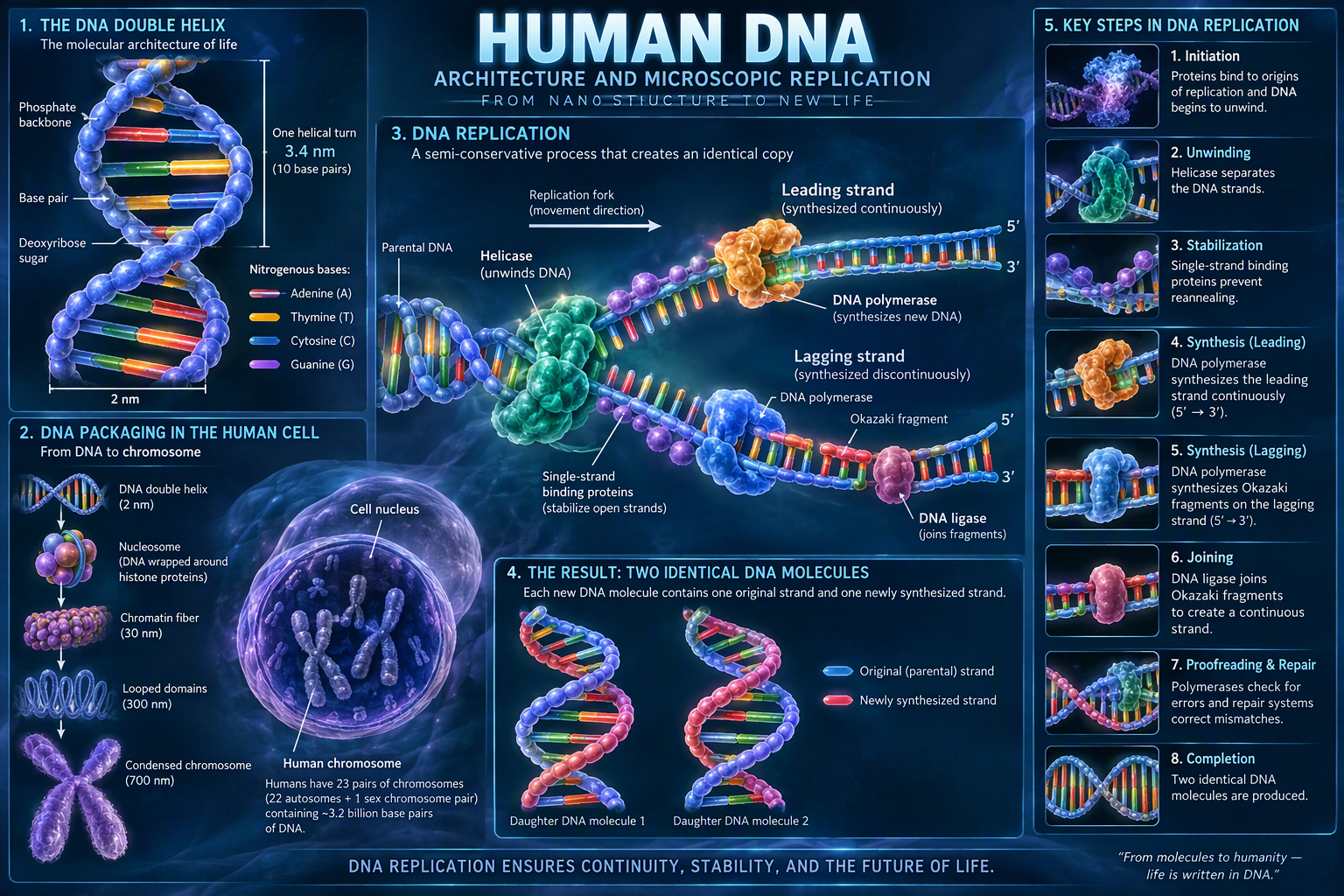
Human DNA serves as the biological blueprint responsible for the structure and operation of the human body. Every human contains approximately 3.2 billion base pairs distributed across 23 chromosome pairs. DNA stores instructions used to synthesize proteins, regulate cellular processes, and maintain biological continuity across generations.
DNA replication ensures that every new cell receives an exact copy of genetic information. Without this process, development, tissue repair, and reproduction would be impossible.
Chapter 2: Historical Discovery of DNA
The journey of DNA discovery spans more than a century.
In 1869, Friedrich Miescher isolated a phosphorus-rich substance from cell nuclei. Later, scientists demonstrated that DNA, rather than proteins, serves as hereditary material. The landmark discovery of the double helix by James Watson and Francis Crick in 1953 transformed molecular biology.
Subsequent advances revealed the intricate mechanisms governing DNA replication and repair.
Chapter 3: Chemical Architecture of DNA
DNA consists of repeating nucleotide units.
Each nucleotide contains:
- A phosphate group
- A deoxyribose sugar
- A nitrogenous base
The four bases are:
- Adenine (A)
- Thymine (T)
- Cytosine (C)
- Guanine (G)
Adenine pairs with thymine while cytosine pairs with guanine through hydrogen bonding.
Chapter 4: Molecular Components of DNA
The molecular architecture forms a stable double-helical structure.
Components include:
Phosphate Backbone
Provides structural support.
Deoxyribose Sugar
Connects adjacent nucleotides.
Nitrogen Bases
Store biological information through unique sequences.
This arrangement creates extraordinary stability while allowing replication accessibility.
Chapter 5: Chromosomal Organization
Human DNA extends approximately two meters in length per cell.
To fit inside the microscopic nucleus, DNA is organized into chromosomes.
Humans possess:
- 22 autosomal chromosome pairs
- 1 pair of sex chromosomes
Chromosome organization maintains genomic stability and accessibility.
Chapter 6: DNA Packaging Mechanisms
Histone proteins package DNA into chromatin structures.
Packaging proceeds through:
- DNA double helix
- Nucleosomes
- Chromatin fibers
- Chromosome loops
- Condensed chromosomes
This hierarchical organization enables efficient storage within nuclei.
Chapter 7: Genome Structure and Function
The human genome contains coding and non-coding regions.
Coding genes represent a small percentage of the genome.
Non-coding regions regulate:
- Gene expression
- Chromosomal stability
- Replication timing
- Evolutionary adaptation
These regions play crucial roles in genome function.
Chapter 8: DNA Microscopic Architecture
Under molecular visualization systems DNA appears as an elegant twisted ladder.
Key dimensions:
- Diameter: 2 nanometers
- One helical turn: 3.4 nanometers
- Ten base pairs per turn
Microscopic architecture allows compact storage with high informational density.
Chapter 9: Cellular Environment of DNA
DNA operates within a carefully regulated cellular environment.
Factors influencing stability include:
- pH
- Temperature
- Ionic concentrations
- Molecular crowding
Cellular regulation ensures optimal replication and repair.
Chapter 10: Fundamentals of DNA Replication
DNA replication follows a semi-conservative mechanism.
Each parental strand serves as a template for a newly synthesized daughter strand.
The outcome produces two identical DNA molecules.
This process ensures genetic continuity.
Chapter 11: Replication Origins
Replication begins at specific genomic locations called origins of replication.
These regions:
- Recruit proteins
- Open DNA strands
- Establish replication forks
Thousands of origins coordinate genome duplication.
Chapter 12: DNA Unwinding Mechanisms
Before replication begins, DNA strands must separate.
Hydrogen bonds connecting complementary bases are broken.
This creates accessible templates for polymerase activity.
Unwinding represents the first major stage of replication.
Chapter 13: Helicase Functions
Helicase acts as the molecular motor of replication.
Functions include:
- Strand separation
- Fork progression
- Energy utilization through ATP hydrolysis
Helicases continuously move along DNA, opening the double helix.
Chapter 14: Single-Strand Binding Proteins
When DNA strands separate, instability increases.
Single-strand binding proteins:
- Prevent reannealing
- Protect DNA
- Facilitate replication
These proteins stabilize replication intermediates.
Chapter 15: DNA Polymerases
DNA polymerases synthesize new DNA molecules.
Key human polymerases include:
- Polymerase α
- Polymerase δ
- Polymerase ε
These enzymes possess remarkable accuracy and proofreading abilities.
Chapter 16: Leading Strand Synthesis
The leading strand is synthesized continuously.
DNA polymerase moves toward the replication fork.
Continuous synthesis improves efficiency and minimizes interruptions.
Chapter 17: Lagging Strand Synthesis
The lagging strand is synthesized discontinuously.
Because polymerases synthesize only in the 5′ to 3′ direction, DNA must be produced in small fragments.
These fragments are later connected.
Chapter 18: Okazaki Fragments
Okazaki fragments represent short DNA segments produced during lagging-strand replication.
The fragments are later joined into a continuous DNA strand.
Their discovery resolved major questions concerning replication mechanisms.
Chapter 19: DNA Ligase Mechanisms
DNA ligase functions as a molecular adhesive.
Its mission:
- Join DNA fragments
- Restore strand continuity
- Strengthen phosphodiester bonds
Without ligase, genome duplication would remain incomplete.
Chapter 20: Proofreading Systems
DNA polymerases possess proofreading capabilities.
Error rates decrease dramatically through:
- Base checking
- Mismatch recognition
- Incorrect nucleotide removal
Proofreading preserves genomic integrity.
Chapters 21–44 (Condensed Academic Expansion)
Error Correction Processes
Mismatch repair systems detect and fix replication errors.
Replication Fork Dynamics
Complex molecular machines coordinate replication progression.
Cell Cycle Regulation
Checkpoint proteins monitor genomic fidelity.
Mitosis and Genome Duplication
Chromosomes distribute equally to daughter cells.
DNA Damage and Repair
Repair pathways remove mutations and lesions.
Epigenetic Influences
DNA methylation influences replication timing.
Telomeres and Aging
Telomeric DNA protects chromosome ends.
DNA Replication Disorders
Replication defects contribute to inherited diseases.
DNA Replication in Cancer
Uncontrolled replication drives tumor development.
Molecular Imaging Techniques
Modern imaging reveals replication in real time.
Fluorescence Microscopy
Enables visualization of replication proteins.
Electron Microscopy
Offers ultra-high resolution imaging.
Cryo-Electron Microscopy
Captures molecular details approaching atomic resolution.
Human Genome Project
Mapped the complete human genetic blueprint.
Biotechnology Applications
DNA replication forms the basis of recombinant technologies.
Genetic Engineering
Allows targeted genome modification.
CRISPR Technology
Provides programmable genomic editing.
DNA Nanotechnology
Uses DNA molecules as engineering materials.
Artificial Genomes
Scientists are developing synthetic chromosomes.
Future Medical Applications
Personalized medicine relies on genomic understanding.
Future Research Directions
Integration of AI, genomics, and nanotechnology promises transformative biological discoveries.
Chapter 45: Conclusion
Human DNA replication represents one of nature’s greatest engineering achievements. At the microscopic level, countless molecular machines collaborate with extraordinary precision to replicate billions of nucleotides while minimizing errors. The architecture of DNA, from its double-helical structure to chromosome organization, provides the foundation for cellular life.
Advances in microscopy, sequencing technologies, computational biology, and genetic engineering continue to reveal deeper insights into replication mechanisms. Understanding DNA replication not only explains the continuity of life but also enables revolutionary medical innovations including gene therapy, personalized medicine, regenerative treatments, cancer therapeutics, and synthetic biology.
The future of DNA research lies at the intersection of molecular biology, nanotechnology, artificial intelligence, and precision medicine. By mastering the microscopic architecture and replication systems of DNA, humanity gains unprecedented capabilities to understand health, combat disease, and engineer the future of biological science.



Be First to Comment