
A Complete Tutorial and Comparative Analysis
ABSTRACT
Business organizations operate within different market structures depending on the nature of their customers. The two dominant commercial models are Business-to-Business (B2B) and Business-to-Consumer (B2C). While both aim to create value and generate profits, they differ significantly regarding target audiences, purchasing behavior, sales cycles, marketing strategies, customer relationships, technological applications, and growth methodologies.
This thesis provides a comprehensive examination of B2B and B2C business models, exploring their historical evolution, organizational structures, strategic approaches, technological integration, customer psychology, financial considerations, and future developments. Moreover, it offers practical tutorials for entrepreneurs, investors, students, and corporate leaders seeking to understand how these models operate within today’s digital economy.
TABLE OF CONTENTS
Chapter 1: Introduction to Business Models
Chapter 2: Historical Evolution of Commerce
Chapter 3: Understanding B2B Business
Chapter 4: Understanding B2C Business
Chapter 5: Key Similarities Between B2B and B2C
Chapter 6: Major Differences
Chapter 7: Consumer Behavior Analysis
Chapter 8: Organizational Buying Behavior
Chapter 9: Marketing Strategies
Chapter 10: Digital Transformation
Chapter 11: Sales Methodologies
Chapter 12: Customer Relationship Management
Chapter 13: Revenue Models
Chapter 14: Pricing Strategies
Chapter 15: Brand Development
Chapter 16: Supply Chain Management
Chapter 17: Technology Platforms
Chapter 18: E-Commerce Architecture
Chapter 19: Artificial Intelligence Applications
Chapter 20: Data Analytics
Chapter 21: Financial Performance Metrics
Chapter 22: Risk Management
Chapter 23: Globalization
Chapter 24: Innovation Strategies
Chapter 25: Startup Perspectives
Chapter 26: Case Studies
Chapter 27: Sustainability
Chapter 28: Future Trends
Chapter 29: Entrepreneurial Tutorial
Chapter 30: Building a Successful B2B Company
Chapter 31: Building a Successful B2C Company
Chapter 32: Hybrid Business Models
Chapter 33: Strategic Planning Framework
Chapter 34: Recommendations
Chapter 35: Conclusion
CHAPTER 1: INTRODUCTION TO BUSINESS MODELS
A business model explains how an organization creates, delivers, and captures value. Every company must determine who its customers are, what products or services it offers, and how it generates revenue.
The two primary categories are:
Business-to-Business (B2B)
A company sells products or services to another company.
Examples:
- Microsoft selling enterprise software
- SAP selling business solutions
- Siemens selling industrial equipment
- Salesforce selling CRM software
Business-to-Consumer (B2C)
A company sells directly to individual consumers.
Examples:
- Amazon
- Netflix
- Nike
- Apple Retail
Both models drive global economic activity but operate through fundamentally different mechanisms.
CHAPTER 2: HISTORICAL EVOLUTION OF COMMERCE
Historically, commerce originated through barter systems.
The Industrial Revolution transformed commerce through:
- Mass production
- Manufacturing specialization
- Supply chain expansion
- International trade
By the twentieth century:
- B2B markets expanded through industrialization.
- B2C markets expanded through consumer capitalism.
The digital revolution accelerated both sectors through:
- E-commerce
- Cloud computing
- Artificial intelligence
- Mobile applications
CHAPTER 3: UNDERSTANDING B2B BUSINESS
B2B involves transactions between organizations.
Examples include:
Manufacturing
Steel producers supplying automobile manufacturers.
Technology
Cloud providers serving corporations.
Logistics
Transportation companies serving businesses.
Consulting
Professional services serving enterprises.
Characteristics
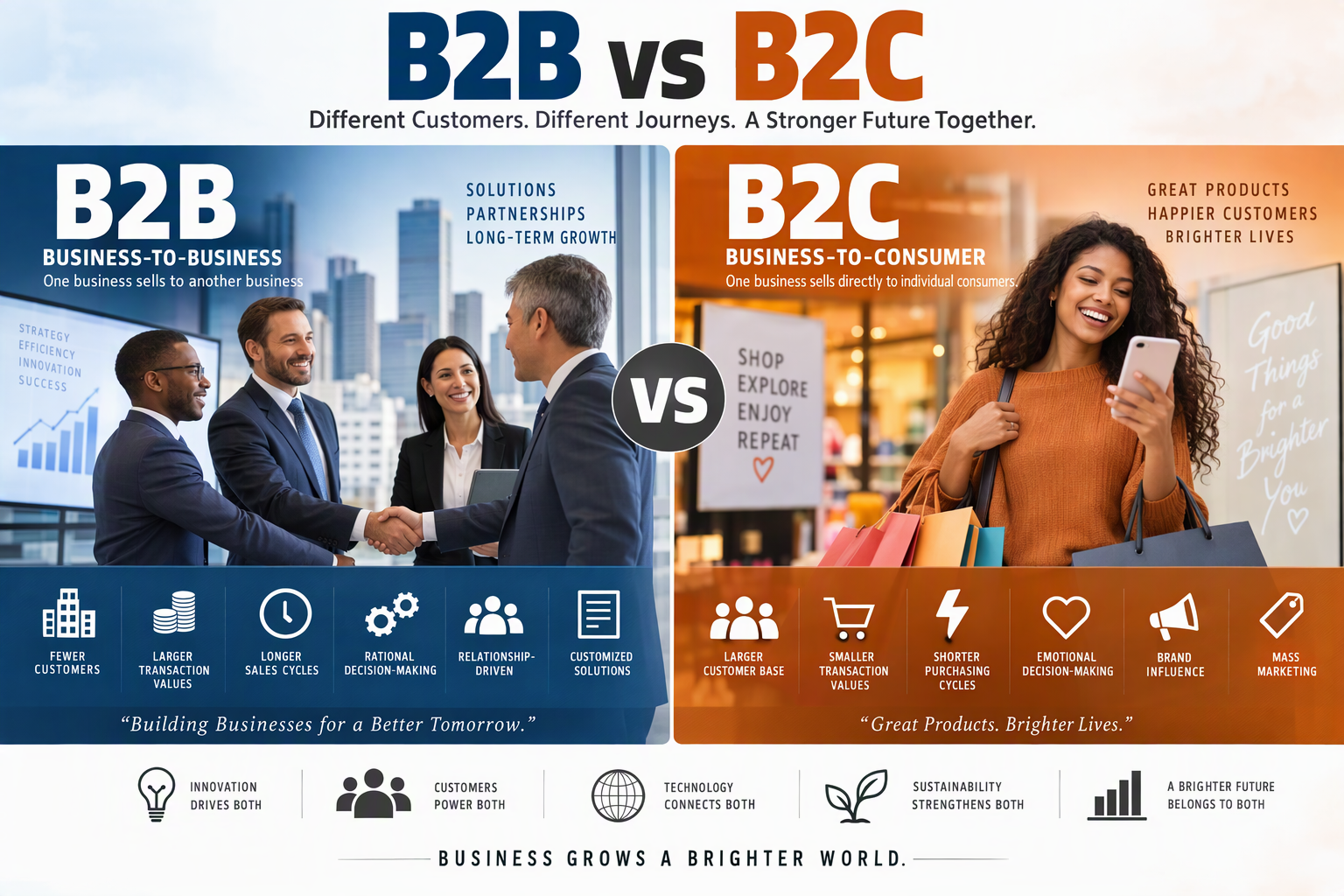
- Fewer customers
- Higher transaction values
- Long sales cycles
- Customized solutions
- Relationship-driven transactions
B2B markets prioritize operational efficiency and return on investment.
CHAPTER 4: UNDERSTANDING B2C BUSINESS
B2C focuses on selling directly to individual customers.
Examples:
- Retail stores
- Online marketplaces
- Streaming platforms
- Restaurants
Characteristics include:
- Large customer base
- Short purchasing cycles
- Emotional decision-making
- Brand influence
- Mass marketing efforts
Success depends heavily on customer experience and brand reputation.
CHAPTER 5: KEY SIMILARITIES
Despite differences, both models share:
Customer Focus
Revenue originates from customer satisfaction.
Value Creation
Businesses must solve customer problems.
Innovation
Continuous improvement is required.
Technology Adoption
Digital transformation benefits both sectors.
Profitability Goals
Financial sustainability remains essential.
CHAPTER 6: MAJOR DIFFERENCES
| Factor | B2B | B2C |
|---|---|---|
| Customer | Companies | Individuals |
| Sales Cycle | Long | Short |
| Order Size | Large | Small |
| Decision Making | Rational | Emotional |
| Marketing | Educational | Promotional |
| Relationships | Long-term | Transactional |
| Pricing | Negotiated | Fixed |
| Advertising | Targeted | Mass Market |
CHAPTER 7: CONSUMER BEHAVIOR ANALYSIS
B2C purchasing decisions are influenced by:
- Emotions
- Brand loyalty
- Social influence
- Convenience
- Price sensitivity
Human psychology shapes retail purchasing behaviors.
Marketing campaigns frequently leverage:
- Storytelling
- Social proof
- Celebrity endorsements
- Lifestyle aspirations
CHAPTER 8: ORGANIZATIONAL BUYING BEHAVIOR
B2B buying decisions involve multiple stakeholders:
Technical Experts
Evaluate product functionality.
Procurement Teams
Assess pricing.
Financial Executives
Analyze ROI.
Senior Management
Approve expenditures.
Decision processes are systematic and data-driven.
CHAPTER 9: MARKETING STRATEGIES
B2B Marketing
Focus areas:
- White papers
- Webinars
- Professional networking
- LinkedIn marketing
- Industry conferences
B2C Marketing
Focus areas:
- Social media
- Influencer campaigns
- Television advertising
- Search engine marketing
The communication style differs significantly.
CHAPTER 10: DIGITAL TRANSFORMATION
Digital technologies have revolutionized commerce.
Examples include:
- Cloud computing
- Artificial intelligence
- Automation
- Digital marketing
- Mobile commerce
Organizations adopting digital technologies achieve superior competitiveness.
CHAPTER 11: SALES METHODOLOGIES
B2B Sales
Stages:
- Lead generation
- Qualification
- Proposal development
- Negotiation
- Closing
- Account management
B2C Sales
Stages:
- Awareness
- Interest
- Purchase
- Loyalty
CHAPTER 12: CUSTOMER RELATIONSHIP MANAGEMENT
CRM systems enable businesses to:
- Track interactions
- Improve retention
- Manage opportunities
- Personalize experiences
Popular platforms include:
- Salesforce
- HubSpot
- Microsoft Dynamics
CRM is especially critical in B2B environments.
CHAPTER 13: REVENUE MODELS
Examples:
Subscription
Netflix, Microsoft 365
Transaction-Based
Amazon
Licensing
Software enterprises
Consulting
Professional services
Revenue diversification reduces business risk.
CHAPTER 14: PRICING STRATEGIES
B2B
- Contract pricing
- Volume discounts
- Negotiated agreements
B2C
- Psychological pricing
- Promotional pricing
- Dynamic pricing
Pricing directly affects profitability and market share.
CHAPTER 15: BRAND DEVELOPMENT
Strong brands create:
- Trust
- Recognition
- Loyalty
B2B brands emphasize expertise.
B2C brands emphasize lifestyle and emotional connection.
CHAPTER 16: SUPPLY CHAIN MANAGEMENT
Supply chains coordinate:
- Procurement
- Manufacturing
- Distribution
- Inventory
Effective supply chain management reduces costs and improves service quality.
CHAPTER 17: TECHNOLOGY PLATFORMS
Technologies include:
- ERP Systems
- CRM Systems
- E-commerce platforms
- AI tools
- Cloud services
Technology serves as the backbone of modern commerce.
CHAPTER 18: E-COMMERCE ARCHITECTURE
Architecture Components:
Front-End
Customer interaction layer.
Back-End
Business processing layer.
Database
Information repository.
Payment Systems
Transaction processing.
Analytics
Performance evaluation.
CHAPTER 19: ARTIFICIAL INTELLIGENCE APPLICATIONS
AI enables:
- Chatbots
- Demand forecasting
- Customer segmentation
- Fraud detection
- Recommendation systems
AI significantly enhances business competitiveness.
CHAPTER 20: DATA ANALYTICS
Analytics assists organizations in:
- Identifying trends
- Predicting behavior
- Optimizing operations
- Improving customer experiences
Data has become the most valuable business asset.
CHAPTER 21: FINANCIAL PERFORMANCE METRICS
Key Metrics:
Customer Lifetime Value
Measures long-term profitability.
Customer Acquisition Cost
Measures marketing efficiency.
Revenue Growth
Tracks expansion.
Profit Margin
Measures operational efficiency.
CHAPTER 22: RISK MANAGEMENT
Risks include:
- Financial risk
- Operational risk
- Cybersecurity risk
- Market risk
Mitigation strategies enhance resilience.
CHAPTER 23: GLOBALIZATION
Globalization expands market opportunities.
Benefits:
- New customers
- Resource access
- Competitive advantages
Challenges:
- Cultural differences
- Regulations
- Currency fluctuations
CHAPTER 24: INNOVATION STRATEGIES
Innovation types include:
- Product innovation
- Process innovation
- Business model innovation
- Technological innovation
Innovation sustains long-term growth.
CHAPTER 25: STARTUP PERSPECTIVES
Entrepreneurs must evaluate:
- Market size
- Competition
- Funding requirements
- Customer needs
The choice between B2B and B2C significantly influences startup strategy.
CHAPTER 26: CASE STUDIES
B2B Success: Salesforce
Created enterprise CRM systems.
B2C Success: Amazon
Built the world’s largest digital marketplace.
Both demonstrate scalability through technology and innovation.
CHAPTER 27: SUSTAINABILITY
Modern businesses increasingly focus on:
- Environmental responsibility
- Social responsibility
- Corporate governance
Sustainability has become a competitive advantage.
CHAPTER 28: FUTURE TRENDS
Expected developments include:
- AI-driven sales
- Hyper-personalization
- Autonomous supply chains
- Blockchain integration
- Virtual commerce
CHAPTER 29: ENTREPRENEURIAL TUTORIAL
Starting a B2B Business
Step 1. Identify industry problems.
Step 2. Develop specialized solutions.
Step 3. Build expertise credibility.
Step 4. Generate leads.
Step 5. Establish partnerships.
Starting a B2C Business
Step 1. Identify customer needs.
Step 2. Develop attractive products.
Step 3. Build a brand.
Step 4. Launch marketing campaigns.
Step 5. Scale distribution.
CHAPTER 30: BUILDING A SUCCESSFUL B2B COMPANY
Requirements:
- Industry expertise
- Relationship management
- Solution-oriented culture
- Long-term planning
- Enterprise technology platforms
CHAPTER 31: BUILDING A SUCCESSFUL B2C COMPANY
Requirements:
- Brand strength
- Marketing excellence
- Customer experience
- Product innovation
- Distribution efficiency
CHAPTER 32: HYBRID BUSINESS MODELS
Many organizations combine B2B and B2C.
Examples:
- Microsoft
- Apple
- Samsung
- Amazon
Hybrid models create diversified revenue streams.
CHAPTER 33: STRATEGIC PLANNING FRAMEWORK
Strategic planning includes:
- Vision
- Mission
- Market Analysis
- Competitive Positioning
- Financial Planning
- Execution
- Performance Measurement
CHAPTER 34: RECOMMENDATIONS
Organizations should:
- Invest in AI
- Strengthen customer relationships
- Improve digital capabilities
- Adopt data-driven decision making
- Focus on sustainable growth
Success requires adaptability and continuous innovation.
CHAPTER 35: CONCLUSION
The distinction between B2B and B2C business models extends far beyond customer type. B2B organizations operate within complex relationship-driven ecosystems characterized by long sales cycles, large transaction values, and strategic partnerships. Conversely, B2C organizations focus on mass markets, emotional engagement, customer experiences, and rapid purchasing decisions.
As digital transformation accelerates, the boundaries between B2B and B2C continue to blur through hybrid models, omnichannel commerce, artificial intelligence, and platform-based ecosystems. Businesses that understand the strengths and challenges of each model can position themselves more effectively within a competitive global economy.
Ultimately, the future belongs to organizations that successfully combine technological innovation, customer-centric thinking, operational excellence, and strategic adaptability, regardless of whether they operate primarily in B2B, B2C, or hybrid markets.
References
- Kotler, P. & Keller, K. L. Marketing Management.
- Porter, M. E. Competitive Strategy.
- Drucker, P. F. The Practice of Management.
- Osterwalder, A. & Pigneur, Y. Business Model Generation.
- Kaplan, R. & Norton, D. Balanced Scorecard.
- Harvard Business Review Articles on B2B and B2C Strategy.
- World Economic Forum Reports on Digital Transformation.
- McKinsey & Company Reports on Consumer and Enterprise Markets.
- Deloitte Global Commerce Studies.
- Gartner Research on Enterprise Technology and Digital Business.


Be First to Comment