
Title Page
Architecture of the Human Genome: Structure, Organization, Function, Evolution, and Future Applications in Genomic Science
Abstract
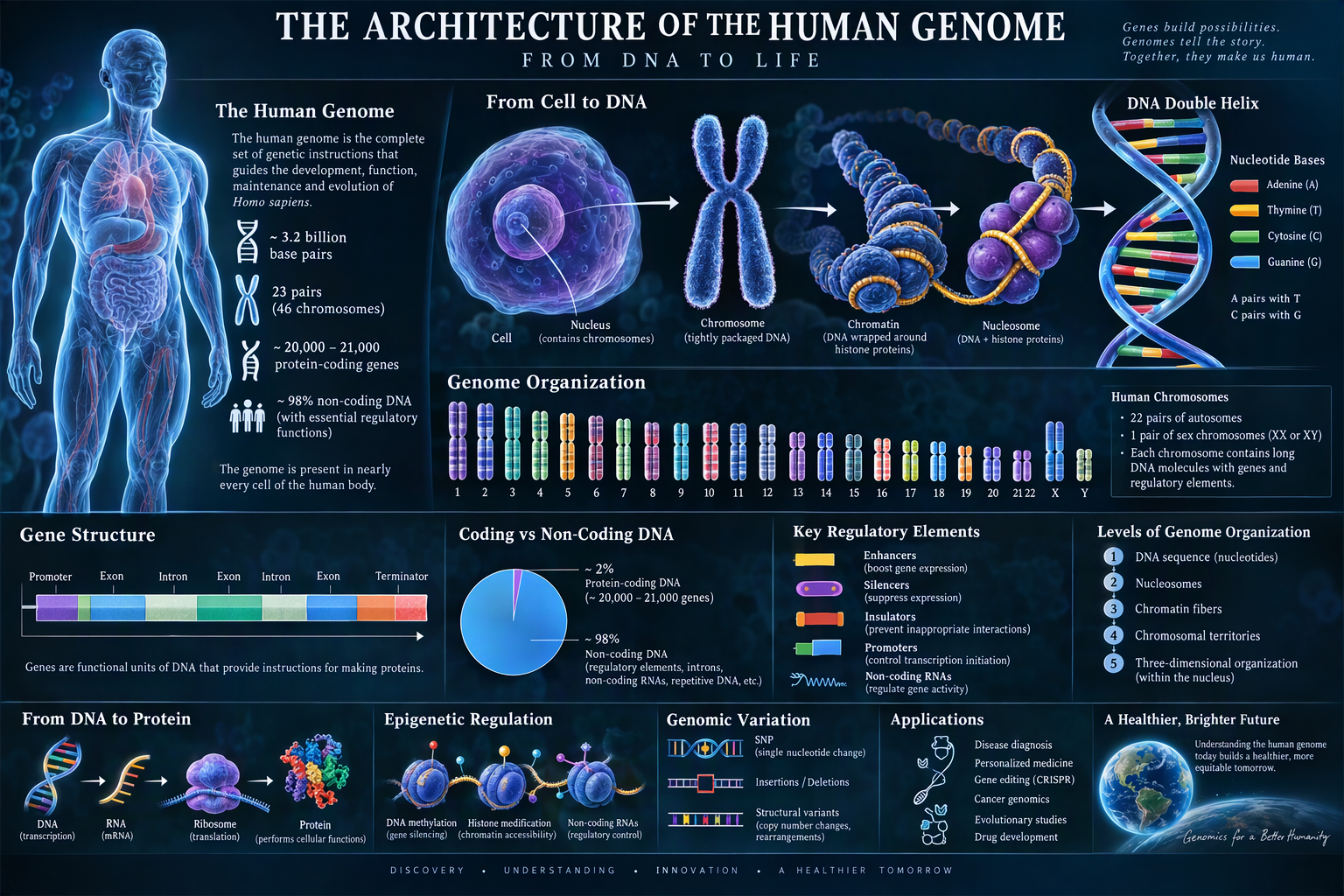
The human genome is the complete set of genetic instructions responsible for the development, growth, maintenance, reproduction, and evolution of Homo sapiens. It represents one of the most complex biological information systems known in nature. Composed of approximately 3.2 billion nucleotide base pairs organized into 23 chromosome pairs, the human genome serves as the biological blueprint that guides cellular functions throughout life.
This thesis explores the architecture of the human genome in detail, examining its structural organization, molecular composition, chromosomal arrangement, regulatory mechanisms, expression pathways, evolutionary development, and clinical significance. Special emphasis is placed on genomic architecture, coding and non-coding DNA, chromosome topology, epigenetic regulation, genomic variation, disease associations, and emerging technologies such as CRISPR gene editing and personalized medicine.
The study also investigates the Human Genome Project and discusses future implications of genomic science in healthcare, biotechnology, artificial intelligence, and human enhancement technologies.
Table of Contents
Chapter 1: Introduction to the Human Genome
Chapter 2: Historical Development of Genomic Science
Chapter 3: Molecular Foundations of DNA
Chapter 4: Chromosomal Architecture
Chapter 5: Genome Organization
Chapter 6: Gene Structure and Function
Chapter 7: Coding DNA and Protein Synthesis
Chapter 8: Non-Coding DNA
Chapter 9: Regulatory Elements of the Genome
Chapter 10: Epigenetic Architecture
Chapter 11: Genome Replication Mechanisms
Chapter 12: Genome Repair Systems
Chapter 13: Chromatin Structure
Chapter 14: Three-Dimensional Genome Organization
Chapter 15: The Human Genome Project
Chapter 16: Genomic Variation
Chapter 17: Mutations and Their Consequences
Chapter 18: Genetic Diseases
Chapter 19: Cancer Genomics
Chapter 20: Mitochondrial Genome
Chapter 21: Comparative Genomics
Chapter 22: Evolution of the Human Genome
Chapter 23: Population Genetics
Chapter 24: Genomic Technologies
Chapter 25: CRISPR and Gene Editing
Chapter 26: Personalized Medicine
Chapter 27: Artificial Intelligence and Genomics
Chapter 28: Ethical Considerations
Chapter 29: Future Directions
Chapter 30: Conclusio
Chapter 1: Introduction to the Human Genome
The human genome is the complete collection of hereditary information encoded within DNA molecules. It contains the biological instructions that determine the characteristics and functions of every cell within the human body.
DNA is organized into chromosomes located inside the nucleus of nearly every human cell. The genome directs protein production, regulates cellular communication, supports tissue development, and influences physiological and behavioral traits.
The human genome serves as a biological operating system. Much like a computer program, genomic information instructs cells on how to perform specific functions. Through a complex network of genetic and epigenetic interactions, the genome coordinates the activities necessary for life.
Chapter 2: Historical Development of Genomic Science
The journey toward understanding the genome began with Gregor Mendel’s experiments on inheritance in the nineteenth century.
Major milestones include:
- 1865: Mendel establishes laws of inheritance.
- 1869: Friedrich Miescher discovers DNA.
- 1953: Watson and Crick describe the DNA double helix.
- 1977: DNA sequencing techniques emerge.
- 1990: Human Genome Project begins.
- 2003: Human Genome Project completed.
- Present: Genomic medicine and gene editing revolutionize healthcare.
These discoveries transformed biology from descriptive science into molecular science.
Chapter 3: Molecular Foundations of DNA
DNA consists of four nucleotides:
- Adenine (A)
- Thymine (T)
- Cytosine (C)
- Guanine (G)
A pairs with T, while C pairs with G.
These complementary interactions create the famous double helix structure.
The DNA molecule resembles a twisted ladder:
- Sugar-phosphate backbone forms the sides.
- Nitrogenous bases form the rungs.
- Hydrogen bonds connect paired bases.
This architecture provides stability while allowing accurate information storage.
Chapter 4: Chromosomal Architecture
Humans possess 46 chromosomes arranged into 23 pairs:
- 22 autosomal pairs
- 1 sex chromosome pair
Chromosomes contain tightly packaged DNA wrapped around proteins called histones.
Key chromosome structures:
Centromere
Maintains chromosome integrity and assists during cell division.
Telomere
Protective DNA regions at chromosome ends.
Chromatid
Identical chromosome copies formed during replication.
Kinetochore
Protein complex involved in chromosome segregation.
Chromosomal architecture ensures precise transmission of genetic information.
Chapter 5: Genome Organization
The genome contains approximately:
- 3.2 billion base pairs
- 20,000–21,000 protein-coding genes
- Millions of regulatory elements
Organization levels include:
- DNA sequence
- Nucleosomes
- Chromatin fibers
- Chromosomal territories
- Nuclear organization
This hierarchical arrangement enables efficient information storage.
Chapter 6: Gene Structure and Function
Genes are functional DNA units.
A typical gene contains:
Promoter
Initiates transcription.
Exons
Protein-coding segments.
Introns
Non-coding intervening sequences.
Enhancers
Increase expression levels.
Terminators
Signal transcription completion.
Genes function as molecular instructions for creating proteins.
Chapter 7: Coding DNA and Protein Synthesis
Protein synthesis occurs through two processes:
Transcription
DNA → RNA
Translation
RNA → Protein
The genetic code consists of codons, triplets specifying amino acids.
Examples:
- AUG = Methionine
- UUU = Phenylalanine
- GCU = Alanine
Proteins perform nearly all cellular functions.
Chapter 8: Non-Coding DNA
Approximately 98% of the genome does not encode proteins.
Major components:
- Regulatory DNA
- Introns
- Satellite DNA
- Transposons
- MicroRNAs
- Long non-coding RNAs
Previously called “junk DNA,” these regions are now known to perform critical regulatory roles.
Chapter 9: Regulatory Elements of the Genome
Gene expression depends on regulatory regions.
Important elements include:
Enhancers
Boost transcription.
Silencers
Suppress expression.
Insulators
Prevent inappropriate interactions.
Promoters
Control initiation.
Together these elements create a genomic control network.
Chapter 10: Epigenetic Architecture
Epigenetics modifies gene activity without changing DNA sequence.
Major mechanisms:
DNA Methylation
Addition of methyl groups.
Histone Modifications
Chemical changes affecting chromatin accessibility.
Non-Coding RNAs
Regulatory RNA molecules.
Epigenetic mechanisms influence aging, development, and disease.
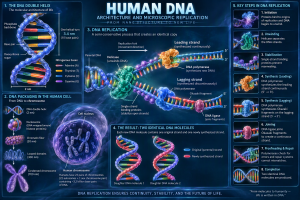
Chapter 11: Genome Replication Mechanisms
DNA replication ensures inheritance of genetic information.
Stages:
- Initiation
- Unwinding
- Primer synthesis
- DNA elongation
- Proofreading
- Termination
Replication accuracy exceeds 99.999%.
Chapter 12: Genome Repair Systems
DNA damage occurs continuously.
Repair mechanisms:
- Base excision repair
- Nucleotide excision repair
- Mismatch repair
- Double-strand break repair
These systems preserve genomic stability.
Chapter 13: Chromatin Structure
DNA wraps around histone proteins forming nucleosomes.
Organization:
DNA → Nucleosome → Chromatin Fiber → Chromosome
Chromatin exists as:
Euchromatin
Active genes.
Heterochromatin
Inactive genes.
Chromatin architecture regulates accessibility.
Chapter 14: Three-Dimensional Genome Organization
The genome is folded within the nucleus.
Features include:
- Chromosome territories
- Topologically associating domains (TADs)
- Chromatin loops
- Nuclear compartments
Three-dimensional folding affects gene activity and cellular identity.
Chapter 15: The Human Genome Project
Completed in 2003, the Human Genome Project mapped nearly all human genes.
Achievements:
- Sequenced 3 billion bases
- Identified thousands of genes
- Created reference genome maps
- Accelerated biotechnology innovation
The project transformed medical science.
Chapter 16: Genomic Variation
Human genomes are approximately 99.9% identical.
Variations include:
- SNPs (Single Nucleotide Polymorphisms)
- Insertions
- Deletions
- Copy Number Variants
- Structural Variants
These differences influence disease susceptibility and physical traits.
Chapter 17: Mutations and Their Consequences
Mutations arise through:
- Replication errors
- Radiation exposure
- Chemical agents
- Viral infections
Types include:
- Missense
- Nonsense
- Silent
- Frameshift
Mutations drive evolution but can also cause disease.
Chapter 18: Genetic Diseases
Examples include:
Cystic Fibrosis
CFTR mutation.
Sickle Cell Disease
Hemoglobin mutation.
Huntington Disease
HTT gene expansion.
Duchenne Muscular Dystrophy
Dystrophin deficiency.
Genome analysis enables earlier diagnosis.
Chapter 19: Cancer Genomics
Cancer is fundamentally a genomic disease.
Key mutated genes:
- TP53
- KRAS
- BRCA1
- BRCA2
Genomic instability promotes uncontrolled cell growth.
Precision oncology uses genomic analysis for targeted treatment.
Chapter 20: Mitochondrial Genome
The mitochondrial genome contains:
- 16,569 base pairs
- 37 genes
Characteristics:
- Maternal inheritance
- Circular DNA
- High mutation rate
It supports cellular energy production.
Chapter 21: Comparative Genomics
Human genomic similarities:
- Chimpanzee: ~98–99%
- Mouse: ~85%
- Fruit fly: ~60%
Comparative studies reveal evolutionary relationships and conserved biological pathways.
Chapter 22: Evolution of the Human Genome
Evolutionary mechanisms include:
- Mutation
- Natural selection
- Genetic drift
- Gene duplication
The human genome reflects billions of years of biological evolution.
Chapter 23: Population Genetics
Population genomics examines genetic diversity among groups.
Applications include:
- Migration studies
- Ancestry analysis
- Disease prediction
- Evolutionary reconstruction
Population variation contributes to human adaptability.
Chapter 24: Genomic Technologies
Modern genomic tools:
- Next-generation sequencing
- Single-cell sequencing
- RNA sequencing
- Genome-wide association studies
These technologies provide unprecedented genomic resolution.
Chapter 25: CRISPR and Gene Editing
CRISPR-Cas systems enable precise gene modification.
Applications:
- Disease correction
- Agricultural biotechnology
- Functional genomics
- Regenerative medicine
Gene editing is transforming healthcare.
Chapter 26: Personalized Medicine
Personalized medicine uses genomic information to tailor treatments.
Benefits:
- Improved drug selection
- Reduced side effects
- Early disease prevention
- Precision diagnostics
Genomic medicine represents the future of healthcare.
Chapter 27: Artificial Intelligence and Genomics
AI accelerates:
- Genome analysis
- Variant discovery
- Drug development
- Diagnostic prediction
Machine learning enables interpretation of complex genomic datasets.
AI-genomics integration is becoming a cornerstone of modern biomedical research.
Chapter 28: Ethical Considerations
Major concerns include:
- Genetic privacy
- Data security
- Gene editing ethics
- Discrimination risks
- Genetic ownership
Responsible governance is essential.
Chapter 29: Future Directions
Future developments may include:
- Whole-genome clinical screening
- Advanced gene therapies
- Synthetic genomes
- AI-assisted genomic engineering
- Personalized regenerative medicine
The next decades may witness unprecedented biological innovation.
Chapter 30: Conclusion
The architecture of the human genome represents one of nature’s most sophisticated information systems. Through intricate arrangements of DNA sequences, genes, regulatory elements, chromatin structures, and three-dimensional nuclear organization, the genome orchestrates every aspect of human life. Advances in genomics, artificial intelligence, biotechnology, and precision medicine continue to expand our understanding of genomic architecture and function.
As humanity enters the genomic age, the human genome will remain central to advances in medicine, biotechnology, evolutionary biology, and human health. Understanding its architecture is fundamental to understanding life itself.
References
- Watson, J.D., Molecular Biology of the Gene.
- Alberts, B., Molecular Biology of the Cell.
- Human Genome Project Publications.
- Nature Genetics Journal.
- Cell Journal.
- Science Journal.
- National Human Genome Research Institute Publications.
- Genetics and Genomics Academic Textbooks.
- Principles of Genome Analysis.
- Encyclopedia of Molecular Genetics.



Be First to Comment