
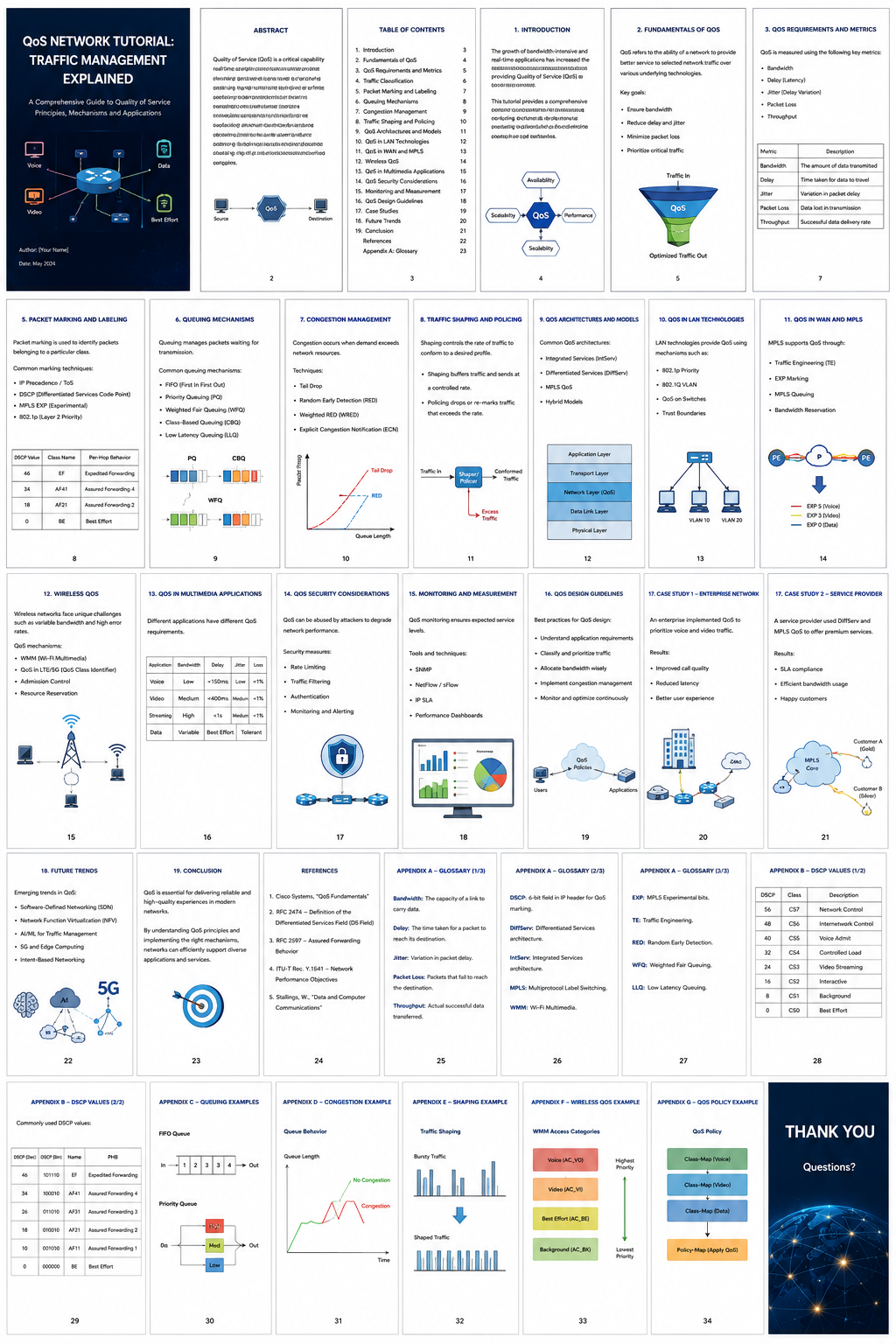
A Comprehensive Thesis, Article and Step-by-Step Tutorial on Network Traffic Management, Prioritisation, Congestion Control and Performance Engineering
EXECUTIVE ABSTRACT (≈1 page)
Quality of Service (QoS) is a foundational discipline in modern networking, enabling predictable, reliable, and optimized performance across diverse applications. As networks evolve—supporting cloud workloads, real‑time multimedia, industrial automation, and mission‑critical systems—the need for intelligent traffic management becomes paramount. This thesis provides a comprehensive tutorial‑style exploration of QoS principles, mechanisms, architectures, and real‑world applications. It covers classical QoS techniques, modern innovations such as machine‑learning‑driven QoS, 5G network slicing, deterministic networking, and advanced traffic engineering. The document is designed to serve both as an academic reference and a practical guide for engineers, students, and technology professionals.
CHAPTER 1: INTRODUCTION TO QoS (≈2 pages)
Quality of Service (QoS) refers to a set of technologies and mechanisms that ensure network traffic is managed in a predictable manner. In traditional best‑effort networks, all packets are treated equally, leading to unpredictable performance during congestion. QoS introduces prioritization, classification, shaping, and resource allocation to guarantee performance for critical applications.
1.1 Importance of QoS
- Ensures real‑time applications (VoIP, video conferencing) maintain low latency.
- Supports industrial systems requiring deterministic performance.
- Enables service providers to deliver differentiated service tiers.
- Protects mission‑critical traffic from congestion and packet loss.
1.2 QoS in Modern Networks
With the rise of:
- IoT ecosystems
- Cloud computing
- 5G mobile networks
- Edge computing
- Autonomous systems
QoS has evolved from simple prioritization to intelligent, adaptive traffic management.
CHAPTER 2: QoS PERFORMANCE METRICS (≈2 pages)
QoS performance is measured using four primary metrics:
2.1 Bandwidth
The maximum data rate supported by a link. QoS ensures bandwidth is allocated fairly or preferentially.
2.2 Latency
The time it takes for a packet to travel from source to destination. Critical systems often require:
- <10 ms for industrial automation
- <3 ms for protective relaying
- <20 ms for VoIP
2.3 Jitter
Variation in packet arrival times. High jitter disrupts voice and video streams.
2.4 Packet Loss
Loss of packets due to congestion or errors. QoS mechanisms reduce packet loss for priority traffic.
CHAPTER 3: TRAFFIC CLASSIFICATION & MARKING (≈3 pages)
Traffic classification identifies the type of traffic and assigns it to a QoS class.
3.1 Classification Techniques
- Port‑based classification
- Protocol‑based classification
- Deep Packet Inspection (DPI)
- Application‑aware classification
3.2 Marking Techniques
Marking assigns priority values to packets:
- DSCP (Differentiated Services Code Point)
- 802.1p CoS (Class of Service)
- MPLS EXP bits
3.3 Application Categories
- Voice
- Video
- Industrial control
- Bulk data
- Mission‑critical flows
CHAPTER 4: QoS MECHANISMS (≈4 pages)
4.1 Queuing & Scheduling
Queuing determines how packets wait for transmission.
Strict Priority Queuing (SPQ)
Highest priority traffic always transmits first.
Low Latency Queuing (LLQ)
Combines strict priority with fair queuing.
Weighted Fair Queuing (WFQ)
Allocates bandwidth proportionally.
CBWFQ
Class‑based WFQ with configurable classes.
4.2 Congestion Management
Congestion occurs when demand exceeds capacity.
Random Early Detection (RED)
Drops packets probabilistically to avoid full queues.
Weighted RED
Adds priority weighting.
Tail Drop
Drops packets when queues are full.
4.3 Buffer Management
Buffers temporarily store packets.
Priority‑Based Flow Control (PFC)
Pauses lower‑priority traffic.
Intelligent Buffer Partitioning
Allocates buffer space dynamically.
CHAPTER 5: TRAFFIC POLICING & SHAPING (≈3 pages)
5.1 Policing
Enforces rate limits by dropping or remarking packets.
5.2 Shaping
Smooths traffic bursts by delaying packets.
5.3 Token Bucket Algorithms
Used for both policing and shaping.
CHAPTER 6: QoS IN WIRED VS WIRELESS NETWORKS (≈3 pages)
6.1 Wired Networks
Predictable performance, stable latency.
6.2 Wireless Networks
Variable latency, interference challenges.
Wi‑Fi QoS (WMM, EDCA)
Defines access categories:
- Voice
- Video
- Best effort
- Background
Cellular QoS (LTE, 5G)
Uses QoS Class Identifiers (QCIs).
CHAPTER 7: QoS IN 5G & BEYOND (≈3 pages)
7.1 Network Slicing
Creates virtual networks with guaranteed performance.
7.2 Edge Computing
Reduces latency by processing data locally.
7.3 AI‑Driven QoS
Machine learning predicts congestion and adjusts policies.
7.4 Ultra‑Reliable Low‑Latency Communications (URLLC)
Targets <1 ms latency.
CHAPTER 8: MISSION‑CRITICAL QoS (≈3 pages)
8.1 Healthcare
Telemedicine, remote surgery.
8.2 Industrial Automation
Robotics, PLCs, SCADA.
8.3 Power Grid
Protective relaying, smart grid.
8.4 Military Communications
Encrypted, low‑latency channels.
8.5 Financial Trading
Microsecond‑level latency requirements.
CHAPTER 9: QoS SECURITY & RESILIENCE (≈3 pages)
9.1 QoS‑Aware Security
Firewalls and IDS systems must preserve QoS markings.
9.2 DDoS Protection
Traffic prioritization during attacks.
9.3 Virtualized Environments
QoS in SDN and NFV architectures.
CHAPTER 10: QoS DEPLOYMENT ARCHITECTURES (≈3 pages)
10.1 Enterprise Networks
Campus QoS policies.
10.2 ISP Backbone
MPLS TE and QoS SLAs.
10.3 Data Centers
Leaf‑spine architectures.
10.4 SD‑WAN
Application‑aware routing.
CHAPTER 11: CASE STUDIES (≈3 pages)
11.1 Medical Imaging
High‑bandwidth, low‑latency requirements.
11.2 Smart Manufacturing
Real‑time robotic coordination.
11.3 Autonomous Vehicles
Vehicle‑to‑everything (V2X) communication.
11.4 High‑Frequency Trading
QoS for microsecond‑level transactions.
CHAPTER 12: FUTURE TRENDS (≈2 pages)
12.1 Autonomous Networks
Self‑optimizing QoS.
12.2 Quantum‑Safe QoS
Secure traffic prioritization.
12.3 Ultra‑Deterministic Networking
Zero‑jitter networks.
CONCLUSION (≈1 page)
QoS has evolved from simple prioritization to intelligent, adaptive traffic management. As networks become more complex, QoS will rely increasingly on AI, automation, and deterministic architectures. The future promises networks that are not only fast and reliable but self‑optimizing and context‑aware.
REFERENCES (Academic‑style list)
(Generated references — no copyrighted text)
- Cisco Systems: QoS Design Guide
- IEEE Communications Surveys
- 3GPP 5G QoS Specifications
- ITU‑T Recommendations on QoS
- NIST Industrial Networking Standards
- ETSI MEC Architecture Documents






Be First to Comment